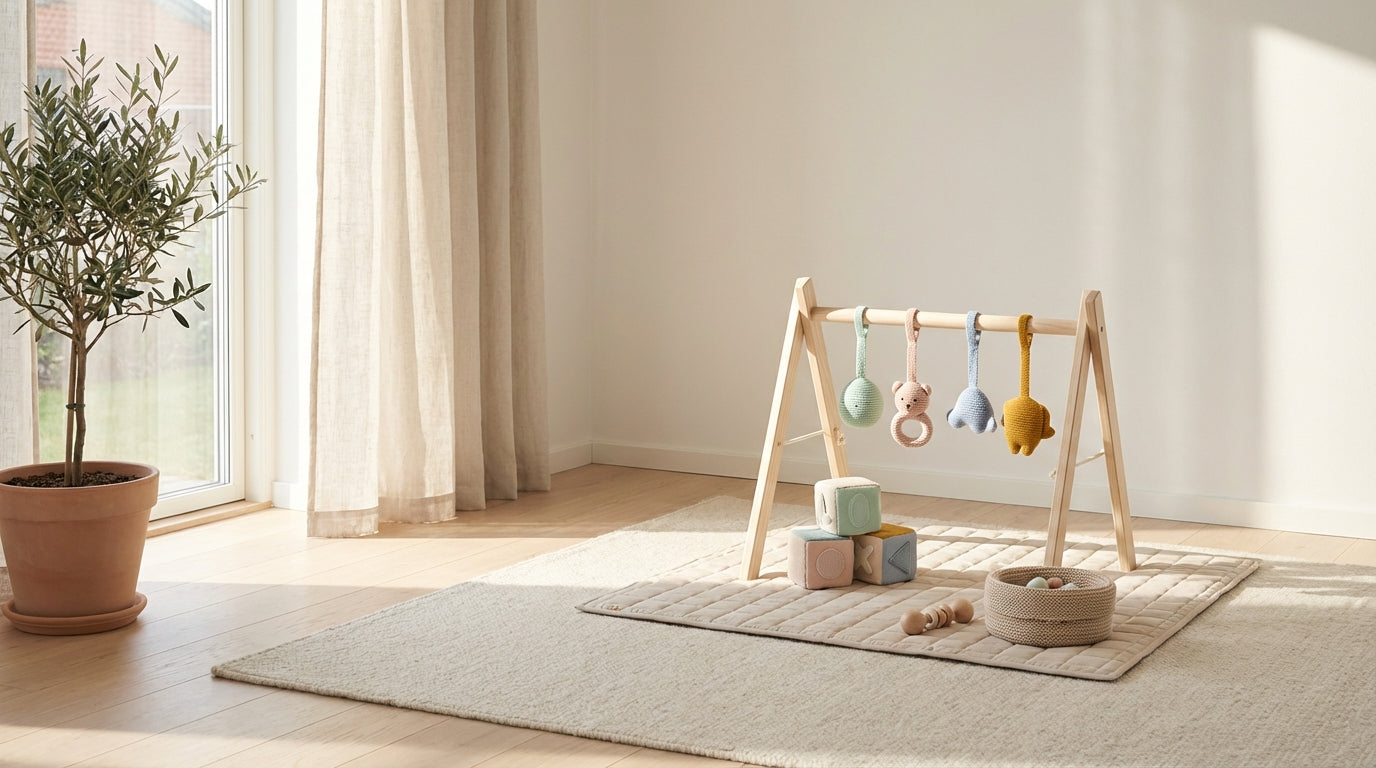
Kids' Room Decor: Safe Ideas, Wall Decor & DIY Without the Chaos
At a glance
- Kids' room decor works best with a calm base and just a few accents.
- You can plan a decor wall in 30 minutes with a trial layout on the floor.
- For babies and toddlers: lightweight pieces, secure mounting, no small parts.
- For good indoor air: let new items air out first and ventilate regularly.
- The most relaxed way to decorate seasonally is with small, swappable touches.

Kids' room decor looks loveliest when you create order first and then decorate with intention. You don't need a complete makeover, just a small toolkit of wall, textiles, light and storage – one that leaves room for everyday life (and tidying up). Here you'll find practical ideas for nurseries, toddlers and primary school kids, plus a simple step-by-step guide for the wall. And because we're from northern Germany: we'd rather be practically pretty than perfectly styled.

Ulli & Flo
Owners of bieco · Hamburg · parents ourselves
We've learned that beautiful kids' room decor doesn't have to be perfect, just practical. With a calm base and a few swappable accents, everyone stays more relaxed. Feel free to browse our collection Kids' Room Decor.
Which kids' room decor makes an instant difference (without rebuilding the room)?
The quickest wins are a wall focus, warm light and a textile “cuddle spot”. If you only have 20 minutes, pick one wall area, place a light source so it doesn't glare, and add a pillow or blanket in your accent color. That is often enough to make a room feel neither “empty” nor “full”.
- Wall focus: 2–4 pictures, a garland or a picture ledge.
- Light: warm, indirect light (worth its weight in gold in the evening).
- Textiles: pillow/blanket/canopy – instantly makes it softer.
- Storage: baskets/boxes that double as decor (and swallow the clutter).
Practical tip: Set a timer for 15 minutes and make just “one corner pretty”. The rest can follow later – promise.
A kids' room doesn't have to be finished; it's allowed to grow. We (Ulli & Flo) are parents ourselves – and more than once, a “favorite theme” has changed overnight in our house. At bieco we're a family business from Hamburg and have been doing this for 66 years; every day we see which ideas work in real life and which just gather dust.
The decor toolkit: 7 building blocks that always work
Good kids' room decoration is made of repeatable building blocks rather than single pieces. Once you've settled on these blocks, you only need to swap accents later – and not start from scratch every time. That saves money, nerves and the infamous “Why did we buy this?” box.

- Base: calm background (wall color/rug/curtain).
- Wall focus: one main area that “speaks”.
- Textiles: make it cozy and visually soften the room.
- Storage: pretty enough to stay in view.
- Light: a warm evening light plus good “tidy-up light”.
- Play spot: a corner that invites play.
- Personal touch: kids' drawings, a name, a favorite book – often the best decor of all.
Accent decor means a few eye-catchers that you can swap easily. That's the trick behind “always looks fresh”: you only change small things, not the whole room.
Finding your style without overload: overall mood + guiding motif
The best style is the one you can keep clean and rearrange easily. Make just two decisions: an overall mood and a guiding motif. That's all you need – and you don't have to love every picture “forever”.
- Overall mood: calm & natural / colorful & cheerful / clean & modern / playful & fairytale-like
- Guiding motif: animals, forest, sea, dinosaurs, hot air balloons, stars, construction site …
A guiding motif is a theme that repeats without overloading the room. You can tell by the fact that it appears in small doses: e.g. 1 wall picture, 1 figure, 1 textile.
Kids' room decor by age: baby, toddler, school child
The smaller the child, the lighter and safer the decor should be. It sounds simple, but it's half the battle: what looks pretty on a shelf for a school child quickly becomes “test material” for hands and mouth with a crawling baby.

Nursery (0–12 months)
In a nursery, calm stimuli and secure mounting matter more than a wealth of themes. A mobile can be lovely, but please make sure it's out of reach and securely fastened. For the wall, lightweight elements and picture ledges that hang outside the grabbing zone are a good fit.
- Wall: a few large motifs instead of many small ones.
- Colors: rather soft, so the room winds down in the evening.
- Space: keep the changing area clear so you can work safely.
Toddler (1–3 years)
For toddlers, decor that is sturdy and can join in the play wins. There's a lot of pulling, climbing and experimenting here – completely normal. Plan decor so that it doesn't become a tripping hazard and doesn't consist of a thousand small parts.
- Storage: baskets/boxes at child height, so tidying up becomes possible.
- Wall: a few sturdy pieces rather than a “gallery up to the ceiling”.
- Play: one clear zone, so not everything ends up everywhere.
School child (from about 6 years)
For school children, the decor can have more personality and “change-of-mind mood”. Posters, self-painted pictures, collectibles – they all belong. If you have a picture ledge or a pinboard, your child can redecorate on their own without you having to hunt for the drill every time.
- Flex: a swappable wall area (ledge/pinboard) instead of a fixed collage.
- Order: keep the desk area clear – it helps with focus.
- Having a say: let your child decide 1–2 things completely.
Safety note: Secure heavy shelves, picture frames and furniture in a child-safe way and place them outside the climbing zone; anchor furniture to the wall where needed.
Wall decor in the kids' room: big impact, little chaos
Wall decor is ideal because it decorates without stealing play space. And it can be built up in stages: first one piece, let it settle, then add more. That's much easier on the nerves than an “everything at once” weekend.

- Picture set: 2–4 motifs in a line or a small grid.
- Garland: fabric/felt feels soft and child-friendly.
- Mobile: lovely above a reading nook or changing area (out of reach).
- Picture ledge: swap motifs without making new holes.
If you want to get started quickly, choose a collection instead of single pieces. In our overview of Kids' Room Wall Decor you'll find combinations that are easy and relaxed to put together.
Kids' room decor wall: step by step (even with tired eyes)
A harmonious decor wall comes together in 30 minutes if you measure briefly beforehand. You don't need a design degree – just a clear shape and a small trial layout. And yes: in a kids' room something ends up hanging crooked at some point anyway, because someone bounced against it.
- Choose a wall: ideally the one you see when you walk in.
- Set the height: the middle of the motifs at about eye level – or deliberately lower for your child.
- Decide on a shape: line (calm), grid (tidy), cluster (lively).
- Trial layout: lay it out on the floor or mark it with painter's tape.
- Mount it: fasten it appropriately for its weight; when in doubt, choose the sturdier option.
- Check the spacing: a little air between the pieces instantly looks calmer.
Practical tip: Take a photo of the layout on the floor. When hanging, you then work “from the photo” instead of by gut feeling.
How many colors in a kids' room? (Spoiler: fewer than you think)
With 2–3 colors, kids' room decor looks calmer and grows with your child for longer. A simple rule of thumb: 1 base tone (wall/rug), 1 secondary color (textiles), 1 accent (small eye-catchers). If you want more, choose different shades of the same color family instead.
- Calm: beige/sand + sage + wood look.
- Fresh: white + light blue + mustard as an accent.
- Warm: cream + apricot + rust/petrol in a few spots.
If you're unsure, start neutral and set accents with swappable pieces. That's exactly what a theme area is good for, which you can easily change later – for example through a wall area or textiles.
Themes without boxes: dinosaurs, hot air balloons & co.
The best themed decor suits your child, not a “pink-or-blue” box. Many kids love excavators and unicorns at the same time – and that's perfectly fine. It's better to plan so that you can turn the theme around with just a few pieces.
For a good foundation, you'll find ideas in our hub Kids' Room Decor. From there you can click your way through to themes and wall ideas at your leisure.
Dinosaur decor for the kids' room: cool, but not a “toy warehouse”
Dinosaur decor works best with one main motif and two companions. Think of it as a small exhibition: a large wall picture or a mobile as the star, plus two small elements (pillow, figure, book). In terms of color, greens and earth tones plus one accent help keep it from shouting.
- 1 main motif: large, clear, well placed.
- 2 companions: small, matching, easy to swap.
- Colors: green/earth + mustard/rust/petrol as a dot of accent.
With materials, it's worth taking a quick look at labels and smell. According to the German Federal Institute for Risk Assessment (BfR), the BfR assesses health risks from chemical substances in toys and provides information on substance groups such as phthalate plasticizers and PAHs, among others. (BfR: Health assessment of toys)
Hot air balloon decor for the kids' room: light, friendly, timeless
Hot air balloon decor is popular because it feels calm and sparks the imagination. The theme is especially lovely above a reading nook or as a gentle wall focus in the nursery. And if your child later shouts “Space!”, the base still stays harmonious.
- Wall: 1–3 balloons, with clouds as spacers.
- Ceiling: mobile or lightweight garland (securely fastened).
- Colors: cream, sage, apricot or light blue – depending on the light.
If you want to collect more themes, treat them as “islands” rather than wallpaper. In the collection Themed Kids' Room Decor you'll find different style worlds that are easy to use in small doses.
Decorating seasonally: Easter decor that stays out of the way
Easter decor in the kids' room works best with things that can disappear again quickly. So nothing that has to be screwed, drilled or untangled for three hours. After all, we're not in a crafting competition – we just want a little bit of spring.
- Window: lightweight hangers (bunny, egg, flower).
- Door/shelf: mini garland or small wreath.
- Wall: swap motifs on a ledge instead of making new holes.
- With your child: 3–5 painted pictures as a mini gallery.
Seasonal means: a little joy for a short while, then calm in the room again. If you like to change things up through the year, take a look at Seasonal Kids' Room Decor – it's a good place to start small.
Materials, indoor air & safety: what you should really look out for
In a kids' room, it's not just looks that count, but also mounting, cleaning and indoor air. Kids touch, pull, climb, throw – that's not criticism, that's everyday life. So it's worth a quick check before anything goes on the wall or onto a shelf.

- Mounting: better sturdy than “it'll probably hold”.
- Cleaning: wipeable or washable saves trouble.
- Small parts: with small children, nothing that can easily tear or come off.
- Smell: let new pieces air out first.
For indoor air, ventilating and low-emission materials help. According to the German Federal Ministry for the Environment (BMUKN), volatile organic compounds (VOCs) from building products and interior furnishings, among other things, influence indoor air quality. (BMUKN: Indoor air)
For toys, labeling and warning notices are a good first check. According to the German Federal Office of Consumer Protection and Food Safety (BVL), CE marking is mandatory for toys in the EU; warnings must, where necessary, be provided in German. (BVL: Labeling elements on toys)
FAQ
Which decor is safe for babies?
Safe decor is lightweight, firmly mounted and hangs outside the grabbing zone. Avoid small parts that could come loose, and make sure nothing hangs loosely above the sleeping area. Mobiles and garlands should be placed so that your baby can neither reach them nor pull them down.
How many colors in a kids' room make sense?
Usually 2–3 colors are enough to keep the room calm. Choose one base tone, one secondary color and one accent. That way kids' room decor feels cohesive without becoming restless. If you want variety, it's better to swap accents (pictures, pillows) rather than the whole base.
How do I attach wall decor without drilling?
Going without drilling works best with very lightweight elements and suitable adhesive solutions. What matters is that load capacity, surface and weight match up, otherwise it ends up on the floor at night. For heavier pieces, screws and wall plugs are usually the safer choice – especially in climbing zones.
Which wall decor is particularly well suited to a kids' room?
Lightweight, swappable elements such as pictures, garlands and motifs on ledges are practical. They don't take up space and can evolve along with your child. A picture ledge is especially rewarding: you swap motifs without constantly making new holes.
How do I plan a decor wall so that it doesn't look cluttered?
Choose a clear shape and limit the colors and the number of pieces. A line or a small grid looks calmer than “randomly scattered”. Lay out the layout on the floor beforehand or mark it with painter's tape. And leave some air: a bare wall in a kids' room isn't a mistake, it's a rest for the eyes.
What are simple ideas for seasonal decor in the kids' room?
The easiest are window hangers, small garlands and swappable pictures. They're decorated quickly and put away just as fast. Kids' drawings as a mini gallery work great too: a few sheets of paper, a bit of tape (out of reach), and the exhibition is ready.
If you're feeling inspired now: start with one wall area and build your decor toolkit. For more inspiration, you'll find plenty of ideas in our hub Kids' Room Decor that combine easily – and don't get in the way of everyday life. For your next step, Wall Decor, Theme Worlds and Seasonal Decor are also good places to go.