Toys for a Holiday with a 2-Year-Old: A Checklist for Relaxed Travel
At a Glance
- Toys for a holiday with a 2-year-old: pack few, quiet and versatile things.
- On the road (car/train/plane), things without small parts work best.
- For holiday apartments & the beach: stacking, sorting and role play almost always work.
- 2 vs. 3 years: more stamina, but also more “I do it myself!”
- Packing rule: 1 favourite item + 2 all-rounders + 1 emergency idea.

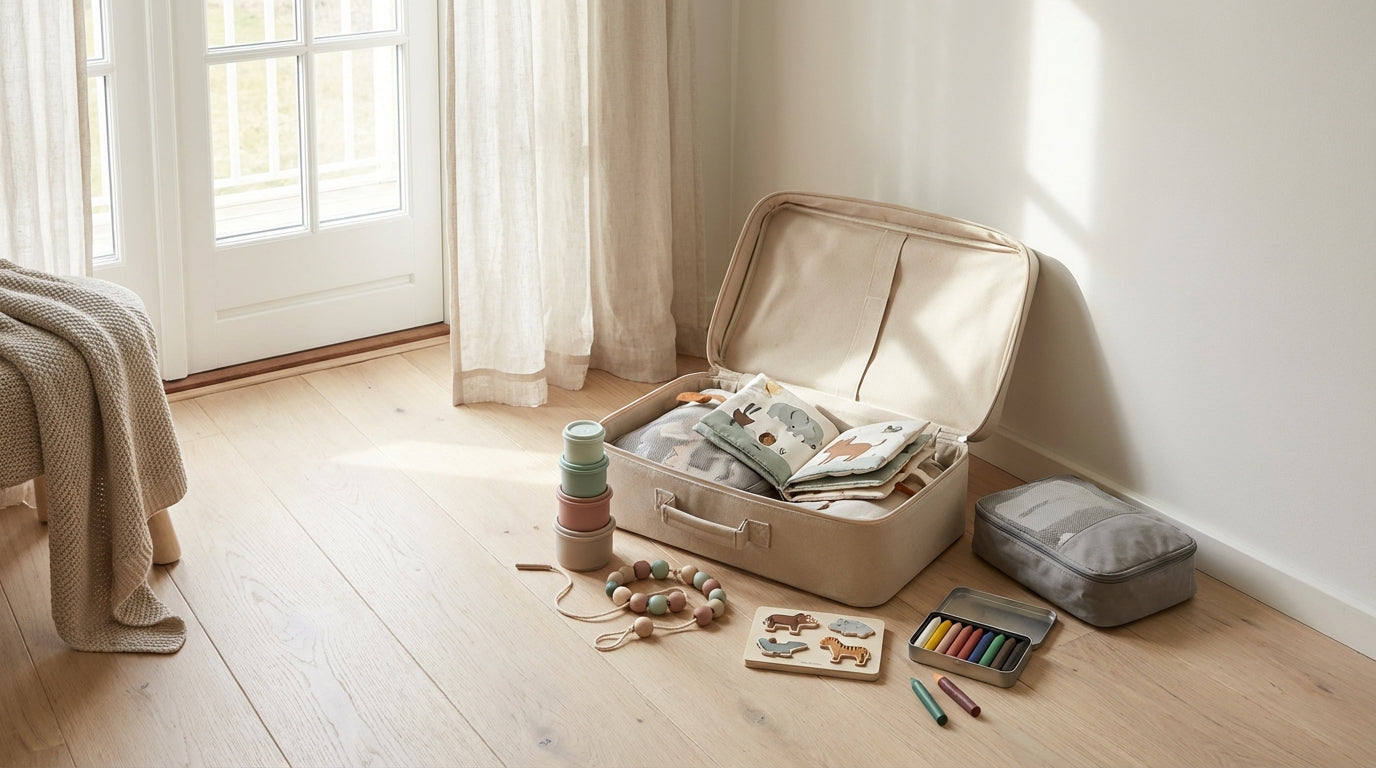
Toys for a holiday with a 2-year-old work best when they are small, quiet and ready to go in seconds. You don't need half a toy chest – just a few clever companions that don't get on your nerves in the car, don't roll off the table in a restaurant, and don't get offended the moment sand gets on them at the beach. Here you'll find a field-tested checklist for car, train and plane, ideas for holiday apartments and outdoors – plus DIY travel games that need hardly any materials. Tested while travelling with kids (and yes: including those famous “just a quick” stops).

Ulli & Flo
Owners of bieco · Hamburg · parents themselves
We've learned on our travels: a small bag of good all-rounders beats any giant suitcase. And if things get grumpy anyway – a quick cuddle, a snack, and off you go. Feel free to browse our collection Toys for Ages 3+.
Table of Contents
With these jump links you can quickly find what you need on the go.
- Why fewer toys make a better holiday
- 2 vs. 3 years: what really changes
- Checklist: toys for a holiday with a 2-year-old (and 3+)
- On the road: car, train, plane & waiting times
- Games without materials (they'll save your day)
- DIY travel games: quick to make, easy to pack
- Materials & safety: what to look out for
- Pack smart: 6 rules that really help
- FAQ
Why fewer toys make a better holiday
A few versatile things make you much more relaxed on holiday. Lots of pieces mean: more searching, more “Mummyyyy, something's missing!”, more clutter on the floor. And in the end they'll play with the hotel room key anyway (of course). If you pack by situation instead of by “type of toy”, you've covered almost everything: on the road, waiting times, holiday apartment, outdoors.
Travel toys aren't a category, they're a quality. A travel toy is a toy that works well on the go thanks to its size, weight and play idea – without lots of accessories and without constant noise.
Practical tip: Pack things into 2–3 small bags and hand them out one at a time – it feels “new” without you lugging more around.
2 vs. 3 years: what differs when it comes to travel toys
At 3 years old, a lot more is often possible – but expectations grow too. For 2-year-olds, “short, safe, repeatable” is usually the key. By 3, there's often more stamina, more imaginative role play and that wonderful “I do it myself!” feeling. That means you can think a bit more complex – but it still needs to stay sturdy and easy to follow.
The biggest difference is usually attention span and fine motor skills, not the suitcase. Many 3-year-olds can stay with one thing for longer, sort more purposefully and tell little stories along the way. At the same time, interest in rules (“It's your turn!”) grows – and so does the drama potential when something doesn't work out. For both ages the same applies: better a few pieces that can do a lot.
Safety note: At 2 years old, small parts are especially risky – on the road, choose toys without loose mini parts that can roll away or end up in the mouth.
Checklist: toys for a holiday with a 2-year-old (and 3+)
The best selection is the one you can carry with one arm. Here's a simple list that works in practice – not just on paper. If you're packing for age 3+, you can go “one level up” on some items (e.g. a bit more sorting, a bit more role play).
- 1 favourite companion – a cuddly toy, comfort blanket or that one item without which sleep is simply out of the question.
- 1 stacking or building game – building, sorting, “bridge”, “garage”, “ice cream parlour”.
- 1 motor skills idea – pushing, turning, threading (without 30 individual pieces).
- 1 role-play nudge – small figures/animals that get to “travel along”.
- 1 outdoor item – a ball, sand play or “search & collect”.
- 1 emergency activity – for when things get really tough (e.g. a little surprise in a bag).
Open-ended play means: the child decides what the toy stands for today. Open-ended play is a play principle in which children give a toy new meanings depending on the situation – a bridge today, an animal stable tomorrow, an ice cream counter the day after.
On the road: car, train, plane & waiting times
On the road, the best games are quiet and don't keep falling down. Anything that constantly lands on the floor eventually gets picked up by an adult with a sigh that sounds like “holidays are lovely” – but means something else entirely.
In the car: short, easy to grab, nothing flying around
In the car, things a child can use with one hand are ideal. Good candidates are small motor skills toys, compact stacking games or figures that travel along in a little tin. Add “zero-luggage” games: spotting colours, counting animals, “Who can see… first?” – they cost nothing and often bring surprisingly much calm.
On the train: activities plus mini movement breaks
On the train, a mix of table games and short walks up and down helps. Deliberately plan little “trips”: one to look out of the window, one to refill water, one to stretch briefly. In between, sorting and stacking ideas work well – as long as you're not balancing 18 pieces on the fold-down table.
On the plane: start quickly, pause quickly
On the plane, short, repeatable play ideas are usually the lifesaver. You want something that starts in 30 seconds, can be paused in 2 minutes and is exciting again after 10 minutes. Sorting, little stories with figures or “building in stages” often works better than one big project.
Practical tip: For the plane: a dedicated “boarding bag” right at the top of your hand luggage. That way you're not rummaging while everyone else has already moved into row 18A.
Waiting times (restaurant, check-in, doctor, ferry): the 5-minute strategy
When waiting, the winning approach is almost always: start briefly, be allowed to stop briefly. Plan to just “kick things off” for 5 minutes: stack together, tell a mini story, start a sorting game. After that, your child can often carry on alone – or you switch to the next mini idea without any drama.
Games without materials (they'll save your day)
Games without materials are worth their weight in gold on holiday because they need no luggage. And yes: they work even when you're tired. You don't have to be an “entertainer” – more of a co-pilot.
- I spy with my little eye – a classic because it works anywhere.
- Colour safari – “Can you find three blue things?” (on the train, at the airport, on the beach).
- Guess the animal sound – one person makes a noise, the other guesses (works whispering too).
- Mini stories – “Today the little dog is travelling to the sea…” and your child adds to it.
- Sorting in your head – “What belongs at the beach?” (towel, bucket, sun hat…).
If your child doesn't want to do anything at all, it's often a sign they need a break. It's not that your game is bad – life is simply loud right now. A snack, a sip of water, a quick cuddle: sometimes that's the best activity of all.
DIY travel games: quick to make, easy to pack
DIY travel games are great because you can tailor them exactly to your child. You don't need a crafty streak – just a few odds and ends you already have at home. And if it doesn't turn out perfect: no problem. Your child is two or three, not an art critic.
1) Magnet tin “Sort & Find”
A small tin with magnetic pieces is more likely to stay where it belongs. Take a flat metal tin (e.g. a sweet tin), stick a sheet of paper inside (colour/photo/sticker as the “task”) and add 6–10 larger magnetic pieces (no mini magnets). Task: “All the red ones”, “All the animals”, “All the round ones” – depending on the material.
2) Cardboard threading card (without a storm of small parts)
A threading card is quiet and keeps little hands busy for a long time. Cut a simple shape out of sturdy cardboard (e.g. a fish or a car), punch holes around the edge and add a thick string (wrap the end in tape). Your child threads “all the way around”. For 3-year-olds you can call out patterns: “Two holes further”.
3) “Holiday bingo” for ticking off
Bingo turns “Are we there yet?” into a search game. Draw a 3x3 grid: car, dog, bicycle, roadworks, plane, boat, red house, tree, sign. Tick things off along the way (pen or little stickers). For 2-year-olds, searching together is enough; 3-year-olds can often already tick things off themselves.
Materials & safety: what to look out for with travel toys
The age recommendation and warnings are a good basis – but your own eye still matters. According to the BMUKN (the German Federal Ministry for the Environment), safety requirements for toys apply in the EU (Directive 2009/48/EC, implemented in Germany via the 2. ProdSV, among others) – including requirements for mechanical, electrical, fire and chemical safety: BMUKN: Safe Toys.
“EN 71” is a series of standards that is often used as a testing basis for toys. When manufacturers provide details, you can often find them in the product safety information – at Bieco, for example, depending on the item, as a note on standards and independent tests in the product description.
Safety note: On the road it counts double: check toys for loose parts, sharp edges and “rolls away” potential – in tight rows, “gone” quickly means really gone.
Here in Hamburg we're pragmatic in the North German way: better clear than fancy. We're a family business and have been doing this for 66 years – which is why we'd rather talk openly about materials, warnings and testing than pretend everything is “magically safe”.
Pack smart: 6 rules that really help
Packing gets easier when you think in situations rather than types of toy. That takes the pressure off – and saves your nerves when unpacking.
- Starter toy on top – for the first 20 minutes after setting off.
- A “new” moment – a bag that only comes out later.
- Favourite item within reach – also during connections and at bedtime.
- No collection of pieces – better 1–2 things that can do a lot.
- Think about cleaning – wipe-clean almost always wins on holiday.
- Rotation instead of constant fire – 2 things in the morning, 2 others in the afternoon.
And if you're wondering whether you've packed “enough”: you probably have. Holiday isn't the time for perfection. It's enough if you get through the transitions well – the rest will sort itself out.
Concrete, travel-friendly ideas from Bieco
When you're looking for travel-friendly things, check size, care and noise level first. Three examples that many parents like to take along because they're compact and work without any set-up:
- Handy activity for car and train: Mini Motorikschleife Waldtiere blau
- Versatile for holiday apartment and beach: Regenbogen blau FSC®
- More play options for “indoors”: Motorikwürfel Berry FSC®
If you'd rather browse by age first, an overview is the most nerve-saving shortcut. Toys for Ages 3+ and Toys for 3-Year-Olds are good places to start.
FAQ
Which toys for a holiday with a 2-year-old are the most practical on the road?
The most practical are small, quiet and versatile toys with few individual pieces. Stacking games, simple motor skills ideas and figures for role play work well. Take 1 favourite item plus 2–3 all-rounders and rotate them. That way it stays exciting without you bringing half a house move along.
What makes good toys for the plane?
On the plane, games that start quickly and can be paused at any time are ideal. Sorting, stacking, little stories with figures or a small “bingo” work well. Pack everything in an extra bag so you don't have to rummage through your hand luggage while everyone is boarding at once.
How many toys should you pack for a holiday?
For 2–3 years, 4–6 small activities plus a favourite companion are often enough. Versatility matters, not quantity. If you don't hand everything over at once, it feels “new” for longer. And yes: a little boredom is okay too – the best play often grows out of it.
What's the difference between toys for a holiday with a 2-year-old vs. a 3-year-old?
At 3 years old, more role play and longer focus often work. At 2 years old, simple, safe repetition is usually more important. For 3-year-olds, there can be a bit more of a “task” (sorting, little rules, stories), but without small-part chaos. For both: sturdy, easy to follow, quick to pack away.
How can I recognise safe toys for travelling?
Look for the age recommendation, warnings and clean workmanship without loose parts. According to the BMUKN, safety requirements for toys apply in the EU (including mechanical and chemical safety): BMUKN: Safe Toys. And then comes the parent's eye: is everything firmly attached, is nothing sharp-edged, does it suit your child?
If you're still looking for a handy selection, you'll find play ideas sorted by age with us. Feel free to browse Toys for Ages 3+ or Toys for 3-Year-Olds. If you'd like to dive deeper: Motor Skills Toys for Ages 3+: Supporting Development at a Glance and Toys & Gift Ideas for 3-Year-Olds: Recommendations for Parents.