Wooden Train Accessories: Planning Switches, Tracks & Extensions
At a glance
- Wooden train accessories make sense once you've figured out your goal and your space first.
- Start with function: a switch plus long straight tracks instantly add more play.
- Compatibility is often “almost fitting”: test connections without forcing them.
- For children under 3, detachable small parts are the main concern.
- With track plans, a sorting box and a base mat, things stay relaxed.

The smartest way to choose wooden train accessories is to plan the layout first. That way you're not buying “just another piece”, but exactly the one that brings new play: a branch line, a station, a bridge, or simply more calm meters to drive on. In this guide you'll find a practical order of purchase (what comes first), small layout plans for typical room sizes, notes on compatibility and standards, and a few safety checks that really help in everyday life. As we say in northern Germany: better to think for a moment than to rebuild three times, grumbling, when everyone is already in their pajamas.

Ulli & Flo
Owners of bieco · Hamburg · parents themselves
We've learned that a good switch and a few long straight tracks save more afternoons than any decoration. And yes – a sorting box is sometimes the best accessory of all. Feel free to browse our wooden train collection.
Wooden Train Accessories: What Really Counts as an Extension?
An extension is anything that creates new play possibilities – not just more pieces. An extra wagon is nice, sure. But a switch, crossing or ramp changes the story: suddenly there are decisions, detours, shunting and “Track 1 is closed” (because a teddy is napping there).
Wooden train accessories are add-on pieces that extend the track, the roles or the functions. They include tracks (straights, curves, crossings), switches, ramps/bridges, stations, signals, tunnels, figures, vehicles and, quite unromantically, storage too – because otherwise the stuff founds a new home under the sofa.
The best guiding question is: should it become longer, more branched, or more “alive”? That quickly sorts accessories into “adds something” and “just sits around”.
- Longer: long straights, large curves, adjustment pieces.
- More branched: switches, crossings, double-track options.
- More alive: station, bridge/tunnel, figures, little places.
If you'd like to get your bearings on which kinds of trains and extensions exist in the first place: the wooden train section shows the whole world quite nicely at a glance.
Top 5: Which Wooden Train Accessories First?
The accessories worth getting first are those that immediately create new track options. These are the kind of pieces that aren't discussed after unpacking, but go straight onto the floor.
Practical tip: If you're giving just one piece as a gift, choose one that can be “built in” right away (switch, crossing, long straight) – not just “someday”.
- A simple switch: Turns driving in circles into an “I decide” game.
- 2–4 long straights: Fewer connections, steadier running, quicker setup.
- 1–2 short adjustment pieces: The little heroes when you're 2 cm short at the end.
- A crossing: Instantly new play (“Who has right of way?”) without everything getting bigger.
- A station or stop: Brings role play, tickets, announcements, chaos – the good kind of chaos.
If your child mostly builds, tracks matter more than decoration. If your child mostly plays stories, a station, switches and signals are often the faster hit.
If you'd like more guidance: Wooden Train Types Compared: Sets, Accessories & Extensions helps with sorting things out (without making you feel like you're reading an instruction manual).
Wooden Train Tracks: Which Tracks Make Setup Easier?
The tracks that help most are those that make your layout more flexible and more stable. In many children's rooms, setting up fails not because of imagination, but because of “doesn't fit” and “wobbles”.

Tracks are building blocks that determine the course, stability and play logic of the layout. A good choice of tracks means: less tipping over, less rebuilding, more playing.
- Long straights: Fewer connection points, less wobbling, finished faster.
- Large curves: Calmer running, look more “real”, less tilting.
- Short adjustment pieces: Close gaps, save your nerves.
- Crossings: Bring rules and encounters into the game.
- Ramps/inclines: Make bridges possible, as long as they're gentle enough.
Always plan a “run-up” for slopes – otherwise it turns into a bumpy road. Two gentle ramps are usually more practical for everyday play than one steep “roller coaster” (unless that's exactly what you want).
Wooden Train Switches: Small Parts, Big Play Value
A switch turns “driving in circles” into a real railway game. Kids love decisions: left to the station, right to the bridge – and suddenly the track becomes a story.

A switch is a track piece that can guide a train onto two different paths. That's not just technology, it's role play: shunting, rerouting, “the freight train has priority”.
- Simple switch: The classic, perfect as a start.
- Y-switch: Handy when space is tight, because it branches compactly.
- Double switch/switch yard: For bigger layouts and more shunting fun.
Safety note: For children under 3 years, detachable small parts are especially critical; the Bavarian consumer portal explains the test-cylinder principle for swallowable small parts (Verbraucherportal Bayern).
Our family realism: better one sturdy switch than five mini extras. We've been working with toys for 66 years – and as a family business from Hamburg, we're more team “can take a beating” than team “just looks pretty”.
Quick Definitions: Switch, Crossing, Adjustment Piece, Ramp
Once you've got the terms straight, you'll plan much more calmly. It's like cooking: if you know what “deglaze” means, things burn less often.
- Switch: Directs a train from one track onto two possible paths.
- Crossing: Two tracks cross; trains can meet and “right of way” becomes part of the game.
- Adjustment piece: A short track piece that closes gaps when the geometry doesn't add up.
- Ramp/incline: A track with a slope, so bridges and level changes become possible.
Compatibility & Standards: What Fits Together (and What Doesn't)?
Many wooden railways are similar, but not automatically fully compatible. The tricky part: on first connecting, it often seems “almost fitting” – and exactly that “almost” later causes wobbling or gaps.
Compatibility means: connector shape, track height and geometry fit together. If one of them differs, it may still run – but you'll be rebuilding more often.
- Check the connectors: Does the connection sit snugly, without jamming or rattling?
- Height transitions: With bridges/ramps, differences show up fastest.
- Curve logic: Some systems have tighter or wider radii; mixing can work, but doesn't have to.
Warnings should be clearly visible and understandable before purchase. That's what the EU Toy Safety Directive says; according to EUR-Lex, Directive 2009/48/EC is the central basis for toy safety in the EU (EUR-Lex: 2009/48/EC).
If you mix: first connect dry, then let a train roll, then build. A quick test run with a train saves you the moment later when everything is finished – and it always derails at that one spot.
Space Planning: Fitting the Railway into Real Life (Rug, Table, Corner)
The best layout is the one you can rebuild without drama. Some families love the “permanent layout”, others have to make room every evening. Both are fine – it just determines which accessories will really help you.

- Permanent corner: More switches, more levels, and gladly a station “with surroundings”.
- Set up and take down daily: More long straights, fewer small parts, clear sorting.
- Rug: Cozy, but often uneven; a firm base makes it more stable.
- Table: Great for overview; watch out for falling edges when play gets wild.
Practical tip: Choose a fixed “building base” (board, large mat). Then the layout is stable faster – and you're not searching for the perfect rug fold every day.
Sample Track Plans: Three Ideas That Almost Always Work
Simple basic shapes keep play going longer than complicated works of art. You don't need to build a “model railway” – you want a layout that holds up and is fun.
1) The relaxed main loop with a branch
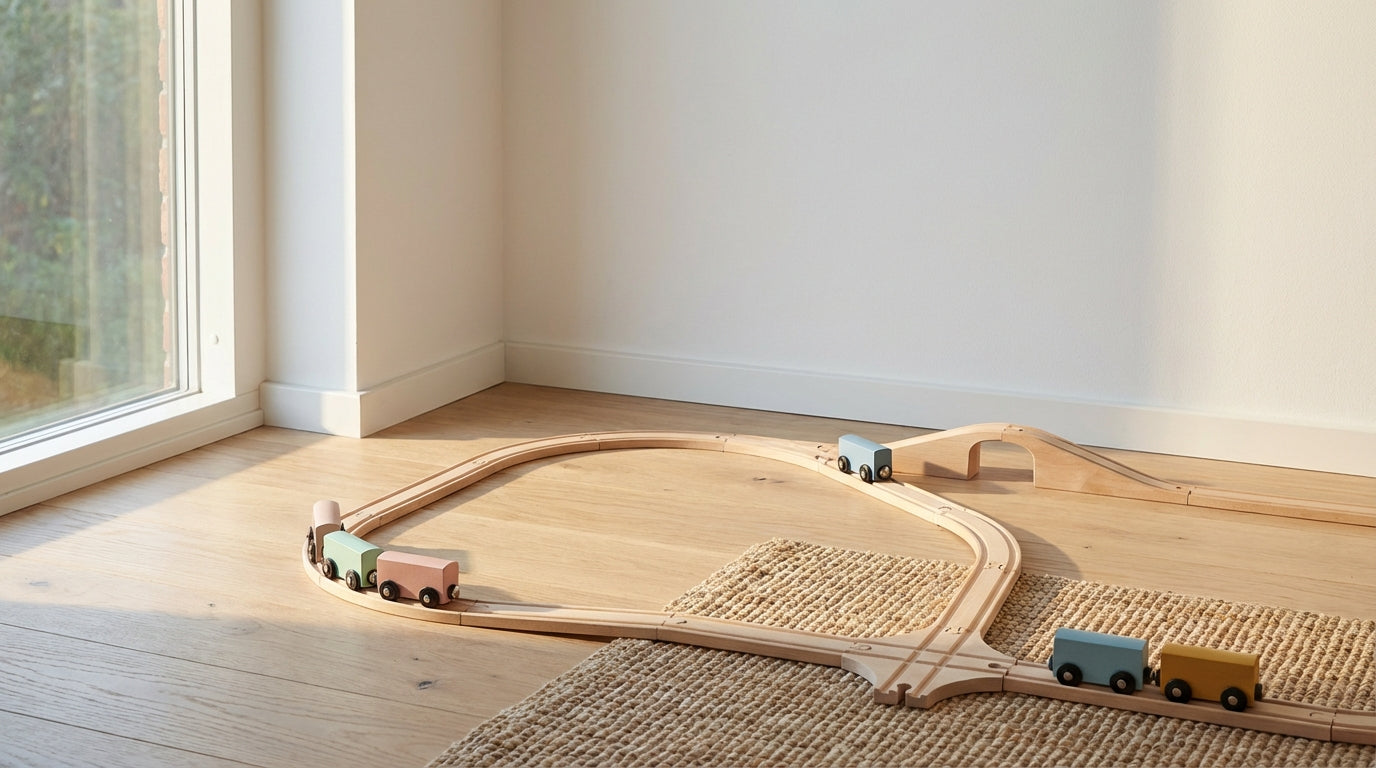
A stable circle plus one switch is the best start for many children. Build the circle first and test the driving, then insert the switch and lead the branch to a stop (station, tunnel or “workshop”).
2) The passing track (for shunting fans)
Two switches make a passing track – and suddenly there's sorting and planning. One train can “park”, another drives past, and the child plays dispatcher. This works on a small area too, as long as you don't choose the straights too short.
3) The bridge loop (when height is wanted)
Bridges work best with gentle ramps and enough run-up. Plan the climb over several pieces, a straight section at the top, then back down. If it wobbles: fewer transitions, build flatter, use a base.
Accessories by Age: What Works in Everyday Life?
The younger the child, the more important large, sturdy and clear pieces are. That's not a “you're not allowed”, but rather “this should be fun without stress”.
| Age (guideline) | Well suited | Rather later |
|---|---|---|
| from 2–3 | Tracks, large curves, simple switches, sturdy bridges | Mini figures, small cargo pieces, tiny signs |
| from 3–4 | Station, crossing, more switches, simple signals | Very small-part decoration, complex switch yards |
| from 4+ | Shunting areas, larger layouts, more levels | — (usually a lot is possible when it's age-appropriate) |
What always matters is the age recommendation of the specific toy. The table is a guideline for everyday life, but doesn't replace what's stated on the packaging or in the manufacturer's information.
Safety & Quality: What to Look for in Wooden Train Accessories
Safety means: sturdy parts, clear labeling and materials that are fit for play. Children don't test toys like adults – more like little quality inspectors with a great deal of stamina.
- Warnings: According to EUR-Lex, warnings on toys should be clear, understandable and visible (Directive 2009/48/EC, EUR-Lex).
- Harmonised standards: The European Commission provides information on harmonised standards for toy safety (including EN 71) (European Commission).
- Small parts: The test-cylinder principle for swallowable small parts is explained by consumer organizations (Verbraucherportal Bayern).
Rules keep evolving – that's a good thing, even if it sounds dry. According to DIN, a new toy regulation was published in the Official Journal on 12 December 2025, with application planned from 1 August 2030 (DIN).
Transparency is gold in everyday life: better to say clearly what a piece can do. For years we've been getting similar questions from consultations and feedback: “Does it fit?”, “Does it wobble?”, “Is it okay for this age yet?” This order of steps grew out of exactly that.
Typical Stumbling Blocks: Why Layouts Wobble (and How to Prevent It)
Wobbling usually comes from too many transitions, tight curves or an uneven surface. It's not that “you're building it wrong”, it's physics – the annoying kind.
- Too many short pieces: Many connections = many wobble points. Solution: more long straights.
- Tight curves + heavy trains: Can tip or jam. Solution: larger curves, slow down.
- Rug as a building site: Often uneven. Solution: firm base or board/mat.
- Bridges without run-up: Ramps need space. Solution: climb more gently, use more ramp pieces.
- “Almost fitting” mixes: Doesn't sit cleanly. Solution: build a test track, reduce critical transitions.
If you're thinking about electric or classic, that affects accessories too. This article fits well here: Electric Wooden Train vs. Classic Models: What Suits My Child?
Storage: How Wooden Train Accessories Stay Ready to Play
Good storage isn't a decor topic, but a play-frequency topic. When setup is quick, the railway comes out more often. When 200 pieces have to be sorted first, the picture book surprisingly often wins.

- Sorted by function: Switches/crossings together, then tracks by length.
- A “quick-start” bag: Basic circle set (curves + straights) within easy reach on top.
- Define a rule: “First the main loop, then extras.” That helps children too.
FAQ: Common Questions About Wooden Train Accessories
Which wooden train accessories are worth getting first?
A switch plus a few long straights is most worthwhile first. That turns the circle into a layout with a decision, without making setup complicated. If you take a third piece: a short adjustment piece – it surprisingly often saves the last connection.
How many switches do you need for a good layout?
One switch is often enough; two switches make shunting truly possible. With one switch you build a branch to the station. With two switches you get a passing track or a small shunting corner. More switches are mainly worthwhile if you have permanent space for a larger layout.
Which tracks make setup easier?
Long straights, large curves and short adjustment pieces are the setup helpers. Long pieces reduce wobbly connections, large curves run more smoothly, and short pieces close gaps when a space remains at the end. These are accessories you don't always see, but notice every day.
How can I recognize safe accessories for a wooden train?
Look for clear warnings, a suitable age recommendation and sturdy workmanship. According to EUR-Lex, warnings on toys should be clearly visible and understandable (Directive 2009/48/EC). For children under 3, detachable small parts are especially critical; consumer organizations explain the test-cylinder principle for this.
Which wooden train accessories make sense for children under 3?
Tracks and large, sturdy functional pieces without small parts make the most sense. Large switches, sturdy bridges and simple track extensions are usually more practical for everyday play than mini figures or small cargo. Check the age recommendation on the specific item and see whether anything can be easily detached.
What do you give when the child already has “a lot”?
Give a piece that opens up a new play role – for example a station or crossing. More of the same (another short wagon) is often quickly “ticked off”. A new stop or a crossing is more likely to get the existing trains used in new ways again.
When choosing wooden train accessories, think like your child: “What can I play with this?” A little less trinkets, a little more function – then the railway gets set up more often and stays exciting for longer. For stress-free browsing: in the wooden train section, extensions and accessories are nicely collected.