Wooden Marble Run: How to Find a Safe One for Your Child
At a glance
- A wooden marble run is a good fit if it stands firmly and suits your child's age.
- Good guidance: a clear age recommendation and references to EN 71.
- When unpacking, what counts is an edge check, a firm stand and the right ball size.
- Affordable can be good, as long as the workmanship and labelling are right.
- With a marble parking spot and a storage box, family peace lasts a lot longer.

A wooden marble run is a good choice if it is sturdy, looks cleanly made and fits your child's stage of development. In this guide, I'll show you what to look for when buying (or gifting) one, without you having to set up a testing lab in your hallway. We'll go through age, type of play, safety and value for money, with a few everyday tricks so the marbles don't take up residence under the sofa every evening.

Ulli & Flo
Owners of bieco · Hamburg · parents themselves
We've learned that a good wooden marble run doesn't have to be huge – it has to work in everyday life. And a marble parking spot is sometimes the best invention since the laundry basket. Feel free to browse our marble run collection.
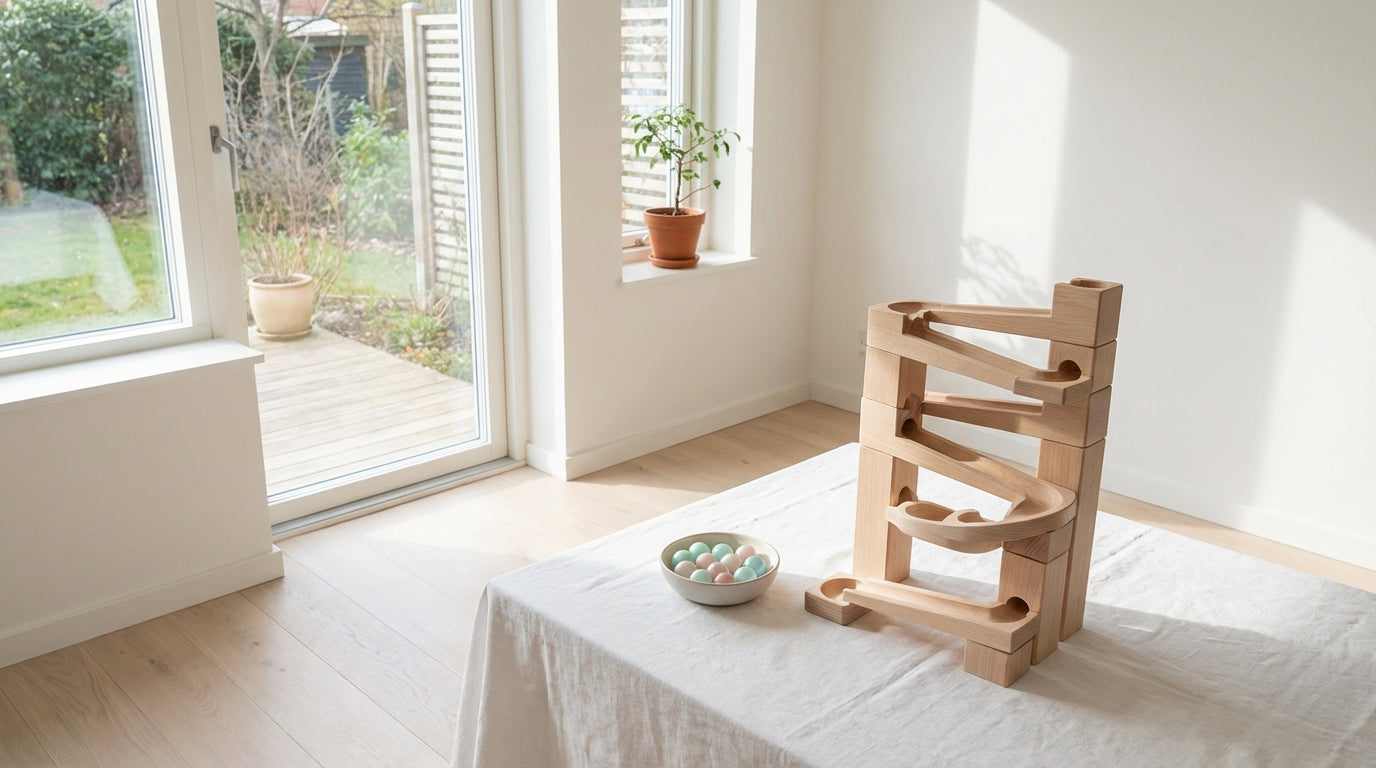
A wooden marble run is a toy where marbles roll along tracks, ramps or elements. Children experience cause and effect first-hand: let go of the marble, the marble rolls – and suddenly “again!” becomes a perfectly legitimate purpose in life.
Why wooden marble runs often work so well in family life
Wooden marble runs are usually pleasantly uncomplicated: set it up, let the marbles roll, done. No charging, no beeping, no app – just child, marble and the big question of where the marble has disappeared to after the third run. Wood feels warm, sits nicely in the hand and can often take quite a bit of everyday wear.

- Durability: If the workmanship is right, a track like this will happily last longer than a single season.
- Calmer play: Many wooden tracks sound less “clattery” than hard plastic parts.
- Playing-together factor: Adults often enjoy building along – and children love an audience.
Wood isn't automatically “better”, but many families find it pleasantly down-to-earth. And down-to-earth is sometimes the highest praise in a children's room.
What children really learn from a marble run (without it feeling like learning)
The biggest gain isn't the material, but repetition with purpose. Marble runs are little practice grounds: grabbing, placing, watching, and again. And when it doesn't work, they simply test whether crying can impress gravity. Spoiler: probably not.

- Fine motor skills: Grasping, placing, refilling and sorting marbles.
- Visual perception: Following movement, judging speed, “where will it come out?”
- Cause and effect: “If I do this, that happens.”
- Perseverance: Coping with small failures and trying again.
Practical tip: Put out a small bowl as a “marble parking spot”. It saves searching and arguments.
Stability means the track doesn't tip over or slide away during play. That sounds simple, but it's the difference between relaxed play and “Muuum, this thing is stupid!” after 30 seconds.
Safety: How to recognize a good marble run (without a lab)
A marble run isn't safe because it says “wood” on it, but because it is well made and correctly labelled. In the EU, basic safety requirements apply to toys; legally, this is regulated in the Toy Safety Directive, among other things. According to the European Union, Directive 2009/48/EC sets out essential safety requirements for toys. (EUR-Lex)

An important point of reference is the EN 71 series of standards for toy safety. If manufacturers state that a product has been tested to EN 71, that is a helpful indication, because these standards describe safety-relevant tests for toys.
EN 71-3 covers tests for certain elements that can migrate out of materials. According to DIN, DIN EN 71-3 describes test methods for the “migration of certain elements” from toy materials. (DIN e. V.)
Safety note: Marbles can be risky for small children. Follow the age recommendation and only let toddlers play under supervision.
The best parent check happens when unpacking – with no technical jargon at all. Take two minutes before the track “officially” moves into the children's room:
- Edges & surface: Run your hand over it: smooth, no splinters, no sharp spots.
- Stand & stability: Give it a gentle nudge: does it tip right away or stand calmly?
- Connections: Is everything firmly in place, nothing wobbling, no loose small parts?
- Ball size: For younger children, larger, easy-to-grip marbles are usually more relaxing.
- Smell: If it smells strongly of chemicals, better air it out first and check.
If you're unsure, take a look at the product safety information on the respective product page. At Bieco, this information is clearly listed there – we're a family business from Hamburg and have been doing this for 66 years, so straight talk for parents simply comes with the territory.
Which marble run suits which age – and which child?
The best marble run is the one your child can use as independently as possible. Age helps as a rough guide, but temperament is at least as important: some children love “zip-zap”, others are little tinkerers with a serious look on their face.
Easy start: short tracks and large elements
For getting started, compact tracks with few parts are often the most nerve-saving choice. Especially with younger children, large elements and a clear flow (marble in, marble out) are often easier to understand than a huge construction set.
Marble runs built into motor skills toys can be practical because they are ready to play right away. One example is a motor skills cube with an integrated marble run; you'll find the details and the respective safety information directly on the product page: Motor skills cube (wood).
For little builders: modular tracks with more parts
Modular marble runs are great if your child loves to build and sticks with it. Then the construction itself becomes the game – including “It has to be higher!” and “No, not like that!” (Children are astonishingly firm when it comes to site management.)
Practical tip: Giving a big track as a gift? Add a storage box. That's not decoration, that's family peace.
If you're looking for more inspiration, an overview of different variants and age groups helps. The marble run overview is a good starting point, and we also have the guide to the right marble run by age.
Value for money: How to spot good affordable models
Affordable is great, as long as stability, workmanship and labelling are right. An inexpensive marble run can bring plenty of joy – you just need to look more closely at very cheap models, because wobbly + marbles + small children is rarely a relaxing combination.
- Fewer parts, but solid: A smaller set often plays better than a wobbly giant package.
- Clear information: Age recommendation, warnings and manufacturer details should be easy to find.
- Clean workmanship: No flaking paint, no rough spots, no crooked tracks.
- Marble flow: The marble should roll smoothly, without constantly getting stuck or jumping out.
And honestly: “cheap” quickly becomes expensive if it constantly annoys you or breaks. Sometimes “a little more solid” is the cheaper decision – for your wallet and your nerves.
Color & design: pink, natural or colorful – what really matters?
Color is a matter of taste – workmanship is non-negotiable. Of course a marble run is allowed to look pretty. But in everyday life, what counts more is the stand, the edges and whether the marbles are easy to grip.
- Surface: It should look robust and not rub off or peel easily.
- Everyday life: Light colors show wear more quickly – that's normal and no drama.
If you're looking for wooden toys in shades of pink, there are suitable options. One example is the wooden rainbow in pink – not a marble run set, but a good example of what color worlds in wooden toys can look like.
Transparency about materials & testing: How to find the information
Good manufacturers don't hide safety and material information, they write it down clearly. On product pages, look specifically for sections such as “Product safety”, “Material” or “Notes” – that is where information on testing, age recommendation and use should be.
Tests such as EN 71 point to defined test procedures for toys. A compact overview of which tests can play a role in the toy sector (including EN 71-3) is also provided by AGES. (AGES)
For us, this is part of our attitude: better to say clearly how things are. Bieco is based in Hamburg, family-run – and after 66 years with toys, you know: parents don't read the fine print as a hobby, but because they have to.
Mini checklist: Is this marble run right for us?
With this list, you can work out in two minutes whether it will be a hit.

- Age recommendation: Does it suit the child (not just the gift idea)?
- Ball size: Easy to grip and appropriate for the age.
- Stability: Does it stand firmly on your floor (carpet/tiles)?
- Surface: Smooth, no splinters, no sharp edges.
- Connections: Nothing wobbles, nothing comes loose easily.
- Information: Are warnings and testing/safety details easy to find?
- Tidying up: Do you have a place for the parts and marbles?
FAQ
Which wooden marble run is suitable for small children?
For small children, short, stable tracks with large marbles are usually the most relaxed option. Look for a clear age recommendation and make sure the track doesn't tip over easily. Models with few individual parts are practical for everyday life, because they are quickly ready to play and cause fewer arguments at tidy-up time.
How can I tell if a wooden marble run is safe?
A safe wooden marble run looks cleanly made and is clearly labelled. Check for smooth surfaces, sturdy connections and a firm stand. References to testing according to EN 71 are a good indicator, because these standards describe safety-relevant requirements and tests for toys.
What is especially important with the marbles?
What matters is a marble size that suits the age, and consistent supervision with small children. Follow the manufacturer's age guidelines and make sure no marbles from other games get mixed in. Especially with older siblings, a fixed “marble parking spot” is worthwhile so nothing is left lying around.
Are there affordable wooden marble runs that are still good?
Yes, if you pay particular attention to stability, workmanship and product information with affordable models. A smaller, solid set often brings more joy than a big, wobbly one. Test whether the marbles roll smoothly, and look for easy-to-find warnings and age information.
Set or integrated marble run in a motor skills toy – which is better?
Integrated marble runs are often ideal for getting started, because they are compact and quickly ready to play. Sets suit children who like to build and stick with it for longer. If you're unsure, the option with fewer parts surprisingly often wins in everyday life – simply because it gets taken out more often.
What role does color play in a wooden marble run?
Color is secondary – what matters is a robust, well-made surface. Make sure nothing flakes off and that edges and transitions are clean. The look is allowed to be fun, of course. But safety and stability are what really help you in everyday life.
If you'd like to keep browsing now: in the marble run overview, you'll find models and inspiration in one place. Take a look here: Marble runs at Bieco. And if you take a quick moment to check the edges and the stand when unpacking: that's not mistrust – that's everyday parenting with a professional degree.