Toys for 1-Year-Olds: Smart Ideas, Safety & Buying Guide
At a Glance
- Toys for 1-year-olds work best when they are sturdy, easy to grip and free of small parts.
- Now it's all about stacking, sorting, rocking, pulling/pushing and first role play.
- Safety: clear labeling, warnings and traceable standards information.
- Less is more: 6–10 good pieces are often enough for everyday play.
- Toys with many ways to play beat the “wow for five minutes” kind (that's boring again in no time).

Toys for 1-year-olds are good when they are safe and your child can handle them on their own. A lot happens around the first birthday: hands get more skilled, legs get braver, and everything gets tested (teeth included). Here you'll find a relaxed buying guide: which kinds of play have proven their worth, what to look for in terms of materials and safety, how many pieces are really enough – plus answers to typical questions from parents, grandparents and gift-giving friends.

Ulli & Flo
Owners of bieco · Hamburg · parents ourselves
We still remember the first birthday well: suddenly you're facing mountains of options. With a few simple criteria, choosing toys for 1-year-olds becomes really relaxed. Feel free to browse our collection Toys for 1-Year-Olds.
Table of Contents
- What children aged 12–18 months love to do
- Useful play categories for everyday life
- Safety: what you should really look out for
- Material: wood, silicone, fabric – what suits your family?
- Quick buying guide (for gifts, too)
- Care & cleaning: keeping things hygienic
- Gift etiquette for grandparents & friends
- FAQ
What Children Aged 12–18 Months Really Love to Do
At 12 months, it's less about “learning” and more about “I can do it myself.” Many children love repetition: stacking, knocking over, stacking again. Add movement (crawling, pulling up, practicing walking) and that wonderful explorer program: “What happens if I put this in here…?”
A good rule of thumb: the more ways a toy can be played with, the longer it stays interesting. A stacking tower can be sorted, stacked, knocked over, worn as a “hat” (yes, really) or used as a “cake” in role play. These multi-purpose pieces usually survive everyday life longer than a toy with only one button.
Open-ended toys have no fixed way to play and offer many possibilities. Children decide for themselves whether today it's a tower, a drum, a phone or a ship – and that's worth its weight in gold when moods are, once again, “changeable.”
Practical tip: If you're unsure, pick the toy up: can your child grip it well, turn it and hold it securely? Then it's often a good fit.
Useful Play Categories for Everyday Life (Without Nursery Overload)
The best play ideas are often the ones that accompany daily life – not drown it out. Here are categories that work reliably for many children from their first birthday.
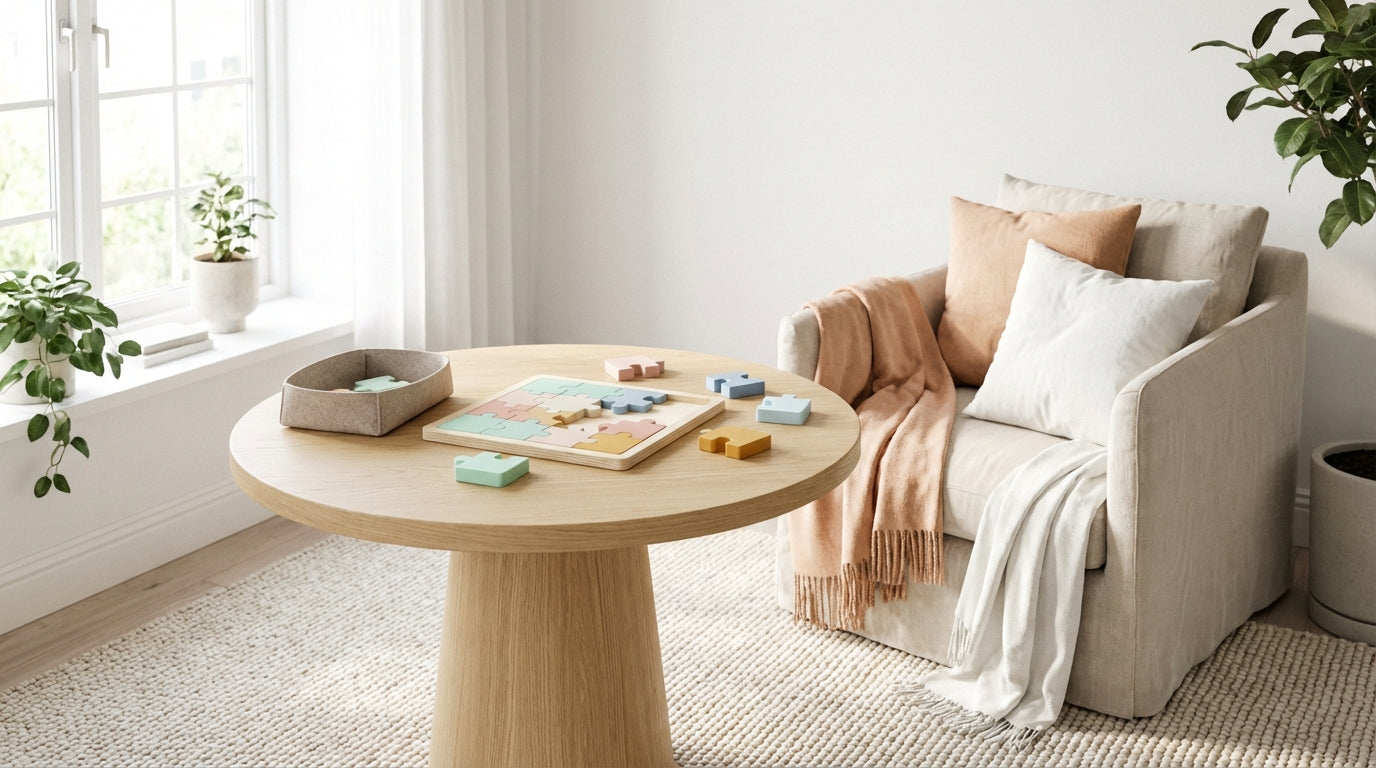
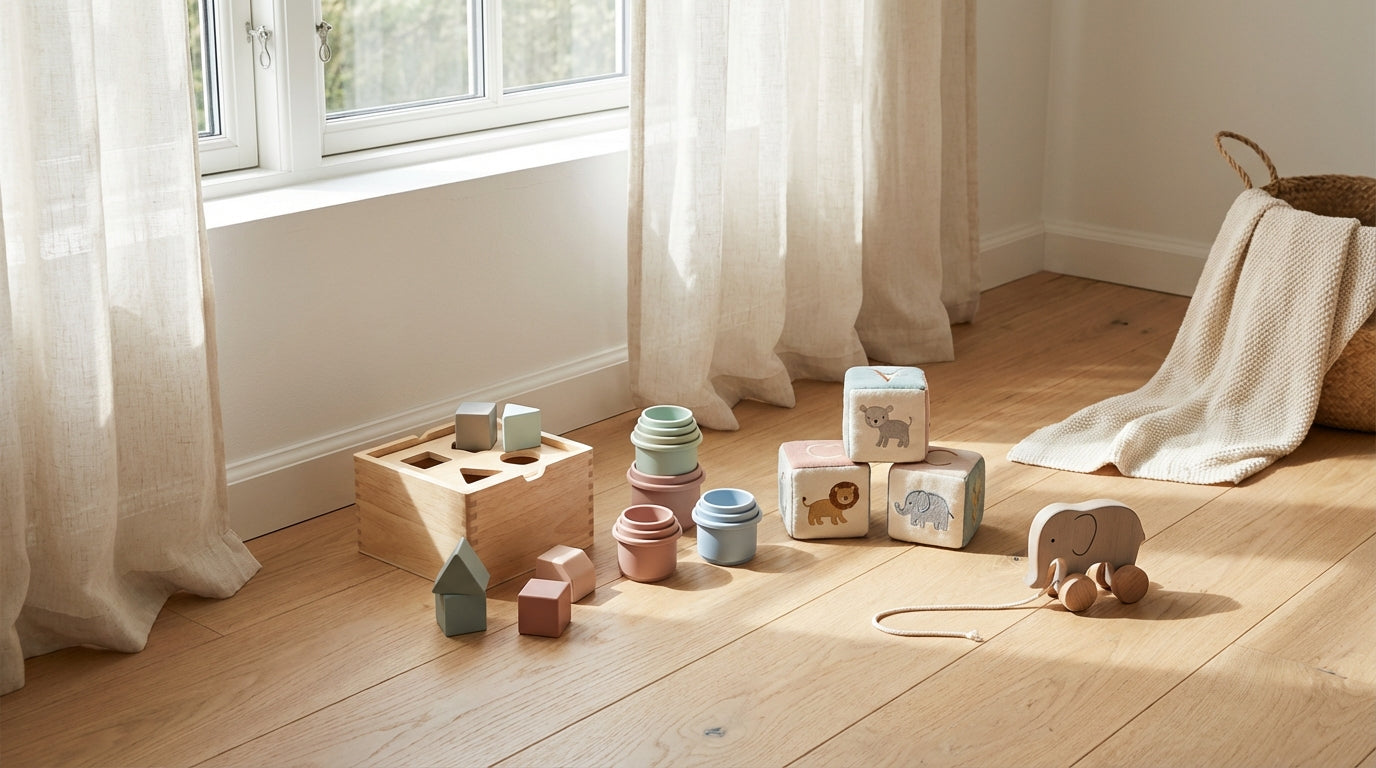
- Stacking & sorting: Great for grasping, hand-eye coordination and a sense of “order.” Example: Stacking Tower Deer Ella FSC®.
- Inserting & simple threading games: Large pieces, clear success, little frustration. Example: Silicone Stacking Toy Flower Tropical Vibes.
- Movement: Rocking, seesawing, pulling, pushing – anything that lets your child say “I'm making something move.” Examples: Wooden Rocking Horse or Rocking Animal Bunny Fine.
- Music & rhythm (preferably the “parent-friendly” kind): Rattles, small drums, claves – the simpler, the better. And yes: quiet is music, too.
- Books & pictures: Board books are toys in the best sense: looking, turning pages, pointing, naming.
- First role play: “Phoning,” “cooking,” “feeding” – simple, sturdy pieces are often all you need.
Motor skills toys are toys that specifically encourage hand and body movements. These include grasping, turning, inserting, balancing or pushing – in other words, everything your child can actively do instead of just watching.
If you'd like to dive deeper: In Motor Skills Toys for 1-Year-Olds: These Types Support Development you'll find more examples and play ideas, sorted by “What can my child do well right now?”
Safety: What You Should Really Look Out For
With toys for 1-year-olds, safety isn't a bonus but the foundation. That sounds strict, but it's quite manageable in everyday life once you keep a few points in mind.
Safety note: For children under 3 years, small parts that can be swallowed are a real risk – check toys regularly for loose parts, cracks and protruding edges.
A rule from real life: anything that can come off will come off eventually. So every now and then, give things a quick tug, a wiggle and a feel – especially parts that often end up in the mouth (and they do).
According to the Bavarian Consumer Portal (Verbraucherportal Bayern), a part is considered critical if it fits into a test cylinder of 31.7 mm. This is the well-known small-parts test from DIN EN 71-1 (mechanical/physical properties) and a good indicator for “too small.” (Source: Verbraucherportal Bayern)
According to the BMUKN (German Federal Ministry for the Environment), the EU Toy Safety Directive 2009/48/EC sets out safety requirements for toys. These include mechanical, electrical and chemical requirements, among others; in Germany it is implemented through the 2nd ProdSV. (Source: BMUKN)
Down to earth: good information on the packaging or product page is a sign of quality. Age recommendations, warnings and traceable standards or test information help you avoid fumbling around in the dark.
Material: Wood, Silicone, Fabric – What Suits Your Family?
The best material is the one that fits your everyday life – not a picture-perfect shelf. Here's an honest overview, without the glossy finish.
- Wood: Feels good in the hand, is often long-lasting and has a weight that helps with stacking. On the flip side: not meant for constant bath time, and with paint or finishes, always look for traceable information.
- Silicone: Unbreakable and easy to clean – handy when the “mouth phase” is in full swing. Example: Silicone Stacking Toy Flower Tropical Vibes.
- Fabric/plush: Cuddle bonus, often an “emotional” companion. For larger pieces to sit on or rock on, what counts is: a stable base, easy-to-reach handles and use under supervision.
We like to be transparent: for many BIECO products, you'll find standards information such as EN 71 in the details. Examples are the Rocking Animal Bunny Fine (EN-71-1-2-3) or the Stacking Tower Deer Ella FSC® (EN 71). We're a family business from Hamburg – relaxed in that northern German way, but quite particular when it comes to child safety. For 66 years now.
Quick Buying Guide: How to Make the Right Choice (Even Under Gift-Shopping Stress)
If you only have two minutes: choose something that allows grasping, sorting or moving. This mini checklist works just as well for parents as for grandparents with a gift list.
- Easy to grip? Large shapes, no tiny buttons, nothing fiddly.
- More than one way to play? Stacking + sorting + knocking over is already a little all-round package.
- Sturdy & easy to clean? It will get licked. Repeatedly. That's not criticism, that's biology.
- Does it fit your space? A giant piece can be great – or end up living in the hallway after three days.
Practical tip: For gifts: ask the parents about their child's current favorite activity (stacking, pushing, climbing). That hits the mark better than “boy/girl.”
If you're looking for a good overview: In the Toys for 1-Year-Olds section you'll find play ideas and categories collected in one place – handy when you don't want ten tabs open.
Care & Cleaning: Keeping Toys Ready for Everyday Life
The goal is clean enough – not sterile like an operating room. With 1-year-olds especially, toys are in constant use: hands, floor, mouth, floor again. A few simple routines help.
- Regular visual check: Cracks, loose seams, chipped spots – better to look once too often than once too late.
- Clean after “mouth-intensive days”: When teething is a full-time job, an extra wipe is worth it.
- Clean according to the material: Wipe wood with a damp cloth and let it dry well; silicone is often more straightforward; for fabric, a look at the care label usually helps.
- Don't “wash away” favorites: Some children are attached to the smell and feel. If an item is a source of comfort, spot-clean it instead.
A little tidying trick: a “in use today” box saves nerves. In the evening everything goes in, in the morning it gets redistributed – it's not perfect order, but it's order that survives.
Gift Etiquette for Grandparents & Friends (So Everyone Stays Happy)
The best gift is one that gets used in everyday life – not one that sits parked in the basement. To make that work, here are a few friendly rules that won't hurt anyone.
- Ask first, then give: A quick call (“What are you missing right now?”) prevents duplicates and XXL pieces in a tiny hallway.
- Quality over quantity: One sturdy piece that lasts is often worth more than five “quite nice” things.
- Space is a real gift criterion: If it's big, it should really be loved – otherwise it quickly gets “moved out of the way.”
- A receipt or a quick check-in is no mood killer: It's simply practical. Parenting life is complicated enough.
FAQ
Which toys are sensible for 1-year-olds?
Sensible toys are those your child can use independently and that allow several ways to play. Stacking, inserting, sorting and simple movement toys often stay popular for a long time. Look for sturdy construction, easy-to-grip shapes and clear age recommendations – then you'll have more play and less “broken after three days.”
How many toys are enough?
For many families, 6–10 well-chosen pieces plus a few books are enough. The mix is what matters: something for stacking, something for movement, something for looking at and naming. When too much is lying around, children often play less. Rotation (one toy away, back out later) feels like “new.”
What about walking aids – are they sensible?
It's important to look closely at what is meant by “walking aid.” Push or pull toys can be exciting for some children if they are sturdy and fit well. Devices in which children “sit” and roll around are a different matter. Manufacturer information, warnings and traceable safety information will give you guidance.
Which marble run is best for children from 1 year?
The best marble run for 1-year-olds is very sturdy and uses large balls that cannot be swallowed. According to the Bavarian Consumer Portal (Verbraucherportal Bayern), parts are considered critical if they fit into a test cylinder of 31.7 mm. (Source: Verbraucherportal Bayern) If you're unsure, stacking and inserting toys are often the more relaxed alternative.
Wood or silicone – which is better?
Wood is often long-lasting and “grippy,” while silicone is easy to care for and unbreakable. If a lot ends up in the mouth at your place and things need quick cleaning, silicone is the relaxed choice. If you're looking for something that stands stable when stacked and feels nicely heavy in the hand, wood is often a good pick.
How do I recognize safe toys?
Safe toys are sturdy, labeled with an appropriate age and come with traceable warnings. According to the BMUKN, the EU Toy Safety Directive 2009/48/EC sets out safety requirements for toys. (Source: BMUKN) In everyday life it also helps to check regularly whether parts are coming loose or the material is damaged.
In Closing: Stay Relaxed – and Choose Quality Over Quantity
Good toys for 1-year-olds don't have to be spectacular, just reliable. If your child keeps reaching for it again and again, it's a hit – no matter whether it beeps or not. If you'd like to gather more ideas, feel free to stop by Toys for 1-Year-Olds. There you'll find a clear collection for everyday life – without feeling lost in a toy maze.