Sensory Toys by Age: Play Ideas & Safety for 0–3 Years
At a glance
- Sensory toys by age: choose based on what your child can do (grasping, sitting, walking) – not just on months.
- 0–6 months: contrast, gentle sounds and safe shapes to grasp are often all you need.
- 6–12 months: everything gets tested – choose toys that are large, sturdy, easy to clean and free of small parts.
- 12–36 months: sorting, building, role play, kneading – with clear rules for small parts.
- At every age, a quick safety check helps: pull, twist, wiggle, look.

Sensory toys by age are the right fit when they safely support what your child can do right now. For newborns, that means calm stimuli (seeing, hearing, feeling); from around 6 months, grasping, rolling, sitting and the “mouth check” join in; from 1 year, sorting, stacking and imitating become the big thing. Here you'll find a clear overview from 0 to 3 years: with play ideas, mini tables for each stage and a safety check that works in real family life. And if you've already tidied up three times today: that counts as a workout.

Ulli & Flo
Owners of bieco · Hamburg · parents themselves
We've noticed it ourselves: when sensory toys by age truly match what a child can do, play gets easier – for your little one and for your own head. And yes, fewer pieces on the floor are an argument too. Feel free to browse our sensory toys collection.
When to start with sensory toys?
Sensory toys make sense from birth, as long as they are simple, safe and not overwhelming. Babies learn through their senses – that's not an “extra exercise”, it's everyday life. According to the Federal Institute for Public Health (BIÖG), play is children's way of learning and accompanies development from the very beginning, (BIÖG/kindergesundheit-info: Play).
Sensory toys are toys that specifically engage sight, hearing, touch, movement or balance. That might be a teething ring, a touch-and-feel book or, later, a shape sorter – what matters is that your child can explore it independently and safely.
Safety note: For children under 3, detachable small parts are a no-go because they can be swallowed or inhaled. Under the EU Toy Safety Directive 2009/48/EC, toys must, among other things, be designed so that they do not contain dangerous small parts for children under 36 months, (EU: Directive 2009/48/EC).
Choking hazard means a part is small enough to get into the mouth and throat. The Bavarian consumer portal explains the idea of the test cylinder (Ø 31.7 mm): parts that fit inside count as small parts, and toys for children under 3 must not contain detachable small parts, (Verbraucherportal Bayern).
Sensory toys by age: 0–3 months (newborns)
For newborns, the rule is: calm stimuli, clear contrasts, lots of closeness. In the first weeks, “less” is often truly “more”: babies love looking at faces, following simple patterns and responding to familiar voices.

| Age | Skills | Suitable toys | Safety focus |
|---|---|---|---|
| 0–3 months | Looking, listening, first grasping | Contrast cards, simple mobile, soft textures | Very lightweight, no loose parts, not hanging too low |
- Seeing: black-and-white contrasts, clear patterns, a simple mobile (not too busy).
- Hearing: quiet rattle sounds, soft little bells – more “ting” than “funfair”.
- Feeling: soft fabrics with different surfaces (smooth/ribbed), without loose fibers.
A good test is simple: if you're getting annoyed, it's often too much for your baby. And yes – sometimes the most exciting “toy” is still your face. It's free and surprisingly rarely returned.
If you'd like a clear definition of the term, you'll find the overview here: What are sensory toys? The big guide for parents.
Sensory toys by age: 3–6 months
Between 3 and 6 months, grasping becomes more purposeful – and the mouth becomes a testing tool. That's normal: babies explore with their hands and mouths. According to the BIÖG, simple things to grasp and explore are suitable at this age; what matters is that nothing is pointed and no parts can come loose, (BIÖG/kindergesundheit-info: Play & Movement).
| Age | Skills | Suitable toys | Safety focus |
|---|---|---|---|
| 3–6 months | Grasping, holding on, first rolling | Grasping toys, teething rings, crinkle elements, light rattles | Mouth-safe, easy to clean, not too loud |
- Grasping toys & rattles: lightweight, easy to hold, without hard edges.
- Teething rings: comfortable to hold, easy to clean, free of fragrances.
- Crinkle elements: exciting, but please not too loud (little ears are sensitive).
Practical tip: Place 2–3 items within reach and leave the rest out. Fewer choices often make babies happier – and you have less to tidy up.
If you're searching “when to start sensory toys”, you usually just want to know: am I doing this right? Yes, if it's safe, stays simple and your baby sets the pace.
Sensory toys by age: 6–12 months
From around 6 months, toys that support grasping, sitting, rolling and cause and effect are a good fit. Many babies pass things from hand to hand and find connections fascinating (“When I shake it, it makes a sound”).

Cause-and-effect toys respond reliably to an action, such as pressing, flipping or shaking. This helps children control their own movements better (and makes them very proud along the way).
| Age | Skills | Suitable toys | Safety focus |
|---|---|---|---|
| 6–12 months | Sitting, crawling, purposeful grasping | Stacking cups, touch-and-feel books, textured balls, activity cubes | No detachable parts, sturdy seams, no long ribbons |
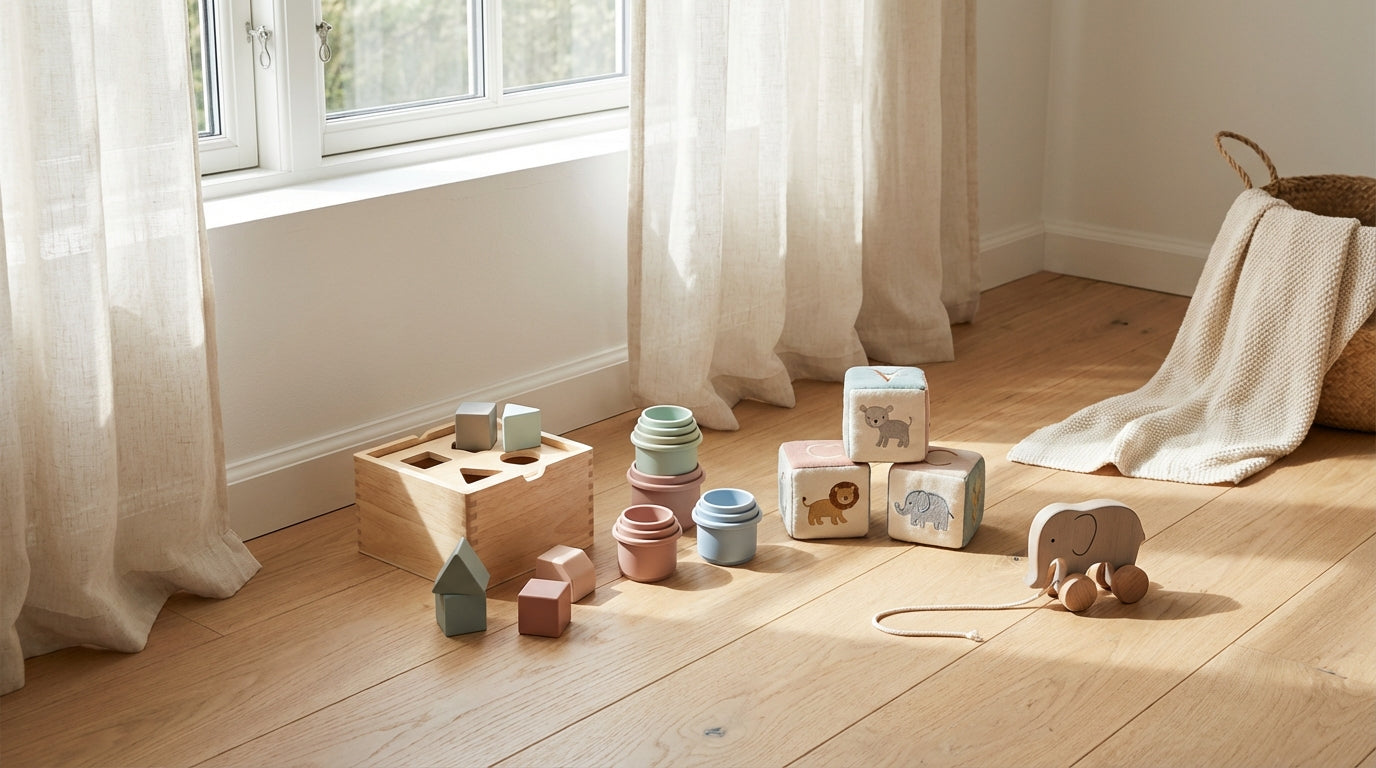
- Stacking or nesting cups: in, out, knock over, build again – a classic.
- Soft textured balls: easy to grasp, exciting to chase as they roll.
- Activity cubes (baby-suitable): with large elements and no small parts.
- Touch-and-feel books: different fabrics, clear pictures, sturdy seams.
Safety note: Do the “mini-human test”: pull, twist and wiggle everything that is sewn or screwed on. If something comes loose, it's out. The test-cylinder idea helps with small parts, (Verbraucherportal Bayern).
If you'd like an overview: you can find a collection here, no rush at all. Sensory toys
Sensory toys by age: 9–12 months (extra play ideas)
At 9 to 12 months, your home becomes a research station – and you become the safety officer. Babies now love things they can search for, find, hide and bring out again. According to the BIÖG, “exploring and discovering” is central at this age; objects should be safe and have no points or sharp edges, (BIÖG/kindergesundheit-info: Play & Movement).
- Hiding games: cloth over it, “where is it?”, there it is again – pure magic.
- Filling and emptying games: large pieces that are easy to grasp.
- Push toys (lightweight): motivate your baby to crawl after them.
- “Knock-knock”: soft ball against a cardboard box (supervised) – sound + movement.
Sensory play here often means: movement plus hands plus eyes – at their own pace. You don't have to “train” anything. You just set the stage.
Safety note: Anything that can roll will be chased – even toward the stairs. Secure play areas and clear away tripping hazards before the explorer express sets off.
Sensory toys by age: 12–18 months
At 12–18 months, it's all about “doing it myself”: putting in, pouring out, imitating. Many children walk or are practicing, understand simple routines and want to repeat things (happily 37 times, on principle).
| Age | Skills | Suitable toys | Safety focus |
|---|---|---|---|
| 12–18 months | Practicing walking, simple problem-solving, imitating | Shape sorters (large), stacking blocks, push/pull toys, simple instruments | Stability, no small parts, stable base (doesn't tip over easily) |
- Shape and sorting games: large shapes, clear openings, low frustration.
- Large building blocks/stacking blocks: stack, knock down, stack again – very scientific.
- Push or pull toys: motivate movement (and little “I can do it!” moments).
- Understated musical toys: drum, rattle, xylophone – please without constant background noise.
- Sensory play in everyday life: spoon in a cup, cloths in a tin (supervised) – simple, but effective.
Practical tip: If a shape sorter is too hard: first offer just 2–3 shapes and put the rest away. That saves tears (for kids and grown-ups alike).
Safety note: At this age, children like to mouth things “on the side” – especially when tired. Check toys regularly for cracks, loose seams and protruding edges.
Sensory toys by age: 18–24 months
At 18–24 months, fine motor skills, language and role play get much more exciting. Children sort, compare, “cook” imaginary noodles and show you very clearly how it's “supposed” to be done (spoiler: differently from you).
| Age | Skills | Suitable toys | Safety focus |
|---|---|---|---|
| 18–24 months | Fine motor skills, matching, first role play | Simple puzzles, sorting box, play dough (child-safe), drawing with thick crayons | Small parts are critical, non-toxic materials, easy to wash |
- Puzzles with few pieces: large knobs/handles, clear pictures.
- Sorting by color/shape: bowls + large pieces – quick to set up, quick to clear away.
- Play dough (child-safe): rolling, pressing, “sausages” – hands at work, mind relaxed.
- Drawing: thick wax crayons or finger paints (with a mat underneath, otherwise you'll have “cave paintings” in the hallway).
- Role play light: feeding dolls, putting stuffed animals to bed – often a cloth as a blanket is enough.
Safety note: Pay attention to warnings and age recommendations. The Verbraucherzentrale NRW (a German consumer advice organization) recommends taking these notices seriously, because “not suitable for children under 36 months” can mean, for example, small parts or long cords, (Verbraucherzentrale NRW).
Sensory toys by age: 24–36 months
At 2–3 years, sensory toys often become “everyday play”: building, cutting, tipping, rolling, storytelling. Children stay with an activity longer (sometimes), talk more and love role play. At the same time, small parts and long cords remain critical, because many children still put things in their mouths – especially when tired.
| Age | Skills | Suitable toys | Safety focus |
|---|---|---|---|
| 24–36 months | Planning, acting things out, finer hand movements | Role play, simple crafts, threading (large), movement & balance | Check small parts/cords, supervision depending on maturity |
- Role play: kitchen, doctor's kit, workbench – with large, easy-to-grip pieces.
- Cutting & gluing: child-safe scissors, thick glue sticks (and a table that forgives).
- Threading games: large pieces, short cord – only if your child is ready for it.
- Movement: balancing, climbing, throwing/catching with soft balls.
- Building: larger building blocks, simple constructions – a “tower” is a full architecture degree.
Safety note: Regularly check cords, ribbons and removable decorative parts. Especially with role-play items, small parts like to reappear “out of nowhere”.
Materials & safety: what to really look for at 0–3 years
The best rule of thumb: sturdy, easy to clean, no detachable small parts. Especially at 0–3 years, “can take a beating” is not just practical, it's relevant to safety.

- Small-parts check: seams, buttons, eyes, wheels – give each a good, firm tug.
- Edges & points: nothing sharp, nothing that splinters.
- Cords & ribbons: be especially careful with small children (strangulation risk).
- Smell & fragrances: better neutral; fragrances are unnecessary.
- CE marking & manufacturer details: should be present (name/address).
If you introduce just one safety ritual: a 30-second pull test once a week. It fits right between brushing teeth and “Where is the other sock this time?”
Bieco in brief: how we look at safety and everyday practicality
We are a family business from Hamburg and have been doing this for 66 years. That's why we like things clear and northern German: materials and workmanship should be transparent, warnings easy to understand, and toys have to withstand everyday life.
Our approach to safety is simple: we'd rather check honestly than sugarcoat. When parent feedback shows that something is hard to clean or wears out faster in one spot, we take a particularly close look – because children don't play “carefully”, they play properly.
Mini overview: sensory toys by age (0–3) as a cheat sheet
Go by what your child can do right now – not by the calendar alone. Here's the quick cheat sheet in case you have to dash off again:

| Age | What fits well now | What to watch for |
|---|---|---|
| 0–3 months | Contrast, gentle sounds, soft textures | Very simple, lightweight, no loose parts |
| 3–6 months | Grasping toys, rattles, teething rings, crinkle elements | Mouth-safe, easy to clean, not too loud |
| 6–12 months | Stacking cups, touch-and-feel books, textured balls, hiding games | No detachable small parts, sturdy seams |
| 12–18 months | Shape sorters, stacking, pushing/pulling, instruments | Stable, secure base, no small parts |
| 18–24 months | Puzzles (simple), sorting, play dough, drawing | Heed warnings, easy to wash |
| 24–36 months | Role play, crafts, threading (large), balance | Check small parts/cords, supervision depending on the activity |
FAQ
When to start with sensory toys?
Sensory toys are possible from birth if they are very simple and safe. For newborns, contrasts, gentle sounds and soft materials are often enough. What matters is that nothing can break off and the toy doesn't overstimulate. According to the BIÖG, play accompanies development from the very beginning, (BIÖG/kindergesundheit-info).
Which sensory toys are right from 6 months?
From 6 months, stacking cups, textured balls, touch-and-feel books and simple cause-and-effect toys are a good fit. Babies grasp more purposefully, pass things from hand to hand and test a lot with their mouths. Look for sturdy construction, materials that are easy to clean and make sure no parts can come loose, (BIÖG/kindergesundheit-info).
Which sensory toys are right from 1 year?
From 1 year, shape and sorting games, large building blocks and understated instruments are a good fit. Children now want to do things “myself”: put in, stack, twist, shake. Pay attention to age recommendations and warnings; the Verbraucherzentrale NRW advises taking these seriously, because “not suitable for children under 36 months” can point to risks such as small parts, (Verbraucherzentrale NRW).
What works as a sensory toy for newborns?
Contrast cards, a simple mobile and soft textured fabrics are suitable for newborns. It's all about calm stimuli: seeing, hearing, feeling – without noise and without a flashing disco. Closeness, your voice and a few safe things to grasp are often already plenty in the first weeks, (BIÖG/kindergesundheit-info).
How can I tell whether a toy is safe for children under 3?
A toy for children under 3 is safe above all when it has no detachable small parts and no risky cords. The EU Toy Safety Directive 2009/48/EC sets out safety requirements for toys, including with regard to swallowing and inhalation, (EU: Directive 2009/48/EC). At home, it also helps to pull firmly, twist and wiggle – just like a determined mini-human would.
Sensory toys by age: do I have to stick strictly to the months?
No, sensory toys by age are more of a compass than a calendar. Two children can be at very different stages in the same month: one is crawling, the other prefers to watch. Take the age recommendation as a guide and then look at abilities: grasping, sitting, walking, fine motor skills – that usually leads to the better choice.
Sensory toys by age: what matters more – sensory stimuli or motor skills?
The two belong together, because children learn through movement and the senses at the same time. A textured ball is touch (sensory) and grasping/throwing (motor) in one. In practice, that means you don't need two categories in your head, just one safe toy that your child enjoys trying out again and again.
In closing: choose with ease – and then let them play
Sensory toys by age are well chosen when your child can explore safely and you don't have to keep calling “No!”. If you'd like an overview, you'll find ideas collected in our sensory toys collection. And if you only manage one thing today: put one toy away, offer one – that's already pretty professional.