Potty Training: Step-by-Step Guide, Tips & When to Start
At a glance
- Potty training works best when your child shows signs of readiness – not by the calendar.
- Many children start between 18 months and 3 years, and the pace is different for every child.
- Daytime first: set potty times, praise the small steps, and keep the pressure off.
- Staying dry at night often comes later; dry mornings are a good sign.
- Setbacks are normal – if there is pain, fever or blood in the urine, have it checked by a doctor.

The best time to start potty training is when your child is ready – not when the family group chat says "it's about time." Here you'll learn which signs of readiness really matter, how to build potty training into everyday life (without endless sitting sessions), and what you can do about setbacks, daycare days, outings and nighttime. I like to keep things down-to-earth, Hamburg-style: steady steps beat big announcements. And yes – accidents are part of it. Otherwise it wouldn't be called training.

Ulli & Flo
Owners of bieco · Hamburg · parents themselves
What helped us most with potty training was thinking small: set times, lots of praise, very little drama. And if it gets stuck: taking a break is not failing. Feel free to browse our Potties collection.
What is potty training – and what isn't it?
Potty training means your child learns to feel their body's signals and get to the toilet in time. It's about noticing, letting you know, sitting down, getting up again – and the good feeling of "I can do this."
Potty training is not a weekend experiment and not a competition with the neighbor's child. If you start too early, it often drags on – and in family life, dragging on is about as popular as a Lego brick in the dark.
"Signs of readiness" are observable skills that show body control and cooperation are coming together. These include, for example, longer dry periods, interest, and understanding simple instructions; the National Health Service (NHS) lists these points as helpful guidance.
When to start potty training? The timing that really counts
The best answer is: start when the signs of readiness are there – often between 18 months and 3 years. According to the NHS, there is no fixed age, but many children show suitable signs during this period.
Age is only a rough guide – everyday life will tell you more. If your child is going through a developmental leap, sleeping well (haha), is curious about the toilet & co., and doesn't run away at every "Come here for a moment," this can be a good time.
When big changes are coming up, "let's wait a bit" is often the smartest shortcut. The NHS advises choosing a start date when everything isn't already turned upside down (a move, a new sibling, settling into daycare).
Practical tip: If you're unsure, try a 7-day "observation week." No training, just spotting patterns (after breakfast? after daycare?). It saves your nerves.
When to start with the potty? These signs of readiness are worth their weight in gold
A strong signal to start is when your child stays dry for 1–2 hours and notices when they need to go. The NHS describes exactly these signs as indications of emerging control.

- Your child notices "wet/full" and (sometimes) wants to be changed right away. This shows that body awareness is developing.
- The gaps between wet diapers get longer. That's what makes training practical in the first place.
- They can sit still for a short while and stand up again. Sounds trivial, but it's half the battle.
- They understand simple instructions ("Come here," "Pants down"). Without that, things get frustrating quickly.
- Interest in the toilet, the flush, or what you're doing in there. According to kindergesundheit-info.de, this is a common sign in the 2nd and 3rd year of life.
Preparation: how to make it easier for your child (and for you)
Preparation means the potty becomes normal – like a toothbrush, not an exam room. According to the NHS, it helps to get children used to the idea gradually and to calmly talk through what's happening during diaper changes.

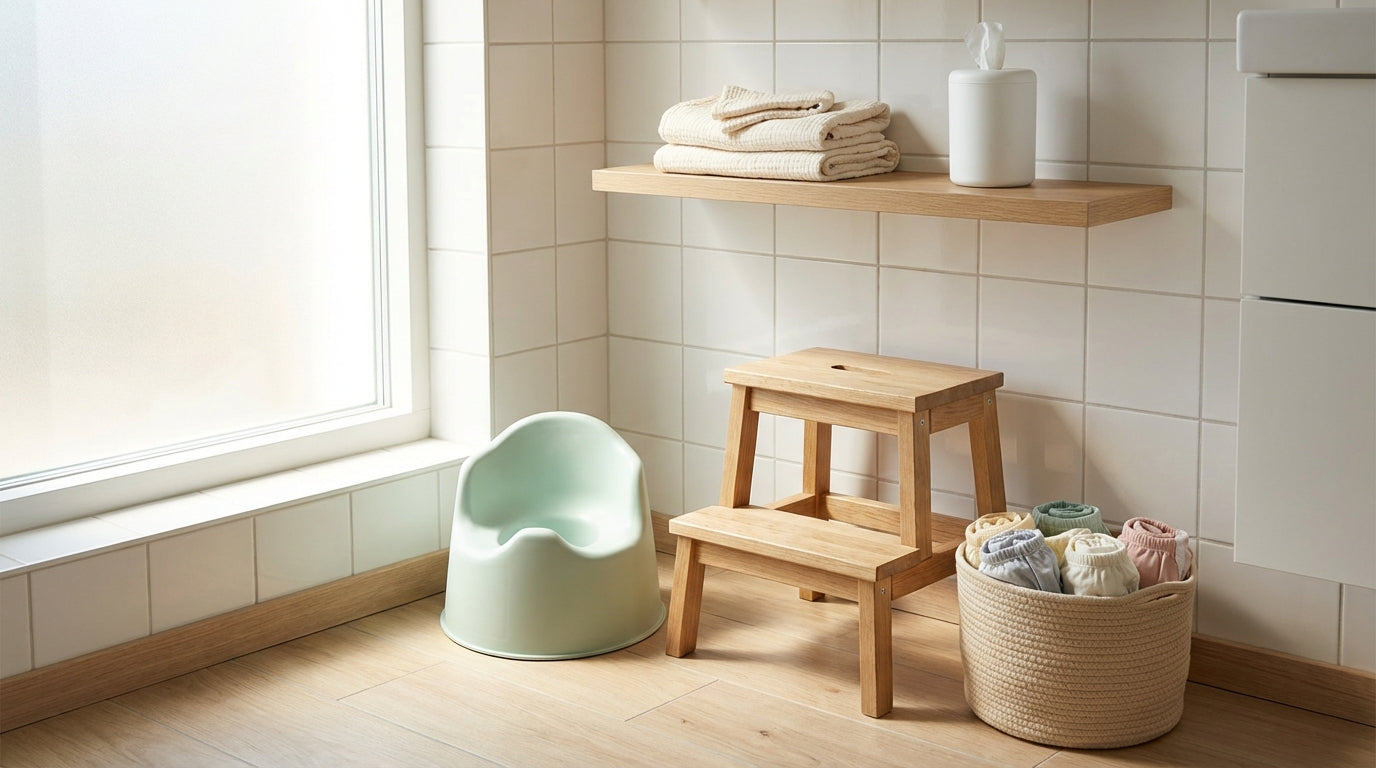
- Put the potty or toilet seat where it can be seen in the bathroom. What you see every day feels less "strange."
- Stick to simple words that suit your family. Children love repetition – and we adults get to practice along with them.
- Choose clothes that are easy to pull down and up. kindergesundheit-info.de explicitly recommends choosing clothing that is easy to handle.
- Prepare an "accident basket": wipes, a change of pants, a laundry bag. Nothing dramatic – just practical.
Whether a potty or a toilet seat suits you better often depends on your child and your bathroom. If you'd like to weigh it up calmly: Potty or toilet seat? Which is better for my child?.
A good step stool is almost as important in toilet training as the sitting itself. With a sturdy footrest, your child sits more securely and relaxed – and you don't have to keep saying "don't wobble!"
Step by step: potty training without the drama
The basic idea is simple: offer short, regular opportunities – and celebrate success without pressure. According to kindergesundheit-info.de, a playful approach with praise and calm when something goes wrong helps.

1) Set "potty times" instead of constant questions
In the beginning, 3–5 set times a day are enough, instead of constantly reminding your child. Typical moments: after getting up, after meals, before going out, before the bath, before bed.
2) Sit down briefly – really briefly
A few minutes are enough; sitting for long often just creates resistance. Better short and often than once for a long time in a bad mood.
3) Praise the journey, not just the result
Praise works best when you notice every step along the way. Pants down, sat down, tried, let you know – these are all small victories.
4) Diaper, training pants or underwear: what fits your daily life?
The best way is the one that fits your day – not an ideal picture. Some families start at home with underwear, while others stick with a diaper or training pants when out and about at first. If you'd like to dive deeper: Training pants & underwear for potty training: what makes sense?.
5) Treat accidents like spilled milk
Staying neutral helps most; scolding often makes things harder. Briefly say what happened, change clothes, carry on. No big theater – otherwise your child is more likely to remember the excitement than the body feeling.
Safety note: Never leave your child unattended on the potty or toilet seat, and make sure they have a firm footing (non-slip floor, sturdy step stool).
Daycare, out and about & visits: how to keep it relaxed
Potty training goes better when all the adults react in a similar way – without pressure and without drama. That doesn't mean everything has to be perfectly coordinated, but a shared basic tone helps.
- Talk to daycare about your "potty times." A short chat is often enough: when is it offered, how is your child praised, how are accidents handled?
- When out and about: Plan A is the toilet, Plan B is a change of clothes. Bring a change of pants, socks and a bag – that's not giving up, that's life.
- When visiting: say beforehand how you handle things. Then nobody has to spontaneously "parent" (which, oddly enough, happens quite often).
Practical tip: For outings, a little "bathroom ritual" helps: first a quick try, then shoes on. That saves you the classic "We really have to go now!" puddle.
Staying dry at night: why it often comes later
Staying dry at night is often a separate step – and for many children it comes later than during the day. According to kindergesundheit-info.de, it is normal for nighttime control to mature later; occasional bedwetting can happen up to about age 5.
A practical sign that "nights might work" is several dry mornings in a row. This is also mentioned as a guideline in NHS advice.
"No more drinks in the evening" is not automatically the solution. According to kindergesundheit-info.de, strictly cutting out fluids in the evening doesn't reliably help, because nighttime bedwetting isn't only due to "drinking too much."
- Make the way easy at night: night light, clear path, quick-to-handle clothing. The fewer hurdles, the better.
- Protect the bed pragmatically: waterproof mattress protector, spare sheets within reach. That's not a defeat, it's sleep protection for everyone.
- Waking your child for a toilet trip works for some and stresses others. If your child gets properly wide awake from it, better to skip it.
Setbacks (regression): what's behind them and what helps
Setbacks are often normal – frequently stress, change or simply development is behind them. According to Just One Norfolk (NHS), changes in routine, constipation or infections can play a role.
- After illness or vacation: bring back the routine first, then the training. Two or three days of "reset" often work wonders.
- With sudden wetting: first gently check whether it hurts. Children sometimes only say "ouch" when you ask specifically.
- If it's become nothing but a fight: taking a break is allowed. A few weeks later it often goes more easily, because maturity catches up.
Constipation & pain when pooping: a common roadblock
If pooping hurts, many children hold it back – and that can slow down potty training. Then the issue is less about "wanting to" and more about "avoiding ouch."
Typical signs are very hard stools, tummy ache, or "poop only in the diaper." According to Just One Norfolk (NHS), constipation can be connected to toileting problems.
- Make it comfortable: feet on a stool, sit calmly, no time pressure. Stability helps with relaxing.
- Keep praising, even when nothing comes. The goal is to win back trust.
- If there is pain, blood in the stool or severe constipation: have it checked by a doctor. This is not a "close your eyes and push through" topic.
When to see the pediatrician?
It's better to go once too often if there is pain, fever or any unusual changes. It is especially important to get it checked if your child has pain when urinating, develops a fever, blood appears in the urine or stool, or the wetting suddenly changes markedly.
Medical advice is also worthwhile for persistent constipation or strong withholding. Together you can then look at what's behind it and how to get back to a more relaxed everyday life.
What we've learned at Bieco from experience (and parenting life)
Staying calm isn't just a saying – it's the trick that works most often. We are a family business from Hamburg, we've been doing this for 66 years, and we write (Ulli & Flo) as parents for parents: when you put less pressure on things, it's usually easier for your child.

Safety isn't a "nice to have" in toilet training, it's part of everyday life. Look for a stable stance, non-slip solutions and a seat height where the feet rest securely – that makes it easier for children (and for your back, too).
If you'd like to look at something suitable for the bathroom, here is a calm overview. You can browse our Potties category at your leisure; we transparently focus on practical materials and everyday-friendly workmanship.
FAQ
How long does potty training usually take?
Weeks to months are normal – and setbacks are often part of it. What matters is less speed than consistency: set potty times, praise for small steps, and a neutral way of handling accidents. If all you do is fight, a break until there is more maturity often helps.
What do I do about setbacks after starting daycare or after illness?
First bring back the routine and take the pressure off. According to Just One Norfolk (NHS), changes, stress, constipation or infections can affect toileting. Go back to the "basics" for a few days: offer, praise, stay neutral about accidents. If pain or fever are added: have it checked.
My child is dry during the day but not at night – what helps?
Usually patience plus good conditions help. According to kindergesundheit-info.de, staying dry at night often comes later. Make the way easy (night light, clear path), protect the bed pragmatically, and look for several dry mornings as your guide. Cutting out evening fluids completely is not a miracle solution.
What should I do if my child only poops in the diaper?
This is often about feeling safe – not about being stubborn. Many children need more trust and calm for a bowel movement. Offer the potty at typical times (e.g. after a meal), without pressure. If pooping hurts or the stool is very hard, have it checked medically.
Are there differences between boys and girls when it comes to potty training?
Signs of readiness and everyday life matter more than gender. Some children are ready earlier, others later – this can vary a lot even within one family. What counts in practice: can your child feel the signals, sit briefly, handle their clothing and cooperate? That's what you're best off going by.
When should I seek medical advice?
If there is pain, fever, blood in the urine or stool, or severe constipation, please have it checked. A check-up also makes sense if bedwetting suddenly changes noticeably or your child complains when urinating. It's better to have it calmly checked once than to wonder for weeks.
Sources
- NHS (UK): Potty training tips
- kindergesundheit-info.de (BZgA): Becoming dry and clean (Trocken- und Sauberwerden)
- Johns Hopkins Medicine: Toilet Training
- Just One Norfolk (NHS): Toileting advice
If you want to get started now: begin small, keep it practical for everyday life – and take the pressure off. For practical bathroom essentials, take a look at our Potties overview, or read up a bit more with Potties for babies & children: overview, tips & buying guide.