Potty or Toilet Seat: Which Suits Your Child Better?
At a Glance
- Potty or toilet seat: Start with whatever lets your child sit securely.
- A potty is often the relaxed way in, because it sits close to the floor.
- A toilet seat reducer often becomes the long-term solution later on.
- With a step, it only works if everything stands steady and non-slip.
- On the go, a folding seat helps against “strange toilet” worries.

Usually a potty is easier at the beginning, and a toilet seat becomes the practical solution later. If you are torn between a potty and a toilet seat right now, you are in good company. Here you get a clear decision guide, a small overview of developmental signs, a 7-day start checklist and a hygiene routine that works in real family life. Calm in the North German way, without pressure – and with the understanding that children don’t become dry by the calendar, but by maturity and opportunity.

Ulli & Flo
Owners of bieco · Hamburg · parents themselves
We’ve learned that becoming dry is rarely a straight line. With a small plan and less pressure, it gets much more relaxed for most children. Feel free to browse our Potties collection.
Potty or Toilet Seat: The Quick Decision Guide
If it’s often “suddenly urgent”, the potty usually wins. The potty is right where you are, and your child can get on it quickly – no climbing, no height, no big fuss. A toilet seat (toilet trainer seat/seat reducer) is great later, because it leads straight to the “real toilet” and you don’t have to maintain an in-between step.
- A potty suits well if your child is small, sits unsteadily or you have lots of “just made it” moments.
- A toilet seat suits well if your child likes to imitate, can sit calmly in the bathroom and you can help with getting up and down.
- Both are perfectly normal if you want to cover home, daycare and being out and about.
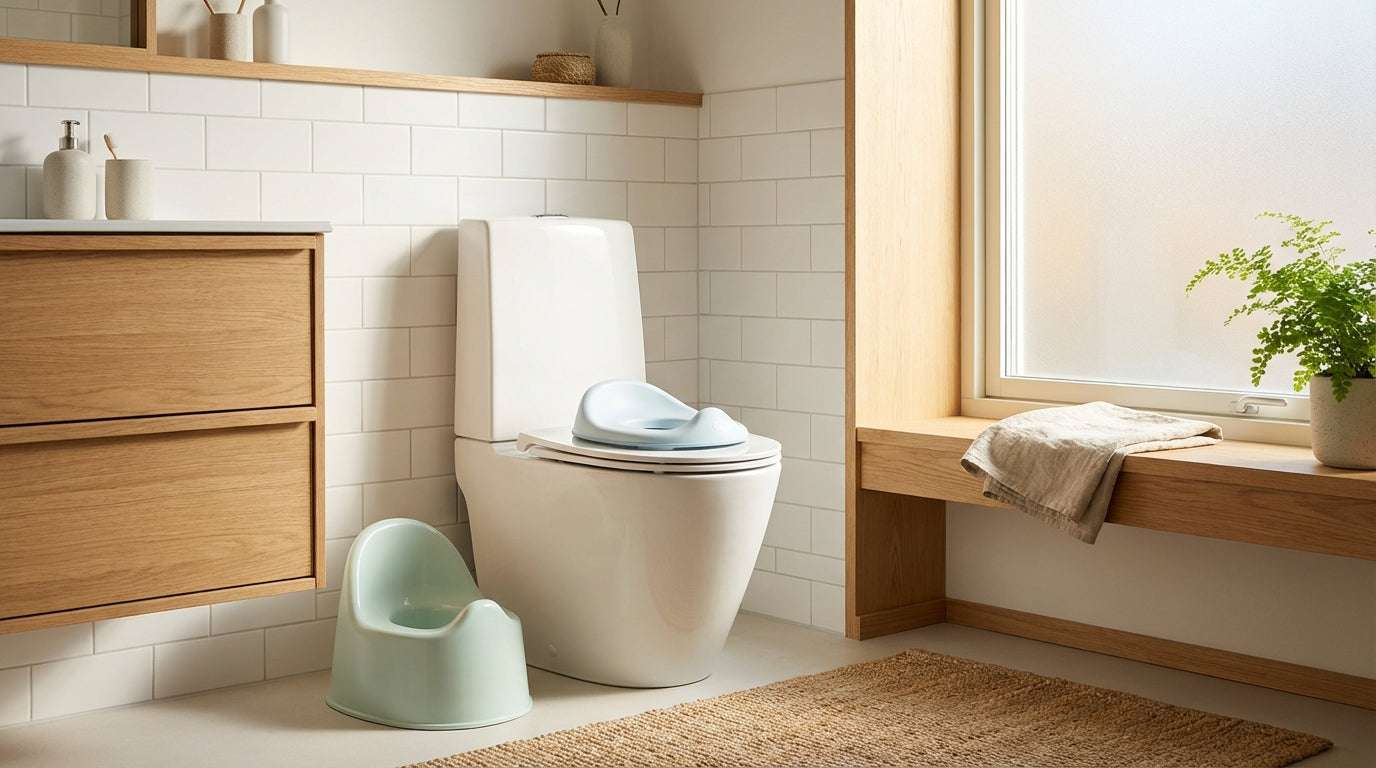
A toilet trainer seat is an insert that makes the toilet opening smaller. This helps children sit steadily, without fear of “slipping in”.
A potty is a low vessel that is used independently of the toilet. It is quick to reach and can be placed wherever it’s needed in everyday life.
Which Solution Suits Which Age? (18–24 vs. 24–36 Months)
Age is a guide, but your child’s signs matter more. Some are curious early, others need longer – and both are okay. According to the NHS, it usually gets easier when children show first signs of control and aren’t pushed.

| Rough range | What often works well | What to look out for |
|---|---|---|
| 18–24 months | Potty as an “offer” in everyday life | Short sitting times, lots of praise for trying, no long discussions |
| 24–36 months | Toilet trainer seat/seat reducer + stool/step | More independence, but continued support with hygiene and safety |
| Transition | Both in parallel | A fixed spot in the bathroom, a backup potty within reach |
Practical tip: At first, put the potty where you actually spend your time. “Too far away” happens more often than “no interest”.
Potty: Pros, Cons and When It’s Worth Its Weight in Gold
A potty is unbeatable when things need to happen fast and safety counts. Especially at the beginning, the low seat height helps: your child feels stable, you don’t have to supervise a climbing operation first, and the hurdle is often lower.
- Pros: can be placed anywhere, close to the floor, quick to reach, often less fear of noises.
- Cons: has to be emptied and cleaned, and (depending on the phase) sometimes gets in the way.
- Typical “potty moments”: in the morning after getting up, after meals, before heading out.
For many children, the potty is first of all a practice spot without much distraction. And yes: sometimes your child sits on it and tells you the entire social structure of daycare – with no result. That counts as practice, too.
If you’d like an overview, you’ll find different options for home in our potty collection.
Toilet Seat, Toilet Trainer, Seat Reducer: What’s the Difference?
They usually mean the same thing: a small seat for the big toilet. In everyday life the terms get mixed up. What matters isn’t the word, but this: does the piece fit your toilet, does it stay put, and can your child sit comfortably?

- Toilet trainer seat/seat reducer: sits on the toilet seat or is fixed in place to make the opening smaller.
- Toilet seat for children: often used as a catch-all term, sometimes also for integrated double seats.
- With a step: combines seat reducer and step so children can climb up more easily.
The real difference is usually the height and the “How do I get up there?” question. When your child is sitting up top, their feet should have support – otherwise the body feels wobbly, and then the mood often wobbles too.
Toilet Seat for Your Child: Pros, Cons and How to Make It “Toilet-Friendly”
A toilet seat is practical if your child likes to do things “like the big ones”. For parents it’s often more pleasant, because there is less emptying and your child practices right at the goal.
- Pros: right at the toilet, less getting used to something new later, easy to integrate into the bathroom.
- Cons: the height can feel intimidating, getting up and down needs support, the flushing sound can be unsettling.
Make it cozy: a footrest, a calm atmosphere, and flush only when your child is ready. Some children simply find the sound too much at first – that’s not a “quirk”, that’s a little person with sensitive ears.
Safety note: Never let your child climb on the toilet unsupervised. Slippery tiles and wobbly steps are real sources of accidents.
Children’s Toilet Seat with Step: When It Helps (and When It Annoys)
A step helps if it stands firmly and your bathroom has enough space. Many children sit more comfortably when their feet aren’t dangling. At the same time, such a combo in a small bathroom can feel like an extra housemate: always there, always in the way.
- Well suited: if your child wants to climb up by themselves but still needs support.
- Less suited: if space is tight, there is a lot of traffic in the bathroom or your child gets very wild when climbing.
- Everyday check: non-slip feet, wobble-free stand, seat sits firmly on the toilet.
Practical tip: Always set up the step and seat the same way. Repetition builds confidence – and you have to “hold on” less.
A step doesn’t replace supervision, it only makes the way easier. At the beginning you stay close, even when your child calls out “by myself!” with great conviction.
Folding Toilet Seat for On the Go: Yes or No?
When you’re out, a folding seat is often the difference between “works” and “not a chance”. Unfamiliar toilets are big, cold, sometimes loud – and simply spooky for children. A familiar seat can help because it gives security and makes the opening smaller.
- Useful for: travel, restaurants, playground toilets, visits to friends.
- Look for: a non-slip surface, easy-to-clean materials, a bag for carrying.
- Reality bonus: You don’t have to be perfect – just prepared enough that things don’t escalate.
Cleaning & Hygiene: Keeping It Doable (at Home and on the Go)
A simple routine is better than a perfect one nobody sticks to. You want something that also works when your child is already shouting “NOW” in the hallway and you’re still looking for a shoe.

At Home: Potty
Rinse it briefly, clean it with warm water and let it dry well. The fewer crevices and the smoother the surface, the more relaxed the cleaning. If there’s an odor: thorough drying and regular cleaning usually help – not necessarily more fragrance.
At Home: Toilet Trainer Seat/Seat Reducer
Wipe it down as needed and clean it more thoroughly on a regular basis, ideally separately. It’s handy to have a fixed spot where the seat can dry without being in the way. And yes: “Who put the seat where?” is a classic. A hook or shelf can keep the peace.
On the Go: Folding Seat
Wipe it down after use and carry it dry in the bag. For you: clean your hands before you touch the lunch box, phone or child again – that’s less hygiene panic, more common sense.
Starting Relaxed in 7 Days: A Mini Plan Without Pressure
A short plan helps because you don’t have to rethink things every day. Adapt it to your own pace – and if day 4 turns chaotic: welcome to the club.

- Day 1: Show the potty or seat, your child may try it out (even fully dressed).
- Day 2: Two fixed “offer times”: in the morning and after eating, each one short.
- Day 3: Bathroom routine: finish with handwashing, even if nothing happens.
- Day 4: Observe: when is the diaper usually wet? Use that time as an offer.
- Day 5: Establish the toilet trainer seat in the bathroom (if your child wants it), the potty stays as backup.
- Day 6: Short outing with a plan: pack spare clothes, without making a big deal of it.
- Day 7: Take stock without drama: What works? What stresses you out? Then adjust exactly that.
According to HealthyChildren.org (American Academy of Pediatrics), cognitive, motor and emotional factors play a role alongside physical maturity, and children can be further along in one area than in another: HealthyChildren.org.
Common Stumbling Blocks When Switching (and What Usually Helps)
When things get stuck, it’s often down to stress, fear or too many expectations. That isn’t “disobedience”, that’s a child who has other things on their mind right now.
- Child is afraid of the toilet: practice first without flushing, make the seat smaller, support the feet, sit briefly.
- Child only wants the potty: okay as an intermediate step, just offer the toilet trainer seat, don’t force it.
- Child only wants the toilet: great, then make the way safe (stool/step, trainer seat, supervision).
- Setbacks: normal during illness, travel or the start of daycare; going back to more routine for a short while often helps.
According to Mayo Clinic Press, many children show readiness somewhere between 18 and 24 months, others only later; what matters is development and behavior: Mayo Clinic Press.
Safety & Material Transparency: What to Look For
Stability and easy cleaning matter more in everyday life than any extra feature. If something slides or wobbles, trust is quickly gone – and trust is truly half the battle when it comes to becoming dry.
- Fit: Does the trainer seat match the shape of your toilet (e.g. oval/D-shape)?
- Non-slip: Does it sit stably without wandering?
- Cleaning: Smooth surfaces, few crevices, easy to wash.
- Everyday use: Can it be taken off with one hand when you need to be quick?
In the EU, the General Product Safety Regulation (EU) 2023/988 applies to general product safety. You can find an easy-to-understand summary at EUR-Lex.
We like to keep it open and honest, because parenting life isn’t a glossy show. We are a family business from Hamburg and have been doing this for 66 years – you learn quickly that “easy to clean” beats “looks stylish” pretty reliably.
FAQ
Potty or Toilet Seat: Which Is Better?
Usually a potty is easier to start with, and the toilet seat is more practical later. The potty is close to the floor and quick to reach, which gives many children a sense of security. A toilet trainer seat helps you practice right at the toilet and means fewer changes later. What matters is what your child sits on calmly and what works regularly in everyday life.
Potty or Toilet Trainer Seat: What’s the Best Way to Start?
Many families start with the potty and introduce the toilet trainer seat step by step. This way your child practices first without height and without “big toilet” respect. Once sitting and routines are familiar, the trainer seat becomes the next step. Using both in parallel is perfectly okay and often the most relaxed solution.
From What Age Does a Toilet Seat Reducer Make Sense?
A toilet seat reducer makes sense when your child shows interest and can sit securely. It helps if they understand short instructions and you can support them getting up and down. According to the NHS, it usually gets easier when children show first signs of control and aren’t pushed.
Is a Children’s Toilet Seat with a Step Safe?
It can be safe if it stands firmly and you stay with your child. Look for non-slip feet, a wobble-free stand and a trainer seat that doesn’t shift. Children love to climb and test limits. So: see the step as a help toward independence, but not, at the beginning, as a “go to the bathroom alone” solution.
How Do I Best Clean a Potty and a Toilet Trainer Seat?
It’s best to clean briefly, let it dry well and clean more thoroughly on a regular basis. For the potty, warm water and a simple routine after emptying help. With a toilet trainer seat, smooth surfaces are handy because you can wipe them down quickly. When out and about: wipe, pack it away dry, clean thoroughly at home.
What If My Child Refuses Both?
Then the moment often isn’t right yet, or there is simply too much going on right now. Take a break for a few weeks and offer it again later – without a marathon of comments. According to HealthyChildren.org (AAP), emotional and cognitive factors also play a role, not just age. Calm and routine usually help more than persuading.
To finish, nice and relaxed: you don’t have to find “the one right” solution. If you take only one thing away today: safety, repetition and a little humor beat perfection. And if you’d like to browse for your home, take a look at our potty selection – North German, practical, made for everyday life.