Sleeping Bag Size: Chart, TOG & Fit Check for Parents
At a glance
- The safest way to find the right sleeping bag size is by your child’s body length.
- Rule of thumb: body length minus head length plus about 10 cm of kicking room.
- Buying too big is no way to save money: the neck opening has to fit securely.
- TOG & room temperature regulate warmth – not a bigger size.
- Between two sizes? Check the fit at the neck first, then decide.

The most reliable way to determine the right sleeping bag size is to measure: body length minus head length plus about 10 cm. It sounds like maths, but it’s done in two minutes – and it saves you from lying awake wondering whether your child is “disappearing into the bag”. Here you’ll find a practical size chart, a fit checklist (including size 110), tips on TOG/temperature and care – all explained so you can follow along with a coffee in your hand.

Ulli & Flo
Owners of bieco · Hamburg · parents themselves
At first we thought so too: “One size up will last longer.” In practice, a secure fit at the neck was the game changer – and suddenly everyone slept more peacefully. Feel free to browse our sleeping bag collection.
And yes: if you’re already buying the third sleeping bag, you’re not disorganised – your child has simply grown. It tends to happen exactly when you’d just thought: “Now things are running smoothly.”
Measure sleeping bag size in 2 minutes: how it really works
What counts for size is body length – plus a little extra room to move. You can measure standing or lying down, as long as your child is more or less straight (with babies, “more or less” is already a success).

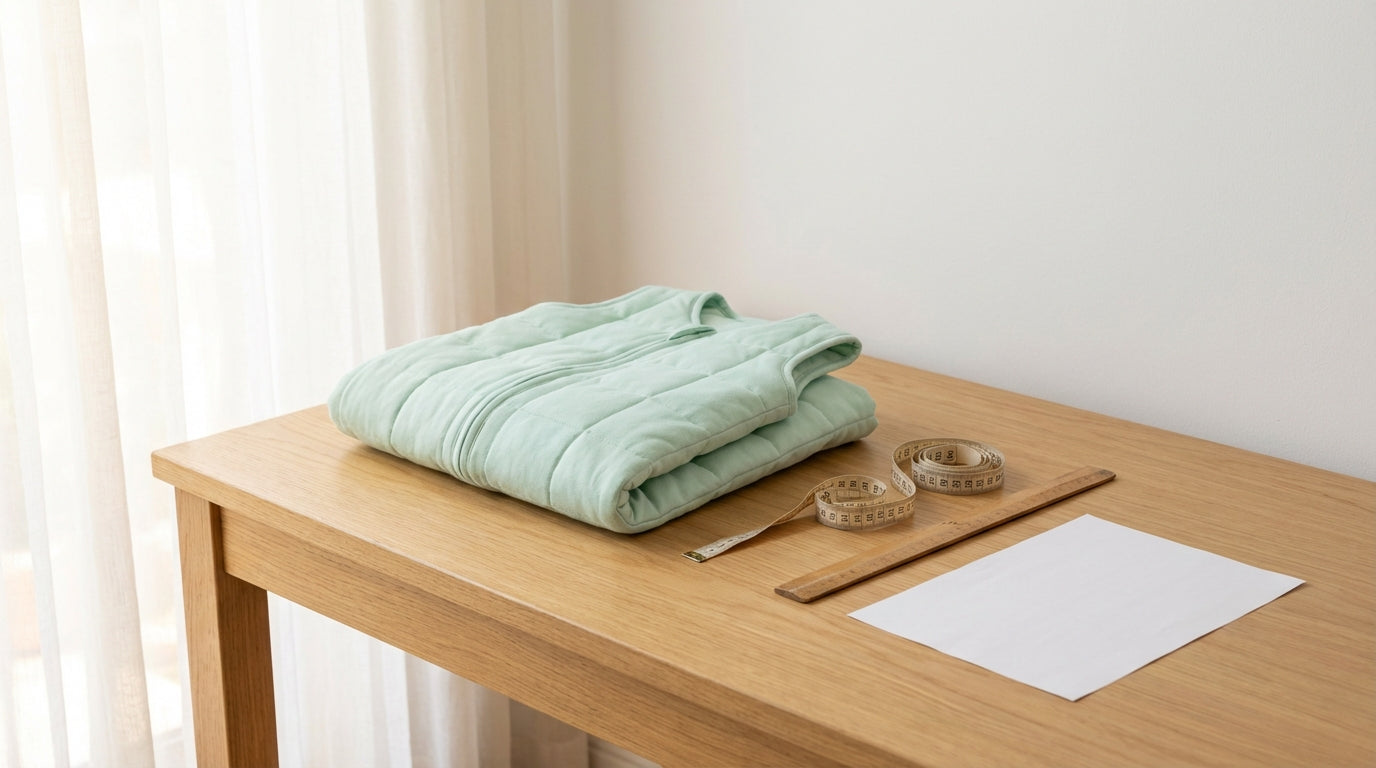
- Measure body length: crown of the head to heel.
- Roughly estimate head length: crown to chin (a ballpark figure is fine).
- Calculate: body length – head length + approx. 10 cm.
The idea behind it: secure at the top, room to kick at the bottom. According to mags.nrw, exactly this allowance is given as a guideline, and it is stressed that sleeping bags should not be too big so that babies cannot slip down inside (mags.nrw).
Practical tip: Measure in the evening while your child is in pyjamas. Then you’ll see right away whether it “pulls” at the shoulders/neck or whether there’s still some room.
A baby sleeping bag is a wearable blanket, so no loose blankets are needed in the cot. It fits snugly around the upper body and leaves freedom of movement at the bottom so that kicking stays possible.
Chart: sleeping bag sizes by body length (age only as a rough guide)
A chart helps you get oriented – in the end, body length decides. Because children don’t grow by the calendar, matching by centimetres is usually more accurate than going “by age”.

| Sleeping bag size | Suitable for body length (approx.) | Age (rough guide) |
|---|---|---|
| 60 | 58–68 cm | 2–6 months |
| 70 | 68–74 cm | 6–9 months |
| 80 | 74–86 cm | 9–18 months |
| 90 | 86–98 cm | 18–36 months |
| 100 | 98–104 cm | 3–4 years |
| 110 | 104–116 cm | 4–6 years |
| 120 | 116–128 cm | 6–8 years |
| 130 | 128–145 cm | from approx. 8 years |
Important: age really is only a rough compass here. Two children who are “18 months old” can easily be 10 cm apart in height – and with a sleeping bag you notice that immediately.
Why “one size up” is rarely a smart move with sleeping bags
A sleeping bag that is too big can be risky because children can slip down inside it. This is exactly what is warned about: if the sleeping bag is too big, the baby can slip down into it (mags.nrw).
Safety note: Check the neck and armhole openings: the head must not fit through the neck opening. According to LGL Bayern, the sleeping bag should not be too big and the neck opening should not be larger than the head circumference (LGL Bayern).
As we say up north: “They’ll grow into it” is fine for rain boots – not for sleep. If you want to save, save your nerves instead: buy the right fit, measure regularly, done.
Fit checklist: how to see right away whether it really fits
A well-fitting sleeping bag sits securely at the top and leaves room to kick at the bottom. Take a short moment for this check – it’s worth more than any chart debate.

- Neck opening: Fits so that the head cannot slip through (see the LGL Bayern note above).
- Armholes: Nothing cuts in, but they’re not so wide that your child “wanders out sideways”.
- Shoulder area: Lies flat without pulling, even when your child raises their arms.
- Length: There is freedom of movement at the bottom without the sleeping bag looking excessively “empty”.
- Zip/chin guard: Nothing chafes at the neck, and the chin guard sits properly.
If your child keeps “sliding down” while lying in it, that’s a warning sign. Then the sleeping bag is very likely too big or the neckline too wide.
Size 110: when does it fit – and how can you tell?
Size 110 is usually intended for a body length of about 104–116 cm. That is often nursery or kindergarten age – but what matters isn’t the candle on the birthday cake, it’s the centimetres on your child.
How to tell whether 110 fits
110 fits if the sleeping bag sits securely at the top and doesn’t feel tight at the bottom. In practice that means: neck and arms sit stably, your child can move their legs, and when you pull up on the sleeping bag, nothing slides towards the face.
Which size for a body length of 74 cm?
At 74 cm body length, you’re often at the transition between two sizes. First look at the secure fit at the neck and the freedom of movement at the bottom. If the larger size gets too wide at the neck, the smaller one is usually the better choice – and you simply measure again in a few weeks.
What to do if your child falls between two sizes?
Between two sizes, the neckline almost always decides. If it gets too wide at the top, go for the smaller size. If it gets too tight at the bottom (your child bumps against the end), go for the larger one – but only if neck and arms still sit securely.
Practical tip: Try the “lift test”: gently lift the sleeping bag at the shoulder area. If the head moves towards the neck opening: too big.
Newborns: which sleeping bag size at the start?
For newborns, small, well-fitting sleeping bags are important so that nothing slips. According to LGL Bayern, specialist retailers offer special newborn sleeping bags, and it is stressed that sleeping bags should not be too big (LGL Bayern).
Pay particular attention to a secure neckline and a smooth fit across the back. mags.nrw likewise describes that the neckline should be small enough that the head cannot slip through, but without being constricting (mags.nrw).
TOG, temperature & clothing: regulating warmth without size tricks
Your child stays warm through TOG, room temperature and clothing – not by “buying bigger”. According to the American Academy of Pediatrics, it is recommended to dress babies in layers rather than use blankets; “wearable blankets” can be an option if they fit properly and do not cover the head (AAP).
TOG is a value for the thermal performance of textiles during sleep. It helps you match the sleeping bag and sleepwear to the room temperature without “fiddling around” with extra blankets in the cot.
If you’d like to get the topic of temperature sorted once and for all, you’ll find our overviews here. Handy for browsing: Sleeping bag TOG & temperature and, in more detail, in the guide TOG value, temperature & season: how to choose the right sleeping bag.
Material & care: what changes how the size “feels” in everyday life
Material and cut can feel tighter or looser even though the length fits. A stiffer fabric or a very narrow cut quickly feels “too small”, especially if your child likes to roll onto their side or pull their knees up.
Cotton, muslin or blended fabrics differ mainly in feel and care. For everyday life, what counts is: pleasant on the skin, easy to wash, and not surprisingly “shorter than yesterday” after washing.
- Washing: Follow the care label so that shape and fit are maintained.
- Drying: If a sleeping bag feels tighter after washing, let it dry completely first and then check again.
- Fit after care: After a few washes, feel free to re-check the fit at the neck – children grow, fabrics work.
If you’d like to compare materials, we’ve collected them clearly in one place. Here is the overview of sleeping bag materials and the guide Sleeping bag materials compared: cotton, wool, muslin & more.
Sleeping bag with feet: does the size choice change?
With sleeping bags with feet, the basic logic stays the same, but leg length becomes more important. If children toddle through the living room in their sleeping bag in the morning (it happens, even with the “actually still sleepy” ones), the cuffs should fit well and nothing should pull when the knee goes up.
For children who are walking, a model with feet can be more relaxed in everyday life. If you’d like to take a look: Sleeping bag with feet and the guide Sleeping bag with feet: benefits, variants & what to look for.
A quick look behind the scenes (because trust helps at night, too)
We are a family business from Hamburg and have been making baby and children’s products for 66 years. Ulli & Flo write here as parents for parents – with the aim of being clear rather than polished when it comes to materials, testing and safety.

With sleeping bags especially, transparency matters more than “sounds good”. If something fits awkwardly or doesn’t prove itself in everyday life, parents notice at 3:17 a.m. at the latest – and then only honest, simple guidance helps.
FAQ about sleeping bag size
Which sleeping bag size is the right one?
The right sleeping bag size depends on your child’s body length. The tried-and-tested rule of thumb: body length minus head length plus approx. 10 cm. In addition, the sleeping bag should not be too big so that your child cannot slip down inside it; mags.nrw explicitly points this out (mags.nrw).
Which size for 74 cm?
At 74 cm, your child is often right on the edge between sizes. Use the chart as a starting point and then decide by fit: if the neckline in the larger size is too wide, take the smaller one. If your child bumps against the bottom, the larger one may fit – but only with a secure fit at the top.
What should I do if my child is between two sizes?
Between two sizes, “secure at the top” matters more than “extra room at the bottom”. Choose the smaller size if the neckline would otherwise be too wide. Choose the larger one if it is visibly tight at the bottom and your child cannot kick freely – but then check the neck and arms especially carefully.
What does size 110 mean for a sleeping bag?
Size 110 is a length measurement based on body length. In many charts it covers roughly a body length of 104–116 cm. What remains decisive is a secure fit at the neck and arms and enough freedom of movement at the bottom – age is only a rough hint.
Can I buy the sleeping bag bigger so it fits for longer?
Better not, because a sleeping bag that is too big can make it easier for your child to slip down inside. This very risk is named: if the sleeping bag is too big, the baby can slip down into it (mags.nrw). It’s better to buy the right fit and re-measure briefly during growth spurts.
Sleeping bag or blanket: which is safer?
Sleeping bags are considered safer than blankets because they don’t shift like loose duvets. According to LGL Bayern, baby sleeping bags are safer than blankets; when it’s cold, you should dress your child more warmly rather than use a blanket (LGL Bayern).
Finally, nice and relaxed: measuring beats guessing – and a good fit means more peaceful sleep. If you’d like to look at sleeping bags in different lengths, you’ll find the overview here: Sleeping bag and sorted by length here: Sleeping bag sizes.