Sleeping Bag with Feet: When It Makes Sense & What to Look For
At a glance
- A sleeping bag with feet helps if your child gets up at night or moves around a lot.
- Most important check: the neck opening must fit well – too big is not a good idea.
- Winter or summer? The room temperature decides, not the calendar.
- Anti-slip soles on the feet make nighttime pitter-patter much more relaxed.
- Care & fabric matter: soft, breathable and easy to wash for everyday life.

A sleeping bag with feet makes sense if your child gets up at night or “wanders” a lot in their sleep. You get the freedom of movement of pajamas – but without a loose blanket that ends up somewhere it shouldn’t (like over the face, if you’re unlucky). In this guide you’ll find a practical decision aid: when it’s worth it, which types exist (summer, winter, with sleeves, wool), how to judge size and warmth, and what to look out for when it comes to safety and care. As we say up in northern Germany: better to take a proper look once than to argue at three in the morning.

Ulli & Flo
Owners of bieco · Hamburg · parents themselves
We’ve had our own nights when our child went wandering in their sleeping bag. With a few checks on fit, warmth and non-slip feet, it gets much more relaxed. Feel free to browse our Sleeping Bag collection.
What is a sleeping bag with feet – and who is it for?
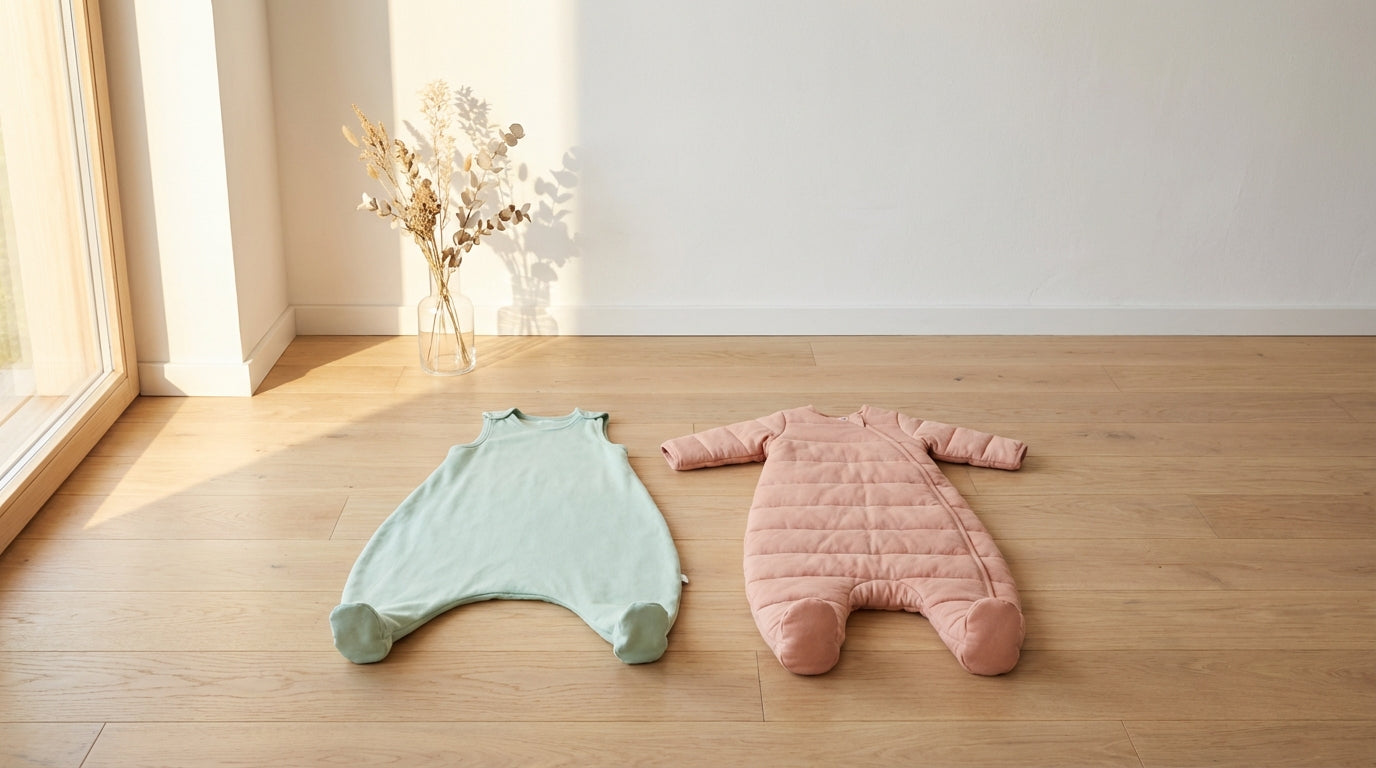
A sleeping bag with feet has two leg openings instead of a closed foot section. This lets your child stand and walk in the sleeping bag without pushing the fabric up like a sausage casing.
A baby sleeping bag is a wearable blanket and replaces loose blankets in the crib. That’s exactly why many families use sleeping bags: according to Stiftung Warentest, a blanket can slip over the head; what matters is that a sleeping bag fits properly and the head cannot slip through the neck opening (Stiftung Warentest, test.de).
For very small babies, a classic baby sleeping bag is often the calmer choice. If your baby isn’t very mobile yet, “with feet” doesn’t automatically bring benefits – the fit at the neck and a simple design usually matter more. It often gets interesting when children turn a lot, crawl or already pull themselves up: then a model with feet can make everyday life noticeably easier.
Sleeping bag with feet: When does it make sense?
A sleeping bag with feet usually makes sense when your child wants to get up while wearing it. That can happen at night (getting water, rescuing a cuddly toy, checking on the parents) or in the morning, when your child is already awake and you’re still negotiating for “five more minutes”.

The switch depends less on age than on your child’s motor skills. Some are on the move early, others lie like a stone. If you notice that the classic sleeping bag rides up, the legs get cold or your child trips over the bag when getting up – that’s a pretty clear sign.
Practical tip: If your child often needs to get out at night: put a small, safe step next to the bed and keep the path clear (no toy landmines).
For floor beds, family beds and daycare naps, “with feet” can be especially practical. These are typical situations parents (and daycare teachers) often mention: the child gets up, sits down, changes spots – and should stay warm without a blanket slipping off.
What are the everyday benefits of a sleeping bag with feet?
The biggest benefit is freedom of movement without your child getting cold. With a classic sleeping bag: child stands up, fabric slips, legs get cold – and you get to play temperature police at night.
- Less tripping when getting up. Two legs are simply better than a sack when little feet set off half asleep.
- More independence. Many children get out of bed on their own in the morning, without you first having to “free them from the sleeping bag”.
- Practical for transitions. From story time to sleep, from bed to your arms, from the nursery to the parents’ room – it often goes more smoothly.
One possible downside: feet can get cold more quickly. Depending on the cut, the leg openings are more open than a closed foot section. Snug cuffs, socks or a model with a foot section or fold-over feet (if available) can help. And yes: some children take their socks off at night as if it were their job.
Sleeping bag with feet: What to look for in size & fit?
The fit at the neck is the most important point for both safety and comfort. Too big is not “room to grow” – it can become a problem. Stiftung Warentest stresses that the head must not fit through the neck opening (Stiftung Warentest, test.de).

For models with feet, it also matters that the crotch and leg length don’t pull. Your child should be able to kick, squat and stand without the fabric pulling at the crotch. At the same time, the leg openings shouldn’t be so wide that there’s constantly a “draft”.
- Neck and armholes: snug, but not restrictive.
- Torso area: enough room to turn and pull the legs up.
- Leg cuffs: cuffs that fit well without cutting in.
If you’re torn between two sizes, the better neck fit wins. A few centimeters of extra length are usually fine – a neck opening that’s too wide is not.
For a size chart, our guide is a quick point of orientation. Here you’ll find a practical overview: Sleeping Bag Sizes: Chart, Age & Tips for Choosing.
Sleeping bag with feet, winter vs. summer: What really matters?
Whether it’s winter or summer is decided by the room temperature – not the month on the calendar. Old building, attic room, north-facing bedroom: you know how it is. “Summer” can have cool nights, and “winter” can sometimes be surprisingly mild.

TOG is a guideline for the warmth of sleep textiles. TOG stands for “Thermal Overall Grade”: a lower TOG means lighter, a higher TOG means warmer. It’s not a magic number, but a useful point of reference (explained e.g. at Love to Dream).
Follow the manufacturer’s guidance and choose the clothing underneath accordingly. If you want to work your way through temperature, layers and TOG properly: TOG Rating, Temperature & Season: How to Choose the Right Sleeping Bag.
Safety note: Avoid weighted sleep products ("weighted"). The US Consumer Product Safety Commission (CPSC) warns against weighted infant sleep products (cpsc.gov).
A winter sleeping bag with feet doesn’t have to be “as thick as possible”, just right. Tightly woven fabrics, clean cuffs and a sensible combination underneath often matter more than sheer thickness. Overheating is just as unpleasant as being cold – you just sometimes notice it later at night.
A summer sleeping bag with feet should be airy and easy to layer. Many families do well with “rather one layer less, easy to adjust quickly”. And if you do need to add something at night: better a thin extra bodysuit than a sleeping bag that’s too warm.
Sleeping bag with feet and sleeves: useful or a bit “too much”?
Sleeves make sense if the room is cool and your child gets cold quickly. Especially in between seasons this can be pleasant – above all if your child consistently kicks off blankets (they do have a talent for it).
The more fabric, the more important it is to look at the actual room temperature. Sleeves increase warmth, and then it can get too warm more quickly – especially if a thick pair of pajamas is already underneath.
Standards provide guardrails, but they don’t replace your own fit check. DIN EN 16781 describes safety requirements for children’s sleeping bags, including construction and risks such as overheating (DIN Media).
If your child finds sleeves “silly” at night, save yourself the fight. Some sleep wonderfully with them, others tug and grumble. In that case, go without sleeves and dress them appropriately underneath – that’s often the more peaceful solution.
Our feature guide gives you an overview of the variants. Here you’ll find the differences between sleeves, legs and other forms: Special Sleeping Bag Features: With Sleeves, Legs, Swaddle & More.
Materials & care: cotton, wool & what really counts in everyday life
The best material is the one your child sleeps peacefully in – without sweating or freezing. It sounds simple, but that’s exactly the point: some children are little radiators, others have ice-cold feet at night.
Wool is often described as temperature-regulating, but it isn’t comfortable for every child. Some love it, others find it scratchy or “weird”. If you’d like a material comparison: Sleeping Bag Materials Compared: Cotton, Wool, Muslin & More.
For many families, cotton is the uncomplicated all-rounder, including in the wash. In real life it’s not just about “feels lovely”, but also: how quickly is it ready to use again if something leaks at night or your child sweats?
Care tip: follow the care label and protect the zippers when washing. Closing the zipper, turning the bag inside out and washing it in a laundry bag if possible can help prevent anything from snagging. (And yes: that’s the difference between “lasts forever” and “used to be nice”.)
Practical tip: Do the “neck check”: warm & dry is usually right. Sweaty = probably too warm, cool = probably too cold. Hands and feet are often not a good gauge.
Safety & checklist: What to check before using it
A safe sleeping bag fits properly at the neck and has no loose parts. That’s the core – and at three in the morning, “safe” suddenly feels pretty reassuring.

- Neck opening: the head must not fit through (Stiftung Warentest, test.de).
- Sleep environment: no soft objects or loose bedding in the baby’s sleep area; this is recommended by the American Academy of Pediatrics (AAP).
- Zipper: cleanly finished, with a chin guard, nothing that scratches.
- No loose appliqués: everything firmly sewn on, nothing dangling.
- Anti-slip soles: if your child walks in it, anti-slip sole surfaces are helpful.
Safety note: If your child walks around in the sleeping bag, keep the floor clear and use anti-slip feet or suitable socks – tripping happens faster than you can say “careful”.
If you’re looking for a compact checklist, you’ll find it here. Our guide helps you go through the basics: Safe Baby Sleep: Checklist for the Right Baby Sleeping Bag.
Why we look so closely at sleeping bags (brief & honest)
We’re a family business from Hamburg and have been doing this for 66 years. And because Ulli & Flo write here as parents for parents, our standards are quite down-to-earth: workmanship, clear and understandable information, and no gimmicks that cause stress at night.
Transparency matters more to us than “it’ll be fine”. When it comes to children’s sleep, it helps to take standards and manufacturer guidance seriously – and then still use common sense: does the neck fit, is anything scratchy, is it not too warm, can your child stand safely?
Which type fits: baby, toddler, children’s sleeping bag with feet?
For babies, calm, safe lying down comes first. A baby sleeping bag with feet can work if it really fits well and your baby is already very mobile – but many families start with a classic baby sleeping bag and switch later, when getting up and climbing become a thing.
For toddlers, “with feet” is often the best compromise between warm and mobile. Typical situations: frequent getting up at night, a floor bed, toddling into the living room alone in the morning. Here the sleeping bag with feet is often less of a tripping hazard and means fewer “ice-cold legs”.
For older children, it quickly becomes a cozy alternative to a blanket. If blankets get kicked off or children sleep in a floor bed, a children’s sleeping bag with feet can be a snug solution – especially in between seasons.
Where to find sleeping bag topics at bieco
For a quick overview, the sleeping bag page is the best place to start. Here you’ll find the category: Sleeping Bag.
If you’re specifically looking for models with legs, the matching collection helps. Here’s the category: Sleeping Bag with Feet.
FAQ
From what age a sleeping bag with feet?
A sleeping bag with feet is usually right when your child stands up in their sleeping bag. Then standing and walking get easier and the legs tend to stay warm. For very small babies, it’s often more important that the neck and armholes fit perfectly and nothing slips.
Sleeping with socks – yes or no?
Socks are fine if your child would otherwise get cold feet and can walk safely. Make sure they fit well (not constricting) and, if possible, choose anti-slip socks if your child gets up at night. If socks regularly disappear overnight: cuffs on the sleeping bag and a suitable room temperature are often the less stressful adjustment.
What should my child wear underneath at 18/20/22 °C?
The best combination depends on the sleeping bag (warmth rating) and on your child. Use the manufacturer’s guidance as a base and feel your way forward in small steps. The neck check helps: warm & dry is usually right, sweaty means too warm. Hands and feet often feel cooler even though everything is fine.
Slip risk: Is a sleeping bag with feet safe for walking?
It can be safe if the feet are anti-slip and the path is clear. Remove tripping hazards and look for a cut that doesn’t pull at the crotch when walking. If your child walks around a lot, anti-slip soles or suitable anti-slip socks are often decisive in everyday life.
What to do if my child takes their socks off at night?
That’s completely normal – and you need a plan B. Many parents rely on snug cuffs, a slightly warmer sleeping bag variant or anti-slip foot areas that work without socks. Also check the room temperature: sometimes socks are just a symptom of “generally too cool”.
Winter sleeping bag with feet or a regular winter sleeping bag?
The difference is less “warmer” and more “more mobile”. If your child lies still, a regular winter sleeping bag is often enough. If they get up at night, a winter sleeping bag with feet is more practical. In both cases: the neck opening must fit and there should be no loose blanket (Stiftung Warentest, test.de).
Summer sleeping bag with feet: What to look for?
Lightness, breathability and the right layering underneath are what matter. The room temperature is decisive. TOG is a guideline for warmth (lower = lighter, higher = warmer). It’s better to adjust flexibly with layers than to “power through” in a sleeping bag that’s too warm (TOG explained e.g. at Love to Dream).
Conclusion: The most important point in one sentence
A sleeping bag with feet is an everyday helper for mobile sleepers, as long as fit and warmth are right. If you’d like an overview, take a look at the bieco category Sleeping Bag or go straight to Sleeping Bag with Feet – you’ll quickly see which variants suit your daily routine.