Sleeping Bag TOG: Choosing the Right Temperature (0.5–3.5 TOG Chart)
At a Glance
- Your sleeping bag tog choice depends on the room temperature, not on the month.
- As a rough guideline, 16–20 °C is recommended for the sleeping room (according to NHS/Healthier Together).
- 0.5 / 1.0 / 2.5 / 3.5 TOG are the common levels – what your baby wears underneath does the fine-tuning.
- The quickest check: feel the back of the neck – warm yes, sweaty no.
- Fit matters: a snug neckline so nothing can slip (according to NHS).

You choose the right TOG value based on the room temperature and adjust the rest with layers of clothing. That turns all the "summer/winter" talk into something quite practical: look at the thermometer, make a rough estimate, do the neck check, done. In this guide you'll find a TOG chart, example combinations for 0.5/1.0/2.5/3.5 TOG and a few tricks that still work at three in the morning.

Ulli & Flo
Owners of bieco · Hamburg · parents themselves
What we've learned: when you go by degrees instead of by season, TOG suddenly becomes wonderfully relaxed. And the neck check is our best friend at night. Feel free to browse our Sleeping Bag collection.
Seasons only matter indirectly, because they often change the room temperature. Old building, new building, attic room, underfloor heating – these make more of a difference than the calendar. So from now on, let's talk about degrees, layers and fit instead.
TOG Value for Sleeping Bags: What Does It Actually Mean?
The TOG value shows how much heat a textile retains: higher = warmer. TOG is a unit of thermal resistance and helps you match the sleeping bag and clothing to the surroundings without guessing.

A baby sleeping bag is a wearable blanket that can't slip out of place. In everyday life this is especially handy because your child can't slide under a blanket or kick it off.
Room temperature means: the temperature at the sleeping spot at mattress level. It can be cosy by the radiator, yet still fresh at the bed next to it (or the other way around).
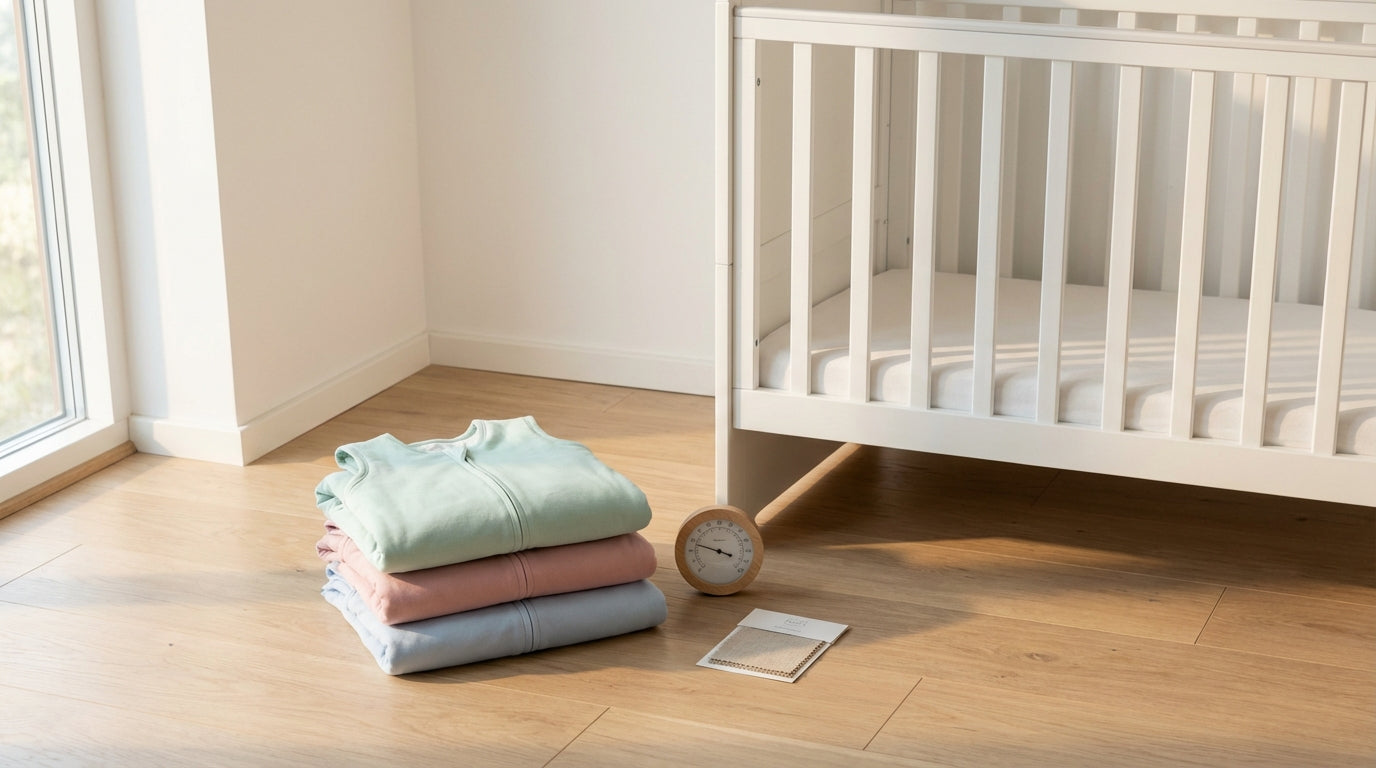
Practical tip: Put a small thermometer at mattress level (out of reach) – then you don't have to "feel and hope".
Which Room Temperature Makes Sense at Night?
As a rough guideline, 16–20 °C is recommended for the sleeping room. According to NHS/Healthier Together, the recommended bedroom temperature for babies is 16–20 °C (Source).
Too warm is usually the bigger problem than a little cool. If it gets noticeably warmer, it often makes more sense to reduce TOG and layers instead of adding something "just to be safe" (advice on avoiding overheating can also be found at NHS/Healthier Together: Source).
Sleeping Bag TOG Chart: 0.5 / 1.0 / 2.5 / 3.5 TOG by Temperature
A TOG chart is a guide; the neck check is the decision. The breakdown below uses the common TOG levels (0.5/1.0/2.5/3.5) and sorts them by room temperature – much as many manufacturer guides present them.

| Room temperature at the bed | TOG range (guideline) | Typical classification |
|---|---|---|
| > 24 °C | 0.5 TOG | very warm / midsummer |
| 21–24 °C | 1.0 TOG | warm / summer |
| 18–21 °C | 1.0–2.5 TOG | mild / in-between seasons |
| 16–18 °C | 2.5–3.5 TOG | cool / autumn-winter |
| < 16 °C | 3.5 TOG | very cool |
Method in brief: we start with the temperature and then choose the TOG level. After that, you fine-tune with a bodysuit or pyjamas, because babies sleep at different warmth levels and rooms can fluctuate at night.
What Do You Put On Under the Sleeping Bag? The Layering Rule
Under the sleeping bag, the rule is: layer flexibly rather than forcing "one thick solution". That way you can start off right in the evening and react quickly during the night if needed, without opening the whole pyjama circus.

- Very warm (> 24 °C, often 0.5 TOG): often a short-sleeved bodysuit; depending on your child, less may be enough.
- Warm (21–24 °C, often 1.0 TOG): short-sleeved bodysuit or thin pyjamas.
- Mild (18–21 °C, 1.0–2.5 TOG): short- or long-sleeved bodysuit; depending on the TOG level, possibly thin pyjamas.
- Cool (16–18 °C, 2.5–3.5 TOG): rather a long-sleeved bodysuit, possibly pyjamas.
Safety note: Make sure the size is right and the neckline fits snugly, so your little one's head can't slip into the sleeping bag (according to NHS: Source).
The neck check is the simplest way to check without doing any maths. Feel the back of the neck: pleasantly warm = just right. Sweaty/hot = remove a layer. Cool = add a layer. As a guide for checking temperature, the neck or chest is often recommended (e.g. NCT: Source).
Which TOG at 20 Degrees? (And Similar "Classics")
At 20 °C, many families land in the 1.0 to 2.5 TOG range – depending on the child and clothing. If your baby tends to sleep warm or the room gets warmer at night, 1.0 TOG plus suitable clothing is often comfortable. If it stays rather fresh or your child cools down quickly, 2.5 TOG may be the right fit.
At 18 °C, 2.5 TOG is often used as a starting point. It's a typical "transition value", because you can easily correct up or down with a bodysuit/pyjamas.
At 22 °C, 1.0 TOG is often a relaxed baseline. And as it heads towards 24 °C, things usually get airier: fewer layers, a lighter sleeping bag.
Summer: When the Bedroom Doesn't Cool Down
In summer, the most common mistake is starting too warm in the evening "because it gets cooler at night anyway". But if the room in the attic stays at 24–26 °C, the lighter option (often 0.5 TOG) is usually the less stressful choice.
What helps in practice: less "plan" and more preparation. Lay out two bodysuits (short/long) and decide based on the thermometer and the neck check. That saves rummaging through the wardrobe and muttering in a half-sleep at night.
Practical tip: When it's very warm: lay out the sleeping bag and bodysuit in the bedroom before bedtime – then everything is "room temperature".
Winter: Keeping Warm Without Overdoing It
In winter, it's about even warmth, not wrapping up like a parcel. At 16–18 °C, many people end up with 2.5 TOG or (in very cool rooms) 3.5 TOG – and adjust the rest with the clothing underneath.
Hands and feet may often feel cooler without anything being "wrong". More telling are the neck/chest and whether your child sleeps peacefully or seems restless.
Material & Care: So Your Sleeping Bag Stays "Good" for a Long Time
Material influences how warmth and moisture feel – not just the TOG value. A sleeping bag can feel different despite a similar TOG level, depending on how breathable the material is and how the lining is made.
Care matters most when you need to change things quickly at night. Check the washing instructions on the product: temperature, tumble dryer suitability and whether the sleeping bag keeps its shape well after washing. For an overview, you'll find calm info on materials and on the right size with us – those are the two things that save the most nerves in everyday life.
Why We at bieco Take Such a Down-to-Earth View of This Topic
We've been making baby and toy products for 66 years – and at night, what counts most is: simple, safe, doable. As a family business from Hamburg, we're more of a "relaxed northern German" team: we prefer clear guidance, honest material info and a fit that works in real life.
For us, safety transparency means: not sugar-coating anything, but explaining it properly. TOG is helpful, but it doesn't replace looking at your child (neck check) and the right size, so that nothing slips at the neckline.
How to Find Your Perfect Sleeping Bag in 5 Steps
- Measure the room temperature: a thermometer at the sleeping spot instead of gut feeling.
- Choose the TOG roughly: start with the chart (0.5/1.0/2.5/3.5 TOG).
- Decide on layers: bodysuit/pyjamas to match the temperature.
- Check the fit: neck and armholes must fit snugly (NHS: Source).
- Neck check after 10–15 minutes: by then your child has "settled in" and you can fine-tune.
FAQ
What does sleeping bag TOG actually mean?
TOG is a warmth rating that shows how warm a sleeping bag keeps your baby. The higher the TOG value, the more heat stays inside the sleeping bag. You use TOG to match the sleeping bag and clothing to the room temperature – and then use the neck check to see whether it really fits.
Which TOG at 20 degrees in the bedroom?
At 20 °C, 1.0 to 2.5 TOG often fits – depending on the child and clothing. If your baby tends to sleep warm, start lighter and dress them appropriately underneath. If they cool down quickly or the room gets colder at night, 2.5 TOG can make sense. The neck check remains decisive.
What do you put on under 2.5 TOG?
Under 2.5 TOG, a bodysuit (short or long) is often used, depending on the room temperature. On milder nights a bodysuit is often enough; on cooler ones, thin pyjamas are added. Take this as a starting point and check the neck after your child has fallen asleep to see whether there's one layer too many or too few.
Which room temperature is recommended for babies at night?
A range of 16–20 °C is often cited. According to NHS/Healthier Together, this range serves as a guideline for a safe sleeping environment (Source). If it's warmer, it's better to reduce the TOG and clothing instead of adding something more.
How can I tell if my baby is too warm?
A sweaty neck or a very hot torso are signs: better to take off a layer. Hands and feet, on the other hand, may often feel cooler without your baby being cold. As a simple check, feeling the neck or chest is often recommended (e.g. NCT: Source).
All-year sleeping bag or separate summer and winter sleeping bags?
An all-year model is practical if your room temperature stays fairly stable at night. But if you have big fluctuations (attic room in summer, cool bedroom in winter), two TOG strengths are often more relaxed. Then you have to improvise less and can dress your child appropriately faster.
Finally: keep it easy – measure the temperature, choose the TOG roughly, feel the neck. If you'd like to look around afterwards: in our Sleeping Bag overview you'll find everything in one place, and under TOG & Temperature the topic is sorted by warmth level. For children who like to go "wandering" at night, a sleeping bag with feet is often a practical solution.