Toddler Cutlery from 1 Year: When Spoon, Fork & Knife Make Sense
At a glance
- Toddler cutlery from 1 year often fits when your child actively wants to feed themselves.
- Starting with the spoon is usually the most relaxed route – thick foods help.
- The fork joins in once “poking and hitting the target” works better.
- Metal vs. silicone is less a matter of belief and more of everyday life: handle, cleaning, feel.
- A mini plan (2 minutes per meal) gets you further than perfection.

Toddler cutlery from 1 year usually makes sense when your child wants to join in at mealtimes. It's best to start with a spoon, practise briefly and regularly, and add the fork once aiming and grasping become more reliable. In this guide you'll find everyday-friendly steps, good foods for practising, a quick age/skill overview and a few tricks against the daily “mealtime battle”.

Ulli & Flo
Owners of bieco · Hamburg · parents themselves
We remember it well: at the beginning, more porridge ends up on the child than in the child. With short practice rounds and the right foods, things get relaxed quickly. Feel free to browse our toddler cutlery collection.
Why “from 1 year” often fits well – and when earlier is possible
Age is only a signpost – your child's abilities are what count. According to the CDC, many babies start using a spoon on their own between about 10 and 12 months, and after around 12 months they often get better quickly with spoon, fork and cup.
Starting earlier is fine if sitting and interest are there. Some children badly want “a spoon like that too” before their first birthday, while others are still Team Finger Food at 14 months. Both are normal – and to be honest, sometimes it simply depends on how the day is going (yours and your child's).
Finger food is not a detour, but a useful stepping stone. According to the WHO, many babies can eat finger foods from around 8 months – that is, pieces they can pick up themselves and bring to their mouth.
How to tell if your child is ready (instead of staring at the calendar)
Ready means: grasping, bringing food to the mouth and sitting securely while doing so. Pay less attention to “it has to happen now” and more to these signals:

- Your child reaches for food on purpose (not just “hand in, hand out”).
- They bring things to their mouth in a controlled way (teething ring, piece of bread, spoon).
- They show interest in your cutlery (“Give me that!”).
- They sit steadily in the highchair (with suitable support).
- They can handle short moments of frustration without calling it a day right away.
Self-feeding means: the child brings food to their mouth independently. It often starts with fingers and later moves on to spoon and fork – the goal is coordination, not a hotel-style table setting.
Practical tip: Always put out two spoons: one for you to “reload”, one for your child to practise with. This saves arguments.
Quick overview: age/skill → what fits right now?
The best guide is a mix of age and ability. This table isn't a rulebook, more of a compass for tired days.

| Age/skill | What often works well | What makes it easier |
|---|---|---|
| approx. 8–10 months (finger food works) | Finger food, holding the spoon/“joining in” | Thick foods for dipping, small spoon for grasping |
| approx. 10–12 months (lots of interest) | First attempts at spooning on their own | Short practice rounds, bowls with a higher rim |
| from 12 months (aims better) | Spoon becomes more reliable, fork joins in | Very soft pieces for poking, little on the plate |
| from 18 months (more control) | Fork becomes more practical, spoon more routine | Rituals, the same routine each time, “you can try” |
| from approx. 2–3 years (depending on the child) | Child's knife for spreading/cutting soft foods | Soft foods, calm supervision, clear rules |
Toddler cutlery from 1 year: spoon or fork – which one do you start with?
Almost always start with the spoon – it is more forgiving than the fork. You can dip, push, make a mess and still, at some point, something ends up in the mouth. According to the CDC, the spoon is also typical for the first self-feeding attempts around 10–12 months.
Spoon: how to start relaxed
With the spoon, at the beginning it's about the “hit rate”, not technique. Let your child hold the spoon while you load it – or the other way round. Many children first turn the spoon like a key in a lock. Not pretty, but instructive.
Fork: typical stumbling blocks (and why they're normal)
At first, the fork is often more “prodding” than eating. Poking, holding, bringing it to the mouth – that's several small tasks at once. Offer very soft pieces that easily “stick”, and expect a learning curve. It will come. Just not always exactly today.
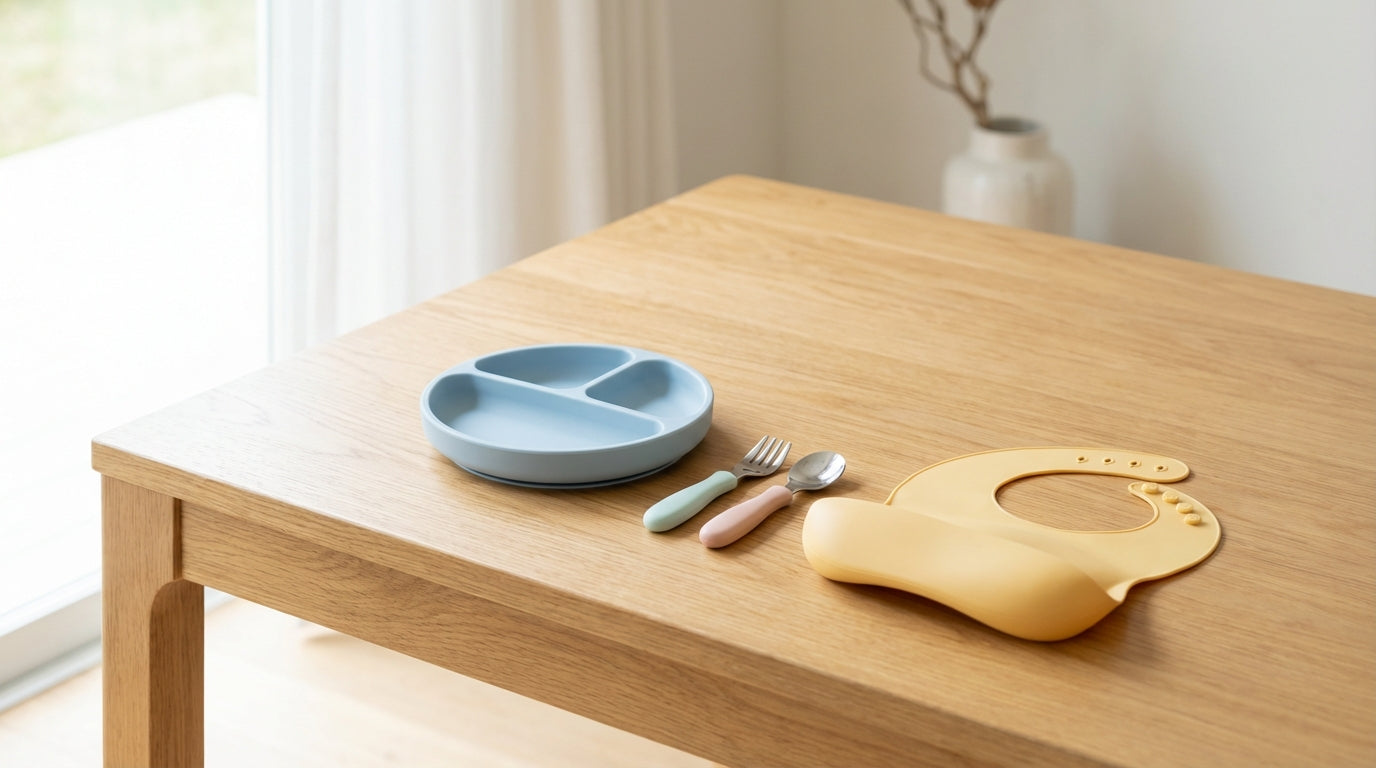
Toddler cutlery is scaled-down cutlery, shaped for small hands. It is usually shorter, easier to grip and rounded, so that grasping and guiding become easier.
Which foods help with practising? (Spoiler: nothing that runs away)
At the beginning, food that stays on the spoon and doesn't escape wins. With very runny foods, even the most patient person eventually goes quiet and stares into the distance. Better to start with:

- Thick yoghurt or quark (small portions)
- Oat porridge, semolina porridge, mashed potato
- Mashed banana, avocado, finely mashed vegetables
- For the fork: very soft pieces (well-cooked vegetables, soft pasta)
Foods for practising: how to make it less sticky
Small portions are half the battle – you can always add more. An overfull plate is like a storm at sea for little hands: more goes overboard than arrives. Better to start tiny, refill often, and collect the little successes.
Practical tip: Use a small, deeper bowl instead of a flat plate. It makes “spoon in, spoon out” much easier.
How to practise step by step (without re-wallpapering your kitchen)
The trick isn't “holding it correctly”, but practising briefly and regularly. Here's how to build it up in a relaxed way:
- Phase 1: Cutlery is part of the meal. Put out a spoon (and later a fork) too, even if you're still doing the feeding.
- Phase 2: Your child leads. You load the spoon, your child brings it to their mouth.
- Phase 3: Dipping/scooping on their own. Thick foods, bowls with a rim, small portions.
- Phase 4: Add the fork. First practise poking, then bringing it to the mouth.
Two minutes count too – this is not a competition. According to the NHS, when starting solid foods it's normal for babies to want to touch the food and feed themselves; they can also hold a spoon while you feed them.
Safety note: Never leave your child unattended while eating and make sure they sit securely in the highchair. Sitting calmly and being attentively accompanied matters more than any cutlery.
Material questions: metal vs. silicone – what really matters in everyday life?
More important than the material is that handle and shape suit your child. Metal feels “like the grown-ups'” and is often very robust, while silicone parts can feel softer and sometimes give small hands more grip. In the end, what counts is: how easy is it to grip, how easy is it to clean, and how much does your child like using it?
Cleaning & care: short, honest, practical
The easier the cleaning, the more often the cutlery will actually be used. Check whether grooves, transitions or soft materials can be cleaned properly. And if after dinner all you can manage is “dishwasher on, lights out”: you're not alone.
When things get stuck: typical problems (and small solutions)
Throwing, squishing, refusing – this is often learning, not defiance. A few classics from real kitchens:
- “My child throws the cutlery on the floor.” Put out only one piece and hand over the second later. And yes: a spare spoon within reach is gold.
- “It only works if I feed.” A mix is perfectly fine: a few spoonfuls on their own, a few with help.
- “The fork doesn't work at all.” Then it's simply still spoon time. Offer the fork again later, without drama.
- “Everything ends up in the bib.” Thicker foods, a smaller dish, less on the plate – that lowers the mess rate.
Mini checklist: starting toddler cutlery without stress
- Child sits securely and is accompanied during the meal
- Thick food + small bowl with a rim
- Put out two spoons (you + child)
- Only a little on the plate, refill often
- After 2–5 minutes, “practice” is already done
A word about us (because trust simply belongs with children's products)
We are a family business from Hamburg and have been doing this for 66 years. Ulli & Flo write here as parents for parents – and in the feedback we receive, the same questions come up again and again: “Does it sit well in the hand?”, “Is it easy to clean?”, “Is it safely made?” That's exactly why we prefer to talk openly about materials, workmanship and testing, rather than pretending it doesn't matter.

If you want to dive deeper into materials and age recommendations, a comparison helps. Our overview is a good fit: Toddler cutlery compared: materials, age recommendations & tips.
FAQ
Is toddler cutlery from 1 year a must?
No, nothing is a must here – it's more of a good time to try things out. Many children become more confident in their motor skills around their first birthday and want to feed themselves. If your child prefers finger food, that's also normal and can support hand coordination well.
Toddler cutlery from 12 months: does the child already have to eat “properly”?
No, “properly” comes later – at the beginning, joining in is enough. Many children first hold the spoon, turn it, dip, make a mess and occasionally hit the target by chance. That isn't a step backwards, it's practice. Short, regular attempts are usually more helpful than long meals with lots of pressure.
When can a child use a spoon on their own?
Many children start with first attempts around 10–12 months. According to the CDC, babies can begin to use a spoon on their own at this age; after 12 months they often improve quickly. Thick foods make getting started easier.
When can a child use a fork – and what's the best way to practise?
A fork is worth introducing when your child can poke more precisely and bring food to their mouth. For many children this works increasingly well after the first birthday, but it can also come later. Start with very soft pieces (e.g. soft vegetables or pasta) and expect “prodding” as an intermediate stage.
Metal vs. silicone: which is better for beginners?
Better is whatever your child can grip securely and you can clean easily. Metal is often very robust and feels “like the grown-ups'”, while silicone parts can feel softer and sometimes give more grip. Look for rounded shapes, a grippy handle and easy cleaning – that's what makes the difference in everyday life.
When can a child use a knife – and what is realistic at the beginning?
A child's knife usually only makes sense once your child eats more calmly and with more control. At the beginning it's more about spreading or cutting soft foods with supervision. Important: always stay with them, increase gradually, and rather “hold back too long” than “leave them alone too early”.
If you'd like to tackle the topic in a practical way now: a clear collection helps with browsing. You'll find it in the shop under toddler cutlery – and if you'd like to dive even deeper into materials, our guide Toddler cutlery compared: materials, age recommendations & tips is a good fit too.