Personalized Wooden Train: DIY Ideas & Safety for a Newborn Gift
At a glance
- A personalized wooden train with a name and date becomes a keepsake.
- Engraving or wood burning lasts the longest, while stickers are more of a “for now” option.
- For play, what counts are smooth edges, firmly attached parts and clear age recommendations.
- DIY works in a relaxed 30–60 minutes with good preparation.
- Wrapping ideas: simple, pretty, and no small parts attached to the toy.
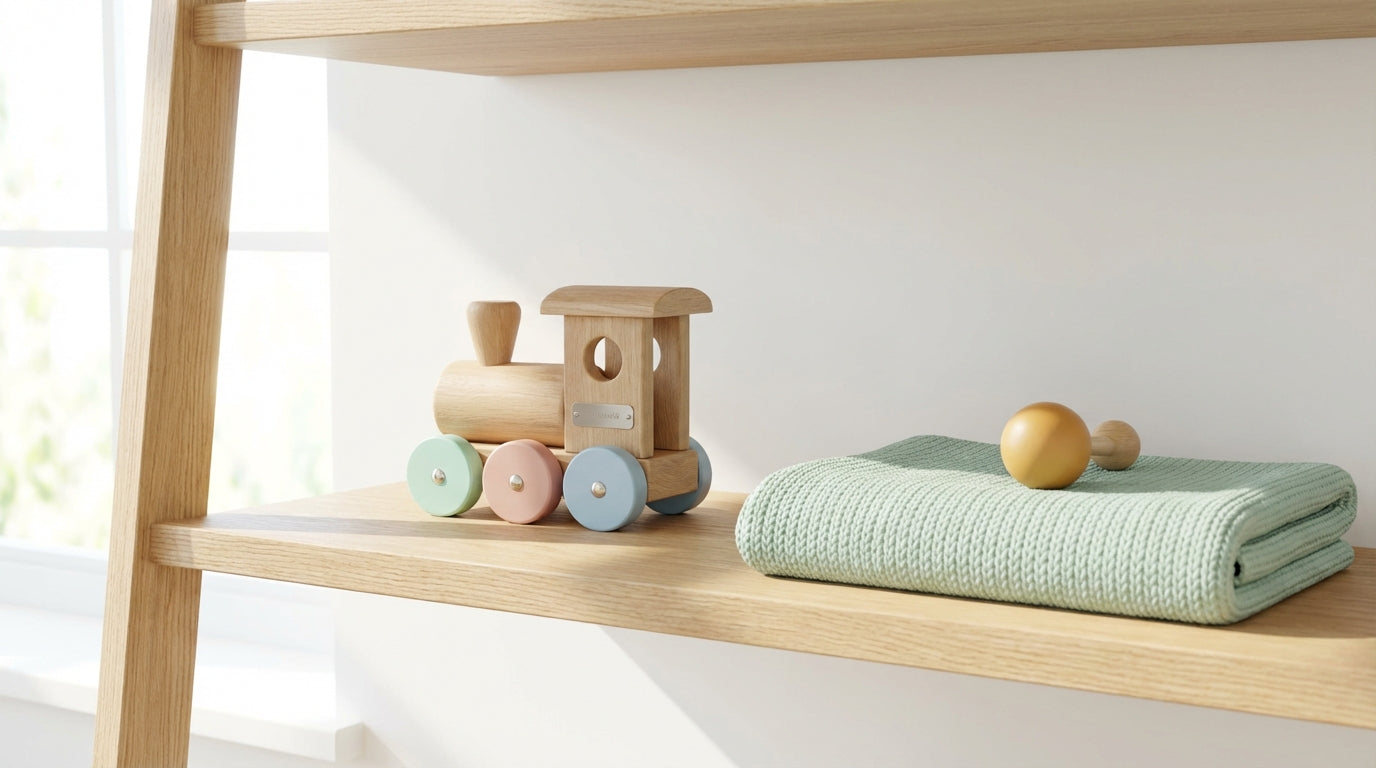
Personalizing a wooden train simply means: add the name, stay safe, done. You turn a lovely wooden toy into a newborn gift with heart, without it looking like a craft contest entry. Here you'll find ideas (engraving, wood burning, stickers), a calm step-by-step guide and a safety check that works even on tired-parent days. And yes: if your baby only looks and drools for now, “decoration now, playing later” is perfectly okay.

Ulli & Flo
Owners of bieco · Hamburg · parents themselves
We love gifts that first warm hearts and later get played with for real. With a few calm steps, a wooden train with a name becomes exactly that kind of companion. Feel free to browse our wooden railway collection.
How can you personalize a wooden train?
The best personalization is one that won't peel off or come loose. You basically have four options: engraving (permanent), wood burning (permanent, but hand-done), paint pen/marker (medium, depending on sealing) and stickers/tags (flexible, but not indestructible). It makes a difference whether you're planning a personalized wooden railway for playing or a wooden train with a name for the shelf.
An engraving is an indentation in the wood that stays legible permanently. It doesn't add any thickness, doesn't peel off and usually looks the “calmest.”
Wood burning is lettering that is burned into the wood with heat. It's sturdy, but only as clean as your hand is steady at that moment (and mine, after three nights of nursing marathons, was… let's say creative).
1) Engraving (laser or router): the “do it once, then forget it” option
Engraving is usually the most durable solution for a wooden train with a name. You can get it done at purchase (if offered) or afterwards at local laser engraving or sign shops. Smooth side surfaces on the locomotive or wagon work best, where hands won't constantly rub over them later.
- Name: short often looks more elegant and stays easy to read.
- Date: DD.MM.YYYY or just month/year if you prefer it simpler.
- Symbol: a star, heart or anchor instead of long sayings (they suit wood better).
Practical tip: Choose a clear font without flourishes. It stays legible even when small – and still looks good years later.
2) Wood burning: charming, but please use a test piece
Wood burning looks handmade, but it takes calm and practice. A simple wood-burning pen is enough, but please test on scrap wood first. Curves get crooked quickly, and with names, “crooked” is somehow a little unkind. If you're unsure: burn just a small symbol and have the name engraved.
- Sketch lightly with a pencil (gently, not deep).
- Trace slowly without pressure – the burner does the work.
- Carefully erase leftover pencil marks once everything has cooled down.
Safety note: Only do wood burning with no child nearby, on a heat-resistant surface and with breaks. The tool gets very hot and stays hot for a long time.
3) Stickers, vinyl or name tags: pretty, but more of a “for now” option
Stickers are quick and lovely, but they don't always last forever during play. Edges can come loose, especially if the train is handled often or needs to be wiped down damp. Name tags (e.g. on the gift ribbon) are a nice alternative – just please don't leave them permanently attached to the toy if small parts are a concern.
- Vinyl stickers: great looking, but the edges are the weak spot.
- Removable tags: good for packaging and photos.
- Fabric ribbon + label: feels “giftlike,” should come off later.
4) Paint pen or marker: quick, but please have a plan
A marker is the quick solution, but without a protective layer it often fades. If you want to seal it, only use products that are explicitly suitable for children's toys and follow the manufacturer's instructions. And if you're not sure: write on a spot that isn't constantly rubbed (e.g. on top of the wagon rather than on the side).
What information belongs on a personalized wooden train?
Less is often prettier – and stays more legible. A name on wood looks best when it has room. Two elements almost always do the job; everything else can go on the card.

- Name (with the correct spelling – really, better to ask)
- Birth date (if it's definitely settled)
- Short greeting (max. 3–5 words, otherwise it gets busy)
- Symbol (if you want something “extra” without stacking up text)
Practical tip: If you don't have the length, weight and time of birth one hundred percent right: leave them out. The card can do that better, and you'll sleep more soundly.
Engraving vs. wood burning: which is better?
Engraving is precise and even, wood burning is handmade and individual. For a newborn gift, many people choose engraving because it looks clean and leaves little room for error. Wood burning is wonderful if you enjoy crafting and have time – or if you only want to burn in a small symbol.

| Option | Advantages | What to look out for |
|---|---|---|
| Engraving | Very durable, clean, no detachable parts | Choose a smooth surface, don't make the lettering too small |
| Wood burning | Handmade, warm, sturdy | Definitely practice, avoid curved surfaces |
| Stickers/vinyl | Quick, inexpensive, replaceable | Edges can come loose, not “forever” |
| Marker | Very uncomplicated | Can rub off, only use suitable products |
What should you look out for regarding safety and materials?
A wooden train is only a good gift if it suits the child's age group. Personalization must not make safety worse – so no loose parts, no sharp edges, no coatings without clear information. And yes: that sounds strict, but it's really just “take a quick look, then gift with peace of mind.”

The Toy Safety Directive 2009/48/EC sets EU requirements for toys. According to the BMUKN (German Federal Ministry for the Environment), it applies to toys in the EU and covers, among other things, technical and chemical safety requirements. (BMUKN: Safe toys)
The CE mark shows that the manufacturer declares compliance with EU toy requirements. According to the Verbraucherportal Bayern (Bavarian consumer portal), toys in Europe must bear the CE marking and carry certain manufacturer information. (Verbraucherportal Bayern: Legal requirements for toys)
EN 71 is a series of standards describing toy safety tests. You can find a compact overview of EN 71 and test marks at TÜV SÜD, for example. (TÜV SÜD: Test marks and EN 71 overview)
Safety note: Anything that can come loose (bows, beads, tags) does not belong permanently on the toy – especially for the youngest children.
Saliva-resistant paints are coatings that are not supposed to rub off when a child sucks or chews on them. If you paint or seal anything, follow the manufacturer's instructions and only use products explicitly intended for children's toys.
DIY: personalizing a wooden train – step by step (without craft stress)
With preparation, a personalized wooden train is finished in 30–60 minutes. It's best to do it when things are halfway quiet at home. (I know. “Quiet” is a big word. But we'll give it a try.)
Materials list
- Wooden train (clean, dry)
- Pencil + eraser
- Masking tape (for straight lines)
- Soft cloth (for cleaning/wiping)
- Option A: engraving (service provider) or wood-burning pen
- Option B: vinyl stickers or paint pen
Step 1: Choose the spot
Choose a smooth surface that isn't constantly rubbing against hands. The side of the wagon often works best. On edges, curves or moving parts, lettering looks worn more quickly.
Step 2: Test the layout
Test size and position on paper first, then on the train. Write the name in the planned size, cut it out and hold it up. If it fits: sketch lightly with a pencil or set a baseline with masking tape.
Step 3: Personalize
Work slowly – this isn't a race, it's a gift. For engraving, give the details precisely (check the spelling!). For wood burning, trace the lines in calm strokes. For stickers, apply from one side and smooth out the bubbles. For markers: go over it thinly first, then trace again.
Step 4: Let it dry and do the “parent test”
Let it dry completely first, then check the hold and the surface. Rub a slightly damp cloth over the spot: if something rubs off or an edge comes loose, that's a sign for “touch it up again” or “decoration only.”
Care: how to keep a name on wood looking nice for a long time
Cleaning gently is better than scrubbing – wood likes it cozy. For everyday care, a slightly damp cloth is usually enough. If you have personalized areas (stickers or marker), wipe especially carefully there and avoid long soaking. And remember: a wooden train is not a submarine, even if kids sometimes see it differently.
- Wipe with a damp cloth instead of holding it under water.
- No harsh cleaners on painted/marked areas.
- Check sticker edges regularly if the train is being played with.
How to make the gift complete (without buying extra stuff)
Simple wrapping turns a wooden toy into a real newborn gift. You don't need any fuss – just an idea that says: “I put some thought into this.”

- Fabric bag instead of paper (practical for toys later).
- Card with 2–3 sentences: why this train, why this name.
- “For later” note: if the train is only meant for a certain age.
Why we at Bieco are so picky about wooden toys
We're a family business from Hamburg and have been doing this for 66 years. That doesn't mean everything here is perfectly polished – but we look closely when it comes to workmanship, materials and transparent information. And yes, Ulli & Flo write here as parents for parents: better to check honestly once than to stand by later with a knot in your stomach.
Safety transparency means: clear information instead of gut feeling. If you're unsure about a toy, look at the age recommendations, markings and manufacturer information – and personalize in a way that nothing extra can come off.
Inspiration: which train base works well?
A sturdy base makes personalization easier and better suited to everyday use. If you want to get your bearings first, the easiest starting point is our train world: in the wooden railway hub you'll find sets and accessories. And if you're looking for a pull-along train, take a look at the pull-along train with building blocks – the details and safety information are clearly listed there.
A personalized wooden railway can often be expanded nicely later on. If you want to know what kinds of sets and extensions exist, the overview Wooden railway types compared: sets, accessories & extensions will help you sort things out.
FAQ
From what age is a wooden train suitable as a toy?
That depends on the manufacturer's age recommendation. For a newborn, a wooden train is often given as decoration at first and becomes a toy later. What matters is that there are no loose parts and that you stick to the recommended age range. When in doubt: shelf first, tracks later.
Which personalization lasts the longest?
Engraving usually lasts the longest because it's part of the wood itself. Wood burning is also very sturdy when done cleanly. Stickers and markers wear out faster, especially with daily play and frequent wiping. For “forever,” permanent is usually the more relaxed choice.
Engraving vs. wood burning: which is better for a name?
For clean, easy-to-read names, engraving is usually the safest bet. Wood burning is great if you want the handmade look and have some practice. If you're short on time or the lettering really needs to be even, go with engraving – and save wood burning for a small symbol.
Can I personalize a wooden train with a name afterwards?
Yes, that often works through local laser engraving or sign shops. What matters is a smooth spot on the train and the correct spelling. If you work with stickers, you can of course add them at any time – they're just usually less durable during play than an engraving.
What should I keep in mind with stickers or tags?
Anything that can come off is a risk during play and a nuisance in everyday life. Stickers can come loose at the edges, and tags belong on the packaging rather than on the toy. If you use decorative elements, remove them later. Simple is often not only prettier, but also safer.
What information should I rather not write on the train?
Anything you're not sure about is better left out. Time of birth, weight and length are easily noted incorrectly or remembered differently later. Name (spelled correctly) and date are usually completely sufficient. You can lovingly write the rest on the card – it will be kept anyway.
If you're now in the mood for more train inspiration, start with the topic of wooden railways. In the wooden railway hub you'll find the starting point – and if you want to dive deeper, Wooden railway types compared: sets, accessories & extensions will help you sort things out. That way, the newborn gift can easily grow into a little train world later on.