Suction Plates for Kids: Choosing, Materials & Everyday Care
At a Glance
- A kids' plate with a suction cup stays put on smooth surfaces far more reliably.
- Grip works best on clean plastic, glass or smooth lacquer.
- Material shapes daily life: silicone is robust, melamine is heat-sensitive, porcelain suits later.
- Cleaning is half the battle: grease film and crumbs are the grip killers.
- Use the checklist: surface, usage instructions, workmanship, rim height, cleaning.

A kids' plate with a suction cup makes sense when your child likes to push, tip or “just quickly test” things at mealtime. It won't bring magical calm to the table, but it noticeably reduces sliding and tipping – and with that, the number of times you have to reach for the cloth. In this guide you'll find a practical selection aid: how suction cups really hold, which materials suit your daily routine, how to clean (dishwasher/microwave included) and how to recognize safe products.

Ulli & Flo
Owners of bieco · Hamburg · parents themselves
We learned at the family table: when the plate stays put, things automatically get calmer. A bit of physics, a bit of care – and suddenly there's less going on on the floor. Feel free to browse our children's cutlery collection.
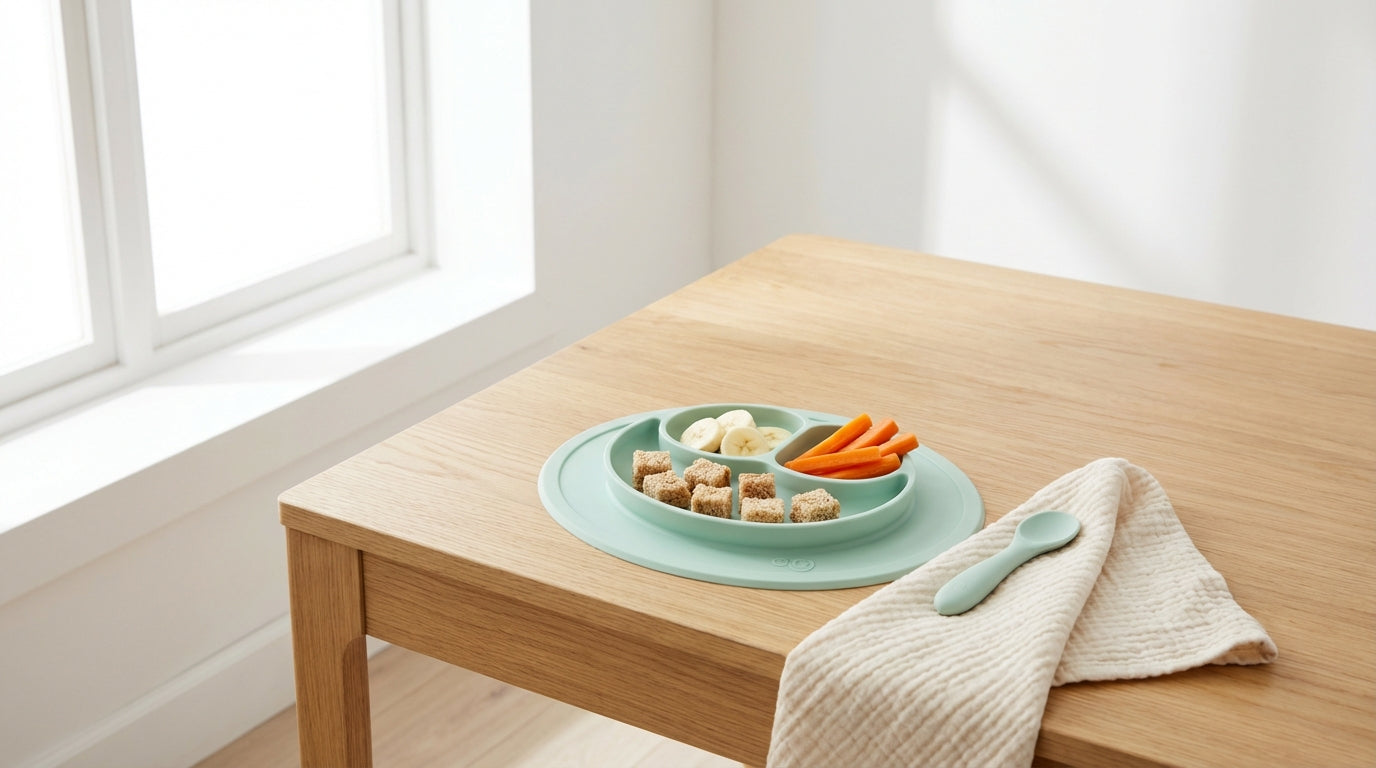
A kids' plate with a suction cup is a plate that sticks to smooth surfaces by means of negative pressure. The benefit is simple: the plate is more likely to stay in place, so children can practice eating independently.
Negative pressure is created when there is less air under the suction cup than outside. The smoother and cleaner the surface, the less air can flow in – and the better it holds.
What does a kids' plate with a suction cup really do for you?
The biggest advantage is everyday practicality: less sliding, less tipping, more practice. Especially in the “I do it myself” phase, the plate is often the first thing that goes wandering – not out of defiance, but because little hands can't yet cleanly separate “spooning” from “holding on.” A plate with a suction base takes some of that constant securing off your shoulders.

- More independence: your child can focus on eating, not on holding the plate in place.
- Less tipping: especially with porridge, yogurt, sauces and rice.
- Less stress at the table: you're more of a companion than a plate-rescue service.
Practical tip: If it “won't hold”: wipe the table and the suction cup once with a damp cloth, then press down firmly and wait a moment. This often makes all the difference.
And yes: some children still manage to pry everything loose. In that case the suction cup isn't “bad” – your child is simply very thorough in their research on gravity.
How does a suction cup work – and why does it sometimes not hold?
A suction cup only holds well if the rim seals tightly. As soon as crumbs, wood pores, matte coatings or a grease film let air in, the negative pressure is gone – and the plate turns back into a sled.

- Good surfaces: smooth plastic (high chair tray), glass, smooth lacquer.
- Difficult surfaces: oiled wood, textured panels, very matte surfaces.
- Typical culprits: crumbs, grease film, dish soap residue, a damp condensation layer.
It can work on wood – but wood isn't all the same. If your table is oiled and slightly porous, that's simply a tough job for many suction cups. Sometimes a smooth underlay (e.g. a smooth board) helps as a “docking station.”
How safe are kids' plates with suction cups?
Safety comes from material, workmanship and correct use working together. The suction cup does reduce accidents from sliding, but what really matters is: food-safe materials, no sharp edges, no parts that can come loose, and clear information on temperature, microwave and dishwasher use.
In the EU, materials that come into contact with food must be manufactured so that they do not release harmful substances under normal use. This is regulated, among others, in Regulation (EC) No. 1935/2004, according to EUR-Lex. (Source)
For plastic there are also specific rules on the transfer of substances (migration). According to EUR-Lex, Regulation (EU) No. 10/2011 sets out, among other things, limits and requirements for plastics in contact with food. (Source)
Safety note: If your child picks at the suction rim or uses the plate as a “lever”: put the plate away and offer it again later. Loose parts don't belong at the dining table.
A little reality check: a suction cup is no substitute for supervision. It's a little helper – not a babysitter with a rubber foot.
Material comparison: silicone, plastic, melamine, porcelain
The best material is the one that suits your eating habits and your kitchen. Here's the honest overview – with the points that really count in everyday life.

Silicone
Silicone is flexible, unbreakable and often very grippy on smooth surfaces. Many suction plates are made of silicone because it forgives knocks and attaches well. According to the BfR (German Federal Institute for Risk Assessment), there are recommendations on materials for food contact; these are not legal standards, but are used as scientific guidance. (Source)
- Pro: unbreakable, often good grip, pleasant for small hands.
- Con: can absorb odors/colors (hello, tomato).
Odor is usually no drama, but a care topic. What often helps: clean thoroughly, let it dry completely and don't put it away “damp in the drawer” – otherwise it quickly gets musty.
Plastic (without melamine resin)
Plastic can be lightweight and practical for everyday use if it is clearly intended for that purpose. What matters are clear manufacturer details on temperature, dishwasher and microwave – and that the product is intended for food contact (EU basis: Regulation (EC) No. 1935/2004, according to EUR-Lex). (Source)
- Pro: lightweight, robust, often easy to care for.
- Con: depending on the surface texture, grip can vary.
Melamine tableware / melamine resin (incl. “bamboo ware”)
Melamine is shatterproof, but not a good idea for heat and microwaves. The BfR recommends not using “bamboo ware” (melamine-formaldehyde resin with bamboo fibers) for hot food or drinks and points out that such products are not suitable for the microwave. (Source) The BfR also advises against using melamine resin tableware for heating in the microwave. (Source)
- Pro: lightweight, sturdy, classic children's tableware feel.
- Con: sensitive to heat – “just quickly warming it up” is often off the table.
If you reheat a lot of food, save yourself the trouble and choose a different material. That's not a moral stance, just a practical one.
Porcelain
Porcelain is neutral in taste and long-lasting, but not made for the throwing phase. Suction combinations with porcelain are rarer; porcelain is often better for later, when the table ritual is calmer.
- Pro: neutral in taste, often very easy to clean, “just like the grown-ups.”
- Con: can break – and nobody likes collecting shards barefoot.
Which type suits which age and daily routine?
A suction plate helps most in phases when a lot of practicing and pushing is going on. That is typical for many children around the start of more solid food and when they begin eating on their own – but every child has their own pace.
- Starting at the family table: flat plate with a good stand and a manageable portion.
- Practicing self-feeding: a higher rim helps with “pushing” food onto the spoon.
- On the go: works well on smooth café tables or trays (if clean).
If your child deliberately pulls the plate off, you don't need “an even stronger one.” What often helps more: a heavier plate, a non-slip mat or a short ritual (“the plate stays down, the food stays up”). Sounds simple – but sometimes that's exactly what it takes.
Concrete buying checklist: how to find the right plate
The best order is: first grip on your surface, then material, then care. That way you avoid wrong purchases that live in the cupboard and only come out at Christmas.
- Grip test: Does the suction cup really hold on your table/high chair tray?
- Usage instructions: Are there clear details on temperature, dishwasher, microwave?
- Workmanship: No sharp edges, no cracks, no detachable parts.
- Rim height: A higher rim supports children when spooning (“pushing” food).
- Size: Better to portion appropriately than to use a giant plate with a tiny serving.
- Cleaning: Does the plate fit into your routine (dishwasher yes/no)?
- Odor/discoloration: With silicone, check whether this would bother you in everyday life.
Practical tip: For the first few weeks, a high rim and good grip matter more than a cute design. The design wins again later.
Cleaning, dishwasher, microwave: how to keep the grip strong
Grip usually fails because of grease film – not because of the suction cup itself. If you keep that in mind, such a plate often holds much more reliably.
- Before eating: quickly wipe the surface with a damp cloth, keep the suction base clean and dry.
- After greasy meals: clean thoroughly so no film remains (including on the rim).
- After washing: let it dry completely before it goes into the cupboard.
- If it's no longer flat: warping or cracks can kill the grip – then replace it.
As for the dishwasher: the manufacturer's instructions on the product are what count. Some materials and shapes take it in stride, others become dull or warp over time – this is less about “good/bad” and more about material plus heat plus dishwasher chemistry.
For melamine: do not heat in the microwave. The BfR advises against using melamine resin tableware in the microwave. (Source)
A little transparency from everyday life at bieco: what we pay attention to ourselves
For 66 years we've been looking at the things that really annoy people in family kitchens. As a family business from Hamburg, we're pragmatic in a northern German way: it has to work, be easy to clean and be described honestly.
For us, transparency means clear material and usage information instead of marketing waffle. Especially on topics like microwave, heat and care, clean product information makes the difference between “works fine” and “why does this smell funny now?”
FAQ
Does a kids' plate with a suction cup hold on wood?
Sometimes yes – but only if the wood surface is smooth and dense enough. Oiled or textured wood often lets air flow in, and then the negative pressure releases quickly. It's best to test it at the spot where you actually eat. A smooth underlay can help as a “suction island.”
Which is better: a suction plate or a non-slip mat?
A suction plate stabilizes the plate directly, while a mat stabilizes the surface. If your table is tricky (rough, oiled, heavily textured), a mat can be more relaxed. If you have a smooth high chair tray, a plate with a suction base is often the simpler solution.
How do I get the silicone smell out of the plate?
Thorough cleaning and complete drying usually help – patience included. Odors like to set in when silicone is stored damp or has held strongly scented foods. Rinse thoroughly, let the plate dry completely and don't store it airtight while it's still damp.
Can a baby's plate with a suction cup go in the dishwasher?
That depends on the specific product – the manufacturer's instructions are what count. If dishwasher use is approved, make sure the suction area stays clean and that no detergent residue forms a film. If the grip weakens, a thorough rinse and drying often helps.
Can melamine children's tableware go in the microwave?
No, the BfR advises against heating melamine resin tableware in the microwave. According to the BfR, melamine resin tableware is not suitable for heating in the microwave. (Source) “Bamboo ware” is also not suitable for hot food, according to the BfR. (Source)
Why does the plate keep coming loose despite the suction cup?
Usually the cause is crumbs, grease film or a matte/rough surface. Wipe the surface with a damp cloth, give the suction cup a quick clean and press it down firmly. If the table is heavily textured or oiled, it's sometimes simply physics – then a smooth underlay helps more than a third plate.
In closing: how to make the table more relaxed
If the plate holds well on your surface and fits your daily routine, you've already won. For an overview of the options, you'll find our kids' plates here. And if you're currently looking at self-feeding: in the children's cutlery hub you'll find suitable basics for small hands.