Learning Toys: How to Choose Safely & Sensibly by Age
At a glance
- Learning toys make sense when they fit your child and your everyday life.
- For 0–12 months, what counts is grasping, looking, listening and chewing (yes, really).
- From 12–24 months, stacking, posting and simple sorting games help.
- Pay attention to warning labels, workmanship and suitable part sizes – especially under 3 years.
- Wood or plastic: what matters is that it's sturdy, easy to clean and well made.

Good learning toys are the ones your child keeps coming back to all on their own. Not the ones with the longest advertising copy, but the ones that work in everyday life: quick to get out, easy to understand, easy to clean and safe. In this guide you'll find practical orientation: what learning toys actually are, which types there are, how to choose by age (including concrete play ideas) and how to recognize safe toys. No pressure at all – more like an experienced friend or a relaxed grandpa chipping in at the kitchen table.

Ulli & Flo
Owners of bieco · Hamburg · parents themselves
We've noticed that one calm, simple learning toy often does more than ten loud ones. And if today is all about “digger,” that's okay too. Feel free to browse our Learning Toys collection.
What are learning toys?
Learning toys are toys that let children practice certain skills while playing. That can be motor skills (grasping, turning, posting), thinking (sorting, comparing), language (naming, storytelling) or social interaction (taking turns, rules). What matters is not whether “learning” is printed on the box, but whether your child becomes actively involved.

Good learning toys have a clear play idea and little distraction. If one toy does everything at once (flashing, singing, talking), it's great for some children – and simply too much for others. Children often learn best when they discover cause and effect for themselves: “When I do this, that happens.”
Fine motor skills are small, targeted movements of the hands and fingers. They come in handy later for drawing, doing up buttons or spreading butter on bread (yes, that counts as a major achievement in family life).
Self-efficacy means that a child experiences that their actions make a difference. That's why a posting toy where the piece really goes “click” is sometimes the secret star of the nursery.
How do learning toys support development – without pressure?
Learning toys work best when children are allowed to try things out themselves. You don't have to “teach” anything: accompany a little, name a little, let them do a lot. And if today it's only about “the digger driving in circles” – that, too, is concentration, perseverance and imagination.
- Language on the side: “You picked the round block.” Often that's all it takes.
- Supporting frustration: “That's tricky.” Then wait a moment instead of rescuing right away.
- Varying instead of replacing: Same pieces, new task: first by color, then by size.
- Allowing repetition: Children are repetition world champions – and that's exactly how they learn.
Practical tip: If your child uses a toy “the wrong way” (stacking cups instead of sorting), that's often exactly the learning that's due right now.
What types of learning toys are there?
The best category is the one your child repeats voluntarily. Still, a little map helps – so you don't stand in front of the shelf as if facing a very colorful math test.
- Posting & sorting toys: recognizing shapes, hand-eye coordination, problem solving.
- Stacking & building: balance, spatial thinking, patience (yes, for adults too).
- Threading & screwing: fine motor skills, concentration, two-handed coordination.
- Puzzles & matching: patterns, memory, perseverance.
- Role play (kitchen, doctor, workbench): language, social rules, acting out everyday life.
- Music & sound toys: rhythm, cause and effect, and sometimes: “How quickly can I find the earplugs?”
For babies, “learning” is often first of all: feeling, grasping, hearing, looking. If you'd like to browse specifically for this, our article Learning Toys for Babies: Recommendations & Tips for the Smallest is a helpful addition.
Learning toys by age: 0–12 months
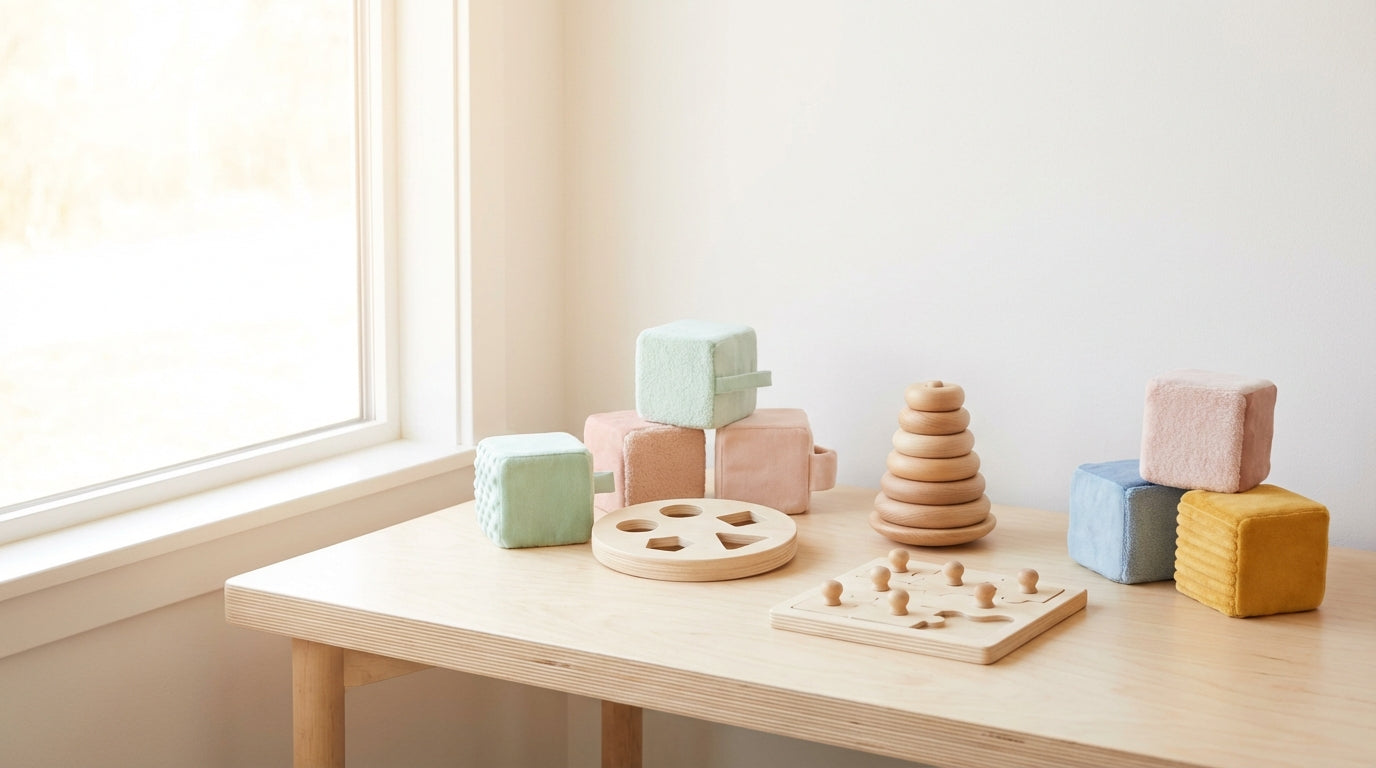
For 0–12 months, what matters most is safe grasping, feeling and discovering. At this age, play is often all about the senses: different surfaces, simple sounds, things that are easy to hold on to. And yes: everything gets tested – including with the mouth.

- Grasping toys & rattles: light, easy to hold, not too many extras.
- Soft fabric books: crinkle, feel, look – short “stories” are enough.
- Play arches: hanging, kicking, grasping – lovely cause-and-effect moments.
- Teething rings: handy when teeth are on the way (and it feels like they always are).
Safety note: For babies and toddlers, toys should regularly go through a “loose parts check”: seams, buttons, protruding parts – better to check once too often.
Learning toys by age: 12–18 months
At 12–18 months, posting, stacking and “I do it!” get really exciting. Many children now love simple tasks with clear feedback: in, out, on, off. And they celebrate themselves for it – rightly so.
- Stacking cups: stack, knock over, stack again (an endless loop, but a meaningful one).
- Large shape sorters: few shapes, big openings, success quickly felt.
- Push or pull toys: movement + control (“It's coming along!”).
- First picture books: naming, pointing, repeating – the same page again and again is perfectly fine.
Practical tip: Put out only 2–3 pieces where your child can see them. Less choice makes playing easier for many children.
Learning toys by age: 18–24 months
Between 18–24 months, sorting, matching and little role-play games pick up speed. Now the first “rules” often form in their heads: this goes there, these fit together. And along the way, language really comes to life.
- Sorting games by color/shape: keep it simple at first, then increase the challenge.
- Wooden puzzles with knobs: few pieces, clear pictures.
- Posting and screwing toys: turning, fastening, loosening – great for little hands.
- Mini role play: phoning, cooking, saying “Hello!” – everyday life gets re-enacted.
Learning toys by age: 24–36 months
At 2–3 years, building, pretending and “Why?” become the daily program. Many children can now stay with one thing for longer – if they get to choose it themselves. Learning toys can have a bit more of a “task” to them, as long as it doesn't frustrate.
- Building blocks & simple constructions: towers, bridges, a “house for the teddy.”
- Matching games: animals & sounds, shapes & shadows, “What belongs together?”
- First, very simple games with rules: taking turns, rolling dice, 1–2 rules are enough.
- Creative materials: large wax crayons, play dough – with supervision and good table protection.
Learning toys from 3 years: more depth of play, more stories
From 3 years, learning toys can become more complex if the child wants that. Many children now love roles (“I'm the doctor”), little building plans or games with clear sequences. At the same time: it doesn't have to look “educational” every day to be educational.
- Multi-piece puzzles: increase gradually, success remains the best motivator.
- Role-play sets: language, empathy, understanding everyday life.
- First logic and matching games: patterns, sequences, “What comes next?”
- Games to play together: taking turns, practicing losing (with you as a calm safe harbor).
How do I recognize safe learning toys?
You can recognize safe learning toys by clear warning labels and clean workmanship. Look at the age recommendation, check edges and seams, and see whether small parts could come loose. Especially with gifts (Grandma means well), a quick check is worthwhile before it moves into the nursery.

Safety note: For children under 3 years, small parts are especially critical – stick to the age recommendation and warning labels, even with little gifts brought by visitors.
CE is a manufacturer's declaration of compliance with EU requirements. According to the European Commission, EU toy legislation sets out the essential safety requirements and obligations for toys in the EU (European Commission).
The EN 71 series of standards covers mechanical and chemical testing, among other things. According to DIN, DIN EN 71 includes requirements for mechanical/physical properties, flammability and chemical aspects such as the migration of certain elements (DIN).
When it comes to harmful substances, it's worth looking at independent consumer information. The Verbraucherzentrale (German consumer advice center) explains what parents can watch out for with problematic substances and odors, and why “strong smelling” can be a warning sign (Verbraucherzentrale).
Wood or plastic: which is better for learning toys?
“Better” is the material that is safe, sturdy and suited to everyday use. Wood often feels warm and is stable, while plastic can be light and easy to wipe clean. What matters are workmanship, smell, edges, stability and whether the toy is easy to clean.
- Wood: often durable, pleasant in the hand; look for smooth edges and a clean finish.
- Plastic: practical to wipe down; look for sturdy parts and avoid strong-smelling products.
- Fabric: wonderful for babies; firm seams and washable materials are important.
In real family life, the toy you can get clean wins. If you sigh at the very thought of hand-washing: choose something wipeable or machine-washable instead. You have better things to do.
Our short checklist for good learning toys
If you only have 30 seconds, take these questions with you.

- Is your child likely to really play with it – even without being “entertained”?
- Is the play idea clear quickly, without long instructions?
- Does the size of the parts suit the age (especially important under 3 years)?
- Can it withstand everyday use and is it easy to clean?
- Are there clear labels and warnings?
We always look at these questions from a parent's point of view – with northern German calm. Ulli & Flo write here as parents for parents, and as a family business from Hamburg we've been doing this for 66 years: solid, transparent and practical rather than loud and overloaded.
Transparency matters to us: we explain our criteria independently of any purchase. After reading, you should above all be able to do one thing: choose more calmly – no matter where you end up buying or what's already in the toy basket.
Keep reading & browsing (stress-free)
Sometimes it helps to take one quick look at everything together – and then close the tab again. If you're looking for ideas, you'll find inspiration in our Learning Toys overview. For a more focused look by topic, Motor Skills Toys and Wooden Toys are a good fit too.
FAQ about learning toys
What is a good learning toy?
A good learning toy has a simple play idea and actually gets used. It suits your child's stage of development, is safely made and leaves room for trying things out. If your child comes back to it on their own, that's usually the best sign – no “educational” label needed.
From what age do learning toys make sense?
Learning toys make sense from babyhood on, as long as they are safe and simple. For 0–12 months, grasping, feeling and cause and effect are important. From about 1 year, posting and stacking become exciting, later sorting, puzzles and role play. The child's interest matters more than their age.
How do I recognize safe learning toys?
Safe learning toys have clear warning labels, suitable part sizes and no loose small parts. Look for clean workmanship (edges, seams, stability) and read the age recommendation. According to the European Commission, essential safety requirements for toys apply across the EU (European Commission).
How many learning toys does a child really need?
A few good pieces are usually enough – the rest can rotate. Many children play better when not everything is visible at once. Two or three options in sight are often plenty. When boredom sets in, simply swap something in from the cupboard – it feels brand new and costs nothing.
Are electronic learning toys better than classic ones?
Not automatically: what matters is whether the child is actively doing something. Classic posting and building toys often support development very directly because children try things out themselves. Electronic toys can be fun, but sometimes they're more “entertainment.” If your child is in control and practices repeatedly with it, it can still be a good fit.
What should I give as a grandparent or friend if I'm unsure?
Choose something sturdy with a clear play idea and a suitable age recommendation. Stacking, posting, simple puzzles or basic role-play items are often safe bets. Ask briefly about interests (animals, vehicles, kitchen, building) and whether they already have something similar – two is better than one, but not every time.
If you'd like to browse now: a small overview saves nerves and time. Feel free to visit our Learning Toys collection – for inspiration, not for stress. And if you're unsure: better one piece fewer, but one that really gets played with.