Buying Children's Toys: Checklist, CE/GS Explained & Age-by-Age Tips
At a glance
- The safest way to buy children's toys: check the age, the warnings and the small parts.
- CE marking is mandatory in the EU, while GS is voluntary and independently tested.
- For children under 3, small parts, magnets and cords are especially tricky.
- Online shops win on choice, the shop around the corner on "touch it & take it home today."
- Sales are worth it mainly for play ideas that have already proven themselves, not for experiments.

Buying children's toys gets much more relaxed when you sort out age and safety first. Play value comes next, and only then price, sales and "oh, isn't that cute." In this guide you'll find a 10-minute checklist, a clear explanation of CE/GS/EN 71, practical age-by-age tips (0–6 years) and a few handy shortcuts for online shops, local stores and catalogs. And yes, you can stay completely calm about it. Nobody has to find the perfect toy, just one that actually gets played with.

Ulli & Flo
Owners of bieco · Hamburg · parents themselves
We know how quickly you can lose track when buying toys, especially before birthdays. With the checklist here, it gets pleasantly simple again. Feel free to browse our children's toys collection.
Table of contents
- 10-minute checklist
- CE, GS and EN 71: What do they mean?
- Toys for children under 3: What to look out for
- Play ideas by age group (0–6)
- Online shop or toy store?
- Children's toy sales: saving sensibly
- Catalogs & preschool catalogs: without the paper chaos
- How we choose toys (Ulli & Flo)
- FAQ
Buying children's toys: the 10-minute checklist
If you only remember one order, make it: age, safety, play idea. Everything else can follow. This way you quickly rule out what doesn't fit, and spare yourself the "why has this thing been under the sofa for three weeks?" moment later.
- Age & developmental stage: Does the recommended age really suit your child (and not just their birthday)?
- Read the warnings: Notes like "not suitable for children under 36 months" are not decoration.
- Small-parts check: If it fits in a mouth, it will end up in a mouth. Always.
- Play idea: Building, rolling, sorting, cuddling, splashing, digging outdoors?
- Everyday practicality: Noise, size, tidying up – those are the real stress points.
- Material & surface: Sturdy, smooth, no sharp edges, nothing wobbly or splintering.
- Cleaning: Wipeable, rinsable or washable is a gift in family life.
- Space: Will it fit on the shelf, or become a permanent hallway resident?
- Interests: Vehicles, animals, music, role play, water, screwing, stacking?
- Budget: Only at the end, otherwise you buy "cheap" and then buy again.
Practical tip: Ask yourself: "Would I still pull this out on the third rainy day?" If so, it's usually a hit.
What do "CE," "GS" and "EN 71" mean for toys?
CE marking is mandatory for toys in the EU. According to the German Federal Office of Consumer Protection and Food Safety (BVL), toys in the EU must carry the CE mark; with it, the manufacturer declares conformity with the requirements, including those of the DIN EN 71 series of standards.
The GS mark is voluntary and based on independent testing. According to the BVL, unlike CE, GS is not merely a self-declaration but a product-specific test by an approved, independent body, and it is valid for a maximum of five years.
EN 71 is a series of standards for toy safety. It helps to test and assess requirements (e.g. mechanical and physical properties) in a consistent way; in practice, it often appears in safety and conformity information.
The EU provides central information on toy safety and the rules that apply. You can find details on the legal situation and harmonized standards on the European Commission's toy safety pages.
Definition: A warning notice is a mandatory safety text that restricts use. It helps you choose toys that suit your child's age and abilities, not to spoil the fun.
Definition: An age recommendation is a guide to the typical abilities of an age. It doesn't replace your own view of your child, but it protects against "too small, too heavy, too risky."
Safety note: For children under 3, small parts, magnets and long cords are especially critical. Always read the warnings, even on gifts.
Toys for children under 3: What really matters?
Under 3, what counts most is: no swallowable parts and sturdy construction. At that age, toys aren't just played with but tested: with teeth, saliva, throwing power and astonishing stamina.
- No loose small parts: Even something "actually firmly attached" can come loose if it's pulled on often.
- No long cords/ribbons: Pay attention to the warnings and to how something is attached.
- Take magnets seriously: If magnets are built in, they must be especially secure.
- Simple play impulse: Grasping, pushing, stacking, sorting – often that's all you need.
- Think about cleaning: Wiping or rinsing saves family peace.
Practical tip: If you're unsure, choose "bigger and simpler" over "small and clever." Clever comes later all by itself.
Play ideas by age group (0–6 years)
The best guide isn't "more features" but play that matches your child's development. Children grow through play, and you save money when you choose toys that fit the present (and not just the "soon").
0–12 months
In the first months, grasping, feeling and listening are the big program. Things that are easy to hold, don't overwhelm and give the baby feedback work well (e.g. gentle sounds, different surfaces). Pay special attention to safe construction and clear age information.
1–2 years
Now it's pushing, putting in, stacking – and everything gets tried out. Stacking and motor-skill toys, simple sorting ideas and sturdy vehicles are often long-time favorites. If you want to browse: an overview like children's toys makes it easy to narrow things down by interest.
2–3 years
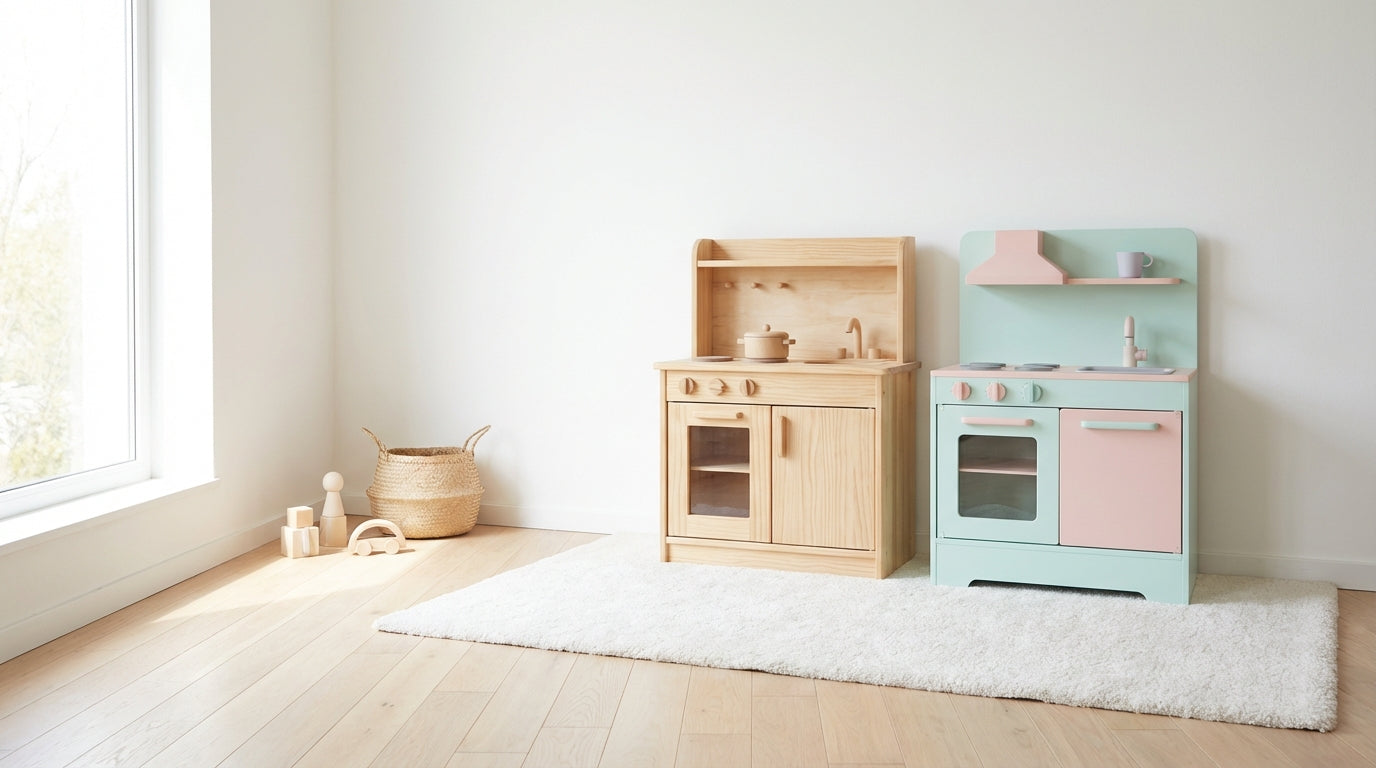
Role play begins, and "doing it myself" becomes a favorite sport. Play kitchen, doctor's kit ideas, workbench feeling – the main thing is that your child can imitate. At the same time, movement stays important: climbing, running, carrying, pouring.
3–4 years
More imagination, longer play phases – and the first little rules. Puzzles, building, simple board games and role-play worlds can really carry now. If you like to think in themes, starting with theme worlds around preschool, farm and doctor helps.
4–6 years
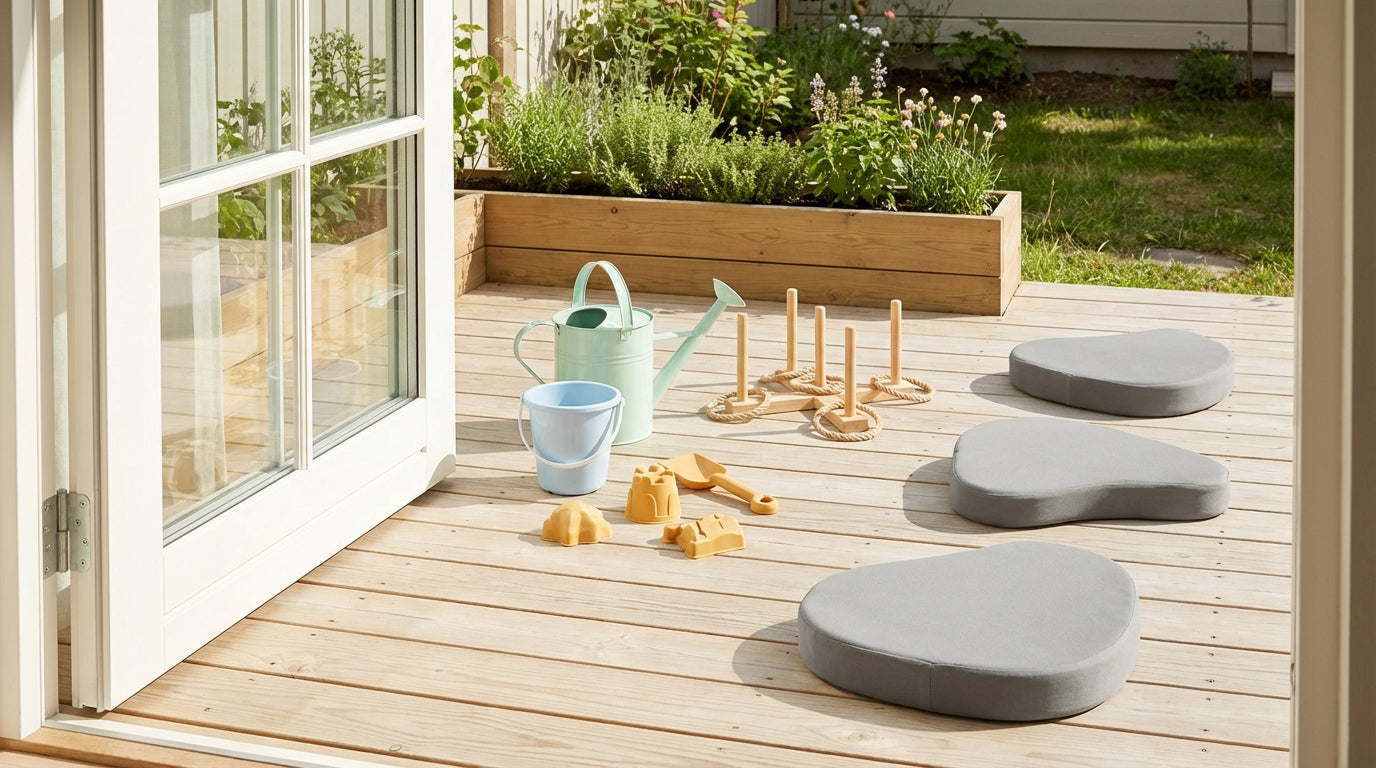
Now challenges count: building, tinkering, testing outdoors, repeating. More complex building ideas, creative sets, outdoor movement and games with clear sequences often fit well. For fresh air and "energy has to get out," outdoor and garden toys are a lovely collection of ideas.
Online toy shops vs. toy store: What suits you?
Online is strong on choice, the local store on gut feeling and taking it home right away. Both can be great, depending on whether you have time to compare right now or simply need "a gift today."
How to recognize good online shops
Good online shops show warnings, age and material so you don't have to hunt for them. You don't want a scavenger hunt, you want clarity.
- Product info: Age recommendation, dimensions, material, care instructions, warnings.
- Photos: Detail pictures (edges, fasteners, small parts) are worth their weight in gold.
- Trustworthiness: Legal notice, clear ways to contact them, transparent returns.
- Reviews: Look for comments on durability, noise and "does it actually get played with?"
When the local store is unbeatable
In a store you can check quality, size and sounds in person. Especially with wooden toys, vehicles or anything that makes music, "live" is more honest than any photo.
- You feel the workmanship: Weight, edges, sturdiness – you notice it immediately.
- You get quick guidance: Especially helpful if you don't see the child every day.
- You take it with you right away: Perfect for a birthday party "tomorrow" (oops).
Children's toy sales: How to save without cursing later
A sale makes the most sense for play ideas that have already proven themselves. If you know your child stacks like a world champion or digs outdoors like a mole, sale shopping is especially worthwhile. For "just having a look," you often end up buying twice.
- Timing: Sales are practical for seasonal items (outdoor, sand, water) – if you can store them.
- Returns: Check return periods, especially for gifts.
- Completeness: With sets, it's better to check once more.
- Age recommendation: A sale doesn't change suitability. Sounds banal, saves nerves.
If you start online, a broad start followed by careful narrowing down helps. An overview like children's toys is handy for that – and from there you continue by age and play idea.
Preschool toy catalogs & children's toy catalogs: using them wisely
Catalogs work best when you treat them like a short wish list. Not as "endless browsing," but as a shortcut: 3–5 concrete ideas, done.
Preschool catalog: great for themes and groups
A preschool catalog is strong on role play, rules and getting along. Many daycare centers work with theme worlds (doctor, farm, construction site) because children practice language and social routines through them.
- For parents: Mark 3 concrete suggestions instead of 30 "maybes."
- For grandparents: A photo of the marked page prevents "I thought it was bigger..."
- For daycare & childminders: Sturdy, easy to clean, clear age approvals.
Catalogs at home: the 3-category rule
With three categories, idea chaos quickly becomes a good selection. Here's how it works in practice:
- Note down your child: Age, favorite game, likes/dislikes.
- Choose three categories: e.g. building, role play, movement.
- One idea per category: Then you have three sure hits instead of twelve half-hits.
For bath time and the evening routine, the simplest ideas often help most. If you're looking for inspiration: bathtub toy ideas are a good shortcut when the evening needs to go quickly.
How we choose toys (Ulli & Flo)
We look at safety first, then play value, and only then at "pretty." We're parents, based in Hamburg, and we've been running this as a family business for 66 years – that makes you pleasantly down-to-earth: What lasts, what gets played with, what becomes annoying after two days?
- Safety transparency: We look for clear labeling, warnings and traceable information.
- Material & workmanship: Sturdy, easy to grip, no nasty edges – and made to withstand everyday life.
- Practicality: Can it be cleaned? Is it too loud? Does it fit on the shelf?
- Feedback loop: We take parents' feedback seriously, especially on "breaks quickly" and "my child has loved it for months."
And yes: sometimes the best toy is the one that promises the least. A clear play impulse, sturdy quality and a child who comes up with their own ideas – that's usually the mix that wins in everyday life.
FAQ
How can I buy children's toys without getting overwhelmed?
Limit yourself to three options and decide by age, safety and play idea. Read the warnings, check for small parts and think briefly: Where will it be played with (indoors, outdoors, bath) and how easy is it to clean? If you're still torn: choose the sturdier one that's easier to tidy away.
What is the difference between CE and GS on toys?
CE is mandatory and a manufacturer's declaration, GS is voluntary and independently tested. According to the BVL, toys in the EU must carry the CE mark; the GS mark is based on testing by an approved body and is time-limited. Always also follow the warnings and age recommendation.
What should I pay special attention to with toys for children under 3?
Under 3, swallowable small parts, magnets and long cords are especially critical. Look for warnings, sturdy construction and simple play ideas that work without small accessories. And, very practically: if something can be easily pulled off or broken off, it's usually not a good idea at that age.
Are online toy shops safe?
Yes, if the shop is transparent and provides complete product information. Look for a legal notice, a way to get in touch, and clear details on age, warnings, material and dimensions. The European Commission also provides information on toy safety and harmonized standards.
How do I recognize a good children's toy sale?
A good sale saves money without compromising on suitability and safety. Check that age, warnings and material details are complete, and look at returns and completeness for sets. Sales work best for play ideas your child already loves – not for pure impulse buys.
If you want to browse now: start broad, then filter down. A relaxed starting point is the children's toys overview – and from there you continue by age, interest and everyday life. And if you think "oh dear" while unwrapping: breathe. Children sometimes like playing with the box best. As we say in northern Germany: you can get annoyed about it – but you don't have to.