Outdoor Toys: Practical Tips & Ideas for Your Garden and Patio
At a glance
- Outdoor toys work best with 3 basics: water, movement, digging.
- The younger the child, the bigger, simpler and fewer small parts the toy should have.
- For small spaces, zones help: a mini water station, a short obstacle course, a digging corner.
- Look for the CE mark, age recommendations, warnings and clear material information.
- With a storage box and a quick cleaning routine, it stays doable in everyday life (even on Mondays).

Outdoor toys for the garden are a good fit when they match your child's age, your space and your everyday life. With water, movement and a digging corner, most children are pretty quickly “happy outside.” In this guide you'll find a practical selection aid, ideas by garden size, a little DIY tutorial for a motor skills obstacle course, and clear notes on safety, materials and care. All of it designed so your toys don't vanish into the shed after two weeks, but actually get used.

Ulli & Flo
Owners of bieco · Hamburg · parents themselves
Playing outside works best for us when there are three clear corners: water, movement, digging. Then you need less stuff, and everyone is more relaxed. Feel free to browse our Outdoor Toys collection.
3 classics that almost always work in the garden
If you cover water, movement and digging, you're already most of the way there. It's not rocket science, more of a parent's observation: kids want to tip, run and splash around, ideally all in one afternoon.

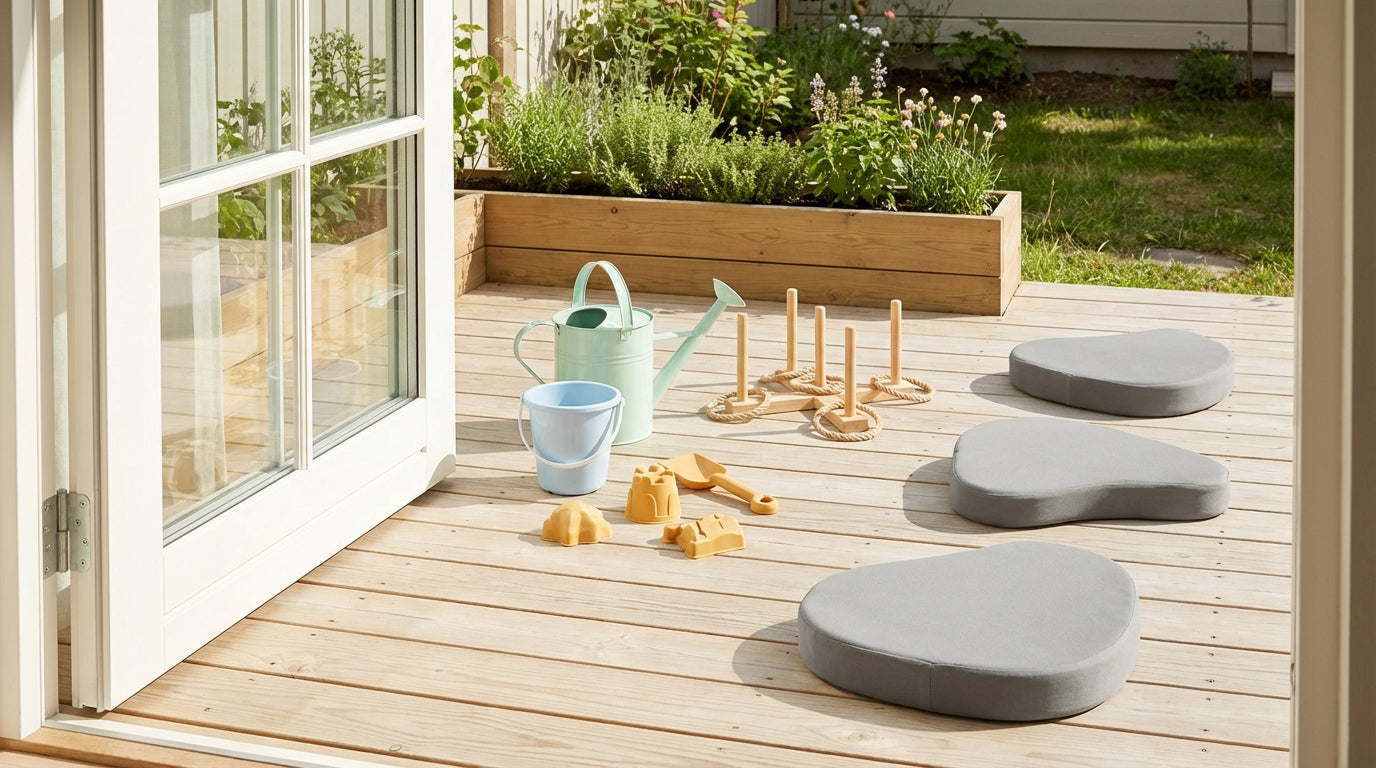
- Water: pouring, watering, splashing, “cooking soup” (please without real herbs from your flower bed).
- Movement: crawling, balancing, throwing, rolling, hiding.
- Digging & nature: sand/soil, leaves, stones, sticks. “Real material” often beats plastic gimmicks.
Outdoor toys are good when they're sturdy outside and quickly ready to go again. That means: easy to clean, not sensitive to moisture, and ideally without 27 tiny parts that camouflage themselves in the grass.
If you'd like an overview, our Outdoor Toys collection shows the typical categories. It helps you sort things in your head before you sort things in the garden.
Outdoor toys by age: less is often more
The younger the child, the simpler, bigger and clearer the toy should be. Toddlers don't need complicated rules. They need things they can grab, carry, tip and repeat. By the way, repeating isn't “getting stuck,” it's their training plan.
For toddlers, outdoor toys are good when they get by without small parts. Large balls, sturdy buckets and cups, a tunnel to crawl through or a small tent as a retreat are typical evergreens. In our overview of outdoor toys for toddlers you'll find exactly these uncomplicated candidates.
Preschoolers can handle more role play and challenge. Throwing games, little races, obstacles, “the floor is lava” courses, and anything you can play in pairs or in a group suddenly becomes exciting.
For school-age children, rules, goals and small projects count. Target throwing, homemade obstacle courses, water slides, treasure hunts or a “garden Olympics” with a stopwatch all work well (only if you're up for debates about tenths of a second).
Terms you're welcome to quote (short & practical)
Outdoor toys are toys that withstand moisture, dirt and active play. In everyday life that means: they're easy to clean, sturdily built and not instantly “fussy” outside.
Water toys are playthings designed for pouring, watering and splashing. They're practical when they have smooth surfaces and dry well after play.
A motor skills obstacle course is a series of simple movement stations. Children practice balance, coordination and body awareness, without you having to announce a sports program.
Water toys in the garden: the fastest way to “everyone is busy”
Outdoors, water is the shortcut to long play, with hardly any instructions. A bucket, cups, a bowl, a watering can: and off they go in explorer mode. If you'd like to browse in a targeted way, take a look at our water toys for the garden collection.

Practical tip: Put the water station on a rubber mat or an old towel, and the rest stays reasonably dry.
In everyday life, water toys are an honest test: they show right away whether something is easy to clean. Look for smooth surfaces and parts you can rinse well and let dry. That saves you smells and frayed nerves later.
With water, the rule is: play fun yes, tripping hazards no. Set up the station so that walkways don't turn into slides, and tidy up briefly after playing. It's two minutes well spent.
DIY: mini motor skills obstacle course in 10 minutes (for garden & patio)
A small obstacle course needs little material but gets kids moving a lot. You can change it slightly every day, and that's exactly what children love.

What you need
- 4–6 “stations” made from whatever you have: chalk, cones, rope, cardboard, buckets, cushions/mats (outdoors only if they're allowed to get dirty)
- 1 ball or soft throwing item
- Optional: a tunnel or small tent as “start/finish”
How to set it up
- Choose a starting point (e.g. at the fence or by the patio door).
- Station 1: “Hopping” (chalk circles or marked spots).
- Station 2: “Balancing” (a rope as a line, or stepping stones/tiles spaced apart).
- Station 3: “Crawling” (under a stretched rope or through a tunnel).
- Station 4: “Aiming” (throw a ball into a bucket).
- Station 5: “Transport” (carry a small object from A to B without hands, depending on age).
The trick isn't perfection, but repetition with small variations. Today it's “crocodile swamp,” tomorrow “fire brigade training”: the same material, a different story.
Safety note: Make sure the surfaces are non-slip, keep a distance from edges and flower beds, and remove tripping hazards such as hoses or loose stones.
Pop-up tunnels and tents can spring open quickly and should be set up by adults. After that they're super practical, because they go up fast and disappear just as fast.
If a trampoline is on your wish list, it's worth taking an extra look at safety. We have a separate article on that: Trampoline safety: what parents should look out for with outdoor trampolines.
Outdoor toys by garden size: keeping it relaxed
Good garden ideas depend less on square meters than on clear zones. When children know what is “allowed” where, things automatically get calmer for everyone.
Mini balcony or small patio
In a small space, pouring, target throwing and a mini obstacle course work best. A small water tub (under supervision), a bucket for throwing and chalk for hopping spots are often enough. Important: everything should be quick to put away, otherwise you'll be living in a permanent slalom.
Terraced-house garden or “normal” family garden
Here the three-part split pays off: water corner, movement track, digging zone. You don't have to set everything up at once. Often it's enough to make one zone nice “today.” Kids are surprisingly easy to please.
Large garden
In a large garden, the challenge isn't space but oversight. It's better to have several small play spots (e.g. water station + throwing target + nature corner) than one huge play park. That way the kids spread out better and you don't have to keep calling “where are you?”
Digging & nature play: the cheapest outdoor toys are often already there
Soil, sand, water, sticks and stones are real premium toys for kids. Not romantic, just everyday life: things that change are more exciting than things that simply “are.”
A nature play area is a fixed corner where dirt is explicitly okay. For family peace, that's often more important than any new item: when it's clear where messing around is allowed, the rest of the garden stays more “normal.”
Practical tip: Keep a box of “garden clothes” ready. Then “Oh no!” quickly becomes “Well, okay, let's go.”
For nature play, you often need just two rules: don't touch anything poisonous, don't eat anything without asking. Kids can work out the rest remarkably well themselves, including “who has the biggest stone.”
Safety & materials: how to recognize good outdoor toys
Good outdoor toys are clearly labeled and understandably described. Age recommendation, warnings, use: a quick read saves a lot of trouble.
The CE marking is a must for toys in the EU. According to the EU, the Toy Safety Directive 2009/48/EC sets out essential safety requirements for toys made available in the EU (EUR-Lex).
DIN EN 71 is a key series of standards for toy safety in Europe. According to DIN, the series of standards describes requirements for, among other things, mechanical/physical properties, flammability and chemical aspects (DIN).
Expert bodies also assess chemical substances in toys, and that's good news for parents. The BfR (German Federal Institute for Risk Assessment) provides information on the health assessment of toys and supports the development of regulations scientifically, including for substance groups such as phthalate plasticizers or PAHs (BfR).
How to recognize “good material” in everyday life: it doesn't smell strongly and wipes clean easily. If something smells strongly of chemicals or feels sticky, I'd let it air out first and check the manufacturer's information.
Transparency in toys isn't a luxury, it's an attitude. We're a family business from Hamburg and have been doing this for 66 years, and we like to keep it honest: materials, warnings and testing should be traceable, not hidden.
Storage & care: so outdoor toys last longer
Outdoor toys last longer when they're stored dry and cleaned briefly now and then. It doesn't have to be a big project: rinse, dry, put away, done.

- A box with a lid (weatherproof) saves searching and keeps parts together.
- Letting things dry is important for water toys so they don't get musty.
- Sort out regularly: broken, sharp-edged, incomplete? Out it goes.
If you want a simple routine, go with “Friday = quickly look through the garden box.” It rarely takes longer than one song, and yes, you're allowed to sing that song yourself if nobody else wants to.
For more details (storage, protection, cleaning), see our guide: How to store, protect & clean outdoor toys properly.
Quick checklist: choosing outdoor toys without going around in circles
With this mini checklist, you'll usually make a good choice. Run through it once, then buy/borrow/build without agonizing for hours.
- Right age? Age recommendation and warnings read.
- Will it be used outside? Water/movement/digging: does it fit into a zone?
- Cleaning okay? Wipeable, rinsable, dries well.
- Storage clear? Where does it go when it isn't in use?
- Few parts, lots of play: better sturdy and often in little hands.
FAQ
Which outdoor toys are a good start for the garden?
A good start is water toys, a ball and a digging corner. That covers experimenting, moving and messing around, and you don't need much space. Choose a few sturdy items rather than lots of small parts, and it stays relaxed in everyday life and quick to tidy up.
Which outdoor toys are suitable for toddlers?
For toddlers, outdoor toys that are big, easy to grip and easy to clean are a good fit. Balls, buckets/cups for pouring, a tunnel or a small tent often work great. Check age recommendations and warnings, and stay close by when they play outside, because toddlers test things very thoroughly.
What is a motor skills obstacle course in the garden?
A motor skills obstacle course is a small series of movement tasks such as hopping, balancing and throwing. It can be built with simple things (chalk, rope, buckets) and changed quickly. That's what makes it so practical: kids stay engaged without you constantly having to invent new play ideas.
How do I choose safe outdoor toys?
Look for age recommendations, warnings and the CE marking. According to the EU, the Toy Safety Directive 2009/48/EC sets out essential safety requirements for toys (EUR-Lex). It also helps when testing against relevant standards (e.g. DIN EN 71) is stated transparently.
Which outdoor play ideas work in a small space (patio/balcony)?
In a small space, a mini water station, target throwing and chalk games work particularly well. A bucket for throwing, cups for pouring and a short course of 3–4 stations are often completely enough. What matters is that you can put everything away quickly, otherwise play fun turns into permanent chaos.
How do I prevent toy chaos in the garden?
With zones and a box, chaos quickly turns into order. Set up a water corner, a movement track and a digging zone. Anything that isn't being used goes into a weatherproof box. That way you don't have to “dismantle” the whole garden in the evening, and it's easier to dive back in the next day.
If you want to make your garden “play-ready” without fuss, start small and add as needed. In our Outdoor Toys overview you'll find suitable categories, and with water toys for the garden it quickly feels like summer, even when the northern German sky is a bit short on motivation.