Wooden or Plastic Play Kitchen? Comparison, Checklist & Decision Guide
At a glance
- When choosing between a wooden or plastic play kitchen, everyday points matter: noise, care and stability.
- Wood is often heavier, quieter and easier to repair – but less likely to be moved around “just quickly”.
- Plastic is light and quick to clean – but may rattle more and scratch more easily.
- More important than the material: safe workmanship, clear labelling and age-appropriate accessories.
- With the checklist and the “if… then…” guide, you can quickly find the right play kitchen for your family.

A wooden or plastic play kitchen is the right one when it fits your everyday life. Wood is often sturdier and quieter, while plastic is often lighter and quicker to clean. Sounds simple – and basically it is. It's just that in real life you trip over the details: does the play kitchen wobble, does it rattle, does it smell, does the accessories fit, and can the whole thing handle daily “restaurant service”?

Ulli & Flo
Owners of bieco · Hamburg · parents themselves
We've learned in everyday life: it's not the “perfect material” that counts, but what stays quiet, stable and easy to clean in your home. With the checklist, you'll find the right play kitchen for your family without endless pondering. Feel free to browse our play kitchen collection.
Here you'll get an honest comparison with a checklist, an accessories overview and a decision guide. That way, in the end you can say, “We'll take this one” – and not, “It looks pretty, but now it's in the way and I'm quietly cursing.”
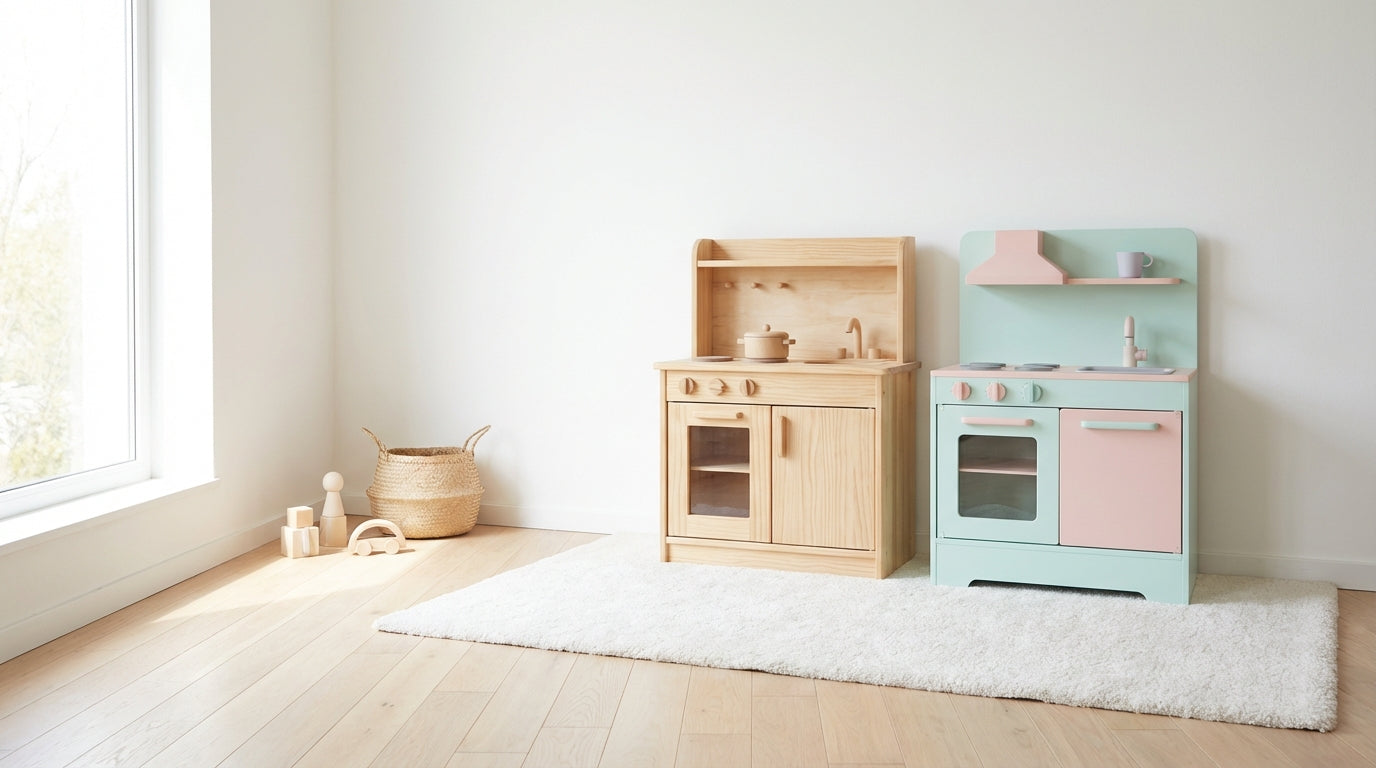
Wooden or plastic play kitchen: the quick comparison
Wood often scores with stability and sound, plastic with weight and care. So you don't get lost in 37 browser tabs, here are the typical differences – no drama, but with a healthy dose of common sense:
| What to look at | Wooden play kitchen | Plastic play kitchen |
|---|---|---|
| Stability | Often very stable (weight helps) | Can be wobblier (depending on the model) |
| Noise level | Usually quieter, a “duller” sound | Often rattlier, more “clickety-clack” |
| Care | Wipe with a damp cloth, don't soak | Very easy to wipe clean, often resilient |
| Look | Often homier, a more “furniture-like” look | Everything from colourful to minimalist |
| Durability | Can last a long time, partly repairable | More likely to scratch or become loose |
| Moving it around | Harder to shift | Easy to carry, quickly rearranged |
Rule of thumb: wood tends to stay put, plastic tends to get clean quickly. And yes, there are exceptions – but as a rough guide, it holds true surprisingly often.
What makes a play kitchen truly “safe”?
Safety doesn't depend on the material, but on workmanship, labelling and age suitability. According to the BMUKN (German Federal Ministry for the Environment), toys in the EU must meet safety requirements and must not endanger health.

DIN EN 71 is a series of standards describing tests for toy safety. Depending on the part, these include mechanical and physical requirements as well as tests for the transfer of certain substances; for DIN EN 71-3 (migration of certain elements), DIN e. V. provides information.
Safety note: For children under 3 years, small parts that can come loose are a real risk. Pay attention to the age recommendation, warning notices, sturdy screw connections and clean edges.
Stability means: the kitchen doesn't tip over when children lean on it. In practice, you can tell by its weight, a wide stance, and whether doors and drawers open without the kitchen “walking” along.
“Migration of certain elements” means that certain substances can transfer from materials on contact. For parents, the benefit is simple: it's a testing term showing that chemical requirements are looked at systematically.
We're a family business based in Hamburg and have been doing this for 66 years – safety isn't waved through here. Ulli & Flo (yes, we're parents) always look first at clean workmanship, clear labelling and understandable warning notices when it comes to toys.
Wooden play kitchen: strengths, weaknesses and who it suits
A wooden play kitchen often looks like a small piece of furniture and usually stands more steadily. You notice this especially when two children are “cooking” at the same time and one of them is also emptying the fridge on the side (purely on principle).

- Stand & stability: The weight helps against wobbling and tipping.
- Sound: Many find wood less shrill in tone.
- Practical for repairs: A loose screw is often quickly tightened.
- Look: Often blends in more discreetly in the living room.
The honest drawbacks are weight and moisture. If you want to move the play kitchen around often, “heavy” suddenly isn't a quality feature anymore. And wood prefers damp to wet: too much water can look unsightly over time.
Practical tip: Felt glides under the feet instantly turn “heavy” into “movable” – and your floor breathes a sigh of relief.
If you'd like to look at wooden options in peace, the overview of wooden play kitchens helps. It's simply a way to get a feel for sizes, colours and features – without having to go to bed with a tape measure.
Plastic kitchen: strengths, weaknesses and when it's worth its weight in gold
A plastic kitchen is often the relaxed choice when things need to be quick. Light, wipeable, quickly rearranged – ideal if the kitchen stands in the living room during the day and should be “gone” again in the evening.
- Care: Usually very easy to clean.
- Weight: Handy for moving around or taking along.
- Features: Depending on the model, more “clicks” and moving parts.
The typical annoyances are noise and visible signs of wear. Plastic can rattle, and depending on the surface, scratches show up more quickly. It's also worth taking a look at gaps, edges and small parts – that's where you see whether a plastic kitchen has been well thought out.
Accessories compared: wood vs. plastic (and why a mix is often best)
Accessories turn “it just stands there” into real role play – often more important than the material. A simple play kitchen becomes a local pub, café and pizzeria all in one with good accessories. An expensive kitchen without suitable accessories? It happens, but then it sometimes just stands around looking pretty. That's a talent, too.
Play kitchen accessories are add-ons such as pots, pans, play food, cutlery and children's dishes. The benefit is very practical: children practise routines (pouring, stirring, serving) and act out social situations.
Wooden accessories: feel, sound, durability
Wooden accessories often feel pleasant in the hand and sound “calmer”. Look for smooth edges and a surface that wipes clean easily.
- Plus: quality feel, often long-lasting
- Minus: can feel “hard” when dropped (and yes, sometimes on feet)
Plastic accessories: light, affordable, quick to clean
Plastic accessories are light and often very easy to care for. Especially with play food for cutting or stacking, or with lots of individual pieces, this can be pleasant in everyday life.
- Plus: light, often cheaper, easy to wipe clean
- Minus: can scratch or bend more quickly, sometimes rattlier
Our real-life favourite: the mix
A wooden play kitchen with plastic play food (or the other way round) is perfectly fine. What matters isn't “all wood” or “all plastic”, but: does it suit your child's hand size and age, and does it stay in one piece with daily use?
Practical tip: Start with a small basic set (pot, pan, 2 plates, 2 cups, cutlery). You can always buy more later – storage space, sadly, you can't.
If you'd like to browse: in the play kitchen accessories overview you'll find add-ons, and under dishes & accessories more of the “table” corner. With children's dishes, make sure they're easy to grip and have no sharp edges.
Cleaning & smell: how to keep it practical
The best play kitchen is the one you can get clean without a fuss. And yes: children cook passionately – but rarely hygienically. That's normal.

Cleaning a wooden play kitchen
Wood likes damp, but not wet – and certainly no soaking. A slightly damp cloth with mild soap is enough, then wipe dry. If some “soup” runs into the cracks: wipe it up promptly rather than waiting until it becomes an art project.
Cleaning a plastic play kitchen
Plastic is usually uncomplicated, but abrasive cleaners quickly dull surfaces. Soft cloth, mild washing-up liquid, done. Loosen sticker residue with warm water first, then peel off carefully – force always shows afterwards.
Smell/emissions: what you can do in practice
If a new toy smells, the first thing that often helps is: unpack it and air it out. Let the play kitchen (or the accessories) stand in fresh air for a while before it moves into the children's room. If the smell stays strong or bothers you: it's better to be critical and ask the manufacturer.
Noise & nerves: how to tame the “clickety-clack”
For many families, noise is the secret main reason for choosing wood. Especially in open-plan living areas, a rattly plastic kitchen can become tiring over time – not for the child, but for the adults who only wanted to drink their coffee “in a minute”.
- Underlay: A thin mat or rug under the kitchen absorbs sound.
- Accessories: Metal pots are often louder than wooden or plastic ones.
- Door stoppers: If doors bang, small felt dots at the contact points help.
And if it's still loud: sometimes that's simply play. Then the only thing that helps is old northern German wisdom: take a deep breath and glance outside to check the sky is still there.
Sustainability: what you can judge without mental gymnastics
“More sustainable” is usually whatever is used for a long time, repaired or passed on. Whether wood or plastic comes out better depends heavily on the specific product: origin of materials, workmanship, durability and how long it's really in use.
- Longevity: Will the kitchen last several years and perhaps siblings, too?
- Passing it on: Is it easy to sell or give away because it stays sturdy?
- Repair: Can you tighten screws, replace parts, fix wobbly doors?
Quite pragmatically: the “most sustainable” play kitchen is the one that doesn't need replacing after a year. And yes, sometimes that's a robust wooden play kitchen – but sometimes it's also a really good plastic kitchen that simply withstands everything.
Checklist: the buying criteria that really matter
With this list, you can make a decision without tying yourself in knots. You can tick it off in your head – or jot down briefly what matters to you.
- Stability: Does nothing wobble, nothing tip, and do doors open without the kitchen “walking” along?
- Edges & corners: Does everything feel smooth, with no sharp spots?
- Small parts: Do the accessories match the age recommendation, and does nothing come loose easily?
- Size: Does the working height suit your child, without them constantly “cooking on tiptoe”?
- Cleaning: Can you reach all the surfaces without special tools?
- Noise: Open-plan living = better to plan for quieter.
- Accessories: A good basic set is better than 50 pieces lying everywhere.
- Space: Is there storage for accessories, or does everything end up in the laundry basket?
Decision guide: if… then… (without the headache)
This little “if-then” guide doesn't replace a gut decision, but it helps sort things out. You're still allowed to choose by looks in the end – this isn't a tax return.

| If in your home… | Then often better is… | Why |
|---|---|---|
| the kitchen has a fixed spot | Wood | Stable, quiet, more “furniture-like” |
| you often have to rearrange/tidy up | Plastic | Light, quickly carried away |
| several children play at the same time | Wood | Weight helps against wobbling |
| cleaning really has to be fast | Plastic | Wipeable, often resilient |
| you're sensitive to noise | Wood (or quiet accessories) | Often less “clickety-clack” |
| you mix accessories anyway | Both possible | Mixing is everyday life, not rule-breaking |
If you also want to think about sizes and variants, the overview Mini, small or large? The right play kitchen for every age helps. It saves you from buying the wrong one if space is tight.
Image ideas: alt text suggestions (so it's visually clear, too)
Good images show details such as edges, feet and accessory size. Here are a few alt text suggestions you can use as they are or adapt:
- “Wooden play kitchen in a children's room, close-up of sturdy feet and turning knobs”
- “Plastic children's kitchen with wipeable surface, sink and hob photographed from above”
- “Comparison of wooden and plastic accessories: pots, plates and cutlery side by side on a table”
- “Detail shot: rounded edges on a play kitchen, safe workmanship”
- “Play kitchen with basic accessory set: pot, pan, two plates, two cups, cutlery”
FAQ
Wooden or plastic play kitchen: which is better?
The better play kitchen is the one that fits your everyday life. Wood is often sturdier and quieter, plastic often lighter and quicker to clean. What matters is stability, clean workmanship, a suitable age recommendation and accessories that actually get played with – not just look pretty.
How do I clean a wooden play kitchen properly?
With little water and without soaking. Wipe with a slightly damp cloth and mild soap, then rub dry. Avoid standing moisture, especially in corners and on edges. Small scratches are normal in children's everyday life – often it's simply play being lived.
What should I do if a new play kitchen smells strongly?
Air it out first, then stay critical if it doesn't get better. Unpack the play kitchen and let it stand in fresh air for a while. If the smell stays strong or unpleasant, ask the manufacturer or use your right of return. Your gut feeling is a good guide here.
Which is quieter: a wooden play kitchen or a plastic kitchen?
Wood is often quieter because it sounds less rattly. But accessories and the surface underneath count, too: metal pots on a hard floor are loud – no matter which kitchen stands above them. A rug or mat and felt dots on doors can noticeably reduce the noise level.
Is a wooden play kitchen automatically more sustainable?
Not automatically – it depends on the specific product. More important than the material alone are durability, repairability and whether the play kitchen is used for a long time or passed on. A sturdy kitchen that lasts for years is often the better choice in everyday life than a model that quickly needs replacing.
How can I tell a play kitchen is safe?
By sturdy workmanship, clear labelling and appropriate warning notices. Look for smooth edges, firm screw connections and accessories without easily detachable small parts – especially for children under 3 years. According to the BMUKN, toys in the EU must meet safety requirements.
If you now have a clear feeling whether wood or plastic will be moving in with you, you've already won. To browse variants and add-ons, you'll find the overview in the play kitchen collection – and sometimes a good pot set is all it takes to open a “restaurant”.