Doll for 1-Year-Olds: How to Find the Right Doll (Including a Doll's Pram)
At a glance
- Doll from 1 year: soft, light, with no detachable small parts.
- From 2 years: dressing and undressing gets exciting, so choose accessories that are big & sturdy.
- From 3 years: a baby doll plus simple extras, if your child loves role play.
- Doll's pram: choose one that is stable & tip-proof, because it often doubles as a “walker”.
- Material & care: washable is worth its weight in gold in everyday life.

Mini FAQ (quick answers)

Ulli & Flo
Owners of bieco · Hamburg · parents themselves
With our own children, we learned that the first doll doesn’t have to be perfect – it just has to fit nicely into little arms. If it’s washable, everyday life feels twice as friendly. Feel free to browse our Dolls collection.
- When is the right time for a first doll? Usually from around 12 months, when imitation begins.
- What matters for 1-year-olds? Soft, light, washable, no small parts.
- When is a doll's pram suitable? Often from 18 months to 2 years, once your child walks steadily.
- How many accessories? Start small and add later – otherwise they’ll end up living under the sofa.
A doll for a 1-year-old should above all be soft, light and free of detachable small parts. That way your child can cuddle it, carry it and drag it everywhere – without you silently thinking “please don’t” at every button. In this guide you’ll find a simple age guide (1, 2, 3 years), a handy table, safety points and a few tricks that work in real life. Ulli & Flo write here as parents – with northern German calm and the know-how of a Hamburg family business that has been accompanying families for 66 years.
When should you give a first doll?
A first doll often suits children from around 12 months, when cuddling and imitating begin. Many children then like to hold something “like a baby”, lay it down, tuck it in or babble to it. It’s not compulsory and it’s not a competition – more of an invitation: “Here, you can be the caregiver for once.”

A doll is a role-play toy that lets children practise everyday life on a small scale. Role play means your child acts out situations (feeding, comforting, putting to bed) and in doing so sorts through feelings, language and routines – without anyone rolling out a curriculum.
Practical tip: If you’re unsure, start with a simple cuddly doll. You can add accessories later – it’s like salt: you can always season to taste afterwards.
Comparison: Age → Doll type → Must-haves → No-gos
A small age table usually helps you make a good choice faster. It doesn’t replace your gut feeling, but it saves you from agonising in the shop aisle (or at night on your phone, when you should really be sleeping).
| Age | Doll type (typically suitable) | Must-haves | No-gos |
|---|---|---|---|
| from 1 year | Fabric doll / cuddly doll | light, soft, easy to grasp, washable, embroidered details | detachable buttons/beads, hard edges, mini accessories |
| from 2 years | Doll with simple clothing | sturdy, can be dressed and undressed, accessories big & easy to grip | lots of small parts, fiddly fastenings, “too heavy” |
| from 3 years | Baby doll (optionally with simple extras) | easy to hold, sturdy construction, manageable accessories | overly complex features, tiny parts, “decoration only” |
| from 18 months–2 years (doll's pram) | Doll's pram / doll buggy | stable, tip-proof, good handles, smooth, quiet rolling | wobbly, sharp edges, unsuitable age labelling |
What makes a good first doll?
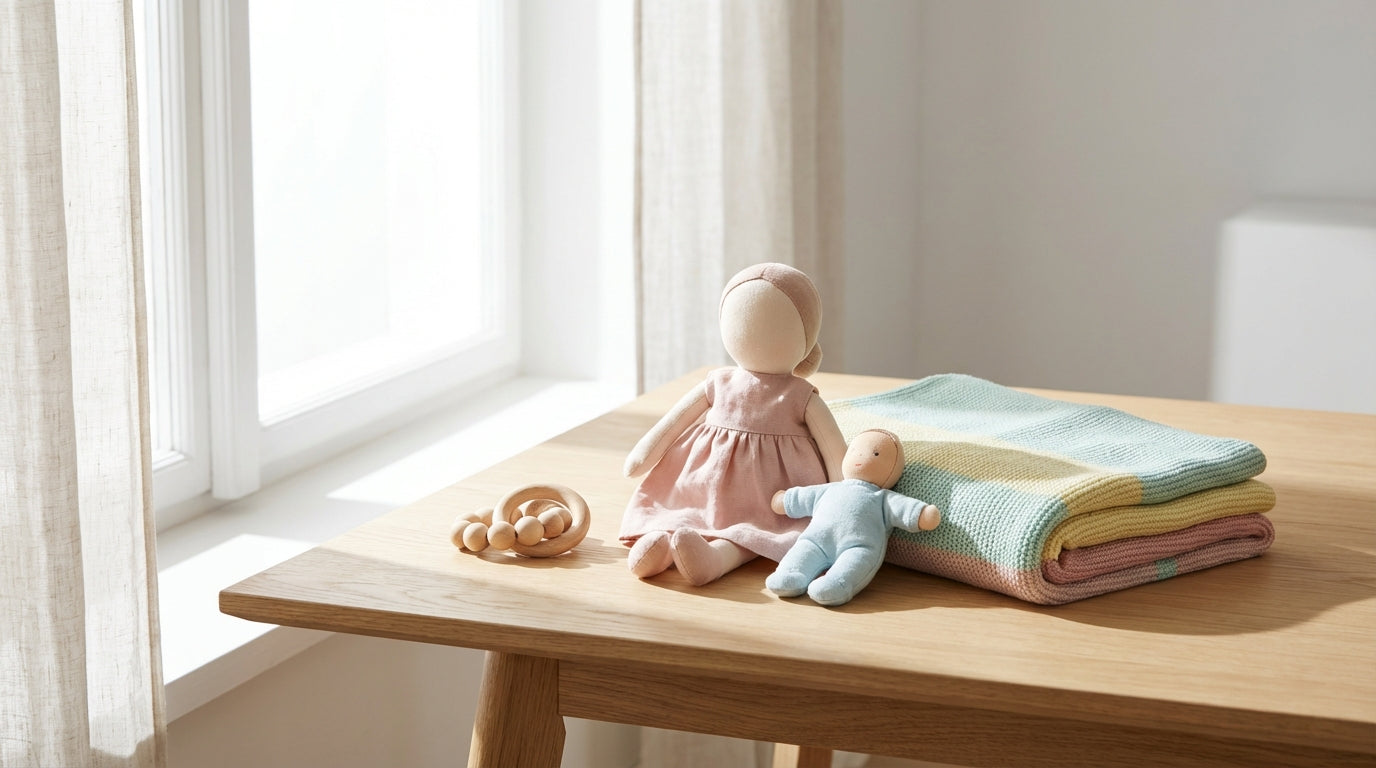
Soft fabric dolls or light cuddly dolls without hard parts make good first dolls. It doesn’t have to “do everything” – it should fit into little arms, not be heavy, and survive the occasional tumble off the sofa. Spoiler: it will fall.
A fabric doll is a soft textile doll that’s lovely to cuddle. The benefit is simple: fewer hard spots, fewer tears, more “doll comes to bed too” (and yes, that can be very sweet – until you’re also asked to tuck it in at night).
Look for clear age labelling and warnings, especially for children under 36 months. In the EU, the Toy Safety Directive stipulates, among other things, that warnings such as “Not suitable for children under 36 months” are used where corresponding risks exist, according to EU Directive 2009/48/EC (EUR-Lex: Toy Safety Directive 2009/48/EC).
Small parts are a real safety issue for children under 3 years. According to the Bavarian consumer portal (Verbraucherportal Bayern), toys for children under 3 must not contain detachable small parts; anything that fits into a test cylinder counts as a small part (Verbraucherportal Bayern: Swallowable toy parts).
Safety note: For children under 3 years: no detachable buttons, beads, bows or mini dummies on the doll. If you can pull it off or pick it off, a child usually can too.
If you’d like an overview, a collection with different doll types helps. In our Dolls overview you can quickly see which are more cuddly dolls and which are more role-play dolls.
Which doll for 1-year-olds?
For 1-year-olds, a soft, light doll without detachable small parts is best. At 12–18 months it’s all about grasping, squeezing, carrying around and “doll comes along”. Lots of accessories are usually too early – and reliably disappear into the sofa crack, where they start a new life.
- Size & weight: small to medium-sized, so your child can carry it alone.
- Material: soft, pleasant, with no hard edges or rigid parts.
- Face & details: embroidered eyes are often the more relaxed choice.
- Care: washable or easy to wipe clean – because everyday life is, well, everyday life.
A good test: can your child pick the doll up and put it down on their own? If that works, it’s more likely to become a true playmate rather than “pretty, but impractical”.
Which doll for 2-year-olds?
At 2 years, the doll can happily be dressable and undressable, but should still be sturdy. Role play now often becomes more concrete: feeding, changing, tucking in, going for a walk. Fine motor skills are improving – still, “just a quick taste” isn’t completely a thing of the past for some children.
Fewer pieces often bring more calm to play than a huge set. One outfit to change into or a small blanket is often perfectly enough. If you’d like to add something, you’ll find ideas in Doll accessories and Doll clothes – choose a few pieces that are easy to grip.
Practical tip: Set up a little “doll basket” (blanket, 1 outfit, 1 large bottle/cup). That keeps things tidy – and you won’t be searching with a torch in the evening.
If your child loves changing clothes, simple fastenings are worth their weight in gold. Velcro or generous openings are often less frustrating than mini buttons – for little hands and for grown-up nerves.
Which baby doll for 3-year-olds?
From 3 years, a baby doll often suits well if your child enjoys stories and role play. Many children now build real scenes: “Baby is sleeping”, “Baby is hungry”, “We’re going to the doctor”. A baby doll can support that, but it doesn’t have to be super realistic.
A baby doll is a doll that supports caregiving role play such as feeding and comforting. The benefit isn’t in “high tech”, but in your child being able to act out things they know from everyday life.
For accessories, the rule is: big, sturdy and easy to grip rather than many and tiny. Lots of small parts rarely make play better – more often just more chaotic. If your child plays very gently and you’re looking for something more realistic, you’ll find a selection in Reborn dolls.
Toy standards describe tests intended to reduce risks from materials. DIN explains that standards such as DIN EN 71-3 set out requirements and test methods for the migration of certain elements from toys (DIN e. V.: Info on DIN EN 71-3).
Materials & care: so your doll lasts
The best doll is the one that survives everyday life – including juice, sand and spaghetti. And yes: spaghetti finds ways that science has yet to explain.
- Washability: If a doll is washable, it’s a real stress reducer in family life.
- Seams & workmanship: Look for clean seams and firmly attached details – especially when there’s lots of cuddling and tugging.
- Smell & feel: A doll should smell neutral and feel pleasant to touch – children are surprisingly honest about this.
Transparency helps: look for material information and clear care instructions. We like things clear and honest ourselves – not least because, as parents, we have no desire to play guessing games.
When is a doll's pram suitable?
Many children use a doll's pram from around 18 months to 2 years, once they walk steadily. Some enthusiastically push anything with wheels from an early age. Others ignore the pram – until at 2.5 it suddenly becomes “the most important vehicle in the world”. Both are normal.
The most important quality is stability, because children like to lean on things. In practice, a doll's pram is often tested as a “walker”. Not officially, but very reliably.
Follow the age recommendations and warnings on the product. The EU Toy Safety Directive regulates labelling requirements and warnings, among other things (EUR-Lex: Directive 2009/48/EC).
If you want to dive deeper, a dedicated doll's pram guide with more details can help. You’ll find it here: Doll's pram: age recommendation, safety and buying advice.
At what age do children play with a doll's pram?
Many children use the doll's pram most intensively between 2 and 5 years. At two, it’s about pushing, loading and unloading. From three it becomes a story: the doll has to sleep, go shopping, visit Grandma. And at some point a teddy goes along for the ride. Or a digger. We don’t judge.
The pram suits best when your child currently loves to “care for” things or to transport things. Some children use it for role play, others as a lorry for building blocks – the main thing is that it’s stable and child-friendly.
How we choose at bieco (short & honest)
With toys, we look first at safety, workmanship and suitability for everyday life. As a Hamburg family business, we’re rather pragmatic about it: can the item take a beating, is it child-friendly, and is the information on material and age easy to understand?
For 66 years we’ve seen that parents need clear information rather than pretty promises. That’s why we pay attention to transparent product information, clean workmanship and making sure a toy works in real family life – not just in the photo.
FAQ
When should you give a first doll?
The first doll usually suits from around 12 months, when your child likes to cuddle and imitate. Some children start earlier, others later – it’s not a race. What matters is that the doll is light, soft and has no detachable small parts, so it’s safe in everyday life and actually gets played with.
Which doll is best for 1-year-olds?
For 1-year-olds, a soft fabric or cuddly doll without detachable small parts is best. It should be easy to grasp, have no hard edges and ideally be washable. At this age it’s mostly about carrying, squeezing and cuddling – accessories are usually still a side issue.
Which doll is suitable for 2-year-olds?
For 2-year-olds, a sturdy doll that’s easy to dress and undress is often a good fit. Accessories can join in, but preferably in big, easy-to-grip pieces. Keep making sure that no small parts can be detached – especially if your child still explores a lot with their mouth.
Which baby doll suits 3-year-olds?
A baby doll suits 3-year-olds particularly well if your child loves role play. Simple extras can be exciting but aren’t essential. More important is that the doll is easy to hold and the accessories stay manageable. “Playable” is almost always better in everyday life than “perfectly realistic”.
When does a doll's pram make sense?
A doll's pram often makes sense from 18 months to 2 years, once your child walks steadily. Look for stability, because children like to lean on it while pushing. Age recommendations and warnings also help you judge whether the pram is already right for your child.
How many doll accessories do you need at the start?
At the start, very few accessories are usually enough: a blanket and an outfit are often plenty. Too many pieces don’t automatically make play nicer – more often just more cluttered. If you want to add more, treat it like a wardrobe: a few favourites that actually get used.
All in all, the “right” doll is the one your child truly takes into their arms. If you’d like to keep browsing: in our Dolls overview you’ll find different options, and for additions there are Doll accessories and Doll clothes – nice and relaxed, step by step.