Stuffed Toy for Dogs & Cats: Choose Safely, Check & Keep Clean
At a glance
- A stuffed toy for your dog or cat is fine if it is sturdy and doesn't lose any parts.
- Keep it simple: firm seams, embroidered details, no ribbons or button eyes.
- Supervise play at first and do the quick check regularly.
- Hygiene works best with a clear separation: pet plush stays pet plush, and your child's cuddly toy stays your child's.
- If something tears or stuffing comes out: take it away, no discussion.

A stuffed toy for a dog or cat makes sense when it stays intact and your pet can't bite anything off or swallow it. That's the whole magic – the rest is fine-tuning. In this guide, I'll show you how to assess a plush dog toy or plush cat toy in everyday life, which risks really matter (small parts, threads, strings) and how a few simple steps can save hygiene and family harmony. As we say in northern Germany: better to check quickly once than to be annoyed for a long time afterwards.

Ulli & Flo
Owners of bieco · Hamburg · parents themselves
More than one plush toy at our place has briefly changed owners – from the nursery to the dog bed. With a few checks, it stays cute and safe. Feel free to browse our Stuffed Toys collection.
Are stuffed toys suitable for dogs or cats?
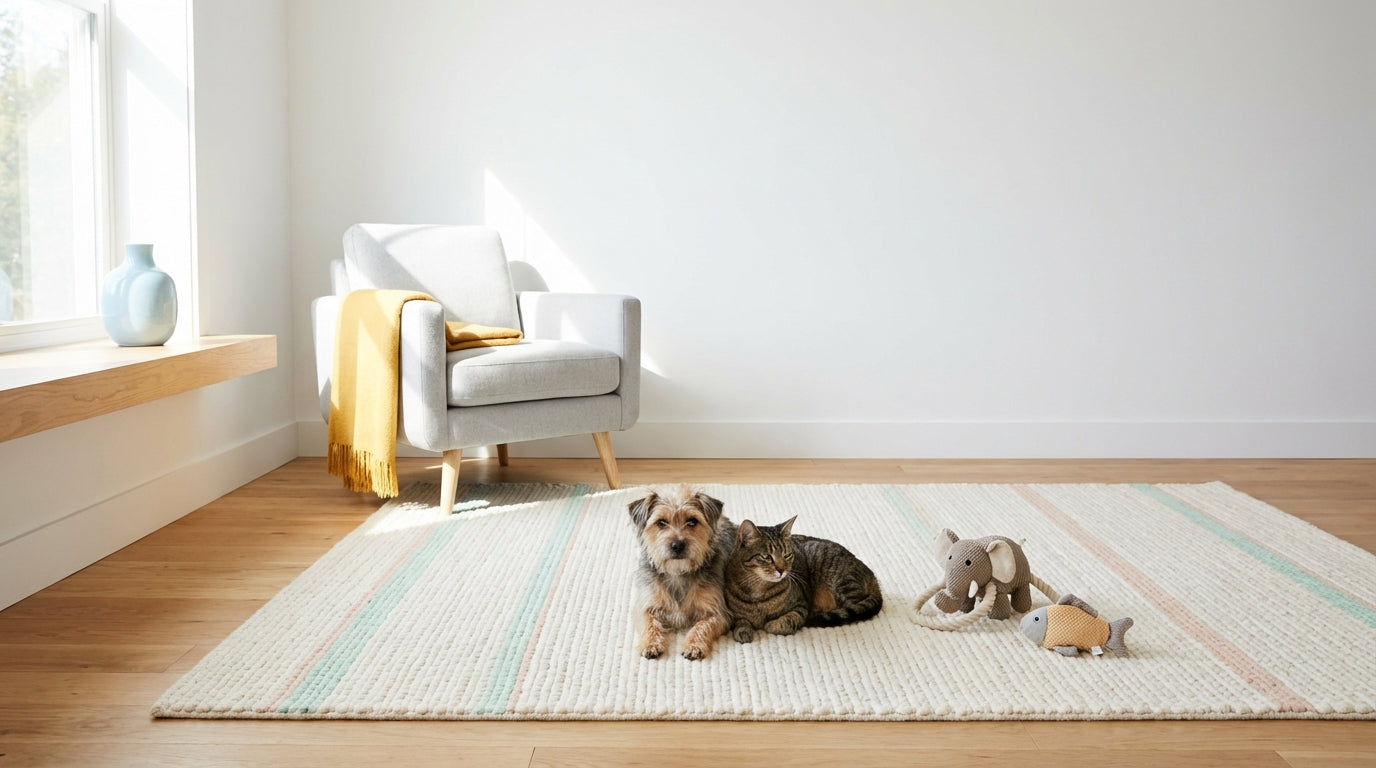
Yes, but only if the plush toy suits your pet's play style. Some dogs are gentle “carriers” and proudly haul their plush friend to their bed. Others are more the “wrecking ball” type and turn any stuffed animal into confetti within minutes. Cats, on the other hand, sometimes cuddle but often prefer to hunt – and anything with a string suddenly becomes highly interesting.
A stuffed toy is only okay for pets if it stays in one piece under strain. As soon as seams open or parts go missing, the risk of something being swallowed goes up. According to the German Animal Welfare Federation, dogs should only play with harmless toys that don't tear and can't be swallowed, ideally under supervision. (Deutscher Tierschutzbund e.V.)
Definition: A “small part” is a detachable piece that can be swallowed. For toys, “swallowable” is assessed, among other things, with a test cylinder (if a part fits inside, it counts as risky). According to the Bavarian consumer portal, this is exactly the reason behind that test. (Verbraucherportal Bayern)
Which stuffed toys are suitable for pets?
The best choice is simple plush toys with firm seams and no decorative extras. The fewer “sticking-out ideas” (bows, buttons, glitter, long labels), the less can come off. It sounds unromantic, but it's exactly what works in everyday life.

- Workmanship: Tight seams, no loose threads, no easily torn transitions (e.g. at the ears).
- Details: Embroidered rather than plastic (eyes, nose, patterns).
- Shape: Not too small, not too “pointy” – anything that's easy to grab gets tugged on with enthusiasm.
- Filling: Less “flying stuffing” is more – especially if your pet likes to pluck.
- No strings/ribbons: Anything that can wrap around is especially critical for cats.
Practical tip: Do the “two-minute check”: pull, tug and squish it all over. If threads come loose while you do: skip it.
For strong chewers, plush is often not a good idea, no matter how cute. If your dog regularly bites toys open or “disembowels” them, a plush toy for pets is usually only suitable under close supervision – or not at all. That's not a training problem, it's simply character (and jaws).
What risks are there with pets and stuffed toys?
The most common risks are swallowing, tangling and “thread in the mouth” moments. That sounds dramatic, but at its core it's simple: anything that can come off can end up in the mouth. And anything that ends up in the mouth can be swallowed.

- Small parts: Plastic eyes, buttons, squeaker elements, decorations.
- Threads & filling: Pulled-out threads and stuffing aren't just messy, they can cause problems if swallowed.
- Strings/ribbons: They can tangle; strings are especially tricky for cats because they play with them and can also swallow them.
- Toys that are too small: They increase the risk that the whole toy fits into the mouth.
- Damaged toys: Even good workmanship doesn't last forever, so check regularly and consistently take away anything damaged (Deutscher Tierschutzbund). (Deutscher Tierschutzbund e.V.)
Safety note: As soon as seams open, stuffing comes out or parts are missing: take the stuffed toy away immediately and replace it.
When it comes to harmful substances, it's worth taking a sober look at the labelling. A CE mark belongs on children's toys in the EU – it shows that the manufacturer declares conformity with the requirements. The basis is the EU Toy Safety Directive 2009/48/EC. (EUR-Lex)
Checklist: How to choose a stuffed toy for your dog or cat in everyday life
With this checklist, you can decide in under a minute whether a toy is up to the job. Perfect for the moment when your child just wants to “have a look” and the dog already thinks “mine”.

- Seams & fabric: Check all over, including the ears/arms/tail. Nothing should creak or give way under tension.
- Details: Embroidered is better than glued or buttoned.
- No strings: It's better to remove bows, cords and long labels (cut off cleanly, without leftover threads).
- Size: Big enough that it can't fit completely into the mouth.
- Play type: Carriers/cuddlers suit plush better; shredders/chewers less so.
- Start under supervision: Watch how your pet handles it, especially in the first few days.
- Repeat regularly: What was intact yesterday can look “odd” tomorrow.
Practical tip: Give a new plush toy after a walk or feeding. Tired pets are far less of a “wrecking ball”.
Puppy, adult dog, senior: does it make a difference?
Yes: age and teeth often decide whether plush is a good idea. Puppies explore a lot with their mouths and test boundaries – including with toys. Adult dogs are sometimes more relaxed, but sometimes also very effective at destroying things. Seniors often prefer to carry and cuddle, but can be more sensitive if something is hard or edgy.
- Puppies: Shorter play sessions, plenty of supervision, and an especially strict check for loose seams.
- Adult dogs: A good fit if your dog is “gentle”; be careful with strong chewers.
- Seniors: Often suitable as a soft carrying or cuddling object, as long as nothing can come off.
Definition: “Supervision” means you can step in before something is swallowed. It's not enough if your pet plays “somewhere in the house” and you just hope everything goes well.
Household with a baby or toddler: How do we keep pet plush and children's plush separate?
The simplest rule is: children's cuddly toys and pet toys stay separate. Not on principle, but because of hygiene, tiny tears and the perfectly normal “who had that in their mouth?” factor. It saves arguments and laundry loads (okay, a little).
- Fixed places: Children's plush in the nursery/basket, pet plush in the dog bed or in a box.
- Clear look: Pet toys are welcome to look different from your child's favorite bunny.
- If it happens anyway: Wash the children's cuddly toy once and check it for damage beforehand.
If you'd like to read up on the difference between cuddly toys, plush toys and stuffed animals, a short overview helps. Here is our explanation: Cuddly Toy, Plush Toy or Stuffed Animal? The Differences Explained Simply.
Hygiene: wash, dry, sort out – without drama
Hygiene works best with a routine: check, wash, let dry completely. A plush toy for pets collects saliva, dirt and “the outdoors” faster. Look at the care label, wash at the appropriate temperature and let it dry completely before it goes back into the dog bed.

- Before washing: Check for tears and remove loose threads.
- After washing: Check the seams again (washing can reveal weak spots).
- Sorting out: If it stays musty, the filling clumps or seams give way: say goodbye.
We've collected detailed step-by-step instructions here. Washing & Caring for Stuffed Toys: How to Keep Them Hygienic and Fluffy.
What about CE, standards and “tested” – and what does that mean for pets?
CE and toy regulations help with children's toys, but they don't replace your everyday check for your pet. For children's toys, the EU Toy Safety Directive 2009/48/EC is the central basis. (EUR-Lex)
Pet toys are not automatically made to the same requirements as baby toys. That's why it's so important to look at small parts, strings, seams and size when choosing a plush cat toy or dog stuffed toy – and not just at a label that “sounds good”.
Good to know: there is a new EU Toy Regulation that applies from August 2030. According to the BMUKN, it is meant to improve consumer information, among other things (e.g. via a digital product passport). (BMUKN)
A word from Hamburg: Why we at Bieco are so picky about safety
We are a family business from Hamburg, and we know real living-room life. We've been doing this for 66 years – and yes, our team (Ulli & Flo included) has parents who have shouted “Where is the cuddly bunny?!” while the dog looked very innocent.
That's why, with materials, workmanship and notes, we'd rather be too honest than too polished. With children's stuffed toys, we pay attention to clean workmanship and transparent information – and we still say clearly: whether a plush toy is suitable for pets always depends on the animal, play style and supervision.
If you'd like to browse, here is our stuffed toy world for inspiration. Stuffed Toys is our overview, and if you like forest animals, take a look at Fox Stuffed Toys or Hedgehog Stuffed Toys.
FAQ
Which stuffed toy is right for puppies?
A simple, sturdy plush toy without small parts and without strings is suitable for puppies. Puppies test a lot with their teeth, so firm seams and embroidered details are especially important. Start with short play sessions under supervision and check the toy for tears or loose threads right afterwards.
Can my cat play with a child's stuffed toy?
If at all, then only under supervision and without strings or detachable parts. Many children's stuffed toys are not designed to be pulled or chewed on. Check the seams, eyes and labels beforehand. And in family life, a clear separation helps: what belongs to your child stays with your child.
How often should I check a stuffed toy for my dog or cat?
Check briefly before every longer play session and additionally after “wild” rounds. A quick look at the seams, ears, tail and details is often enough. According to the German Animal Welfare Federation, supervision during play is sensible so that damaged toys can be taken away in time. (Deutscher Tierschutzbund e.V.)
How often should I wash pet plush?
Wash it when it is visibly dirty, smelly or has regularly been in the mouth. Follow the care label and let the stuffed toy dry completely. The safety aspect matters too: seams can seem weaker after washing – so always check afterwards that everything is still firmly attached.
How can I tell that a plush toy is unsuitable for pets?
If your pet quickly opens seams, pulls out stuffing or bites off parts, it is unsuitable. Strong shaking and plucking are also warning signs, because seams and details suffer most from them. In that case, it's better to take it away immediately and not count on “it'll be fine” – that rarely ends as relaxed as planned.
Is a CE-marked stuffed toy automatically safe for a dog or cat?
No, CE refers to children's toys and does not replace your own assessment for your pet. The CE mark is linked to the EU Toy Safety Directive 2009/48/EC. (EUR-Lex) Whether a pet can play with it safely also depends on play type, jaw strength, small parts and your supervision.
And finally, nice and relaxed: a beloved stuffed toy is nothing bad in itself – as long as it stays safe. If you're looking for inspiration, feel free to browse our Stuffed Toys overview. And if “plush snowfall” does happen once in a while: it happens to the best of us. Even those with a laundry schedule.