Doll's Pram: Age Recommendations, Safety & the Right Handle Height
At a Glance
- A doll's pram usually suits children from around 12 months, once they walk steadily.
- Handle height: the easiest way is to go by your child's navel height.
- For ages 1–2: wide, sturdy, smooth-rolling, with no small parts.
- For ages 3–5: more “real pram feeling”, but without pinch points.
- Check: stability, wheels, edges, cords/straps, folding mechanisms.

A doll's pram usually makes sense from around 12 months, as soon as your child walks steadily and can push with confidence. Then the wobbly “let me give it a try” quickly turns into a proud chauffeur service through the living room. In this guide you'll find age recommendations (1, 2, 3 and 5 years), a simple way to measure the handle height, a safety checklist, and material and care tips. All explained so you can actually use it between the lunchbox and the laundry basket.

Ulli & Flo
Owners of bieco · Hamburg · parents themselves
We've noticed that with the right handle height, a doll's pram goes from decoration to favourite toy. And when it's sturdy, you don't have to call out “Slow down!” every three minutes. Feel free to browse our Dolls collection.
What is a doll's pram – and what is it good for?
A doll's pram is a push toy in which dolls or cuddly toys go for a ride. It's meant for role play, but in everyday life it often becomes a favourite “I'll push something in front of me” thing too. Some children like to lean on it for support at first – that's normal, but the pram should be sturdy enough for that.
Role play means children act out everyday life to understand it and practise it. Today the doll gets bundled up, tomorrow she's driven “to the doctor”, the day after she gets a banana stuffed into her sleeve. We've seen it all.
A doll's pram is a toy, not a means of transport for real babies. That sounds obvious, but in family life it sometimes needs to be said out loud once, before the big brother wants to push the little sibling “just for a moment”.
From what age a doll's pram? (Age recommendation, nice and practical)
The rule of thumb: from about 12 months – when your child walks freely and steadily. Before that, children tend to pull, tip and lean on it more than push. That can work, but it's often frustrating: pram tips, child tips, and everyone tips toward “this is annoying”. If your child already walks steadily, getting started is usually much more relaxed.

Safety note: A doll's pram is not a standardised walking aid, but children like to use it for support. So pay particular attention to stability and pinch points.
Why “walking steadily” matters so much: when pushing, the weight shifts forward. If the pram is very light or rolls extremely fast, it can shoot away. If it's very heavy, it becomes more strength training than play. You're looking for the happy medium: smooth-rolling and easy to control.
At what age do children play with doll's prams – and for how long?
Many start between 1 and 2 years, and it's often most intense between 2 and 4. In this phase the doll's pram is in use every day: putting the doll to sleep, going for a “walk”, shopping, comforting. From about 4–6 years it gets more individual: some switch to a dollhouse & accessories, others still love things “just like the real thing”.
A realistic play time is often 2–4 years, if height and quality fit. And if the pram doesn't start “wobbling weirdly” after three weeks. Children don't test toys maliciously – just very thoroughly.
Practical tip: If you're torn between two sizes, go for the slightly higher handle. Children grow faster than you can say “Where's the second sock gone again?”
Which doll's pram for which age? (1, 2, 3 & 5 years)
Which doll's pram for 1-year-olds?
For 1-year-olds, what counts is: sturdy, wide, smooth-rolling – and no small parts. At this age the pram is often driven “with the whole body”: leaning, turning, backwards, sideways. The simpler, the better.
- Wide wheelbase (tips less when used for support)
- Smooth, steady rolling (not too slippery, otherwise it runs away)
- No small parts (nothing that can come loose or end up in the mouth)
- Rounded edges and cleanly finished seams/transitions
If your child is still wobbly, a slightly “weightier” pram with a good stance often helps. But please not so heavy that it only moves with a run-up.
If you'd like to browse everything around doll play: Under Dolls you'll find the right starting point and lots of play ideas.
Which doll's pram for 2-year-olds?
At 2 years, role play becomes more concrete – the pram can have more details. A bag, a blanket, maybe a small hood: great. At the same time, children also drive faster, so stability remains a must.
- Suitable handle height (navel height is a good starting point)
- Sturdy wheels (quieter ones are nice for indoors)
- Good workmanship (nothing rattles loose)
- Easy to clean (because “the doll had spaghetti”)
The material question gets interesting now: wood often feels very sturdy, fabric models are often lighter. Both can be great, as long as the pram rolls smoothly and doesn't wobble.
If wood is popular in your home: Wooden dolls & accessories often complement the play really nicely.
Which doll's pram for 3-year-olds?
At 3 years, many children love things “just like the real thing” – the pram can be more of a real pram. Hood up, hood down, pack the bag, “buckle in” the doll (if there's a strap) and off you go. Children now steer more deliberately, so manoeuvrability is handy.
- More features are fine – as long as nothing jams or breaks
- Good manoeuvrability (for corners in the hallway and in the park)
- Room for bigger dolls (baby dolls often get bigger)
Accessories round out the play, but it doesn't need to get out of hand. A blanket, an outfit, maybe a little pillow – done. You'll find ideas at Doll accessories and Doll clothes.
Which doll's pram for 5-year-olds (and older children)?
For 5-year-olds, it's less about “support” and more about realism and comfort for play. Many now want a pram that feels “real”: sturdy, not too babyish, with space and ideally a basket or bag. And because more happens outdoors, connections and wheels need to cope with that.
- A slightly bigger pram (so it doesn't look “too small”)
- Robust connections (because it's played with outdoors)
- Good wheels (kerbs are the final boss)
If very large or heavy dolls ride along, check the lying surface and load-bearing capacity. Nothing should sag or wobble when your child pushes.
How tall should a doll's pram be? (Handle height in 30 seconds)
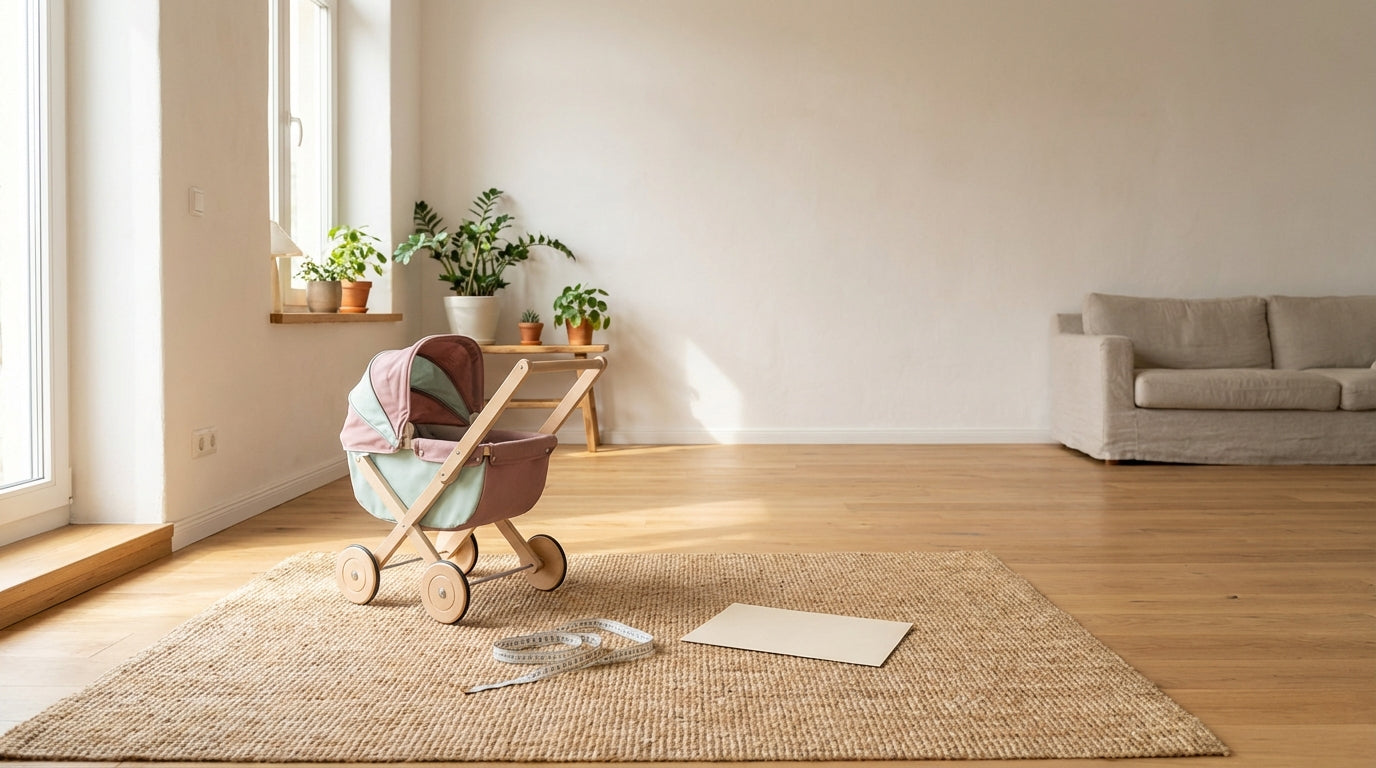
The best handle height is roughly at your child's navel height. That way your child pushes upright, has control and trips less. Too low: a hunched posture and “I'm just hanging on to this”. Too high: shoulders up, less control, and it's more likely to tip when steering.

- Have your child stand (barefoot or in the shoes they usually play in).
- Measure navel height (floor to belly button, a rough measurement is enough).
- Check the handle (a few centimetres above or below is fine).
Practical tip: Test at home with a laundry basket or a box your child can push. If they stay upright while doing it, the direction is right for the doll's pram too.
Materials: wood vs. fabric/metal – what suits your family?
Wood, fabric or metal is less a matter of belief than an everyday question: where do you play, and how wildly? Indoors in the living room, different rules apply than outside on the pavement. And yes: some children drive their pram as if there were points for the fastest corner.

- Wood often feels sturdy and durable, but can be heavier depending on the model.
- Fabric/metal often feels “like a real pram” and is frequently lighter.
- Basket/wicker looks pretty and classic, but needs clean workmanship without prickly spots.
More important than the material is the workmanship: nothing splinters, nothing pinches, nothing comes loose. Take a look at the wheels, axles, seams, screws and edges – those are the spots that win or lose in everyday life.
Are doll's prams safe for toddlers? Checklist + standards
A doll's pram is safe when it is sturdy and has no pinch points, small parts or risky cords. That's the short version. And because nobody has time for 20 pages of small print, here's a check that works in everyday life.
Safety checklist (short & helpful)
- Stability: Does it tip easily when your child pushes sideways or leans on it?
- Pinch points: Are there folding mechanisms, scissor joints or gaps for fingers?
- Small parts: Can buttons, decorations, screw caps or clips come off?
- Edges & surfaces: No sharp edges, no splintering spots, no loose seams.
- Cords/straps: Nothing that could wrap around a neck or fingers.
- Wheels: Are they firmly attached, do they run cleanly, does nothing get caught?
Safety note: According to the EU Toy Safety Directive 2009/48/EC, toys should be designed so that risks such as suffocation and strangulation are minimised. (Source: EUR-Lex)
DIN EN 71 is a series of standards describing tests and requirements for toy safety. According to DIN e. V., DIN EN 71-3 covers, among other things, requirements and test methods for the migration of certain elements from toy materials. (Source: DIN e. V.)
A pinch point is a gap or joint in which fingers can get trapped. On doll's prams this mainly shows up with folding or adjustable mechanisms, so take a deliberate look and try them out once.
Care & everyday life: how to keep the doll's pram looking nice for longer
With a little care, a doll's pram lasts longer – and looks less like a “permanent building site”. You don't have to become a hobby workshop enthusiast. A few small routines are enough.
- Fabric parts: Follow the care instructions on the product; remove stains as soon as possible, before they “sink in”.
- Wooden parts: Wipe dry or with a slightly damp cloth and let dry well.
- Wheels: Remove hair and fluff now and then so nothing rubs or jams.
- Screws/connections: If something wobbles, take a look (and tighten if necessary).
If the pram is used outdoors, a quick “hallway check” after playing is worthwhile. Sand in the wheel is like popcorn at the cinema: small, but eventually everywhere.
What we look for at Bieco (from a parent's perspective, no fuss)
We'd rather check toys once more, because in doubt children use them very creatively. We're a family business from Hamburg and have been doing this for 66 years – and Ulli & Flo write here as parents for parents. That's why, with toys, we pay particular attention to clean workmanship, easy-to-understand use and the things that really count in everyday life.
Transparency is part of it: materials and safety requirements should be easy to understand. If you're unsure, a simple look often helps: are there loose parts, sharp edges, risky cords or mechanisms that could trap fingers? That's exactly where the typical annoyances happen.
Which doll's pram is the best? (Buying advice without the fuss)
The best doll's pram is the one your child enjoys pushing – and where you don't have to keep calling “Careful!” So you can get a feel for it quickly, here are the most important criteria in a small overview.

| Criterion | How to recognise it | Especially important for |
|---|---|---|
| Stability | Wide base, doesn't tip when leaned on | 1–2 years |
| Handle height | About navel height, child pushes upright | all age groups |
| Wheels & rolling | Roll smoothly, sit firmly, nothing rubs | indoors & outdoors |
| Features | Hood/mechanism without pinch points | from 3 years |
| Cleaning | Wipeable, textile parts washable | all (spaghetti happens) |
If you're looking for a gift, “fits the child's height” is often the best hit. Looks are nice, of course. But a pram that's easy to push actually gets used.
FAQ
From what age a doll's pram?
Usually from about 12 months, once children walk freely and steadily and can push with confidence. Some are interested earlier; in that case the pram should be especially sturdy and smooth-rolling. If your child tips far forward when pushing or the pram slips away, it's better to wait a little longer or choose a sturdier model.
What is the right handle height?
Ideally the handle height is roughly at your child's navel height. That keeps their posture upright and steering works better. A few centimetres of difference is no big deal. If possible, let them try pushing briefly – you'll see within ten seconds whether it fits.
Wood or fabric: which is better?
Both can be good; what matters is stability and workmanship. Wood often feels very sturdy, fabric/metal frequently feels “like the real thing” and is often lighter. Look for smooth rolling, firm wheels, clean edges, and make sure nothing comes loose or pinches.
Are doll's prams safe for toddlers?
Yes, if the pram is sturdy and has no small parts, cords or pinch points. Check folding mechanisms, wheels and decorative elements in particular. According to the EU Toy Safety Directive 2009/48/EC, risks such as suffocation and strangulation should be minimised. (Source: EUR-Lex)
How long is a doll's pram used?
Often 2–4 years of play are possible, depending on the child and fit. Many use it most intensively between 2 and 4 years. If handle height and quality fit, it often stays interesting for longer – then more for playing “going on an outing” and role play with friends.
What matters more: lots of features or a simple pram?
For small children, a simple, sturdy pram is usually better than a feature-rich one. At 1–2 years, control counts: smooth-rolling, sturdy, with no fiddly parts. From 3 years, features can be fun, as long as they work cleanly and don't pinch fingers.
Bottom line: a doll's pram is a little piece of everyday life to act out – and it's allowed to be robust. If you'd like to round out doll play, under Dolls you'll find matching companions and accessories. And if you're just thinking “one more thing in the hallway”: don't worry. It passes. Mostly.