Wooden Train Sets for Kids: A Guide to Age, Quality & Space
At a glance
- A wooden train set for kids works well when age, piece size and available space all fit together.
- Start small (oval + train) and only expand when there's real demand.
- Look for smooth edges, firm connections and clear warning labels.
- Many wooden tracks can be mixed – switches, bridges and heights are the typical stumbling blocks.
- Storage decides family peace: a crate, basket or flat box.

A wooden train set for kids is a great choice when it suits your child's age, motor skills and your space. You don't need to turn it into a science – but a few practical checks will save your nerves later (and the infamous search under the sofa). In this guide you'll get step-by-step orientation: from what age it makes sense, how to recognize quality, what compatibility really looks like, how much space you need – and how to keep tracks & trains tidy. Short and sweet, the Hamburg way: it should be play, not stress.

Ulli & Flo
Owners of bieco · Hamburg · parents themselves
We've learned that starting with a small track is more relaxing for everyone – kids start playing quickly, parents get to breathe quickly. And yes: cookie fingers do come off again. Feel free to browse our wooden train set collection.
From what age is a wooden train set suitable?
Many wooden train sets suit children from around 2–3 years, as long as there are no swallowable small parts. The tracks themselves are rarely the problem – it's more the mini figures, tiny cargo, small attachments or decorations that end up in a mouth faster than you can say “Stop”.

What you can easily judge in everyday life
If your child can grasp and connect things on purpose, getting started is usually relaxed. Just take a look, without testing like an examiner: does your child enjoy building with Duplo? Then track connections are often already fine. Is there still a lot of “trying out” going on (aka: in the mouth)? Then go for large, sturdy pieces without mini accessories.
- Grasping & connecting: does it work without frustration after 10 seconds?
- Mouthing phase: choose larger pieces, little small stuff.
- Play style: more “driving” or more “building”?
The age rating on the packaging is the manufacturer's safety and usage recommendation. If it says “not suitable for children under 36 months”, it's usually about small parts and choking hazards – not about young children not liking trains. They do. A lot.
Practical tip: To start, an oval plus 1–2 switches is often enough. Only expand when your child really wants “more track”.
Which wooden train set is the best?
The best wooden train set is the one your child enjoys using and that you can expand without stress. In family life, “best” usually means: it holds up, goes together without swearing, and after playtime not everything has vanished in 37 individual pieces.
Quality criteria you notice right away
Good tracks sit firmly without adults constantly having to press them down. If you keep having to “hold on” while building, it's not just annoying – it also takes away your child's fun, because the track keeps falling apart.
- Track connections: do they hold when a train barrels over them?
- Feel: smoothly sanded, no rough edges.
- Rolling behavior: does the train roll smoothly without catching?
- Couplings: for many kids, magnetic couplings are easier to handle.
- Expandability: are there switches, bridges, crossings, stations – and can you still get them later?
A good set “grows” with your child: simple first, more complex later. At the beginning a few pieces are often enough so your child can start playing quickly. Later come the things adults secretly find exciting too: crossings, ramps, construction site, station, animals, town.
A wooden train set is a modular play system made of tracks, connectors and vehicles. The benefit is simple: kids can build, rebuild and take apart tracks – without it getting boring after the third time.
We're a family business from Hamburg and have been doing this for 66 years – repetition isn't standing still for kids. Driving the same loop ten times? To adults that sounds like being on hold. For kids it's “I can do it!”, imagination and “Again!” all in one.
Material & craftsmanship: not all wood is the same
With wooden train sets, smooth finishing, robust surfaces and clear material information count. Wood feels warm, lasts a long time and forgives a lot in everyday life – but you can see (and feel) the differences in edges, paint and fit.

Solid wood vs. engineered wood – what does it mean in practice?
Solid wood is a single piece of wood; engineered wood consists of glued layers of wood or fibers. In everyday life that means: both can be good if they're well made – what matters are stable connections, smooth surfaces and a coating that withstands children's hands.
- Edges: should be smooth, without splinters or rough spots.
- Smell: a strong chemical smell is a warning sign – better leave it on the shelf.
- Color/paint: even, not sticky, no chipping.
Safety note: Quickly check new tracks for splinters, sharp edges and loose small parts – especially if younger siblings are in the room.
Safety & labeling: what you really need to know
CE marking is mandatory for toys in the EU and is a manufacturer's declaration of compliance with EU requirements. According to the European Union (Your Europe), the manufacturer uses the CE mark to declare that the product meets EU requirements (CE marking (EU overview)).
The EU Toy Safety Directive 2009/48/EC sets out essential safety requirements for toys. You can find the legal text at EUR-Lex (EU Toy Safety Directive 2009/48/EC (EUR-Lex)).
DIN EN 71 is the central series of standards for toy safety in Europe. According to DIN e. V., it covers, among other things, requirements for mechanical/physical properties, flammability and chemical aspects (DIN EN 71: Requirements for safe toys).
How we look at safety at bieco – without the drama
Transparency helps more than big words: materials, notices and tests must be traceable. We're parents (Ulli & Flo) and have learned in everyday life: the best toy is one where you're not constantly scanning with one eye for “danger!”. That's why, with toys, we generally look for clear labeling, clean craftsmanship and understandable warning notices – and we take complaints seriously, because they often show exactly the spots that are annoying in daily use (e.g. when connections come apart too easily or pieces warp).
Are wooden train sets from different brands compatible?
Many wooden train sets are compatible with each other, but there are exceptions with connectors, heights and special tracks. Over the years the market has developed so that “classic” connections are often similar – still, a single millimeter can make the difference.

How to test compatibility without frustration
A small trial purchase saves you the “Why doesn't this fit?!” moment later. If you want to mix, go about it pragmatically:
- Compare the track ends: do the “peg and groove” look like they match?
- Test with 2–4 pieces: only then buy bigger.
- Mind the heights: bridges and ramps are the most common stumbling block.
- Check the trains: magnetic couplings can vary in strength.
In everyday terms, compatibility means: it can be built without anyone constantly holding it together. When the track stays stable, your child plays more independently – and you might even get to drink your coffee while it's still warm.
If you want to dive deeper, a short overview of set types and expansions helps. You'll find our comparison here: Wooden train set types compared: sets, accessories & expansions.
Space & storage: so the train doesn't become permanent furniture
A wooden train set needs less space than many think – but it needs a firm plan for tidying up. This is the part gift-givers like to forget (and parents then have to deal with). The good news: with a simple storage solution, the topic stays relaxed.
How much space does a track need?
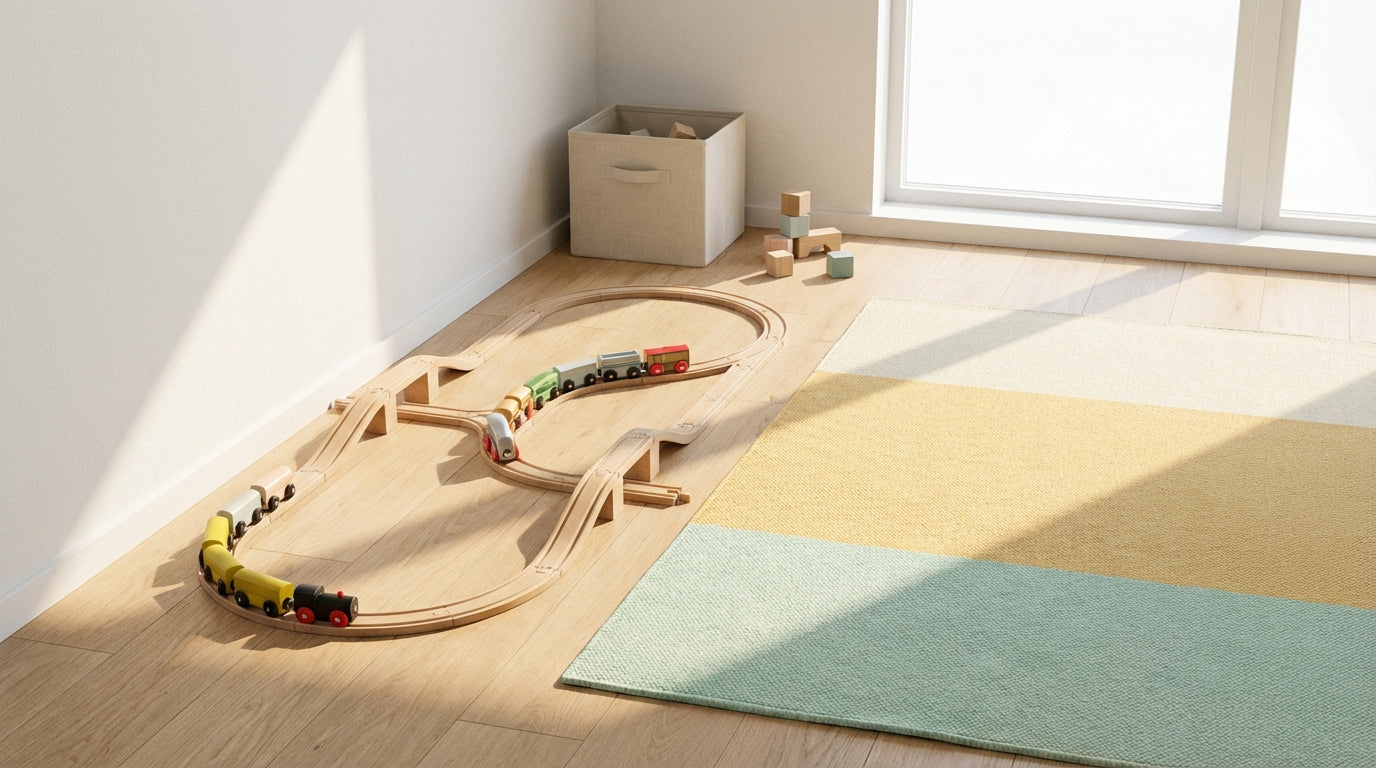
A simple oval often fits on a rug area or play mat. As soon as bridges, stations and several branches are added, it gets wider quickly – and suddenly the walk across the living room is a slalom course.
- Start small: oval + train is usually set up quickly and put away quickly.
- Plan for a construction phase: switches and crossings need more surface.
- A base helps: on smooth floors there's less sliding, on carpet you sometimes need more pressure when connecting.
Storage that really works
Best is a box that tracks fit into without any sorting skills. Sorting is great – in theory. In practice, in the evening you just want everything gone.
- Flat crate/box: tracks stay straight, and you find what you need faster.
- Fabric basket: super quick, but small pieces like to disappear at the bottom.
- Extra mini box for switches/magnets: saves searching at the next setup.
Practical tip: Start a little “lost and found box”. Everything that turns up under the sofa goes in there – and at the next playtime it gets handed out again.
Starter set recommendation by age (very pragmatic)
A good starter set is so small that your child can start playing within two minutes. The more pieces at the beginning, the more likely it becomes a building project for adults – while the child just waits for the train. It doesn't have to be that way.
About 2–3 years: large pieces, little accessories
At this age, what counts most is: connecting, driving, repeating. A simple oval, a train, maybe a station – done. If figures are included, then preferably larger ones that are easy to hold.
About 3–5 years: switches and small “tasks”
Switches quickly turn “driving” into a real game. Suddenly there are decisions: left to the construction site or right to the station. For many kids, this is the moment the railway becomes “real”.
From about 5 years: more complex tracks, role play, possibly an electric locomotive
When children play with something for longer, bigger tracks and sequences become exciting. Then bridges, crossings, more trains and (if it fits) electric locomotives are an option too. For help deciding, there's a separate comparison: Electric wooden train set vs. classic models: what suits my child?.
If you want to expand with purpose, a few solid accessory classics help. Switches, curves, straights, bridges – here are some ideas: Accessories for wooden train sets: switches, tracks & more.
Care & cleaning: keeping wooden tracks clean (without the drama)
Wooden tracks stay beautiful the longest if you store them dry and only clean them with a slightly damp cloth. Usually nothing more is needed – except maybe patience with cookie fingers. They're surprisingly stubborn.
How to clean tracks and trains
A slightly damp cloth is enough for most everyday stains. If something is sticky, loosen it briefly first, then wipe off – don't scrub like a baking tray. Wood prefers a gentle touch.
- Dust: dry cloth or soft brush.
- Sticky spots: slightly damp cloth, then wipe dry.
- No long water baths: wood can warp.
Storage & climate
Don't store tracks permanently damp or directly next to the radiator. Extreme moisture or strong heat are the classic causes of warping wood and connections that fit worse. Normal storage in a box in your living space is generally perfectly sufficient.
FAQ
From what age is a wooden train set suitable for kids?
Many sets suit children from around 2–3 years, if no small parts are included. What matters are piece size, the mouthing phase and motor skills. Pay attention to the manufacturer's age rating and warnings such as “not suitable for children under 36 months” – this mostly refers to swallowing hazards.
Which wooden train set is the best?
The best one is the one that stands stable, rolls well and can be expanded. Clean craftsmanship, firm connections and everyday-friendly vehicles matter more than as many pieces as possible. A small starter set is often the more relaxed choice – you can always buy more later.
Are wooden train sets from different brands compatible?
Often yes, but not guaranteed – especially with switches, bridges and ramps. Many systems use similar connections, but heights and geometries can differ. If you want to mix, it's best to test with a few pieces first before expanding further.
How can I tell if a wooden train set is safe?
Look for CE marking, clear warning notices and splinter-free craftsmanship. According to the European Union (Your Europe), the manufacturer uses the CE mark to declare compliance with EU requirements (CE marking (EU overview)). A simple check also helps: nothing is sharp-edged, nothing smells strongly, nothing is loose.
How much space does a wooden train set need in the living room?
A small oval needs little space; large tracks quickly grow wider. To start, plan a fixed play area that you can clear again afterwards. As soon as switches, stations and bridges are added, a storage box is worthwhile so everything can be tidied away quickly.
How do I clean wooden tracks properly?
Wipe them with a slightly damp cloth and dry them briefly afterwards. Avoid soaking them for long so the wood doesn't warp. For dust, a dry cloth is often enough. If something is sticky: loosen it briefly, wipe gently – done.
In closing: start relaxed, then let it grow
When choosing a wooden train set for kids, think first about age, space and expandability – the rest happens while playing. And if you'd now like to see what sets and ideas are out there: in our overview you'll find everything about wooden train sets.