Plug-In Night Light for Kids: Choosing an LED, Dimmable and Safe One
At a glance
- A plug-in night light for kids is ideal as a orientation light – a secure fit is a must.
- LED is usually energy-efficient and long-lasting in everyday use, but never cover it.
- Dimmable is especially worthwhile for nursing, diaper changes and light-sensitive children.
- Sensors (dusk/motion) save your nerves when everyone is half asleep.
- Good placement: light the way to the door, don't shine straight onto the bed.

A plug-in night light is a good one when it gives you orientation at night without really waking you up. That's exactly what this guide is about: which features of a plug-in night light actually help (LED, dimmable, sensors), what to look out for when it comes to safety and placement – and how you can tell in two minutes whether it suits your family's daily life. For parents, grandparents and anyone who has ever walked into a door frame at night with a tired child in their arms: welcome to the club.

Ulli & Flo
Owners of bieco · Hamburg · parents themselves
At night, we like anything that helps quietly and wakes no one. With a well-placed, gentle plug-in light, the walk to the nursery simply becomes more relaxed. Feel free to browse our Night Light collection.
A night light is not a decor statement, but a small piece of calm. If it secures your paths, prevents falls and then becomes “invisible” again, it has done its job.
Plug-in night lights: why they're so popular in family life
A plug-in night light is ready instantly – no charging, no searching, no tipping over. Plug it in, done. That sounds trivial, but at night it's about as valuable as a coffee in the morning (just quieter). Especially in the hallway, by the bathroom or on the way to the nursery, it's practical because it simply “runs along”.
A plug-in night light is a small lamp that runs directly from a wall socket. It serves as an orientation light and typically stays plugged in permanently so that paths are safer in the dark.
- Plus: No battery, no cable clutter, no “where did it go?”
- Plus: Many models have a dusk sensor or motion detector.
- Minus: A socket is often taken up (unless it's a pass-through model).
- Minus: In a nursery, the location really has to be child-safe.
Safety note: Plug-in night lights are mains-powered devices. Make sure they fit firmly, the housing is intact, and in the nursery only use sockets that are child-safe.
There is a dedicated standard with special requirements for this type of device. According to DIN Media, DIN EN 60598-2-12 describes special requirements for night lights mounted in sockets (accessed: 10.02.2026).
Which features are really helpful (and which are more of a gimmick)?
When you're half asleep, anything that works automatically and quietly wins. Sure, color changes can be nice – but at night you mainly want: light on when needed. And off when not. Without having to study a manual first.

- Dusk sensor: Switches on in darkness and off in daylight – great for hallways and landings.
- Motion sensor: Lights up only when there's movement – good if you're very light-sensitive.
- Pass-through socket: The socket stays usable – sometimes a lifesaver in older-building hallways.
- Switch/child lock: Helps when little fingers love to go “click”.
Practical tip: Ask yourself: “Can I operate the light with one hand?” If so, it's usually really good at night, too.
We're pretty pragmatic about this: at night it simply has to work. As a family business from Hamburg, we've been doing this for 66 years – and we keep seeing it: the fewer decisions you have to make at night, the better everyone sleeps in the end.
LED night light: why LED suits plug-in lights so well
LED is popular for night lights because it uses little power and lasts a long time. That's handy when the light runs for many hours at a stretch – or when it simply needs to be “always ready”. Even so: an LED light should also be placed where it gets air and isn't covered.

An LED (light-emitting diode) is a semiconductor component that produces light efficiently. For night lights, that means enough orientation at low energy consumption – and usually without much heat build-up when the device is used correctly.
- Power: Many LED orientation lights are in the low-wattage range (depending on the model).
- Heat: In normal operation, many devices stay only hand-warm – still, never cover them.
- Light color: Warm white is often perceived as more pleasant in the evening than very cool white.
There are EU rules on ecodesign and labeling for light sources. According to EUR-Lex, Regulation (EU) 2019/2020 sets ecodesign requirements for light sources, and Regulation (EU) 2019/2015 governs energy labeling (accessed: 10.02.2026).
Dimmable or not: when a dimming function is worth its weight in gold
Dimmable is worthwhile if you switch between “just looking” and “quick task” at night. A quick trip to the bathroom is different from changing a diaper, nursing or fetching a glass of water. With a dimmer, you can keep the light low enough that it doesn't blow up the whole sleep mode.

- Nursing: Soft light that doesn't dazzle and doesn't shout “good morning”.
- Diaper changes: Briefly brighter, then back down – without the ceiling light.
- Older children: They can adjust it themselves when they wake up at night.
Practical tip: If it's dimmable, set a “night level” (very dark). That way there are no discussions at night – not even between adults.
What matters isn't just “dimmable”, but how dimmable. A dimming function that jumps in big steps from “almost off” to “floodlight” is about as popular at night as Lego bricks in the hallway.
Light color & brightness: keeping the night light night-friendly
The less the light dazzles, the more easily you find your way back to sleep. For many families, warm, rather subdued light is more pleasant than very bright, cool white. That's not magic, just plain comfort: eyes relax faster, and your child gets less “revved up”.
Light color describes whether light looks more warm (yellowish) or cool (bluish). In everyday life, a simple rule helps: warm and low for the night, brighter only briefly and purposefully.
Too much light at the wrong time is not only annoying, but also an environmental issue. The German Environment Agency (Umweltbundesamt) points out that “too much light at the wrong time” can reduce health and performance and wastes energy (source: Umweltbundesamt, accessed: 10.02.2026).
Placement in the nursery: where a plug-in light really makes sense
The best spot is where feet walk – not where eyes sleep. In a nursery, the socket is unfortunately often exactly where you don't need it: behind the bed or next to the toys. Take two minutes for a mini walk-through: where do you actually walk at night?
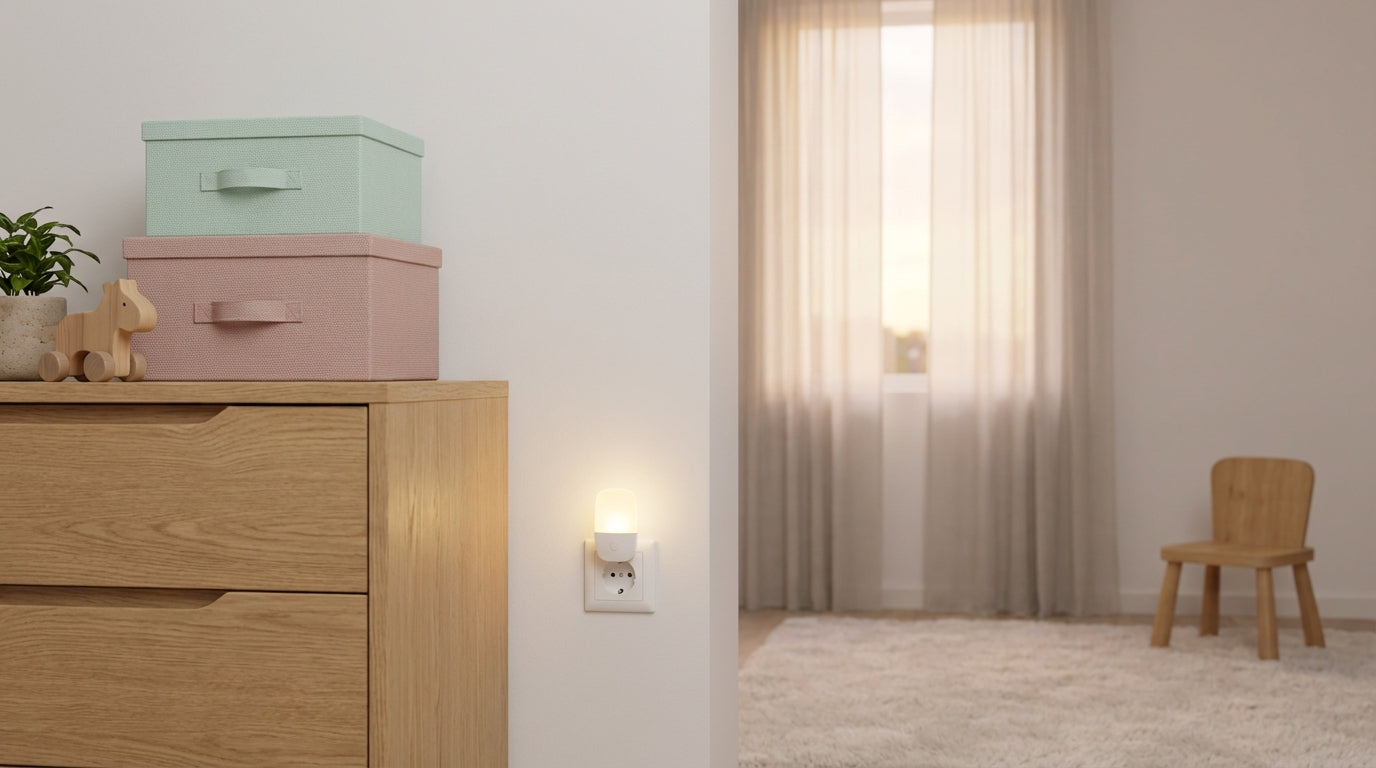
- Good spots: Near the door, toward the hallway, along the way to the changing area or bathroom.
- Rather unfavorable: Right next to the bed at eye level, when the light shines into the face.
- Free air: Not behind curtains, not “squeezed in” behind furniture.
- Low glare: Better close to the floor and indirect than high up and frontal.
Safety note: Never cover night lights (fabric, decorations, stuffed toys). Even though LEDs are efficient: devices need air and should sit freely in the socket.
If your child already has “explorer hands”, the mechanics matter too. Does the night light sit without wobbling? Are there sharp edges? Is it easy to pull out? These aren't side issues – this is everyday life.
Quick checklist: how to recognize a good plug-in night light
A good night light is safe, quiet, low-glare – and makes no extra work. Here's the little shopping list for your brain before you get lost in the lamp aisle:

- Secure fit: Plugs in firmly, doesn't wobble, housing is sturdy.
- Standards/information: Manufacturer information is clear and traceable; DIN EN 60598-2-12 exists for this type of design.
- Heat: Doesn't get noticeably hot during operation (and isn't covered).
- Operation: Switch/dimmer usable when half asleep, ideally with a memory function.
- Sensor (if desired): Switches reliably, without constant “false alarms”.
- Brightness: Enough for orientation – not enough for a “kids' disco”.
Transparency is simply fair when it comes to children's products. We ourselves like it when materials, care instructions and safety information aren't hidden somewhere in the fine print – that's a bit of a Hamburg thing for us: better to say clearly how things are.
“Test winner” & recalls: why you should still take a quick look yourself
“Test winner” is only helpful once the test criteria and date are clear. Otherwise it remains a label. Rather, look at information you can verify: What was tested? For how long? And are there notes on electrical safety?
- Good test: States the date, test criteria and measured values, and explains the rating.
- Everyday use: Reports on sensor behavior, build quality and long-term use.
- Warning signs: Wobbly fit, unusual smell, visible damage.
Recall notices show that you should stay alert with plug-in devices. Stiftung Warentest reported on the recall of an Ikea children's plug-in night light due to the risk of electric shock (source: Stiftung Warentest, accessed: 10.02.2026).
What we keep seeing in family households (completely unfussy)
Most families aren't too “messy” – they're simply tired. That's why the best solutions are the ones that still work when toys are lying in the hallway and you only have one eye open at night. A plug-in light along the walking path gets used. One behind the armchair gets ignored. It's that simple.
And one more thing: children change their preferences faster than the weather on the coast. Today it has to be “completely dark”, tomorrow “a little light”. If the night light is dimmable or has a sensor, you can grow along with it without reinventing everything.
FAQ
Plug-in night light for kids – is it safe?
Yes, if the device is intact, fits firmly and the location is child-safe. Make sure the housing is undamaged, there's no loose contact, and the night light is left uncovered. According to DIN Media, DIN EN 60598-2-12 describes special requirements for plug-in night lights (accessed: 10.02.2026).
LED night light – does it get hot?
Many LED night lights stay only hand-warm, but check it once on the first evening. If it feels clearly hot or smells unusual, take it out of the socket and don't use it any further. Important: never cover it, and don't “build it in” behind curtains or furniture.
Dimmable night light – do you really need it?
You need dimmable if you want very little light at times and a bit more at others at night. For falling asleep, a hint of light is often enough; for changing diapers or searching for something, a bit more briefly. For pure hallway orientation, a sensor light without a dimmer is enough for many families – as long as it's low-glare.
Nursery plug-in night light – where is the best place to plug it in?
Ideally so that it shows the way to the door but doesn't shine onto the bed. Good spots are near the door or along the walking path toward the hallway/bathroom. Avoid positions right next to the pillow or behind fabrics. The light should stand free so that it neither warms nor dazzles.
Dimmable baby night light – which light color is more pleasant?
Many parents find warm, dimmed light more pleasant at night than cool, bright light. If possible, start with warm white and low brightness. If your baby becomes more alert because of it, dim it down further or place the light more as a “path light” toward the door.
Plug-in night light test winner – how do I recognize a good test?
A good test is transparent: date, criteria, measured values and a clear rationale. “Test winner” without a source says little. Check whether electrical safety, build quality, heat behavior and sensor reliability were assessed. Recall notices (e.g. from Stiftung Warentest) show that these points really matter.
If you now feel like making nights “a little easier”: start with the overview. In the Night Light section you'll find various lighting ideas for family life, and in our guide Night Light for Babies & Kids: Benefits, Types & Tips for Choosing we sort through the options once more, calmly and in detail.