Wooden Toy Kitchen & Co.: Types, Ages, Accessories & Play Ideas
At a glance
- A wooden toy kitchen often fits into role play from around 2–3 years.
- A few big basics usually get played with more often than lots of tiny bits and bobs.
- A wooden toy garage is worth it for vehicle-loving kids in a “park & roll” phase.
- Wooden toys for outdoors work well as long as they are stored dry.
- A workbench and a toy shop are great alternatives for the “I'll do it myself!” stage.
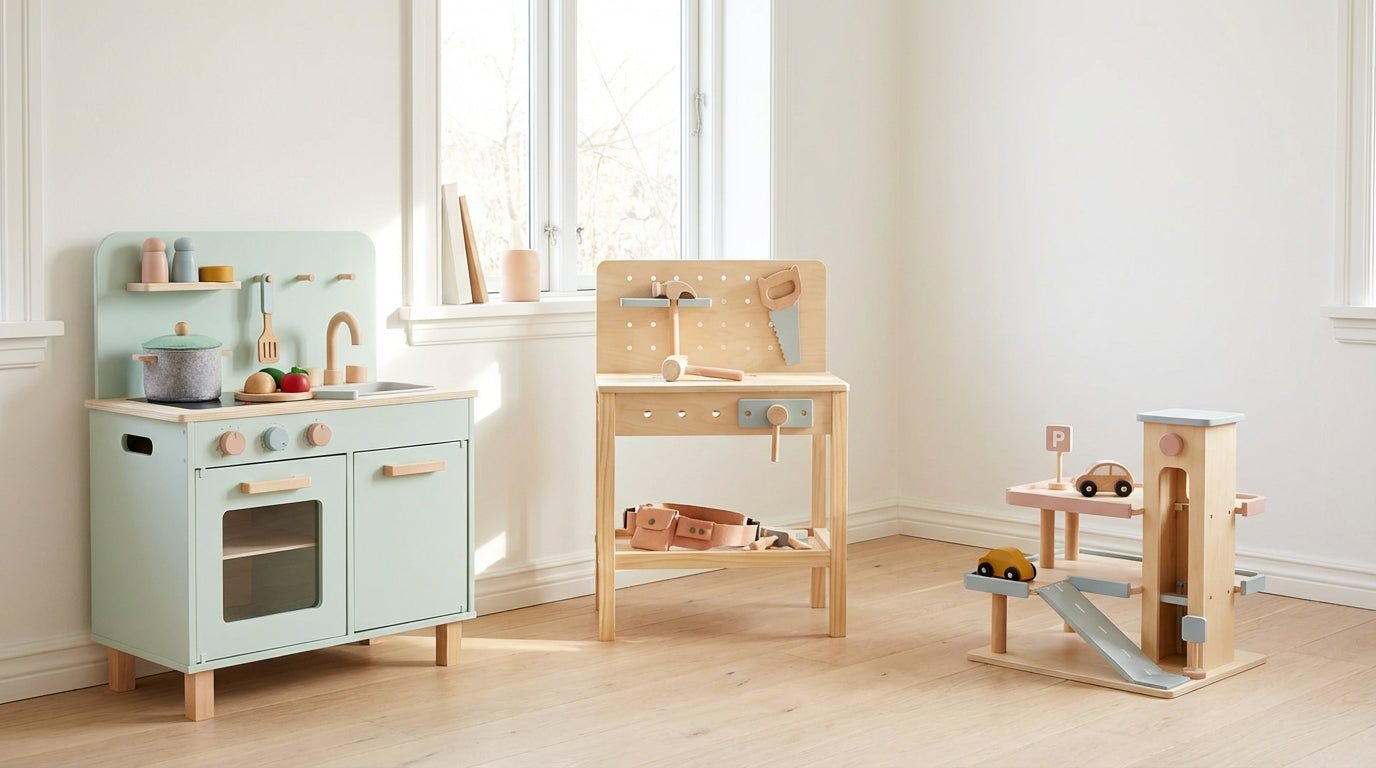
The easiest way to choose a wooden toy kitchen & co. is by play phase, space and everyday practicality. That turns “What on earth should we give them?” into “Yes, this is it” pretty quickly. Here you get a relaxed overview: wooden play kitchens (including the age question), wooden play food, wooden toy garages, outdoor ideas – and, as a bonus, workbenches and toy shops. Plus: care, safety, and a little decision guide in case you're torn between two ideas.

Ulli & Flo
Owners of bieco · Hamburg · parents themselves
We've learned that a wooden toy kitchen is the most fun when it doesn't drown in accessories. A few good basics – and the shop is open for business. Feel free to browse our wooden toys collection.
Why types of wooden toys are so different (and why that's a good thing)
The right type of wooden toy is the one that matches your child's current play interest. Some children get into role play early (“Coffee?”), while others first sort cars until each one has its own parking spot. Both are perfectly normal – and both can be wonderful.
Role-play toys are toys with which children act out everyday life while practising language and social roles. Typical examples are a wooden play kitchen, a toy shop or a workbench.
Vehicle and ramp toys are toys that let children experience rolling, sequences and cause and effect. These include, for example, a wooden toy garage or ramp tracks.
Outdoor toys are toys meant for the garden, sandpit or balcony, so they have to put up with dirt and weather. Here it's less about “beautifully arranged” and more about “survives Tuesday”.
At what age is a play kitchen right? (And why the answer is never set in stone)
A play kitchen often becomes really exciting from around 2–3 years, when imitation turns into role play. Then it's not just stirring, it's “cooking”: for teddy, grandma, the whole daycare group – and for you at 6:30 a.m.
More important than a number is the combination of the manufacturer's age recommendation and your child: Do they still put a lot of things in their mouth? Do they tend to play roughly? Then larger, sturdy pieces are the more relaxed choice. And if batteries are involved (light/sound): take one extra look.
Safety note: With accessories, watch out for small parts that could be swallowed and for firmly closed battery compartments; the BfR (German Federal Institute for Risk Assessment) warns of serious harm from swallowed button cells (according to the Federal Institute for Risk Assessment). Source
A practical check: Can your child already “pretend” (e.g. talk on the phone using a building block)? Then a wooden toy kitchen is often a hit.
Wooden toy kitchen: basics, accessories, storage
A wooden toy kitchen works best with a few easy-to-grip basics. Too many accessories sound nice, but they often end up in the “drawer of oblivion” (right next to that single sock).
Basics that really get used a lot
Doors, knobs and a “sink” are often more exciting than 30 mini food items. Children love handles and movements that feel real: open, close, turn, click.
- Cooking: pot, pan, spoon, bowl – better sturdy and not too small.
- Serving: plates, cups, a tray or basket (for “delivering”).
- Everyday life: oven door, knobs, sink – that rounds off the story.
How much accessories make sense?
To start with, 8–12 pieces are often enough, and the rest can come later. That keeps play manageable – and you don't have to fish 27 pieces of “cheese” out of the sofa every evening.
Practical tip: Put half of the accessories in a box and swap them every 2–3 weeks. For children it feels like “new” – for you it feels like “finally less clutter”.
Storage without drama
A small box or basket next to the wooden play kitchen is often the best tidy-up helper. Not perfectly sorted, but quickly put away – and that's what counts in real life.
- One basket per play world: kitchen basket, garage basket – done.
- Big pieces at the bottom: That way less topples over when rummaging.
- One “favourite piece” visible: That draws children back into play.
If you'd like to look around more generally, you'll find lots of play worlds collected here: Wooden toys.
Wooden play food: how to spot good sets
Good wooden play food is sturdy, easy to grip and cleanly made. That's the difference between “lying around” and “cooked with every day”.
- Size: Better a little bigger than too fiddly (especially for small hands).
- Surface: Smooth, without splinters or sharp edges.
- Connections: If something can be cut apart (e.g. with Velcro), it shouldn't wear out right away.
The DIN EN 71 series of standards describes requirements for the safety of toys in Europe. According to DIN, it covers, among other things, mechanical and physical properties as well as other safety aspects. Source
If you want to dive deeper into materials, testing and “what is actually harmless?”: Wooden toys: benefits, safety & tips for parents.
Wooden toy garage: who is a parking garage in the nursery right for?
A wooden toy garage is ideal when vehicles are currently “the thing” and rolling is fun. Driving up, rolling down, parking, refuelling, repairing – it's just like real life, only without the search for a parking space.
- Cause and effect: The car rolls down the ramp – fascinating again and again.
- Sorting: parking spaces, levels, “this car belongs here”.
- Role play: workshop, petrol station, tow service – the stories come all by themselves.
The practical thing is that garage play is often self-explanatory and starts without lengthy instructions. Child sees ramp – child tests ramp. Science.
Workbench & toy shop: two alternatives that often grow with your child
A workbench and a toy shop are great play worlds when children love to “do it themselves” and imitate. And yes: This is often the phase when you suddenly become a “customer” – paying with play money.
Wooden workbench: for tinkering hands and “I can do it!”
A workbench is a good fit when turning, plugging and sorting are currently all the rage. Children like tasks with a beginning and an end: screw in, screw out, again.
- What works well: big tools, sturdy screws/nuts, few small parts.
- Play idea: “repairing”, “building”, “workshop” – often together with parents.
Toy shop: for language, roles and little everyday rituals
A toy shop often becomes great when children enjoy talking, asking questions and “haggling”. It's role play with lots of everyday life: shopping, weighing, checking out, packing up.
- Easy start: 6–10 products are enough, plus a basket or bag.
- Nice and simple: Empty, clean packaging (without sharp edges) can be a nice addition.
Practical tip: If a gift is meant to “last a long time”: A toy shop or workbench is often the relaxed choice – the play ideas change, the furniture stays.
Wooden toys for outdoors: selection, care, storage (and a mini checklist)
Wooden toys for outdoors work best when they are sturdy and can be stored dry afterwards. Wood and constant dampness aren't enemies – but they won't become close friends either.
What really works outdoors
Outdoors, play ideas with few pieces almost always beat delicate sets. Sand, water and wind are very creative “playmates”, after all.
- Movement: skittles, rings, target games – quickly set up, quickly put away.
- Sand & digging: shovels/spades with a sturdy handle, if expressly suitable for outdoor use.
- Role play outdoors: picnic, “kiosk” or “café” with sturdy pieces.
Care & storage without fussiness
Shake it out, wipe it dry briefly, store it dry – that's usually all it takes. You don't have to run a wooden toy museum.
- After playing: Get the sand off, wipe with a damp cloth, let dry thoroughly.
- Storage: In the shed/hallway/balcony box, dry and airy, not in wet grass.
- Regular check: Loose parts, cracks, splinters – better to pause or sort out the toy.
Outdoor checklist (30 seconds, honestly)
If you can tick off these three points, everything outdoors is usually fine. A quick look, no overthinking.
- Sturdy: Does the piece withstand rough digging?
- Easy to grip: Can small hands hold it well?
- Dry place: Is there somewhere it can go after playtime?
If you want to leave toys outside permanently, other materials are often easier to care for than wood. That's not “wood is bad”, it's simply physics and weather.
Safety & materials: what you can pragmatically look out for
You can recognise safe wooden toys by clean workmanship, clear age recommendations and transparent information. You don't have to be a laboratory – but a quick look saves trouble.
- Workmanship: No splinters, no sharp edges, nothing wobbly.
- Age recommendation: Does the recommendation suit your child and the way they play?
- With batteries: The battery compartment must be firmly closed.
The EU keeps working on stricter requirements for toy safety. In 2023, the European Commission proposed new rules to better protect children (according to the European Commission). Source
At bieco, as a family business from Hamburg, we have been looking closely for 66 years at what has to stand up to everyday life. And yes: That includes being open about what we look for in materials and testing – without a big fuss, but with common sense.
Which type of wooden toy suits which child? (a little decision guide)
If you're torn between two ideas, decide by play type, space and your tidy-up nerves. That's often more helpful than “What's popular right now?”

| Play world | Fits especially well when … | Typical space needed | Everyday tip |
|---|---|---|---|
| Wooden play kitchen | there is a lot of imitating and stories are being played out | medium to large | start with few accessories, rotate later |
| Wooden play food | role play is already there or should be expanded | small | larger pieces are often less stressful |
| Wooden toy garage | vehicles are “the thing” and rolling is fun | medium | one basket for cars prevents a carpet traffic jam |
| Workbench | turning, plugging and sorting are currently popular | medium | keep a few tools visible, the rest in a box |
| Toy shop | language, roles and being a “customer” are fun | medium | starting with 6–10 products is perfectly fine |
| Wooden toys for outdoors | movement, sand and garden time come up often | small to medium | store dry, otherwise wood quickly gets tired |
FAQ
At what age is a play kitchen right?
A play kitchen often suits children from around 2–3 years, when they start to act out everyday life. The manufacturer's age recommendation and your child also matter: If they still put a lot in their mouth or play roughly, larger, sturdy accessories are usually the more relaxed choice.
How much accessories make sense for a wooden toy kitchen?
To start with, 8–12 pieces of accessories are often enough to keep play manageable. Later you can add more bit by bit or rotate accessories so they feel “new”. Many families notice: fewer pieces mean less chaos – and still more play.
How do you clean a wooden toy kitchen and wooden play food?
Usually a slightly damp cloth is enough, and afterwards everything should dry well. Wood doesn't like staying wet for long, so it's better to wipe briefly rather than soak. If surfaces become rough or splinter, sorting the piece out is the safe and nerve-saving solution.
What age is a wooden toy garage suitable for?
A wooden toy garage is exciting as soon as children actively want to push vehicles, let them roll and “park” them. Depending on the child, that can start early and stay interesting for a long time. Look for sturdy ramps and easy-to-grip cars, and follow the age labelling when it comes to small parts.
Which wooden toys make sense for outdoors?
Outdoors, wooden toys with a few sturdy pieces that can be stored dry make the most sense. Target and throwing games often work particularly well because they're quickly set up. Leaving wood in the rain permanently is usually not a good idea – it tends to take its revenge with rough patches.
If you now have a feel for which play world suits your family, the rest is almost cosy. Feel free to browse our overview of wooden toys – you'll find lots of ideas without having to dig through a thousand individual pieces. And if you're currently thinking about age and play phase, this overview helps too: Wooden toys for every age: recommendations for 1, 2 and 3 years.