Baby Wrap Test & Comparison 2026: Popular Models & Buying Guide
At a glance
- In a baby wrap test, seat, support and free breathing matter more than perfect knots.
- Stretchy wraps are often the easy start; woven ones usually carry more firmly and for longer.
- For newborns: carry high, fabric all the way to the knee bends, face free.
- Comparing helps: material, length/size, warmth, learning curve and comfort range.
- At the end: a checklist plus “Which wrap for whom” saves nerves and returns.

A good baby wrap test is really simple: does it work for you within 5 minutes – yes or no. You don't need an expert eye for this, just a few clear checkpoints (fit, tension, breathing) and a little honesty about your everyday life. In this guide you'll find a compact comparison of popular models (Didymos, manduca Sling, Ergobaby Aura, Koala, Hoppediz), a mini buying guide and, at the end, a decision aid by user type. As we say in northern Germany: it should carry – not keep you busy.

Ulli & Flo
Owners of bieco · Hamburg · parents themselves
When testing baby wraps, what helped us most was keeping the bar low: safe, comfortable, suited to everyday life. If it feels good after a few minutes, you're usually already on the right track. Feel free to browse our baby carrier collection.
Testing a baby wrap: How to tell in 5 minutes whether it fits
When testing a baby wrap, what counts first: baby high, back supported, and you can breathe freely. If that works, the knot is allowed to look like you tied it half asleep – it happens to the best of us.

- High enough: You can kiss the top of their head without contorting yourself.
- Fabric fully supports: From knee bend to knee bend, not just under the bottom.
- Back well supported: Your baby isn't hanging “in a sack” but lies close to your body.
- Clear airways: Face free, fabric not over mouth/nose.
- You feel stable: No pulling in your neck, no shoulders up at “ear level”.
Practical tip: Practise first with a doll or a rolled-up towel. It takes the pressure off – and saves tears (yours or your baby's).
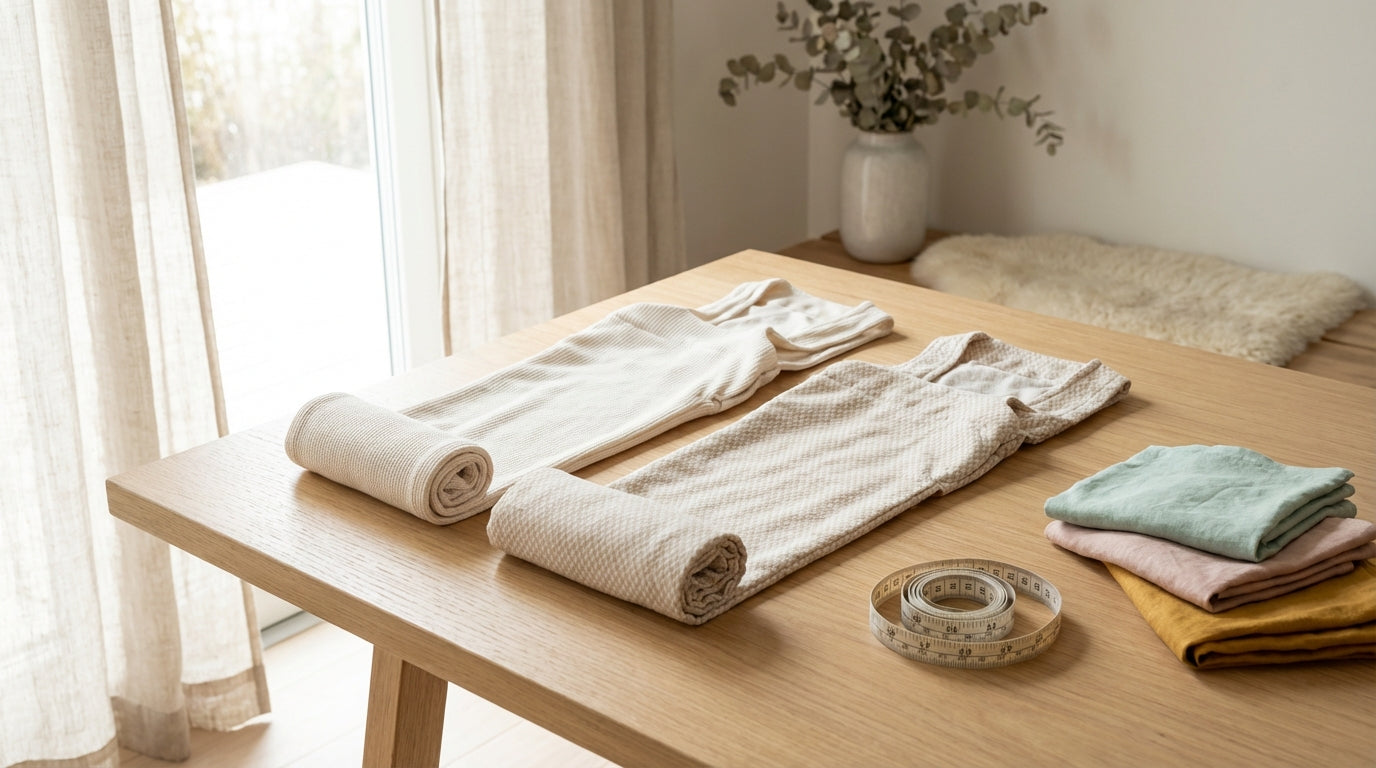
A stretchy baby wrap is an elastic jersey cloth that hugs snugly. This often makes getting started easier, because small wrapping mistakes are forgiven.
A woven baby wrap is a sturdily woven cloth with little stretch. It usually supports more firmly and stays comfortable as weight increases, but takes a bit more practice.
Newborn baby wrap test: What really matters for the little ones
In a newborn baby wrap test, “safe and close” matters more than any special wrapping method. Especially in the first weeks, you want something you can manage even on little sleep.
For leg and hip position, a squatted, spread posture is often recommended: knees slightly higher than the bottom, thighs well supported. According to the International Hip Dysplasia Institute, the so-called “M position” (also “spread-squat”) is considered hip-healthy because the legs are not held straight and together (International Hip Dysplasia Institute).
Safety note: Make sure the face stays free and the chin isn't pressed onto the chest. If you're unsure: re-wrap or get babywearing advice from a consultant.
Warmth is often the secret spoilsport – especially with stretchy wraps. If you both turn into a “sauna” after a short while, a thinner material or fewer layers of clothing can sometimes help.
Baby wrap test: Stretchy vs. woven – which type suits you?
Stretchy is usually ready to go faster; woven is often a loyal companion for longer. Both are fine – it depends more on your routes, your patience and your back.

| Type | Typical strengths | What to look out for |
|---|---|---|
| Stretchy baby wrap (jersey/mesh) | Soft, snug, often easy to tie; good for the first months | Can feel “bouncy” with more weight; warmth depends on the fabric |
| Woven baby wrap | Firm support, many wrapping methods, often comfortable for longer | Steeper learning curve; choose length/size more carefully |
| Pre-tied/hybrid | Quick to put on, less knot action | Fit depends heavily on the model; check fine adjustment |
If you're already rolling your eyes inwardly while wrapping, “quick” is a real criterion. Then a pre-tied system or a carrier can simply put you in a better mood in everyday life.
Baby wrap test: The most popular models compared
The comparison becomes fair when you always lay the same criteria side by side. Below you'll find a compact module that helps with exactly that.
| Model/brand | Material (per manufacturer) | Length/size | Comfort range/max. | Season/warmth | Learning curve | Suitable from |
|---|---|---|---|---|---|---|
| manduca Sling | 100% (organic) cotton, bi-elastic, no elastane | One-size, >5 m long, approx. 60 cm wide | 3.5–15 kg; best comfort up to approx. 9 kg | medium (cottony, depending on layers) | easy | from 3.5 kg |
| Ergobaby Aura | depending on variant, e.g. Tencel™ Lyocell (knit) or mesh (e.g. recycled polyester) | approx. 490 cm | 3.6–11.3 kg | Knit: rather warm/medium; mesh: rather airy | easy | from 3.6 kg |
| Didymos DidySling (ring sling) | material-dependent (manufacturer details vary by fabric) | Size 1 approx. 170–180 cm; size 2 approx. 190–200 cm | depends on fabric/wearer; ring sling typically practical for short distances | material-dependent | medium | depends on instructions/wrapping method |
| Koala Cuddle Band (pre-tied) | depending on variant, blended fabric (e.g. polyester/cotton/elastane) | adjustable/pre-tied | manufacturer details vary by model | model-dependent | very easy | from birth (manufacturer information) |
| Koala Cuddle Wrap Stretchy | 100% organic cotton | 500 cm | manufacturer details vary by model | medium | easy | from birth (manufacturer information) |
| Didymos woven baby wraps | material-dependent (manufacturer details vary by fabric) | Sizes 3–8 (numbered) | depends on fabric/wrapping method; often popular for longer carrying times | material-dependent | medium | depends on wrapping method/instructions |
| Hoppediz baby wrap | check manufacturer details (model-dependent) | lengths/sizes vary by model | manufacturer details vary by model | model-dependent | medium | model-dependent |
A note on transparency: The data above comes from the respective linked manufacturer pages. These are not paid placements, but a guide to help you narrow things down faster.
Didymos baby wrap: Which size fits? (without the headache)
With Didymos, the size depends mainly on the wrapping method and the amount of fabric you want. Didymos offers woven baby wraps in numbered sizes (e.g. 3 to 8) (Didymos).
If you want “one wrap for everything”, many people start from a base size and then adjust depending on the wrapping method. Because body shape, shoulder width and favourite knots vary so much, the most reliable way is: first choose the wrapping method, then determine the length using the manufacturer's size guide.
For ring slings, there are separate lengths that you can measure against your upper body. For the DidySling, Didymos lists e.g. size 1 at approx. 170–180 cm and size 2 at approx. 190–200 cm, and explains the measuring method (Didymos).
manduca Sling baby wrap: an easy start, clear manufacturer data
The manduca Sling is a stretchy jersey baby wrap in one size for an uncomplicated start. According to manduca, the Sling is “one-size” with a length of over 5 m and a width of approx. 60 cm (manduca).
manduca also describes a bi-elastic knit fabric without elastane made of 100% (organic) cotton (manduca).
When it comes to the comfort range, manduca is refreshingly specific: 3.5–15 kg, best comfort up to approx. 9 kg. This information helps you judge when switching to a woven wrap or a carrier might make sense (manduca).
Practical tip: If you're on your own: tie it first, then place your baby in. It feels much safer the first time.
Ergobaby baby wrap: Aura Wrap (knit/mesh) at a glance
The Ergobaby Aura is a stretchy baby wrap designed for the first months. For the Aura, Ergobaby states a length of 490 cm and a weight range of 3.6 to 11.3 kg (Ergobaby).
Depending on the variant, different materials are described: the Aura (knit) is listed e.g. with 100% Tencel™ Lyocell, the Aura Mesh as a mesh fabric (e.g. recycled polyester) (Ergobaby).
If you tend to get hot quickly, mesh can feel noticeably more comfortable. But as always: a fabric can be great on paper – and still be annoying on your skin.
Koala baby wrap: pre-tied – quick, but please make sure it can be readjusted well
Koala relies on “step in, tighten, go”, saving you knots and fabric management. For the Koala Cuddle Band (pre-tied, adjustable), Koala lists materials (depending on variant e.g. polyester/cotton/elastane), use “from birth” and machine washing at 30° (Koala).
For the Koala Cuddle Wrap Stretchy, Koala lists 100% organic cotton, 500 cm length and washing at 30° (Koala).
The crux in the test: Can you fine-tune the tension without starting over? Especially with small babies, “a little looser/tighter” often makes the difference between a contented sigh and a protest concert.
Hoppediz baby wrap: What to check before buying
With Hoppediz, you should check length details, weave and instructions directly with the manufacturer. I deliberately don't link half-baked data here when the original source can't be cleanly verified.
- Is there a clear size chart in cm?
- Is the centre marked? That really saves time when wrapping.
- How “grippy” is the fabric? Too slippery can be annoying when tightening, too stiff can be overwhelming at first.
- How easy is it to care for? Washable is good – but also: how does it feel after washing?
If you're testing Hoppediz: take 10 minutes and do the same wrapping method three times. Not because you need to practise – but because you'll notice whether you're “working together” with the fabric or against it.
How to compare models fairly: Checklist + “Which wrap for whom”
A fair baby wrap test works when you always tick off the same points. Then it's not the prettiest photo that wins, but the most comfortable everyday life.

- When do you want to start carrying? Right from birth or only later?
- How much practice is realistic? 2–3 evenings of practising or “please, right now”?
- Material & warmth: Do you tend to sweat? Then think thinner/airier.
- Length/size: One-size or choosing a size (woven)?
- Care: Washing, drying, everyday life.
- Carrying feel: Shoulders relaxed? Back okay? Baby calm?
- Leg/hip position: Thighs supported, knees higher than the bottom; the IHDI describes this M position as hip-healthy (IHDI).
Which wrap for whom? (quick decision aid)
If you're a beginner, choose a stretchy wrap with clear manufacturer information. The manduca Sling or Ergobaby Aura are typical candidates, because length and comfort range are stated transparently.
If you get hot quickly in summer, look at airier fabrics (e.g. mesh). What matters is less the brand than how the material feels on your skin and how many layers you wear.
If you want to carry a lot and for a long time, a woven wrap is often the more long-term choice. It supports firmly and often stays more comfortable with more weight, but takes a little practice.
If you can't stand knots, pre-tied systems are worth a look. Then pay particular attention to whether you can fine-tune the tension without redoing everything.
Why we take this topic so seriously at bieco (without the drama)
We are a family business from Hamburg and have been part of baby everyday life for 66 years. And honestly: the best solutions are the ones you can still manage with tired eyes.
When it comes to safety, we're happy to be boring: transparent rather than polished. When we talk about materials, standards or tests, we do it in a way you can follow – not as a smokescreen.
If you notice you're more of a “click and go” person, that's completely okay. Then take a look at our baby carrier overview – sometimes less fabric simply means fewer frayed nerves.
FAQ
Which baby wrap is best for newborns?
For newborns, a stretchy wrap with clear instructions is usually the easiest. What's important is that your baby sits high, the fabric supports all the way to the knee bends and the face stays free. Also make sure you don't feel laced in and that your back stays relaxed.
Stretchy or woven: Which is better?
Stretchy is often better for starting out, woven often better for longer carrying times. Stretchy wraps are soft and more forgiving when wrapping, but can feel “bouncy” with more weight. Woven wraps support firmly, but need a bit of practice and the right length.
How can I try a baby wrap without buying one right away?
The easiest way is trying one out through a babywearing consultation, friends, or second-hand with a return option. Test the fit (high enough), the tension (firm, but not constricting) and whether your baby can breathe freely. If you're already hunching your shoulders after 10 minutes, it usually doesn't suit you.
Didymos baby wrap: Which size do I need?
The right Didymos size depends on your build and the wrapping method. Didymos offers woven wraps in several sizes (e.g. 3–8) (Didymos). If you're unsure, first choose your favourite wrapping method and then use the manufacturer's size guide.
What matters for the hips in a baby wrap test?
What matters is that the thighs are supported and the knees sit higher than the bottom. The International Hip Dysplasia Institute describes the M position (spread-squat) as a hip-healthy posture for carrying (IHDI). In practice that means: fabric all the way to the knee bends, baby close to your body.
Conclusion: Three recommendations by user type (without the holy war)
For beginners: stretchy and uncomplicated – as long as you actually use it. For summer/heat: try airier materials (e.g. mesh). For frequent or long-term carriers: woven in the right length, if you're willing to practise briefly. And if you notice you'd rather “put it on and go”: browse our baby carrier category – sometimes that's the most relaxed shortcut.