Wooden Marble Run from Age 1: When It Makes Sense – and Which One Fits?
At a Glance
- A wooden marble run from age 1 works well if it is large, sturdy and simple.
- From age 2, “building” gets more exciting: more pieces, more variations.
- What matters: the age rating, stability, smooth edges and no loose small parts.
- Wood feels calm and easy to grip, while plastic is often lighter and snaps together.
- A small catch tray at the end saves you a “marble search party” in the living room.

A marble run makes sense from around 12 months, as long as it is large, sturdy and easy to use. Then your child can drop a marble in at the top, watch it roll, and repeat – and you don’t constantly have to “rescue” things. Here you’ll find a relaxed age guide (from age 1 vs. from age 2), a short checklist for choosing, and practical tips on material, cleaning and safety. We explain it the way you’d explain it to a friend or grandpa at the kitchen table: no drama, but with a watchful eye on real family life.

Ulli & Flo
Owners of bieco · Hamburg · parents themselves
We’ve learned from experience: a marble run is worth its weight in gold when it works without constant help. And when the marbles don’t keep wanting to live under the sofa. Feel free to browse our marble run collection.
From what age does a marble run make sense?
A marble run is worthwhile as soon as your child can grasp and release on purpose. For many children this happens around their first birthday – sometimes earlier, sometimes later. You can tell when your child can place a marble (or roller) at the top, waits a moment and follows the movement with their eyes. When that works, the track is often a little oasis of calm in the day.
A marble run is a toy for repetition – and that’s a good thing. Children love doing the same sequence a hundred times (yes, really). That’s not “getting stuck”, it’s practice: hand-eye coordination, attention, cause and effect. And it’s pleasant for you too, because the game doesn’t become “too hard” after three attempts.
For children under 3, swallowable small parts are the main concern. That’s why age ratings and warnings are not just decoration. According to the BMUKN, special safety requirements apply to toys in the EU, which are implemented in Germany through the Toy Safety Ordinance (Spielzeugverordnung).
Wooden marble run from age 1: What really matters
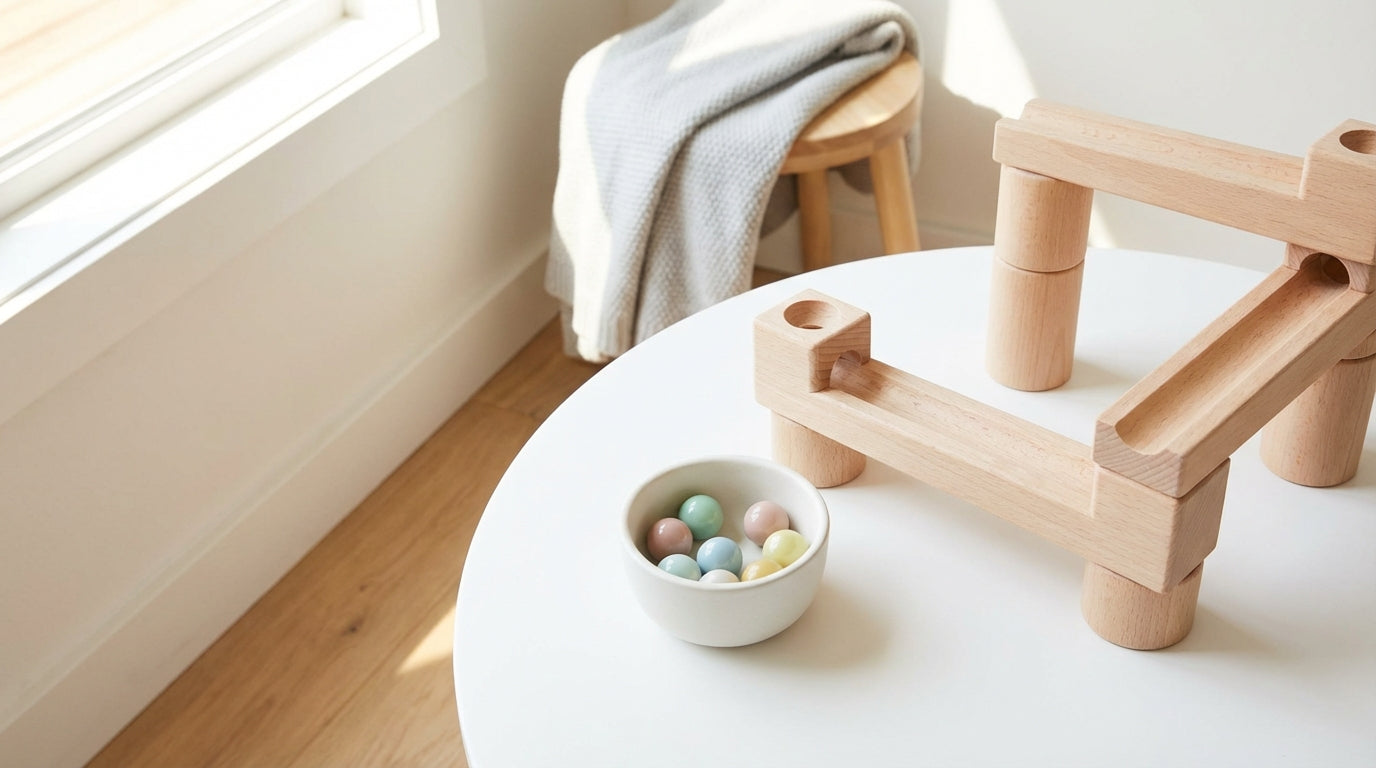
For 1-year-olds, what counts is: large, robust, easy to follow – and quickly understood. At this age, a track works best when it functions more like a “roll track”: in at the top, out at the bottom. No delicate little towers, no mini pieces that vanish under the sofa and found a new civilization there.

- Large pieces: Marbles or rollers should be clearly too big to swallow.
- Stable stand: If a child leans on it, it shouldn’t tip over right away.
- Reliable tracks: If something keeps getting stuck, the fun is gone quickly.
- Smooth edges: Wood is wonderful, but please make sure it’s properly sanded and pleasant to touch.
Safety note: For children under 3, check marble size, loose parts and the age labeling especially carefully – and always play with supervision at first.
EN 71 is a series of standards for toy safety in Europe. In practical terms, it describes tests and requirements that manufacturers can follow (e.g. mechanical or chemical). According to DIN, EN 71-3 covers, among other things, the migration of certain elements from toy materials.
Wooden marble run for babies: What’s realistic – and what isn’t?
For babies, a marble run is usually more about “watching” than “building”. Many parents notice that the rolling is fascinating, but hand-eye coordination is still developing. That’s completely normal. In that case, a simple track with clear movement (in at the top – out at the bottom) is just right.
A “baby marble run” is essentially a very simple roll track with extra-large pieces. That’s not a downgrade, it’s deliberate. Babies need little successes, not an engineering exam. If you’re unsure: choose a track that’s fun even as a “peek-a-boo game”, even if your child doesn’t place the marbles perfectly yet.
Practical tip: At first, place the track on the table (with supervision) – it saves your back and reduces the “plop” sounds from the floor.
From age 2: More building, more experimenting (and yes, more chaos)
From age 2, “letting things roll” often turns into a real “want to build”. Many children now want to rearrange pieces, try things out, build higher – and sometimes even “break” things on purpose to see what happens. Welcome to the research lab: admission is free, please bring your own patience.

- More variations: Curves, switches and additional elements become exciting.
- A bit more height: A taller setup is fine – as long as it stays stable.
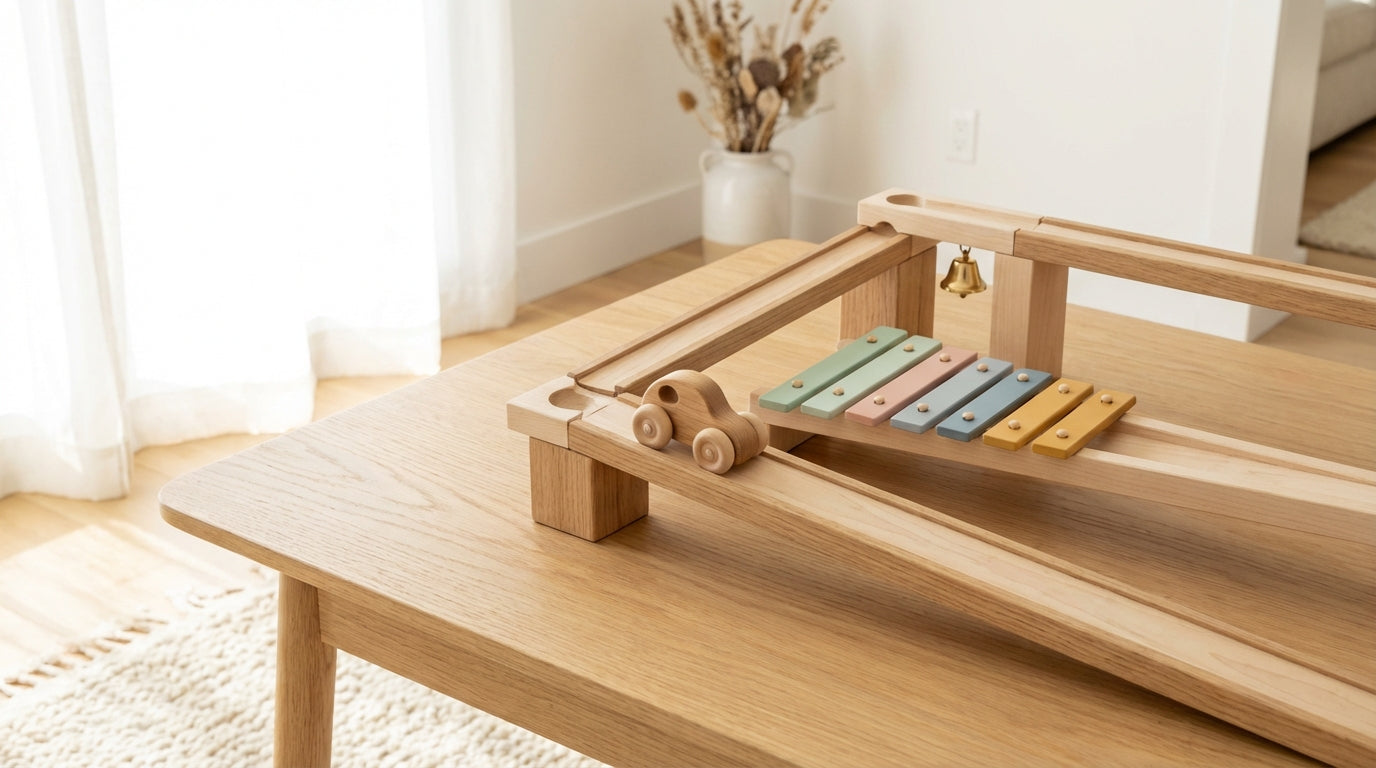
- More play ideas: Cars, sound elements or little challenges (“Can you get three marbles in a row?”).
A marble run for 2-year-olds should still be forgiving. If every second marble gets stuck, the experiment ends in tears rather than insight. Good tracks forgive crooked hands and impatient movements.
Sound is great – as long as it doesn’t accidentally become the constant soundtrack. Some tracks sound pleasant, others sound like someone sorting cutlery in the kitchen. If you’re sensitive to noise, it’s worth a quick look at the description to see whether “sound” is explicitly mentioned.
If you’re looking for versions with vehicles and sound, a clear overview helps. In our guide Marble Runs with Car and Sound Effects: Fun for Kids you’ll find typical designs and what parents should look out for in everyday life.
Buying checklist by age: How to make a relaxed choice
The best marble run is the one that doesn’t constantly call for “parent help”. So here’s a short list you can keep in mind while browsing – no calculator needed, promise.
- From age 1: few pieces, large marbles/rollers, short track, very stable.
- From age 2: more elements, first rebuilds possible, still stable and “marble-proof” in its run.
- Under age 3: no swallowable small parts, take warnings seriously.
- If you have little space: choose compact and quick to put away rather than a “living room construction site”.
- If siblings play along: a system that can be split into “easy” and “tricky”.
CE marking is mandatory, but it doesn’t replace your everyday check. It shows that the manufacturer declares conformity with requirements. For you, what still matters is: does the track suit your child (development) and you (space, volume, tidy-up mood)?
Quick comparison: From age 1 vs. from age 2
At age 1, success within 10 seconds counts; at age 2, it’s the experiment. This little table helps you sort things quickly – especially when you’re draining pasta at the same time.
| Feature | From age 1 | From age 2 |
|---|---|---|
| Play idea | Place & watch | Rebuild & experiment |
| Number of pieces | Few, large pieces | More pieces, more variations |
| Stability | Very important | Important, but a bit more “building” possible |
| Frustration tolerance | Needs to be very high (nothing may keep jamming) | A bit more patience available |
| Tidying up | Ideally done quickly | More pieces = more collecting (reality is reality) |
Practical tip: Put a tray or a flat box at the end of the track – then the marbles won’t roll across the whole room.
Wood or plastic: What suits your family?
Wood feels calm and often stands stably, while plastic is frequently lighter and snaps together. Both can be great. Wooden tracks are often heavier and tip less, while plastic systems are often a “construction kit” that grows with your child – if they already enjoy building.

- Wood: easy to grip, sturdy, visually calm, often long-lasting.
- Plastic: light, many expansions, often easier to snap together.
For 1–2-year-olds, when in doubt, the track that doesn’t constantly fall over wins. From around age 3, a snap-together system can really come into its own – before that it’s sometimes more “parents build, child tests gravity”. (Also a form of science, just a noisy one.)
“Wood” is not automatically “safer” – craftsmanship and testing are what count. Look for properly sanded surfaces, sturdy connections and clear manufacturer information. And if something splinters or comes loose: that’s not being fussy, that’s common sense.
Cleaning & care: How to keep your wooden marble run ready for everyday life
The best way to clean a wooden marble run is with a slightly damp cloth and mild soap. A lot of water is rarely a good idea for wood, because it can swell. Wipe it down once, let it dry well – done. If your child is in the “everything is sticky” phase: you’re not alone.
- After playing: Quickly wipe off crumbs and sand before they wander into crevices.
- For stains: mild dish soap, little water, then rub dry.
- Please avoid: harsh cleaners or long soaking.
A regular quick check saves trouble: is anything wobbly, is anything loose, is an edge rough? It takes 20 seconds and prevents “playtime” from suddenly turning into “why did this come off?”.
Why we look so closely at marble runs at Bieco
We are a family business from Hamburg – and we think in terms of real living rooms. Ulli & Flo write here as parents for parents, and in consultations and feedback we hear the same classics again and again: “Does it tip over?”, “Does it jam?”, “How quickly can it be put away?” Exactly these everyday questions decide whether a toy is loved or gathers dust in the cupboard.
For 66 years we’ve seen that safety and everyday practicality are not extras, but the foundation. That’s why we talk openly about materials, age ratings and what you should check briefly when unpacking. And if you think “this doesn’t feel right” when you pick it up – that’s a completely legitimate gut feeling.
FAQ
What marble size is safe for a marble run?
For children under 3, marbles should not be swallowable and should match the age rating. Don’t rely on “looks big enough”, but on clear manufacturer information, warnings and the recommended age range. If your child still puts a lot in their mouth, extra-large marbles or alternatives such as rollers are often more relaxed.
Is a wooden marble run really suitable from age 1?
Yes, if it is approved for this age and built large and stable. For 1-year-olds, simple roll tracks are ideal: place the marble, watch it roll, repeat. Look for clean craftsmanship, smooth edges and make sure nothing breaks off or comes loose easily when little hands grab hard.
Wood vs. plastic: Which is better for toddlers?
Wood is often sturdier, plastic often lighter and more flexible – both can work. For 1–2-year-olds, stability is usually more important than maximum building height. If your child likes to rebuild, a snap-together system can be exciting from age 2. If it’s more “action” on the floor, a heavy wooden track is often more relaxed.
What’s the best way to clean a wooden marble run?
With a slightly damp cloth and mild soap – then let it dry well. Avoid long soaking or harsh cleaners, because wood can react sensitively to a lot of water. A quick check for crumbs and sand after playing helps keep the tracks clean and prevents unnecessary jams.
Which safety rules matter for marble runs?
What matters are suitable age ratings, no swallowable small parts and a stable construction. According to the BMUKN, special safety requirements for toys apply in the EU. According to DIN, EN 71-3 describes tests on the migration of certain elements from materials.
From what age does a marble run make sense?
Often from around 12 months – as soon as grasping and deliberate releasing work well. The exact age matters less than your child’s stage of development: does your child understand the sequence and enjoy repeating it? Then a simple track usually fits very well. If it doesn’t work yet: wait a few weeks, it often comes by itself.
If you’d like to browse now, you’ll find a good overview in our shop. Take a look at the marble run collection. And if you want to dive deeper into materials and selection criteria: Wooden Marble Runs: Benefits, Safety and Selection Criteria helps you sort things out.