Wooden Marble Run with Cars: A Guide to Wooden Tracks with Sound & Racers
At a Glance
- A wooden marble run with cars combines rolling, wonder and "again!" in a single game.
- Sound elements work best when they are short and rhythmic.
- Stability, clean edges and suitable piece sizes matter more than extras.
- For less noise: put a rug or play mat underneath and introduce "sound rounds".
- Mini play ideas (start, finish, colors) keep it exciting for longer.

A wooden marble run with cars is a real hit when it is easy to start. Children love instant feedback: let go, watch it roll, hear the sound, do it again. In this guide you get a relaxed overview of designs, useful sound effects, safety points and everyday play ideas, including small DIY add-ons using things from around the house. And don't worry: nobody has to play in an "educationally valuable" way here. It's allowed to simply be fun.

Ulli & Flo
Owners of bieco · Hamburg · parents themselves
What helped us: put the track on a mat, play short "sound rounds", and the fun is big while the noise level is smaller. And yes: "again!" is expressly allowed here. Feel free to browse our Marble Run collection.
We're pleasantly north German about it: practical, friendly, no fuss. Bieco has been a family business from Hamburg for 66 years, and Ulli & Flo write here as parents for parents. We like toys that work in a real living room: not just pretty on the shelf, but easy to grab, sturdy, and not lost after three days with a "where on earth is piece 7 again?"
What is a wooden marble run with cars, and why do children love it so much?
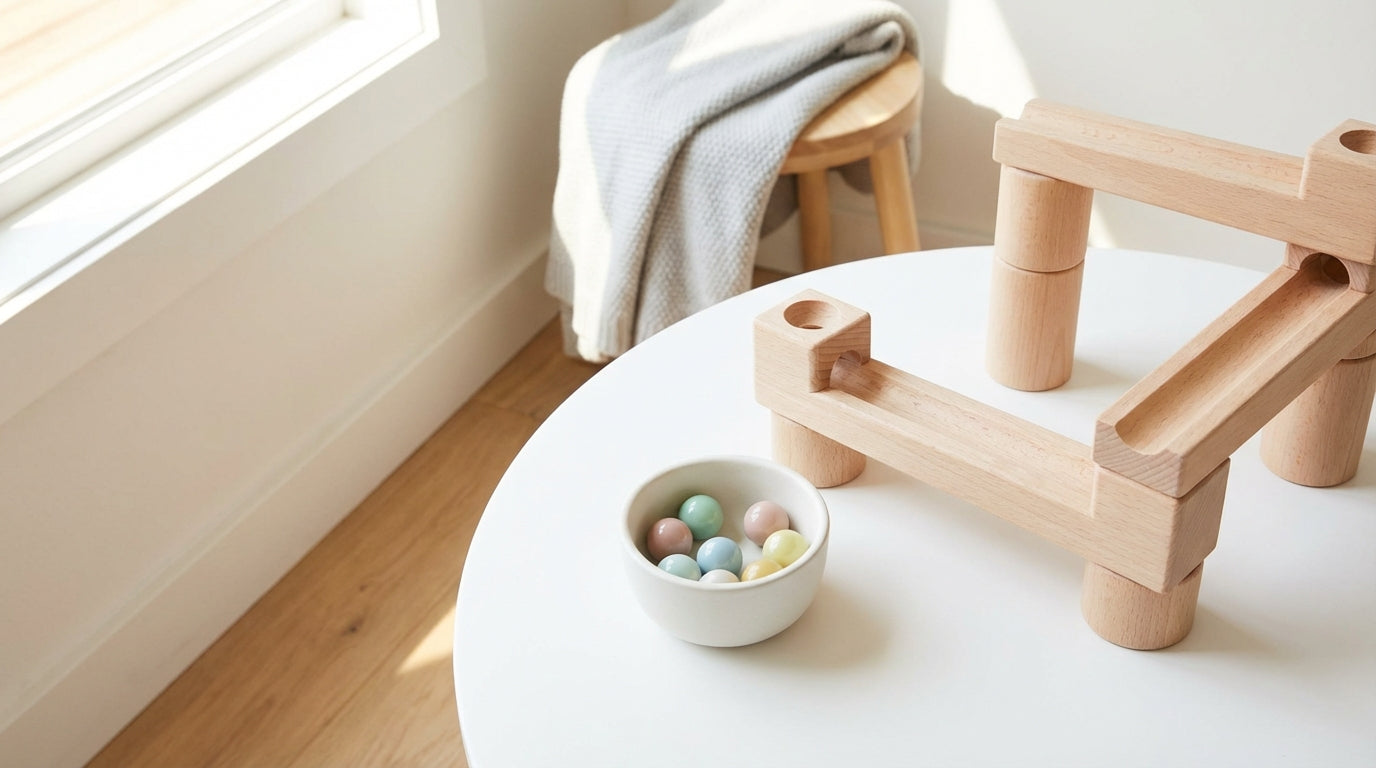
A wooden marble run with cars lets marbles or little racers roll down ramps and steps. The appeal is simple: the movement is understood right away, and you can see (and hear) the result immediately. Many children stay with it because they test cause and effect again and again: start faster, let go differently, start over.
A marble run is a toy where marbles roll along tracks by gravity. That's handy because your child can get started without a long explanation: in at the top, out at the bottom, and you're done.
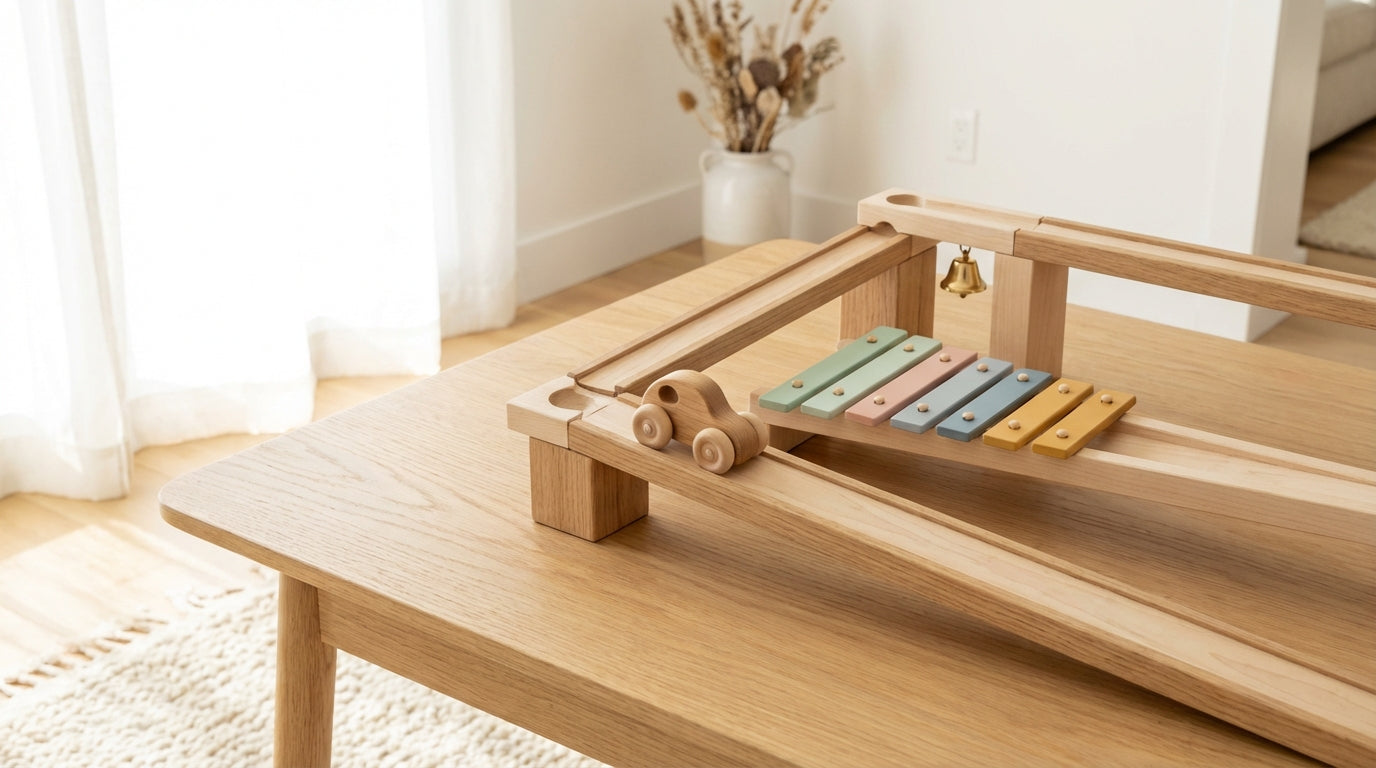
"Car" often means a theme and a play feel, not necessarily a race track. Some tracks have extra lanes for small wooden cars, others use marbles with a "racer look" or gates that something zooms through. In the end, what counts for children is: it rolls, it looks impressive, and it doesn't vanish under the sofa every 30 seconds.
What designs are there, and which one fits your daily life?
The best design is the one your child can restart on their own. Because "again!" is sweet, until you're fishing the marble out of the sofa crack for the 47th time today. Here are the common types, with no glitter foil:

- Step/staircase tracks: Classic "clack-clack-clack", very beginner-friendly and often sturdy.
- Channels & curves (ramp tracks): You can watch the ride for longer, often a bit quieter in sound, with more "watching factor".
- Switches/points: Children can steer and decide, which is fun but needs a little more finger dexterity.
- Modular building sets: Great for little builders, but relaxed in everyday life only if not everything is rebuilt right away.
Practical tip: If the track wanders: put a yoga mat or a leftover piece of carpet underneath. It dampens noise and saves you from constantly pushing it back.
Wood can feel pleasant in everyday use because it is grippy and often seems sturdy. At the same time: wood is not automatically "better". What matters is the workmanship, the precision of fit, and whether your child can grasp the pieces well.
If you'd like to look at different wooden tracks, our overview is a good starting point. In the Marble Run category you'll find different variants and play ideas, as a guide, not a obligation.
Sound on the marble run: what's lovely, and what gets annoying fast?
Good sound motivates children without parents mentally moving out. On wooden tracks, sounds are usually "mechanical", meaning battery-free, and that is often exactly the charm: no constant jingling, no random blaring.

- Sound staircase/sound steps: Rhythmic clacking, which many children love right away.
- Sound bars/plates: A brighter tone, often a bit more "musical" than pure wooden clacking.
- Bell/chime at the finish: A short closing tone, easy to keep in check.
A sound effect is a tone created by movement, without batteries. That's worth its weight in gold in family life, because you control the volume through the surface and the play spot rather than through buttons.
If you prefer to control sound separately, a small instrument next to the track helps. Then your child actively decides when it "sounds", for example with the Mini Xylophone Hedgehog as a calm addition to rolling play.
Safety & materials: what to look out for with wooden tracks
What matters are a sturdy construction, suitable piece sizes and clean edges. Especially with marbles or small vehicles, you want nothing to splinter, wobble or come loose easily, and the pieces to suit the age group.

Safety note: Use marbles and small cars only in an age-appropriate way and play together at first. If your child still puts a lot in their mouth, choose larger pieces.
The European toy safety standards of the EN 71 series serve as a guide. According to the Bavarian State Office for Health and Food Safety, EN 71 describes, among other things, requirements for mechanical/physical properties (Part 1) and flammability (Part 2), see Verbraucherportal Bayern.
For certain substances in materials, EN 71-3 is an important building block. According to DIN e. V., DIN EN 71-3 covers the migration of certain elements from toy materials, see DIN e. V..
EU rules on safe toys are also explained by federal agencies. The BMUKN gives an overview of "safe toys" and legal requirements, see BMUKN.
FSC tells you something about the origin of the wood, not about toy safety. According to FSC Germany, certification is awarded after checks by independent third parties and is monitored regularly, see FSC Deutschland.
Our everyday experience: the "stumbling blocks" are often quite mundane. Marbles too small for curious mouths, tracks too light on a smooth floor, or a construction that only looks stable in the photo. If you already think "hm, it wobbles" when unpacking: better to put it on a non-slip mat or against a wall edge right away.
How to keep the marble run exciting: play ideas that really work
It gets exciting through small rules that children can repeat themselves. You don't need 100 pieces; you need three ideas that your child gets and loves. Here are a few classics that work surprisingly reliably with us (and with visiting children):
- Start ritual: "3, 2, 1 – go!" Predictability is wonderfully calming for children.
- Target game: A basket/cup stands at the bottom: "Hit the target." Missing it is training too, by the way.
- Color game: "Red goes first" or "Blue only on the left". Simple, but effective.
- Turn-taking game: "You start, I catch" – and it automatically becomes a little togetherness.
- Speed game: "Release gently" vs. "let it zoom" – children observe the differences and stay engaged.
Practical tip: If it gets too loud: announce a "sound round" (e.g. 5 minutes), then a break. Sounds simple, but works wonders.
If your child wants to do more than just roll, combined play ideas help. A motor skills cube with an integrated track brings variety, because there's also plugging and sliding along the way, for example the Motor Skills Cube Bunny Fine FSC®.
DIY add-ons: more play fun with things you already have at home
DIY here means: quick, safe and without crafting stress. You don't have to open a workshop; a few household items are enough to make the track feel "new". Important: everything only under supervision and in a way that nothing small can come off or be swallowed.
- Target basket: A small laundry basket or a bowl at the bottom turns "rolling" into "hitting the target".
- Parking lot: A shoebox lid as a "garage" for marbles/cars. Children love order when they are the boss.
- Start line: A strip of masking tape on the floor: "The race starts here." No residue, no drama.
- Making it quieter: A folded towel under the track or under the finish takes the edge off the impact.
Typical parent moment: your child wants it "even higher", but the table is sacred. A compromise often helps: track on the floor, but with a sturdy base (rug/mat) and a cushion as a "little hill" under one end. Please don't stack anything wobbly; that reliably ends in tears (usually on both sides).
Care & storage: how wood stays beautiful for a long time (and easy to find)
Wood stays pretty the longest if you wipe it damp and let it dry well. A slightly damp cloth with mild soap is usually enough. Don't soak it and don't give it a bath; wood, let's say, only moderately enjoys that.

For sticky residue: first loosen it dry, then wipe with a damp cloth. That protects surfaces, and you don't have to scrub like on a fishing boat.
Storage is half the battle when there are pieces in play. A small box or a cloth bag just for marbles/cars prevents the daily treasure hunt. And yes: "just a quick tidy-up" goes faster when everything has a fixed place.
Brand terms like "wooden marble run motorway": how to put them in perspective
Such terms usually mean a wooden track that looks like a race track. Often it's a classic marble run idea, just in a car look: ramps, gates, a finish area, and there's your "motorway" for the children's room.
Look less at the name and more at the details. So: are the vehicles/marbles big enough? Can your child operate switches? Does it stand stably? And, very important in real life: how loud is it on your floor?
For the question of age, a quick guide by developmental stage and piece size helps. If you'd like to read more on this, our article Marble Run Guide: From What Age and Which Track Makes Sense? fits in well.
FAQ
What exactly is a wooden marble run with a car?
A wooden marble run with a car theme combines rolling with a "racer" play feel. Depending on the model, marbles roll over steps and ramps or small cars zoom along lanes. The exciting part is the direct feedback: see the movement, hear the sound, hit the target, and then of course start over again.
Which sound effects make sense on wooden tracks?
Sounds that are short, rhythmic and easy to dampen make sense. A sound staircase (clacking) or a small bell at the finish motivates many children without being loud all the time. If you are sensitive to noise: put a mat underneath and plan sound as a short play phase.
How can I tell if the piece size is right for my child?
The piece size is right if your child can grasp it safely and nothing seems "temptingly small". Especially with marbles and mini cars, the age recommendation matters. If your child still puts a lot in their mouth, larger pieces and playing together at the beginning are usually the more relaxed solution.
Which rules and standards are relevant for toys like marble runs?
The EN 71 standards for toy safety serve as a guide. According to the Verbraucherportal Bayern, EN 71 covers, among other things, mechanical/physical properties (Part 1) and flammability (Part 2). EN 71-3 is relevant for the migration of certain elements, as DIN e. V. explains.
How do I make a marble run quieter without rebuilding it?
It almost always gets quieter through the surface and the "impact" at the finish. Put the track on a rug, play mat or yoga mat. At the bottom, a folded towel or a soft basket as a target helps. And: a short "sound round" is often more family-friendly than non-stop operation.
How do I clean wooden toys like a marble run properly?
Usually wiping damp and then letting it dry well is enough. Use a slightly damp cloth with mild soap and avoid long wetting so the wood doesn't swell. Loosen sticky residue dry first, then wipe. If a manufacturer gives care instructions, those are of course the best guideline.
If you'd like to compare after reading, you'll find fitting ideas in our marble run overview. Feel free to look at the Marble Run category, and if your child prefers to "build, rebuild, reinvent", Large Marble Runs & Building Sets: For Little Builders is also a good complement.