Large Diaper Backpack: Size, Liters & Features for Everyday Life
At a glance
- A large diaper backpack is a good fit if you're often out and about for long stretches.
- Comfort comes first: wide straps, back padding and a good fit on your back.
- Helpful features include a wide opening, a wipe-clean lining, a wet pocket and a changing mat.
- Pack by zone: changing, food, clothes, parent stuff – and the endless searching is over.
- With two kids, “large” pays off especially quickly, but only if you stay organized.

A large diaper backpack is the right choice when you need space without wearing yourself out. It helps on day trips, daycare runs, long car rides, or when a older sibling tags along with the baby. Here you'll get a realistic take on size (including the “liter” reality), a no-frills feature list and a packing system that works even when you're bleary-eyed.

Ulli & Flo
Owners of bieco · Hamburg · parents themselves
We've learned that it's not the biggest backpack that counts, but the one you can pack blindfolded and grab quickly. That leaves more calm for all of you on the go. Feel free to browse our diaper bag collection.
Large diaper backpack: who does “large” really make sense for?
“Large” makes sense if you're regularly out for more than 3–4 hours. That's typical for day trips, visits to Grandma & Grandpa, longer train or car rides, or when you're looking after a baby and a toddler at the same time. During daycare years (spare clothes, mud pants, slippers), a bigger backpack makes a lot of things easier too.

A big backpack doesn't replace organization, but it's more forgiving. And honestly: in real life, “forgiving” is sometimes the most important feature. If you mostly just pop to the playground or the doctor, “large” can be needlessly heavy and bulky.
A diaper backpack is a backpack with a changing-friendly, easy-to-clean interior layout. In practice, that means compartments for diapers & co., quick access and often extras like a changing mat or bottle pockets.
What size does a large diaper backpack need to be? (Practice over number crunching)
The right size depends less on the baby than on trip length and season. In winter you often need more volume (thick clothing), in summer less, but maybe a sun hat, picnic blanket or water. A simple everyday rule: plan at least one diaper per 2–3 hours, plus a spare.
As a rough guide: “one diaper every two to three hours” plus 1–2 extra. According to Pampers Germany, a common rule of thumb is to pack “a diaper for every two to three hours” and take one or two extra (Pampers).
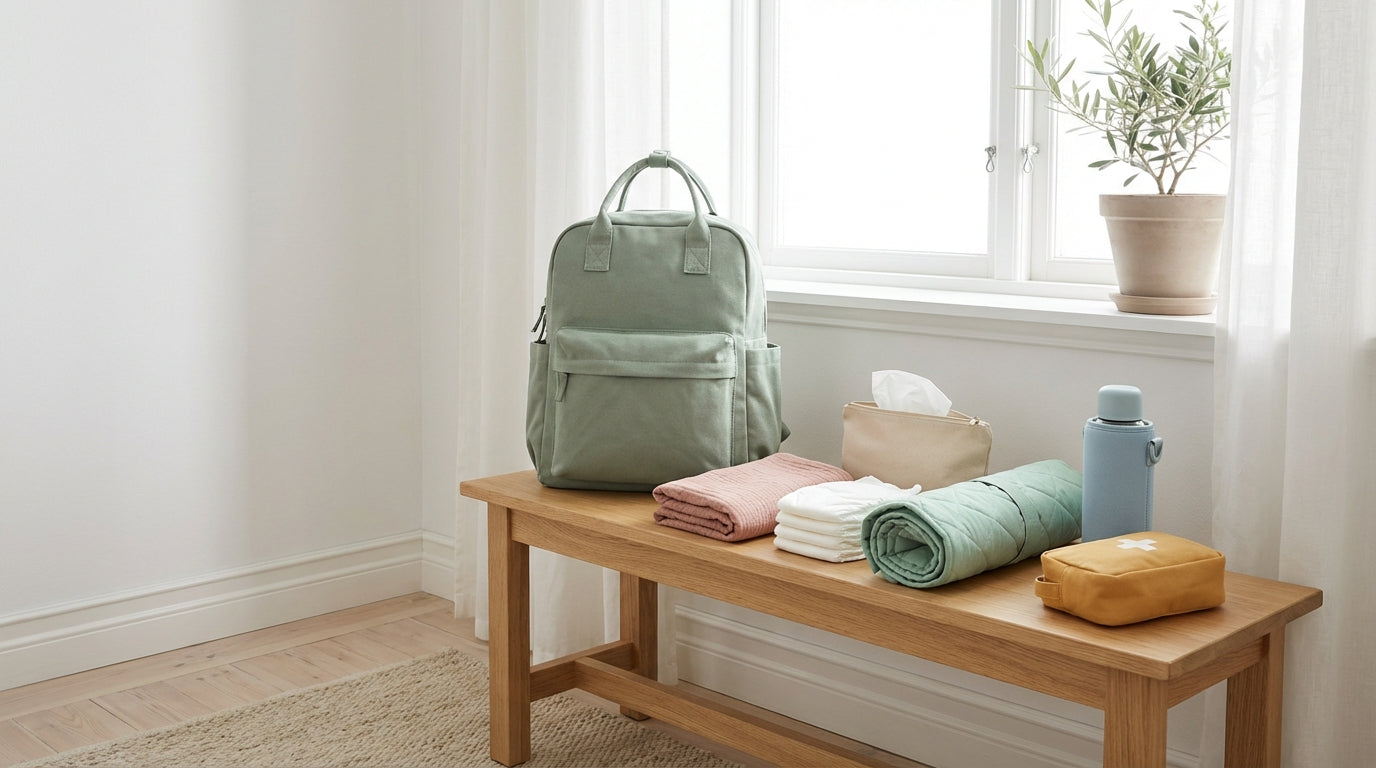
For half a day you usually need four packs: changing, food, clothes, odds and ends. Eltern.de lists typical contents including diapers, wipes, a changing mat, spare clothes and a burp cloth (Eltern.de).
Practical tip: Pack your “standard outing” (e.g. 4 hours) completely, just once. If there's still noticeable room left, the size works for everyday life.
“Large” doesn't mean “huge”, it means: spare capacity without zipper stress. If you can only close it by pushing, it's either too small or you're packing too much “just in case”. It happens to the best of us – usually on Mondays.
How many liters does a large diaper backpack have?
There's no standard liter limit, because manufacturers measure differently. Some count every outer pocket, others only the main compartment. That's why “liters” is helpful but not the only thing that matters.
More practical than the number is this check: does everything fit without you having to stuff it? Use this test set: 4–6 diapers, wipes, changing mat, 1–2 spare outfits, snacks, water bottle/baby bottle, small bags, hand sanitizer for adults, plus your own things (keys, phone, wallet). If that all fits neatly and you can still reach the wipes quickly, you're in “large enough” territory.
In everyday life, a “large diaper backpack” is one that handles a day trip plus a reserve. And reserve means: one more outfit, one more snack, one fewer “oops” moment.
What features should a large diaper backpack have?
The best features are the ones you can operate with one hand. It sounds trivial, but it's the difference between “this works” and “I'm unpacking the whole backpack in the rain right now”.

- Wide opening: You want to be able to look in rather than fish around.
- Wipe-clean lining: Milk, porridge, apple juice – it's all happened before.
- Wet pocket: For wet clothes or used burp cloths.
- Changing mat: Practical and hygienic, because you don't have to change your baby on unfamiliar surfaces.
- Outer pockets/quick access: For wipes, keys, phone.
Insulated bottle pockets are nice, but not a must for everyone. If you breastfeed or already use a cooler bag, a regular pocket is often enough. If you're out with bottles a lot, though, it can be really handy.
A wet pocket is a separate, wipe-clean compartment for damp or dirty items. It keeps the rest clean and stops odors from spreading through the whole backpack.
Material & cleaning: so your backpack doesn't collect “memories”
An everyday-friendly material is wipe-clean on the inside and tough on the outside. Because outside there are puddles, and inside there's applesauce. Make sure you can easily get crumbs out of the corners and that the lining doesn't start smelling “forever” after a single spill.
Cleaning works best in three small steps rather than a big Sunday operation. First shake it out (crumbs), then wipe the lining with a damp cloth, then let it dry thoroughly (zipper open). For stains, mild soapy water often helps; harsh cleaners are rarely needed and can damage materials.
Practical tip: Keep a small, washable pouch for the “messy stuff”. That keeps the rest of the backpack fresh for longer.
If you're sensitive to smells: drying matters more than perfume spray. A well-aired backpack smells of nothing – and in this case, that's a compliment.
Comfort: something you only notice when it's too late
With a large diaper backpack, your back decides your mood. Look for wide, padded shoulder straps, back padding and a stable fit on your back. A chest strap can help if you walk a lot or the backpack gets heavy.
Heavy items belong close to your back in the main compartment, not in the front pocket. That way the backpack pulls less backward, and you won't feel like an upside-down beetle when you bend over.
A well-fitting backpack doesn't “dangle”, it stays close to your body. That's especially nice when you're also carrying a child or pushing a stroller.
Interior layout: lots of compartments are good – but only if they make sense
The best layout is one you can find even in the dim light of a café. Too many mini pockets sound great, but often end up with you stuffing everything into the big main space anyway.

A 4-zone system that you always keep the same has proven itself.
- Changing: Diapers, wipes, cream, changing mat, small bags.
- Food & drink: Bottle/cup, snack, bib, thermos if needed.
- Spare clothes: Bodysuit, pants, socks, a sweater if needed.
- Parent stuff: Phone, wallet, keys, a power bank if needed.
Packing lists are good, but they shouldn't make you nervous. You'll find a solid basis at Eltern.de, for example; additional packing lists are available at babyartikel.de (babyartikel.de).
Hygiene & safety on the go: think small, help big
Your own changing mat is the simplest hygiene rule when you're out. According to Eltern.de, it makes sense for hygiene reasons to use your own mat even if one is provided on site (Eltern.de).
Safety note: Never leave your baby unattended during changing – not even “just for a second”. Anything that can roll will roll at exactly that moment.
Hand hygiene matters more than a whole chemistry set in your backpack. If you carry sanitizer, it's mainly for your own hands. For childcare settings there are clear hygiene rules around changing; the DGUV describes hygiene during changing as an important part of daycare everyday life (DGUV).
Large diaper backpack for 2 kids: what changes?
With two kids, you need less “more” and more system. The volume helps, sure. But what's decisive is that you can quickly get to the right things without emptying the whole backpack.
Here's how to pack for two kids without knots in your head.
- Color codes: Two small pouches (e.g. “Baby” and “Big kid”) so you don't have to search.
- Double basics: One spare outfit per child, plus 1–2 shared “emergency items” (e.g. socks).
- Snack strategy: Snacks on top, so you don't unpack the changing stuff at every “I'm hungryyy!”.
- The changing zone stays sacred: Diapers & wipes always in the same place.
If you're often out on your own, access matters more than perfect looks. A backpack is allowed to look like it's lived through everyday life. What matters is that you find the wipes before your child licks the floor.
How to pack a large diaper backpack without it packing you
A large diaper backpack only becomes really good through routine. Here's a routine that has proven itself in everyday life:
- Leave the basics in permanently: Changing mat, 2–3 diapers, small bags, mini wipes, 1 burp cloth.
- Add before heading out: Spare clothes to suit the weather, food/bottle, cream if needed.
- Quick access on top: Wipes, diaper, mat – so you don't have to unpack everything.
- Restock briefly after the outing: 2 minutes that will save your nerves next time.
Packing double saves the most in everyday life: one set at home, one set on the go. Eltern.de gives the practical tip of not constantly repacking things like wipes or diaper rash cream, but keeping them in duplicate (Eltern.de).
Why we at Bieco are so picky about everyday life & safety
We're a family business from Hamburg and have been doing this for 66 years. Ulli & Flo write here as parents for parents: rather practical than polished, rather “really works” than “only looks good”.
It matters to us that materials are traceable and that things can be cleaned. With baby and children's products, we generally make sure they are designed for everyday use: openly named materials, clear care instructions and an honest look at safety and use.
If you'd like to read up further: an overview saves you brooding later. In our diaper bag overview you'll find a starting point on the topic. And if you're torn between a backpack and a bag, Diaper backpack or diaper bag? Differences, advantages & tips will help you sort it out.
FAQ: Large diaper backpack
When is a large diaper backpack worth it?
A large diaper backpack is worth it if you're often out for more than a few hours. For day trips, daycare routines or with siblings, more space is often a relief. If you mostly just step out briefly, a more compact model is often enough, because you carry less weight.
How many liters does a large diaper backpack have?
There's no fixed liter figure, because manufacturers measure differently. Some include outer pockets, others don't. So also rely on the practical test: does your standard set for half a day to a full day fit without stuffing, and can you quickly reach wipes and diapers?
How many diapers should I pack when I'm out?
Plan roughly one diaper per 2–3 hours plus 1–2 extra. According to Pampers Germany, “a diaper for every two to three hours” is a good guide, plus a reserve (Pampers). That way you're prepared without taking half the household with you.
Which compartments really matter in a large diaper backpack?
What matters are a large main compartment, quick access and a wet pocket. Outer pockets for keys/phone are worth their weight in gold. Lots of mini pockets, on the other hand, can be annoying when you no longer know where anything is while out. Better to have a few areas that you always use the same way.
Do I absolutely need a changing mat in the backpack?
Yes, your own changing mat is very useful when you're out. According to Eltern.de, it's recommended for hygiene reasons to use your own mat even if one is provided on site (Eltern.de). It also saves you the “Is this clean?” thoughts.
Does a large diaper backpack make sense for 2 kids?
Yes, often it does, but only with a clear packing system. With two kids, spare clothes, snacks and “emergency stuff” add up quickly. If you sort into pouches by child and always keep the changing zone the same, you'll find everything faster and still won't carry more than necessary.
Bottom line: a large diaper backpack is less a luxury than a nerve-saver. If you'd like an overview now, feel free to take a look at our diaper bag category. And if you'd like to compare models, Diaper backpack test & comparison: the best models 2024 can help you put them in context.