What Is Montessori? Core Principles & Montessori at Home Explained
At a glance
- Montessori at home works with small steps and clear order.
- “Help me do it by myself” means: guide, don’t constantly take over.
- A prepared environment saves arguments – and time when getting dressed.
- Tasks and materials change noticeably with age (1–2, 3–4, 5–6).
- Typical mistakes are too much choice, too much help and too little patience.

Montessori means: you prepare the environment, and your child gets to do things themselves. Not perfectly, not polished, but in a way that works in real family life. If you’ve ever wondered whether Montessori means “everything made of wood” or “children just do whatever they want”: nope. Here you’ll get the core principles, everyday examples and a little age-based guidance – so you can start at home with a relaxed mindset, without rebuilding your whole living room.

Ulli & Flo
Owners of bieco · Hamburg · parents themselves
Montessori helps us most where everyday life gets stuck: in the hallway in the morning, in the kitchen and at tidy-up time. Small changes often make the biggest difference. Feel free to browse our Montessori collection.
Table of contents: What is Montessori? · Core principles · Learning worlds · Prepared environment · Montessori by age · Do’s & Don’ts · Daycare & school · FAQ
Montessori: What Is It, Really – Simply Put?
Montessori is an educational approach that trusts children to learn from their own motivation. It goes back to Maria Montessori (1870–1952) and is practiced in children’s houses, schools – and, quite pragmatically, at home too. Its guiding idea is the phrase “Help me do it by myself,” which many Montessori institutions name as their core principle. According to Montessori Deutschland, this motto is at the heart of Montessori education.
Important: Montessori is less a “method” and more an attitude in everyday life. You don’t rely on constant entertainment, but on meaningful activities, real involvement and an environment your child can understand. And yes: this works in a perfectly ordinary home with mountains of laundry. (We’re not in a furniture showroom, after all.)
Montessori education is an approach in which children learn independently through free, meaningful activity. Adults observe, guide and shape the environment so that the child can do as much as possible on their own. According to the Association Montessori Internationale (AMI), the Montessori environment is deliberately prepared, child-centered and geared toward self-chosen, practical work.
The 5 Core Principles: How to Recognize Montessori in Everyday Life
Montessori often works quietly – but quite consistently. These core principles come up again and again, whether in a children’s house or at your kitchen table.
- 1) Independence instead of “I’ll just do it quickly.” Children get to try things themselves: getting dressed, pouring, sorting, cutting (with suitable tools and supervision).
- 2) Free choice of activity – within clear limits. The child chooses what they want to practice. You make sure the selection stays sensible and manageable.
- 3) Order and clarity. Less stuff, but a clear place for everything. Children find things again – and are more likely to tidy up (not always, but more often).
- 4) Learning with all the senses. Much of it is hands-on: pouring, stacking, feeling, listening, comparing.
- 5) Adults are guides. You observe, help when needed – and step back when things are going well.
Practical tip: If you want to practice “Help me do it by myself”: wait 10 seconds before you step in. Often the solution comes on its own.
What Are “Montessori Learning Worlds”?
“Montessori learning worlds” are clearly structured areas that make independent activity easier. In Montessori settings, materials are often organized by area (e.g. everyday/practical life, sensorial materials, language, math). At home, you can think smaller: a corner or a shelf that your child can use without much instruction.
A Montessori learning world is a tidy area with a few well-chosen materials. The child can choose, use and put things back on their own – without you having to say “careful” and “not like that” every time.
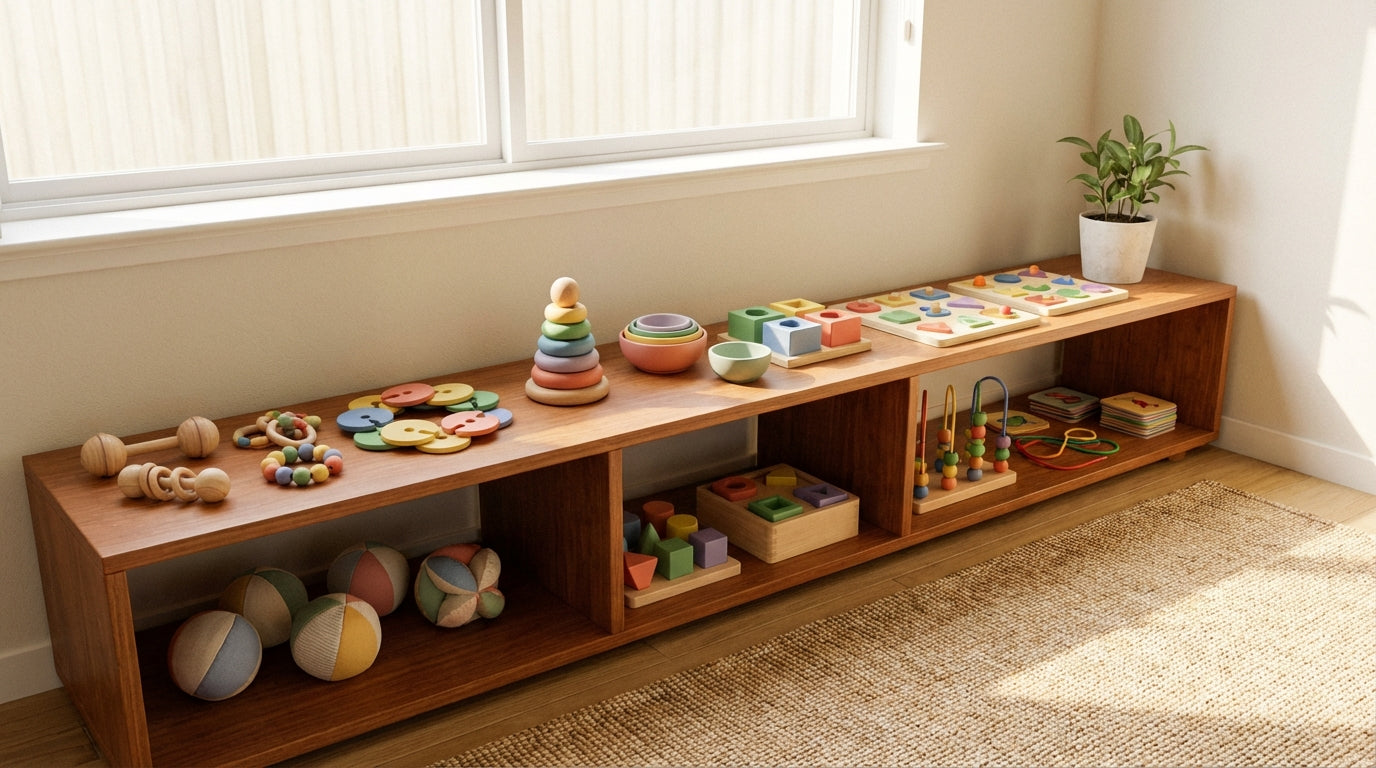
A mini learning world is perfectly enough to get started. A low shelf, 6–10 things that are really used, and a clear place for each item. If you like, browse the Montessori hub later – simply as a collection of ideas, not as a “must.”
The Prepared Environment: The Heart of Montessori (No Secrets Involved)
The prepared environment is designed so that your child can manage as much as possible on their own. That means: furniture, materials and routines are arranged so that independence becomes likely – and doesn’t just remain a nice intention.
Child’s room: fewer boxes, more clarity
In the child’s room, one fixed place per item helps more than ten storage boxes. A low shelf, a few play options and a basket for “played with today” are often worth their weight in gold. If you’re looking for a small selection of suitable materials, the Montessori Shop is a calm corner to browse.
Kitchen: helping out instead of “let me do it”
In the kitchen, Montessori suddenly becomes very practical – and very sticky. A step stool, a cup of their own, a small board and a spot where children’s things are allowed to live are often enough. For children who want to practice cutting safely and under supervision, a child-friendly knife can make sense – you’ll find ideas under Montessori knives.
Bathroom & hallway: defusing the little time-eaters
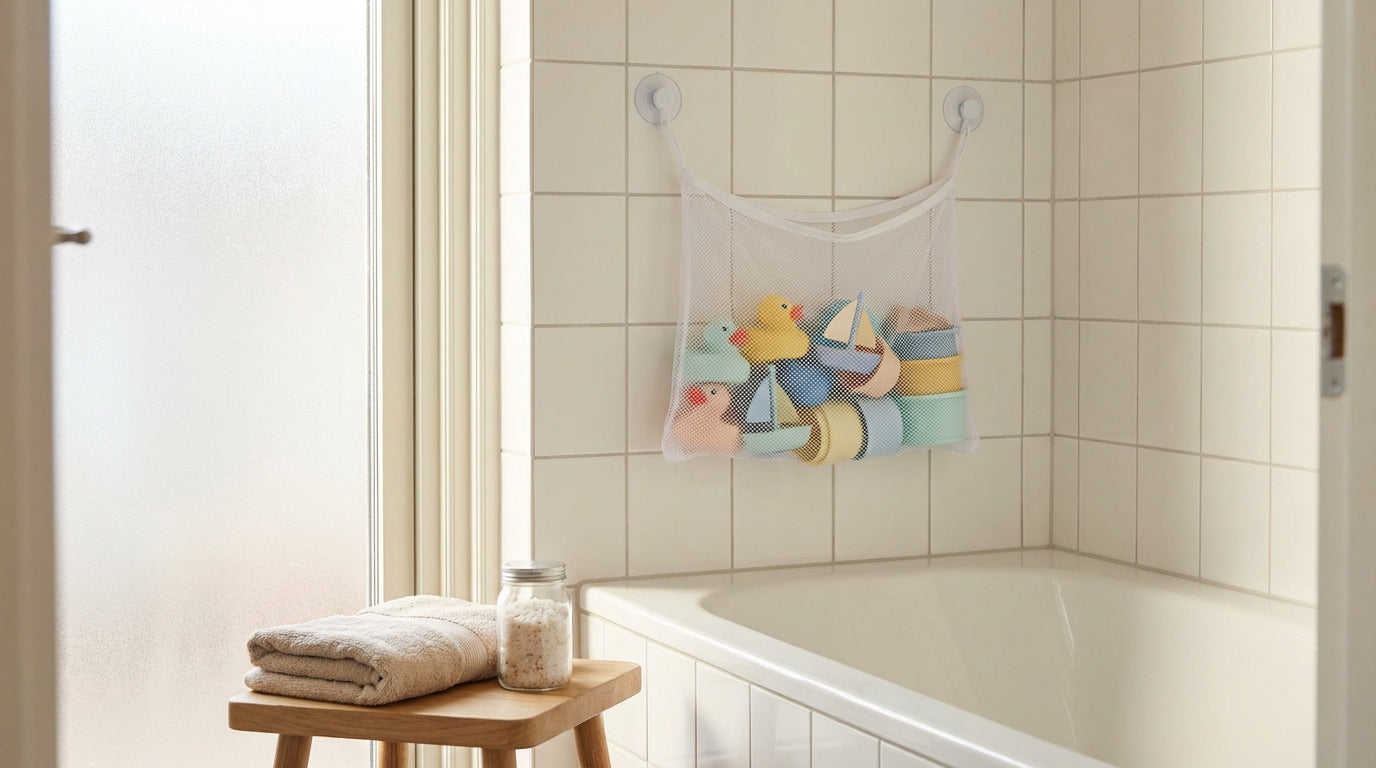
In the hallway and bathroom, you save your nerves in the morning when everything is within reach. Hooks at child height, a small brush, a cloth for wiping up, toothbrush and towel placed so your child can reach them – that’s no magic, just good placement.
And now, honest the northern German way: It doesn’t have to look like a catalog. We’re a family business from Hamburg, we’ve been doing this for 66 years – and we know that family life is rarely “Pinterest-perfect,” but it can still work well.
Montessori Materials: Why They’re Often “Self-Correcting”
Montessori materials are often designed so that children can discover mistakes themselves. That takes some pressure off you, because you don’t have to correct constantly. According to AMI, this principle is described as the “Control of Error”: materials support children in recognizing and correcting their own mistakes.

What does that mean in practice? A shape puzzle only fits together properly when the shape is right. A sorting set shows through “fits/doesn’t fit” whether it’s correct. Your child notices – without you having to be the correction robot.
Safety note: For materials for children under 3 years, watch out for small parts that can be swallowed and use them only under supervision. Also check regularly for loose parts and damage.
Sensitive Periods: When Children Want to Practice “As If by Themselves”
In sensitive periods, children are especially receptive to certain skills. Maria Montessori described these times as phases of heightened readiness to learn – for example for language, order or movement. According to Montessori Zentrum ANGELL Freiburg, there are developmental phases in which children acquire certain skills particularly easily.

How you can tell: Your child repeats something a hundred times (and by the 83rd time you think: “Well, so this is my life now.”). That very repetition is often the learning.
- Order: Things have to be “exactly like this.”
- Movement: Climbing, carrying, pushing – preferably everything.
- Language: Collecting words like other people collect bonus points.
Practical tip: If your child is currently celebrating “order”: set out 3–5 identical little baskets (socks, cloths, building blocks). Sorting suddenly becomes a hobby.
Montessori at Home by Age: 1–2, 3–4, 5–6 Years
Montessori grows with your child – and you don’t have to master everything at once. Take this as rough guidance, not a timetable. Children develop differently, and sometimes “just putting on shoes today” is already an achievement.
Montessori at 1–2 years: “I want to do it myself!” – safely
At 1–2 years, it’s mainly about safe independence in everyday life. Good activities are short, repeatable and have a clear ending.
- Practicing getting dressed: hat on/off, hook-and-loop fasteners, putting shoes in a fixed corner.
- Putting things in and taking them out: A drawer with harmless items (cloths, wooden spoons) can be “legal.”
- Pouring & spooning: A small jug with water in the sink, spooning from one bowl into another.
- Tidying up as a mini routine: 2–3 things back on the shelf, done. More is often wishful thinking.
If you’d like to gently include babies: Calm visual stimuli can be interesting without overwhelming. You’ll find ideas under Montessori mobiles.
Montessori at 3–4 years: tasks with real purpose
At 3–4 years, “I’m really helping” often works surprisingly well. Children want to contribute – and are proud as can be when you let them.
- In the kitchen: washing vegetables, stirring dough, cutting fruit (under supervision).
- Household: setting the table, sorting socks, watering plants.
- Toy rotation: A few options visible, the rest put away – this noticeably reduces chaos.
- Language games: naming things, rhymes, “I spy with my little eye” (old, but good).
Montessori at 5–6 years: more responsibility, more “real” tools
At 5–6 years, tasks can take longer – and be more challenging, too. Many children can now plan sequences and take on small responsibilities.
- Cooking & baking: measuring, recipe steps with pictures, wiping the work surface themselves.
- Organization systems: one drawer for crafts, one for games – with clear categories.
- Fine motor skills: practicing tying bows, small screwing/plugging tasks.
- Their own project: finishing a puzzle, building a model, something that spans several days.
Do’s & Don’ts: Common Montessori Mistakes (and How to Avoid Them)
The most common stumbling blocks aren’t “the wrong material,” but too much good intention. Here are a few classics – so you can spare yourself (if possible).
- Don’t: Too much choice at once. When 40 things are visible, it quickly gets restless for children (and parents). Better: a few complete options.
- Do: Rotate rather than constantly buying new. Put one item away, bring it back out later – it often feels brand new.
- Don’t: Step in too early. If you always “rescue,” your child learns: I just have to wait. The 10-second rule helps.
- Do: Show slowly, then let them do it. Demonstrate once, calmly, then hands behind your back (figuratively speaking) and observe.
- Don’t: Turn order into a power struggle. If tidying up is only stress, it’s no longer learning. Mini steps are okay.
- Do: Create clear places. A fixed place for each item is half the battle – for the child’s brain and the parent’s brain.
Safety note: For kitchen and cutting tasks: child-friendly tools, calm guidance, and an adult stays within reach. No distractions on the side.
Montessori in Daycare and School: What’s Typical?
Montessori settings often work with mixed-age groups and longer periods of free work. Children choose activities, work with focus and are accompanied by educators who observe a lot and offer targeted impulses. AMI describes Montessori environments as prepared so that self-chosen, practical work is possible – with a restrained, observing role for the adult.
If you’re looking at a setting, these questions help:
- What does the daily routine look like? Are there longer periods of free work?
- How are conflicts handled? Calmly, respectfully, solution-oriented?
- How are materials offered? Tidy, accessible, not “just decoration”?
And in case you’re thinking: “That sounds lovely, but my child is wild”: Montessori isn’t only for quiet children. Plenty of energy can flow into meaningful tasks – if the environment fits and you don’t want everything at once.
FAQ
What is Montessori in one sentence?
Montessori is an educational approach that lets children learn independently – adults guide and prepare the environment. Its guiding idea is “Help me do it by myself.” It’s not about perfection, but about trust, order and suitable tasks that children can choose out of their own motivation.
Is Montessori “anti-authoritarian”?
No: Montessori means freedom within clear limits. Children may choose what they occupy themselves with – but rules for behavior, materials and consideration for others are binding. The goal isn’t “anything goes,” but self-discipline and a respectful framework in which focused work becomes possible.
What does “prepared environment” mean in Montessori?
A prepared environment is designed so that children can do as much as possible themselves. This includes reachable furniture, tidy materials and clear places. According to AMI, the Montessori environment is deliberately organized and accessible so that children can carry out self-chosen activities.
What are Montessori learning worlds?
Montessori learning worlds are ordered learning areas with suitable materials for particular skills. In settings, these are often areas such as everyday life, senses, language or math. At home, it can also be a small shelf from which your child can choose and tidy up on their own.
From what age does Montessori make sense?
Montessori ideas can be gently introduced from babyhood and then grow along with your child. With babies, it’s more about calm stimuli and safe freedom of movement, later about practical tasks and independence. What matters is less the age than the question: What does your child want to practice right now?
Do I need special Montessori materials?
No – a lot can be done with everyday items, as long as they are child-friendly, safe and easy to see. Montessori materials can help because they are often designed to be “self-correcting.” According to AMI, the “Control of Error” supports children in discovering and correcting mistakes themselves.
Finally, nice and relaxed: Pick one thing to try out this week – nothing more is needed. If you’d like to collect ideas, feel free to browse the Montessori hub or visit the Montessori Shop. With our products, we pay transparent attention to materials and child-appropriate use – just the way we need it at home as parents (Ulli & Flo), too.