Bath Toy Storage: Smart Drying Tips to Prevent Mold
At a glance
- Bath toy storage works best like this: let toys drain first, then store them where air can circulate.
- A net, wall organizer or open basket is often the most hygienic choice in the bathroom.
- Squeeze toys are the classic mold culprits: get the water out, clean them regularly and dry them well.
- Cleaning that fits real life: a quick rinse after every bath, plus a regular deep clean.
- If residue stays inside or a smell never goes away: replace the toy instead of fighting a losing battle.
Storage is most hygienic when bath toys can dry out in the open. In practical terms, that means: squeeze out the water, rinse briefly, let them drain – and only then put them in a net, an airy bag or an open basket. In this guide you'll find simple solutions for the bathroom (even a tiny one), concrete cleaning methods and a short checklist for when it's time for a toy to go. No perfectionism required – we just want your bathroom to avoid smelling like “aquarium meets basement”.

Ulli & Flo
Owners of bieco · Hamburg · parents themselves
We've learned that when bath toys get a fixed, airy spot, bath time instantly becomes more relaxed. And yes – the net on the wall regularly saves our evenings. Feel free to browse our Storage collection.
Why bath toys need to be stored properly
Moisture plus warmth is the turbo boost for residue and odors in the bathroom. Bath toys reliably bring both: water inside, water outside, plus shampoo residue, bubbles and bathwater. That's perfectly normal – but it explains why “just toss it in the corner” tends to backfire after a few weeks.

A biofilm is a slimy layer of microorganisms on damp surfaces. What that means for you: where water stays put and “food” (soap, skin flakes, bath additives) is added, this film forms faster – even on the inside of toys.
Eawag found dense biofilms inside the used bath toys it examined. According to Eawag, bacteria and in some cases fungi were detected in many toys – encouraged by moisture, nutrients from the bathwater and the material. (Source: Eawag)
Preventing mold: the 3 things that really help
You prevent mold with air, dryness and a small routine. Sounds unspectacular – but that's exactly the point. Three quick steps after the bath beat any “I'll do it on the weekend” hope.

- Water out: Squeeze squeeze toys several times until nothing comes out anymore.
- Residue off: Rinse briefly with clean water, especially after lots of bubbles or oil.
- Air in: Store toys openly so everything can dry (net/organizer/open basket).
Squeeze toys with a hole are especially prone to problems because water stays trapped inside. If your child squeezes the animal and “mysterious soup” comes out: that's not a witch's brew, but a pretty clear signal.
Safety note: If there is visible residue inside and you can't reliably remove it, it's better to throw the toy away – especially with squeeze and squirt toys.
An unpleasant smell is a warning sign you should take seriously. The German Federal Institute for Risk Assessment (BfR) recommends avoiding consumer products with a noticeable odor, because smell can point to low quality and possible risks. (Source: BfR)
The best storage solutions for the bathroom (without the Pinterest pressure)
The best solution is the one you can manage with one hand in the evening. While the other hand is catching a wet child and you're trying not to slip on a duck.

1) Net on the wall (airy, simple, inexpensive)
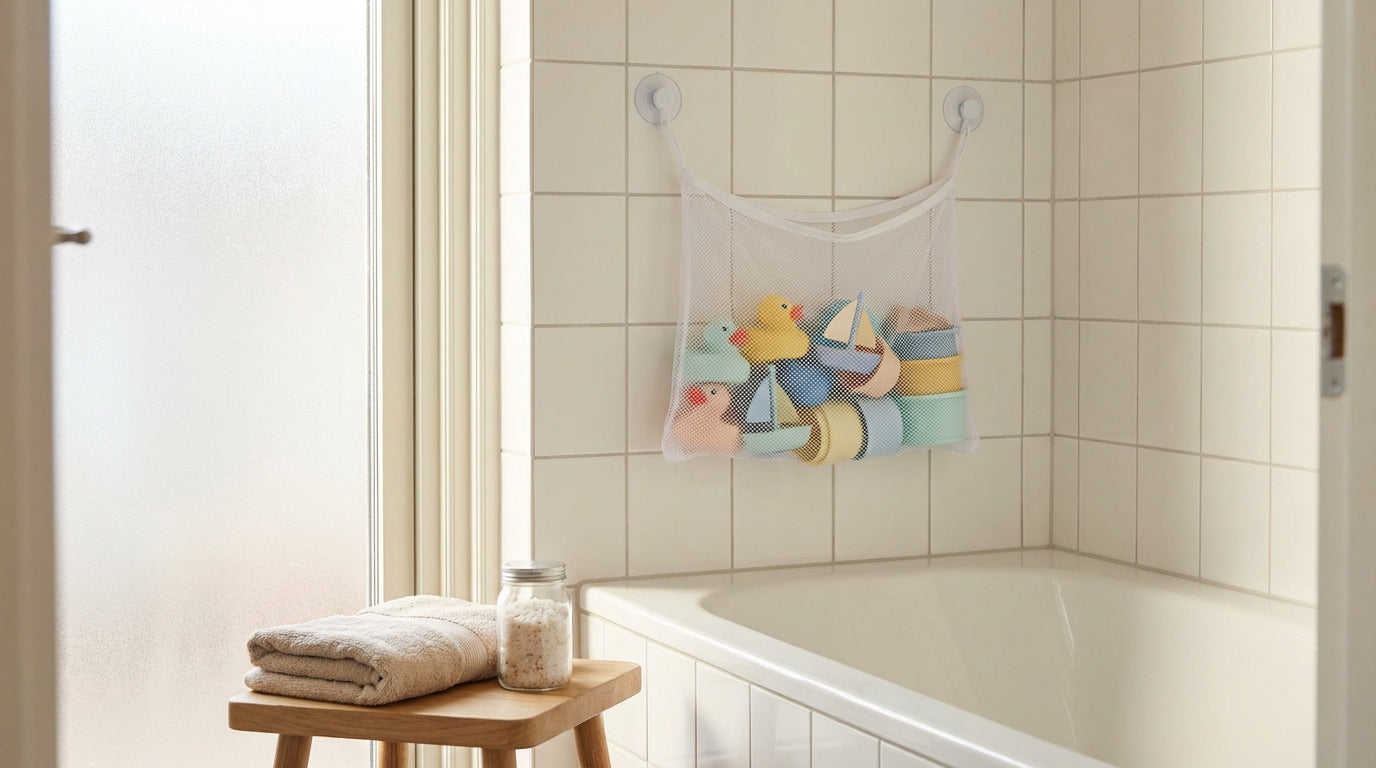
A net is ideal because water can drain away and everything dries faster. Hang it so that your child (depending on age) can help – then “tidying up” sometimes even turns into a game. tesa shows a DIY version with adhesive hooks in its instructions. (Source: tesa)
2) Suction cup bag / wall organizer (for small bathrooms)
An organizer with drainage collects toys and lets them dry at the same time. Make sure there are really openings at the bottom – otherwise you've got a stylish damp chamber on your wall. And yes: suction cups sometimes have a mind of their own. Cleaning the surface once and pressing firmly often helps.
3) Open basket (quickly tidied away, but please with airflow)
An open basket works when the toys were allowed to drain beforehand. For families who like to just toss “everything into one basket”: totally fine. Just not dripping wet. If you're looking for an easy collection spot, a storage basket works nicely as a “drying parking spot” in the bathroom.
4) Box with a lid (as a second station, not first aid)
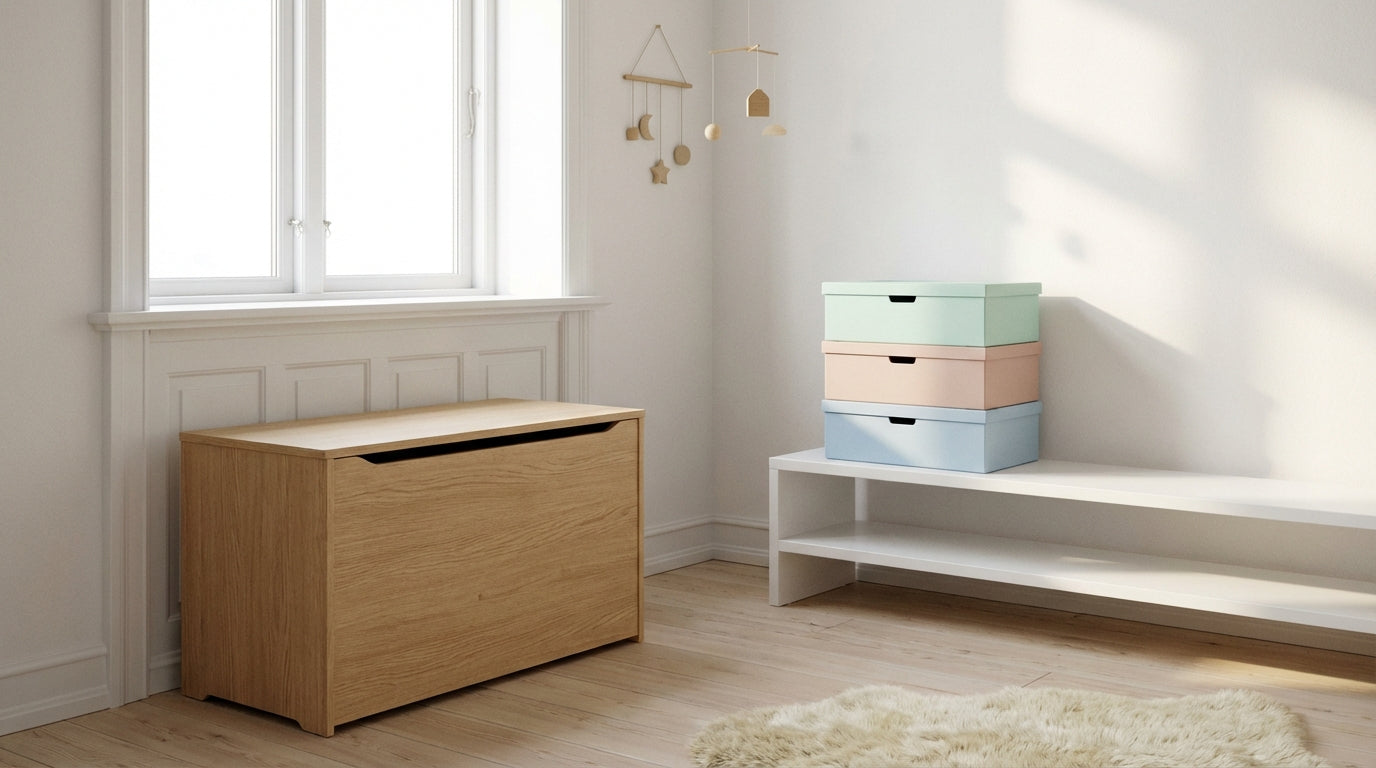
Closed boxes only make sense in the bathroom if everything is truly dry. For bath paints, small boats without cavities or spare parts: fine. For squeeze toys straight after the bath: better not. If you want to use a box, use it as a second station after draining, for example a storage box with lid.
Practical tip: Set up a small “drip zone” (colander, shower caddy, small laundry basket). Let toys drain for 20–30 minutes first, then put them away.
Drying bath toys properly: step by step
The best order is: empty, rinse, drain, store with airflow. The less “bath soup” stays on the toy, the less food there is for residue.
- Water out: Squeeze squeeze toys several times (over the sink, if you like).
- Rinse: Rinse briefly with clean water, especially after a bubble bath.
- Drain: Put them in the net/organizer or the drip zone.
- Ventilate: Air out the bathroom so overall humidity goes down.
Ventilating helps because it lowers the humidity in the room and speeds up drying. The consumer advice center (Verbraucherzentrale) recommends ventilation as a measure against moisture and mold damage in living spaces. (Source: Verbraucherzentrale)
Cleaning bath toys: concrete methods (no magic potions)
Cleaning means: loosen residue, rinse well and then let everything dry completely. Which method suits depends on the material and construction – and on what the manufacturer allows.

How often should you clean? A rhythm that works in everyday life
As a rule of thumb: immediately if there's a smell or film, otherwise regularly in your everyday rhythm. If you bathe daily, a quick “once a week” is realistic for many families. If baths are occasional, less often is usually enough. More important than the calendar are: smell, slimy film, discoloration.
Quick everyday cleaning (after the bath)
A short rinse with clean water reduces residue and therefore also buildup. Bubble bath and oils in particular like to leave a film. After that: let toys drain and store them where air can reach them – that's already half the battle.
Deep clean: soaking + brush (for “somehow slimy”)
Soaking helps when a film has formed that rinsing can't remove. Use a bowl or bucket, soak the toy according to the manufacturer's instructions and scrub accessible spots (e.g. with a small dish brush). Then rinse thoroughly with clean water and let it dry completely.
Manufacturer instructions are the first place to look, because material tolerance varies. Infantino, for example, describes a soaking method and advises: if mold caused by trapped water doesn't go away, throw the toy out. (Source: Infantino)
Dishwasher: only if explicitly permitted
The dishwasher is convenient, but not every bath toy is made for it. Some parts warp, colors suffer, or water collects inside afterwards all the more. If the manufacturer allows the dishwasher: place the toy so that water can drain, and let it dry extra thoroughly afterwards.
Vinegar & co.: only if the manufacturer approves
Household remedies aren't automatically harmless, especially for soft plastics. If a manufacturer mentions a vinegar solution, that's a good indication – otherwise be cautious and, when in doubt, stick to gentle cleaning. What matters in the end: always rinse thoroughly with clean water and dry completely.
Material & construction: what makes a bath toy “hygienic”?
Hygienic toys are mainly those you can clean completely and dry fully. That's often more important than “material X versus material Y”. If you can reach every surface and no water stays inside, you're already well ahead.
“Holeless” bath toys have no opening that lets water into hollow spaces. That reduces the risk of buildup inside – and saves you the squeezing. If your child loves squirt toys: fine, then just empty them consistently and store them with airflow.
How do I know when cleaning isn't enough anymore and the toy has to go?
Replacing a toy is sometimes the more relaxed and safer solution compared with endless scrubbing. Especially with toys that can't be reached inside, you can't just quickly check whether everything is really clean.
- Visible residue inside: You see dark spots/streaks inside and can't get to them.
- Constant smell: It keeps smelling unpleasant despite cleaning and drying.
- “Soup” when squeezed: Cloudy water repeatedly comes out even though you emptied the toy.
- Material changes: Sticky, cracked, porous or discolored – then it becomes hard to keep hygienic.
Staying tidy with a mini system: 60 seconds that pay off
Tidiness in the bathroom works better with a fixed mini routine than with willpower. Willpower is – let's say – a limited resource in the evening.

- 1: Gather all the toys in the tub.
- 2: Squeeze out the squeeze toys, rinse briefly.
- 3: Into the net/organizer – done.
Practical tip: If your child wants to help: give them exactly one task (“All the boats into the net!”). More tasks = more chaos. Tried-and-tested laws of nature.
A small selection in the bathroom is easier to keep clean than an entire zoo. The rest can be stored dry elsewhere and rotated in. That's not deprivation – more of a “greatest hits program” for the tub.
Which storage suits which bathroom?
The right solution depends mainly on space, ventilation and your habits. Here's a little decision aid, no big fuss:
| Bathroom situation | Practical solution | Why it works well |
|---|---|---|
| Small bathroom, little shelf space | Net or wall organizer | Uses the wall, dries with good airflow |
| Lots of pieces (cups, molds, boats) | Open basket + drip zone | Quickly gathered, still gets air |
| You want “everything put away” after the bath | 2 stages: net first, then box | Dry storage without a moisture trap |
Why we at bieco are so picky about storage
We're a family business from Hamburg and have been doing this for 66 years. And yes: we know the moment when all you think is “quick, just get it out of the way”. That's exactly why we like storage that works in everyday life: open, within reach, quick to use – and preferably in a calm Scandi look, so the bathroom doesn't look like a toy warehouse.
Transparency is part of it: materials and tests must be traceable. When we talk about storage, we always look at child safety and everyday practicality – not at glossy perfection. If you want to build a simple drying and collection spot for the bathroom, you'll find suitable basics in the Storage overview, and for the bathroom corner specifically, the Bath Toy Storage.
Further reading (if you're in tidying mode)
- More ideas for toys: Toy Chests & Storage Ideas
- Box comparison: The Best Storage Boxes for the Nursery
- If you'd like a basket: Storage basket
- If dry toys can go in a box: Storage box with lid
FAQ
What is the best way to store bath toys?
It's best to store bath toys with good airflow after they've had a chance to drain. A net or wall organizer is ideal because water runs off and air can reach the toys. An open basket also works well – the only important thing is that the toys don't get thrown in dripping wet.
My bath toy is moldy inside – what can I do?
If there's visible residue inside and you can't properly reach it, throwing the toy away often makes sense. According to Eawag, biofilms can form inside used bath toys when moisture stays trapped. (Source: Eawag) With toys that have a hollow space, you can try cleaning – but if it comes back: replace it.
Can bath toys go in the dishwasher?
Only if the manufacturer explicitly allows it. Some plastics warp, and with squeeze toys, water can get stuck inside afterwards. If the dishwasher is permitted, place the toy so that water can drain, and then let it dry completely.
How often should you clean bath toys?
Clean immediately if there's a smell or slimy residue, otherwise regularly according to your own rhythm. With frequent bathing, a short deep clean once a week is doable for many families. What matters: follow the care instructions, because material and construction determine what the toy can handle.
How do bath toys dry fastest?
They dry fastest when the water is out and air can reach them. Squeeze squeeze toys several times, rinse briefly and then hang them in a net or organizer. It also helps to ventilate the bathroom – the Verbraucherzentrale recommends ventilation to reduce moisture. (Source: Verbraucherzentrale)
When should you replace bath toys?
Replace them if they're visibly dirty inside, smell permanently or no longer get clean. Especially with toys in which water stays trapped, this is a recurring problem. Manufacturers like Infantino advise throwing toys away if mold caused by trapped water doesn't disappear despite cleaning. (Source: Infantino)
Bottom line: airy storage beats any “perfect” decorative solution. Start with a net or organizer, add an open basket if needed – and only use a box with a lid once everything is truly dry. If you want to sort out your bathroom corner, you'll find suitable basics in our Storage collection, and specifically for the tub in the Bath Toy Storage.