Toy Box with Lid: Storage Ideas for the Nursery
At a Glance
- A toy box with a lid makes a room look “tidy” in minutes.
- Lids for small parts & dust protection, open baskets for quick toss-ins.
- Check the lid: easy to use, no finger-pinch points, stable stance.
- Big boxes need 2–3 inner categories, otherwise they turn into a black hole.
- The living room works best with zones: one container per play area.

A toy box with a lid is at its best when it takes the tidying off your hands. Meaning: lid on, room looks calm, done. In this guide I’ll show you practical storage ideas for the nursery and living room: which box is good for what, how to organize a big toy box so nothing gets lost, what to look for in a lid (yes, including little fingers) and how children can really help depending on their age. No pressure to be perfect – more of a “good enough, as long as the floor is clear” approach.

Ulli & Flo
Owners of bieco · Hamburg · parents themselves
It worked best for us when we radically cut down the categories: one basket for “soft”, one box for “hard” – and that’s it. Everything else is a bonus. Feel free to browse our Storage collection.
Toy Box with Lid: When It’s Really Worth Its Weight in Gold
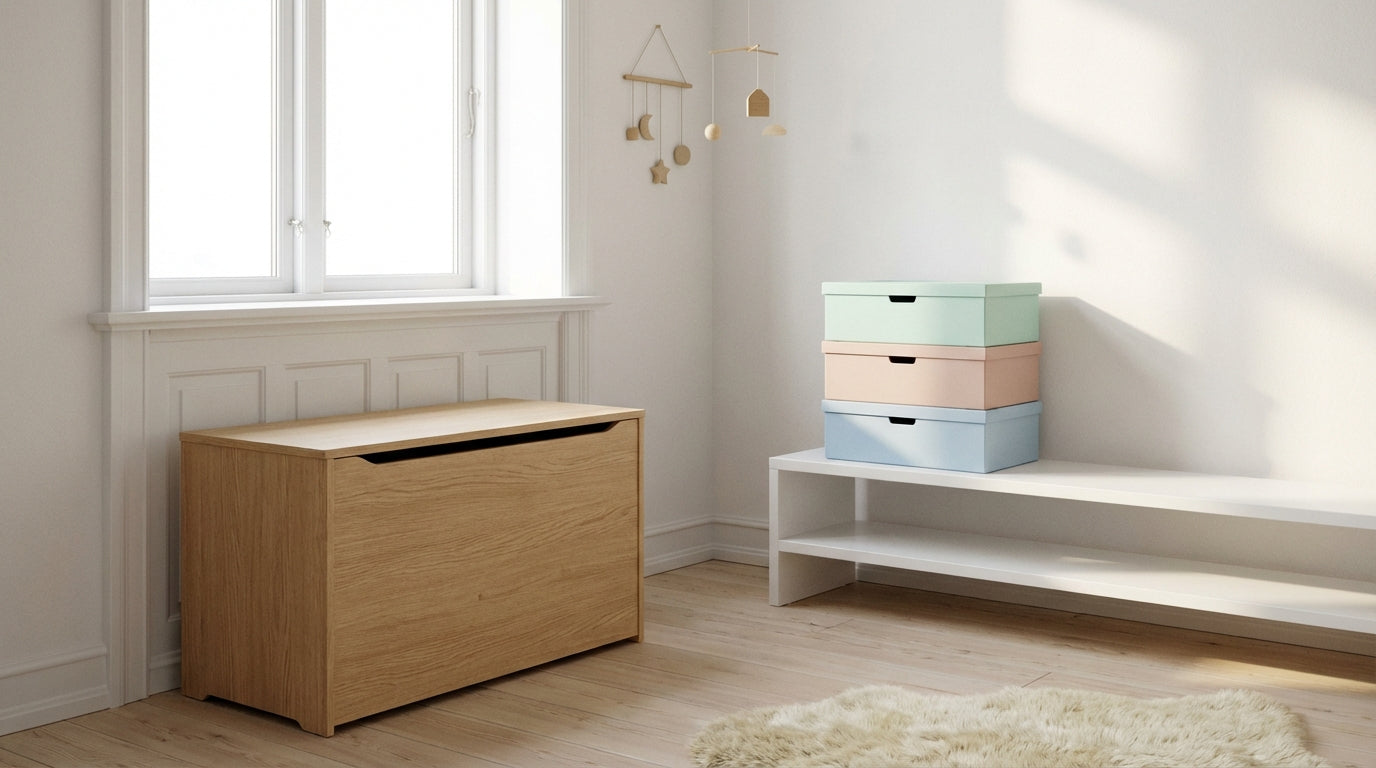
A lid is perfect for “out of sight, fast” and less visual clutter. A toy box with a lid is ideal for everything you don’t want to see all the time: small parts, craft supplies, building blocks, seasonal toys or the famous “Aunt Inge’s gift” stuff that rarely gets played with.

A toy chest with a lid also helps against dust and everyday crumbs. Especially in the living room or open-plan kitchens, the space instantly feels calmer when small stuff isn’t “decorating” everywhere.
Practical tip: When the evening is tight: “everything into the box” is a perfectly legitimate strategy. Sorting can happen later.
Lid for small parts, open baskets for “just toss it in” – that’s the relaxed combo. Anything too fiddly won’t be used in real life. And then it’s all over the floor again. (We know the feeling.)
If you want an overview, the best place to start is our storage collection. There you’ll find different solutions for nursery storage: Storage.
Wooden or Fabric Toy Box? How to Decide Without Overthinking
The best material is the one you like to touch every day. A wooden toy box often looks more “like furniture” and is sturdy – great if the box doubles as a shelf now and then. Fabric or canvas boxes are lighter, quieter and easy to move around (and that happens about as often as the laundry piles up).
A storage box with a lid works well if you can operate it with one hand. Your other hand is usually busy: child, sippy cup, laundry basket – take your pick.
A toy box is a large catch-all storage for mixed toys. It’s there to create order quickly – not to manage every single piece individually.
A storage basket is a flexible quick-drop spot that’s easy to carry. It works especially well for stuffed animals, dress-up clothes, balls or anything big and light.
If you’re looking for a soft, lightweight solution, baskets are often the most relaxed choice. One example is a sturdy fabric basket with handles that you can quickly carry out of the living room: Ella Deer Storage Basket.
Checklist: What to Look for in a Lid (So There Are No Tears)
A good lid closes securely without putting little fingers at risk. With a toy box with a lid in particular, it’s worth taking a quick look at the details – it saves stress in everyday life.

- Easy to open: Your child should be able to manage the lid on their own (appropriate for their age), otherwise everything ends up next to the box.
- No finger-pinch points: Look for designs where fingers can’t get caught between the lid and the edge.
- Stable stance: The box shouldn’t wobble or tip when children lean on it.
- Lid stays where it should: A lid that slams shut unexpectedly is simply annoying in everyday life.
- No small parts on the outside: Decorative buttons, loose parts or long ribbons are not ideal around small children.
Safety note: Small parts should be kept out of reach of children under 3 years. According to LAVES, toys are tested for, among other things, whether parts can be swallowed (test cylinder) – this is especially relevant for this age group.
If you want to assess toys by safety requirements, it helps to look at recognized standards. The standard DIN EN 71-1 describes requirements and test methods for the mechanical and physical properties of toys; according to DIN Media, it also covers labeling and warnings. DIN EN 71-1 (DIN Media)
And if you’d like a quick understanding of what “swallowable” means in practice, the LAVES explanation is helpful. The page clearly shows how the test with the test cylinder works: How is it tested whether toys can be swallowed? (LAVES)
Large Toy Box: How to Keep It from Becoming a “Black Hole”
A large toy box only works with 2–3 rough inner categories. Otherwise everything you’ll look for tomorrow disappears at the bottom. (And tomorrow is usually exactly when you’re in a hurry.)

- 1 bag or small box for small parts: Cars, figures, accessories – everything that would otherwise wander around the box.
- 1 area for “building”: Bricks, blocks, tracks, magnetic pieces.
- 1 area for “cuddling” or “dress-up”: If it fits – otherwise better to use an extra storage basket.
The fewer the categories, the more likely your child will join in. Two categories are often better than six. And yes: “everything goes in” is a category too – just please make it a conscious choice.
If you’d like to look at different box variants, the toy box collection helps. There you’ll find different sizes and styles: Toy Box.
Toy Boxes for Kids: How Children Learn Tidiness (Without Drama)
Tidying works best when the system fits the age. A toy box for children should work in a way that your child can use it on their own – otherwise it stays your project. And you already have enough projects.
- 1–2 years: Large, light pieces. Open baskets or low boxes. Rule: “Everything goes in.”
- 3–4 years: 2–3 categories. Pictures/stickers help (car, building block, doll).
- 5–7 years: More subdivisions possible. Small boxes for sets (figures, accessories).
Ritual beats discussion: 3 minutes of tidying before dinner. Timer on, music on, done. No prize for perfection. Just “off the floor”.
Toy Storage in the Living Room: Pretty, Quick, Made for Everyday Life
In the living room, the quick system wins over the perfect one. For toy storage in the living room, many families have found a zone principle works well: exactly one container per play zone. Then the evening is about “collecting”, not “sorting”.

- Sofa zone: 1 storage basket for books & stuffed animals.
- Rug zone: 1 box/crate for building (bricks, tracks).
- Table zone: 1 small storage box with a lid for pencils, play dough, craft supplies.
A storage basket for toys is the best friend of “We’re having visitors in a minute”. Two handles, one trip across the room – zip, done. Or, as we say in northern Germany: as long as nobody breaks a leg.
If you’re looking for stackable solutions, the collection of boxes with lids is a good place to start. You’ll find variants that bring visual calm: Storage Box with Lid.
Toy Storage Boxes & Shelves: How to Build a System That Lasts
Shelves work best when children can actually reach them. A storage shelf in the nursery only helps if your child can get to it: low compartments, clear containers, not too much at once.
- Bottom: heavy items (wooden blocks, large vehicles) in sturdy boxes.
- Middle: everyday toys (books, puzzles, figures) – ideally in open boxes.
- Top: rarely used toys or sets that only come out with an adult.
Storage boxes for toys are strongest when each box has exactly one job. “Cars”, “building”, “dress-up” – done. A “quick box” is allowed, but then it’s simply the official chaos drawer. That’s more honest.
Practical tip: Set a lid rule for each category: anything that needs a lid is small stuff. Anything without a lid is big enough for quick tidying.
If you’re reorganizing right now, comparing boxes can really save time. Here you’ll find a practical overview: The Best Storage Boxes for the Nursery Compared.
And if you’d rather stay flexible than invest in rigid grids, this article helps. Especially for rental apartments or frequent rearranging, it’s worth its weight in gold: IKEA Alternatives: Flexible Storage Instead of Trofast & Co..
Dimensions & Space Needed: How the Toy Box Fits Into Your Daily Life
The best box is the one that stands where the playing happens. Sounds trivial, but it’s the most common reason storage systems fail: the box is “officially” in the nursery, but the playing happens in the living room.
- Do a placement test: Mark the planned spot with painter’s tape and see for two days whether it bothers you.
- Keep walkways clear: Boxes belong against the wall or in corners, not on the race track.
- The lid needs room: If a lid opens upward, plan some space so it doesn’t bang into furniture.
If you’re torn between “one big” and “two medium”: two medium ones often win. You can spread them across two play areas, and there’s less “digging around” when tidying up.
Cleaning & Materials: How to Keep the Box Looking Nice for Longer
Keeping things clean works best with simple routines instead of big cleaning sessions. Nursery life is sticky, dusty and sometimes a little “Why is this damp?”. So it’s better to do a little, regularly.
- Wooden surfaces: Wipe with a slightly damp cloth, then dry with a cloth.
- Fabric baskets: Shake out or vacuum crumbs first; treat stains individually.
- Inside: Small bags/inner boxes make emptying and re-sorting easier.
If you use a storage box with a lid, a quick “lid check” while cleaning is worthwhile. Just take a look to see whether everything is secure and closes properly – then there’s less squeaking and less frustration.
DIY: Labels Kids Will Actually Use (Without a Crafting Marathon)
Good labels save arguments because they take decisions off your plate. And no, you don’t have to spend three evenings making them. A practical approach works too.
- Decide on 2–3 categories: For example “building”, “cuddling”, “drawing”.
- Picture instead of text: Take a photo of the contents (your phone is enough) and print it.
- Attach sturdily: Use wide tape or a label sleeve so it doesn’t fall off after two days.
- Trial run: Watch for a week to see if it works – only then label everything.
If your child picked the pictures themselves, participation goes up noticeably. That’s not a magic trick, more like real-life psychology.
Why We’re So Picky About Storage (Briefly, Promise)
Everyday-friendly storage is real relief for families, not decoration. We’re a family business from Hamburg, we’ve been doing this for 66 years, and in conversations we keep hearing the same longing: less stuff on the floor, less stress in the evening.
It matters to us to speak openly about materials, workmanship and safety. Especially with boxes and lids, what counts is that they’re practical and feel good – and that you as a parent don’t constantly have to shout “Watch out!”.
FAQ
Which toy box with a lid is the most practical?
The most practical one is a box that’s quick and easy to use with one hand. A lid is especially worthwhile for small parts, craft supplies or anything that should stay dust-free. Make sure your child can open the box themselves (depending on age) – otherwise it becomes storage for parents only.
What’s better: a toy chest with a lid or open baskets?
Both together are usually the best solution. Open baskets are unbeatable for daily tidying because nothing has to be opened. A toy chest with a lid is great for small stuff, dust protection and visual calm. Many families use baskets for “today” and boxes with lids for “not all the time”.
Is a wooden toy box better than a fabric one?
Better is whatever fits your daily life. Wood often looks sturdy and more “like furniture”, fabric is lighter, quieter and more flexible to carry. For frequent rearranging and living-room zones, baskets and fabric boxes are often more relaxed. For heavy building blocks, a sturdy wooden toy box can make sense.
How big should a large toy box be?
Big enough to help – but not so big that everything disappears. If you use a large toy box, plan rough subdivisions inside (bags or small boxes). Otherwise you’ll constantly be searching for pieces. For many families, two medium-sized boxes are more practical than one huge one.
How do I organize toy storage in the living room?
With zones and exactly one container per zone. One basket for books/stuffed animals at the sofa, one box for building at the rug, one storage box with a lid for pencils at the table – done. That way the evening is about “collecting” instead of “sorting”. It lasts longer than any perfect system.
What should I look for regarding safety and storage?
Stability, lid construction and age-appropriate small parts. Heavy items belong at the bottom so shelves don’t tip. Small parts should be stored so that small children can’t reach them unsupervised. According to DIN Media, DIN EN 71-1 describes requirements for the mechanical/physical safety of toys.
If you now feel like making things “simply better”, start small – with one box in the right spot. In our Storage collection you’ll find boxes, bins and baskets that play along with family life – even on days that are far from a catalog photo shoot.