Stick Horse Age: When to Start, What Size to Pick & How to Play Safely
At a glance
- Stick horse age: from about 3 years old is often a good fit – depending on your child & the model.
- The stick length should suit your child, otherwise things get trippy fast.
- For indoors: a clear track, soft obstacles, and firm rules (stairs are off limits).
- Hobby horsing is equestrian sport “on foot” – with dressage, jumping and racing.
- Look for clean workmanship, an age recommendation and clear, traceable labelling.

Stick horse age: a stick horse usually makes sense from around 3 years old, as long as the size and workmanship suit your child. That takes the pressure off: you don't need to make a science of it, just take a quick look. In this guide you'll get practical guidance on age, stick length, model types (plush, felt, wood, with or without sound) and safety – plus tips for indoors and outdoors. We'll also clear up what actually sets a hobby horse apart from hobby horsing, without you having to read a tournament rulebook first.

Ulli & Flo
Owners of bieco · Hamburg · parents themselves
We've learned that once the stick length and the “riding track” are right, everything gets much more relaxed – for kids and furniture alike. And yes, in our house the stairs stay strictly horse-free, too. Feel free to browse our stick horse collection.
Stick horse age: when does it make sense?
A stick horse suits many children from about 3 years old, because balance and coordination are often steadier by then. It's not a hard limit, more of a good starting point: many three-year-olds can run quickly, stop and dodge – and (mostly) understand that you don't “jump” into the sofa corner with a running start. What matters is less the birth date and more the mix of motor skills, temperament and play environment.

A stick horse is a toy horse on a stick that children “ride” while running. The benefit is simple: movement, role play, imagination – and sometimes a bit of extra energy that no longer drifts around the living room in the evening.
Practical tip: If your child keeps stumbling while running, the problem is often not “too wild” – it's a stick that's too long or too short.
What age for a stick horse – how to tell in everyday life
The manufacturer's age recommendation is the starting point, but your child is the truth. Three quick checks help you decide in 30 seconds:
- Motor skills check: Can your child run quickly and stop without falling right away?
- Rules check: Does “riding only on level ground” work, at least most of the time?
- Parts check: Are there decorations, buttons or loose elements that could come off?
For children under 3, soft, sturdy models without small parts are generally more relaxing. Not because the little ones aren't “allowed”, but because speed + stick + furniture is a combination that makes parents' hearts beat faster. If you want to start early: better outdoors or in a large room, and with a clearly marked “riding track” to begin with.
Stick horse size: rough guide by body height (table)
The right stick horse size is the one where your child runs freely without the stick dragging. Exact centimetres are hard to give, because heads differ in size and weight and sticks end differently. But as a rough guide, a simple range by body height helps – plus a quick test (below).

| Child's height | Rough stick length (without horse head) | How you can tell |
|---|---|---|
| approx. 90–100 cm | approx. 50–60 cm | Stick doesn't drag, child can lift it easily |
| approx. 100–115 cm | approx. 60–75 cm | Galloping works without the stick catching on the ground |
| approx. 115–130 cm | approx. 75–90 cm | Chest/shoulder height looks right |
| from approx. 130 cm | approx. 90–100+ cm | Often more comfortable for courses/jumping |
Important: this is a guide, not a ruler-strict law. If the head is very large or heavy, a slightly shorter stick length can make sense – simply so your child can control the “horse” well.
Which stick length is right? The 3-step test without a tape measure
A quick test shows you right away whether the stick horse suits your child's posture. Here's how:
- Stand up: Your child stands upright, the stick horse held vertically in front of the body.
- Check the height: The horse's head sits roughly between chest and shoulder (not stuck to the chin, not at hip height).
- Test the movement: Walk 10 steps, then “gallop” 10 steps: the stick shouldn't keep catching on the ground.
Too long = more stumbling, too short = more dragging and frustration. If your child constantly pulls the stick backwards or “scoops” while running, it's usually a length problem – not a lack of enthusiasm.
Safety note: Stick horses and stairs are not friends. Set a clear rule: riding only on level ground.
Materials & model types: plush, felt, wood – and what that means day to day
The “best” stick horse is the one that suits your child's play style and your home. Here are the common types – very pragmatically:
- Plush head (soft): Feels cuddly and is often nicer for little ones, because it seems less “hard” if it bumps into a wall.
- Felt/fabric head (holds its shape): Often looks a bit more “horse-like” in shape, but depending on the workmanship can be more sensitive to moisture/dirt.
- Wooden head (hard, sturdy): Can be very durable, but indoors it's better suited to calm riders – and needs especially good edges/workmanship.
- With sound: Can be fun, but can also get “exciting” after day 3. It's handy if the sound can be switched off (where available).
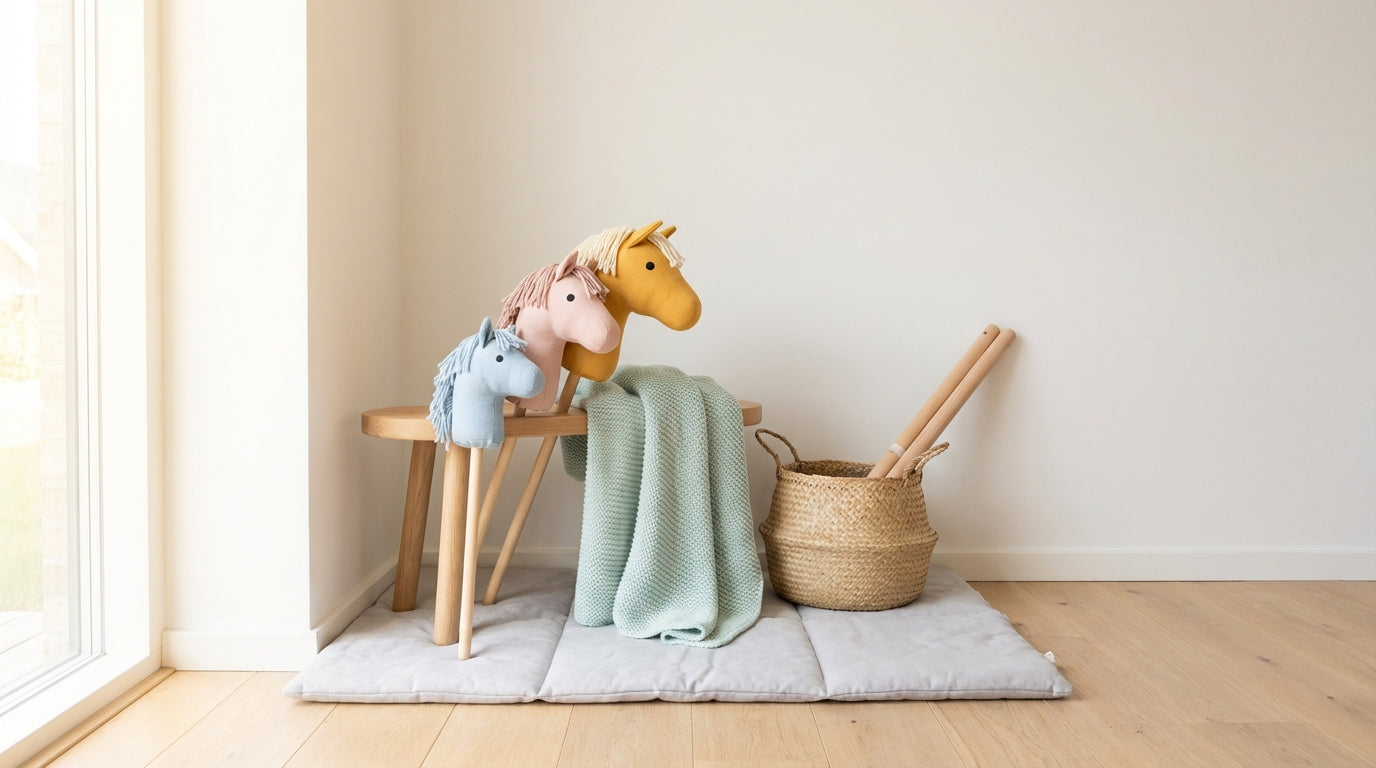
- With/without accessories (bridle, decorations): Looks great, but should sit firmly and have no swallowable small parts.
You can recognise good workmanship by firm seams, a sturdy head attachment and a cleanly finished stick end. If you already have doubts during the “wobble test”: take your gut feeling seriously – in parenting, that's usually the best sensor.
Safety & labelling: what you should really look for
A safe stick horse shows a clear age recommendation and looks so well made that nothing is loose or sharp. For toys in the EU, the Toy Safety Directive 2009/48/EC applies; according to EUR-Lex, it covers products designed for use in play by children under 14 years of age. (EUR-Lex, Toy Safety Directive – summary)
The EN 71 series of standards describes tests for toy safety, including chemical requirements. According to DIN e. V., DIN EN 71-3 deals with the “migration of certain elements” and thereby specifies requirements from the Toy Safety Directive. (DIN e. V., DIN EN 71-3)
Practical safety checks before the first ride take less than a minute.
- Stick end: Smooth, no splinters, no sharp edges.
- Head attachment: Sits firmly, doesn't wobble, can't easily be pulled off.
- Seams & decorations: No loose threads, buttons or parts that could come off.
- Grip/handling: Your child can hold it without tensing up.
“Safety transparency” means to us: better to check honestly than to sugarcoat. We're a family business from Hamburg, we've been doing this for 66 years – and Ulli & Flo write here as parents: when something is annoying or looks risky in everyday life, you don't notice it in the lab, but at the latest somewhere between the coffee table and your child's laughter.
Indoors vs. outdoors: how to keep everything in one piece (kids, furniture, nerves)
With two or three rules, wild bumping around turns into a game that's good for everyone. And yes: rules sound unromantic, but they're the best shortcut to more fun.
Indoors
Indoors, a stick horse works best with a clear track and soft obstacles. Good ideas: cushions as a “water jump”, masking-tape lines on the floor, a cardboard box as a “gate”. Better to avoid hard stool edges or glass in the “course area”.
Outdoors
Outdoors it can get wilder – but the ground decides the mood in the evening. Grass is usually forgiving, paving stones get slippery quickly, and gravel is only so-so for little feet. Sturdy shoes help, and a clearly marked area keeps the neighbour's dog from suddenly standing in the slalom.
Practical tip: If several children are riding: agree on a “direction of travel”. That saves collisions and arguments in the middle of a gallop.
Hobby horse & hobby horsing: differences, special features and getting started
“Stick horse” is the umbrella term – “hobby horse” is often used for sportier, more detailed versions. In everyday family life, many people simply say “stick horse” for everything, and that's perfectly fine. In the hobby horsing scene, “hobby horse” often means a horse that sits well in the hand for training and looks more realistic (head, mane, sometimes a bridle).
Hobby horsing is a sport and form of movement in which equestrian disciplines are imitated on foot. In a nutshell: dressage, jumping, racing – just without a real horse, but with technique, rhythm and stamina.
In Germany there are organised structures for it, with tournaments and championships. The Deutscher Hobby Horsing Verband e. V. (German Hobby Horsing Association) describes hobby horsing as a sport with rulebooks, tournaments and events. (Deutscher Hobby Horsing Verband e. V.)
What's the difference between a stick horse and a hobby horse – in practical terms?
In practice, the difference is less “either/or” – and more about how intensively and how sportily it's played. A stick horse can be the cosy role-play horse (“Today I'm a fire-brigade pony”), while a hobby horse is often geared more towards training (“Today I'm practising jumps and a freestyle routine”). Many children switch back and forth daily – depending on their mood.
For hobby horsing, what matters most is control, balance and a stick that doesn't constantly get stuck on the ground. If your child is jumping seriously, the size check is especially worthwhile: too long gets in the way at take-off, too short makes the posture hunched. And please: keep obstacles soft and low at the beginning – the ambition will come on its own.
How long do children play with a stick horse? (And when does it get “too small”?)
Many children use a stick horse for years – first for role play, later for courses and hobby horsing. This is the development you often see:

- 3–5 years: Pure imagination, lots of “I'm a horse!” and racing.
- 5–8 years: Obstacles, rules, little “tournaments” in the garden.
- from approx. 8+: Some train more purposefully (freestyle routines, technique, jumps).
A stick horse usually becomes “too small” when your child has to bend down while running or the stick keeps dragging. Then the interest isn't gone – just the proportions. And proportion is half the battle when riding (even without a real horse).
FAQ
Stick horse age: when does it make sense?
Stick horse age: for many children, starting from around 3 years old makes sense, as long as the model is sturdy and the right size. Use the age recommendation as a guide and check motor skills, rules and surroundings. For younger children, soft versions without small parts and a start on open ground are usually more relaxing.
Stick horse age: what matters more – age or body height?
Body height and stick length are often more important in everyday life than exact age. If the stick is too long, the risk of tripping goes up; if it's too short, it drags and gets annoying. Age helps as a rough guide, but what matters is coordination, speed and whether rules like “not on the stairs” work.
What stick length is good for a stick horse?
A good stick length is one where the horse's head sits at about chest-to-shoulder height and nothing drags while running. Use the 3-step test: stand up, check the height, walk/gallop 10 steps. If the stick keeps catching or your child holds it tensely, the length usually isn't right.
What's the difference between a stick horse and a hobby horse?
Stick horse is the general term, while hobby horse is often understood as sportier and more detailed. In hobby horsing, hobby horses are often meant for training (control, balance, looks). In everyday family life the terms blur – what matters is that your child can play safely and the model suits how it's used.
Is hobby horsing really a sport?
Yes, hobby horsing can be physically demanding, because technique, speed and jumps all come together. In Germany there are organised tournaments and rulebooks for it; the Deutscher Hobby Horsing Verband e. V. provides information on competitions and events. To get started, soft, low obstacles and a safe space are enough at first.
How can I tell if a stick horse is safe?
A safe stick horse has firm seams, no sharp edges, no loose small parts and a clear age recommendation. In the EU, the Toy Safety Directive 2009/48/EC applies to toys (see EUR-Lex). Also do the “wobble test”: head firm, stick end smooth, nothing coming loose.
If you'd like to keep browsing: in the hub you'll find everything about stick horses in one place. Take a look at our stick horse collection – and if you'd like to test first whether it clicks with your family, the DIY guide helps too: Making a stick horse: DIY guide, materials & tips. And for the budget question, there's also: How much does a stick horse cost? Price comparison & saving tips.