Toys for 2-Year-Olds: A Guide to Meaningful, Safe Gifts
At a Glance
- Toys for 2-year-olds work best when they are sturdy, simple and versatile.
- Building, role play, movement and simple music ideas work best.
- Safety means: no detachable small parts, smooth edges, firm seams.
- Less is more: rotate toys instead of living with constant chaos in the living room.
- Gifts hit the mark when they match your child's interests (vehicles, animals, "helping").

Toys for 2-year-olds are a good choice when your child can really get into play with them. The box shouldn't be the impressive part. Everyday life should get easier: keeping your child busy for a little while, being used for a long time, and causing little frustration. At two years old, "I'll just watch" quite often turns into "I do it!" – including discussions about "by myself" and "mine." Here you'll find a practical selection guide: categories, a short checklist, safety checks, and ideas that can even rescue grandparents when it's time to buy a gift.

Ulli & Flo
Owners of bieco · Hamburg · parents themselves
At age 2, toys are best when they actually get used in everyday life – not just a brief burst of excitement. We hope the checklist helps you sort things out and gift with a relaxed mind. Feel free to browse our collection Toys for Age 2+.
Table of contents: Jump straight to the part you need right now.
- What children really need at 2 years old
- Categories: building, role play, movement, music, vehicles
- Checklist: How to recognize meaningful toys
- Safety: What you can check at home
- Wood vs. plastic: What suits your family?
- Care & storage: so toys last longer
- Gift ideas for a 2nd birthday (without the clutter)
- FAQ
Toys for 2-Year-Olds: What Children Really Need Right Now
At 2 years old, play value is what counts: touching, moving, imitating, repeating. Many children walk more confidently, love to climb and begin to act out everyday life: cooking, phoning, feeding animals, driving a car. That's exactly what toys for 2-year-olds are best for when they are "open-ended" – meaning they don't have just one function but allow many ideas.
"Open-ended toys" are toys that don't dictate how to play. A stacking tower is a construction site today, a birthday cake tomorrow and a "parking garage" the day after (for three cars and a banana). That's not chaos – that's creativity on little legs.
At this age, repetition is practice, not boredom. When your child sorts or stacks 20 times in a row, they are practicing control, patience and "I can do it!" You're allowed to zone out inwardly while they do – that's parental self-care at its finest.
Toys for 2-Year-Olds: Categories That Almost Always Work
Toys for 2-year-olds should be chunky, sturdy and understood quickly. Here are the classics that many families really use – without needing an educational handbook.
Building & Stacking
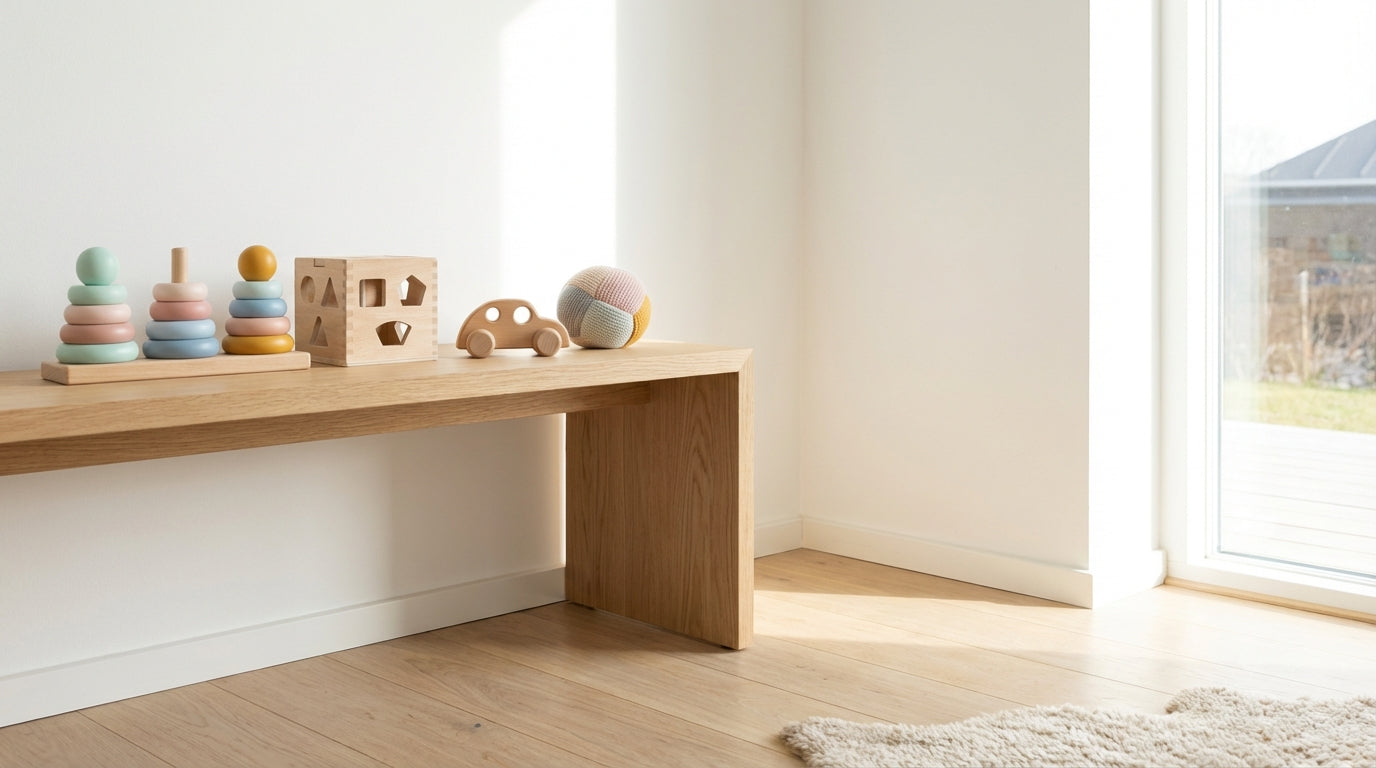
Building is ideal because it "grows" with your child. Large building blocks, stacking cups or simple shape-fitting toys are great because they work roughly at first and more precisely later. Today: knocking the tower over. Tomorrow: planning the tower. The day after: "This is a zoo, Mama!"
If you'd like to browse: you'll find an age-appropriate overview in the hub Toys for Age 2+. You can click through at your own pace without feeling overwhelmed.
Role Play (Acting Out Everyday Life)
Role play is often a turbo boost for language and social mini-rules. Children play "shopping," "doctor," "workshop" or "kitchen" – and process their day while doing so. Handy: role play works on the kitchen floor too, while you rescue the pasta.
Movement (Indoors & Outdoors)
Movement toys are gold when the energy is bigger than the sofa. Pull-along and push toys, skittles/bowling, large balls or simple balancing ideas get the body involved. That's often exactly what's missing after daycare or a long rainy day.
Music & Rhythm
Musical toys are good when they can't go "shrill on endless repeat." Rattles, drums or simple claves are fun because children experience cause and effect: "I do something – something happens." And yes: you're allowed to set limits. Even rhythm needs breaks.
Vehicles (Car, Tractor & Co.)
Vehicles almost always work because they combine movement and storytelling. A car doesn't just drive – it delivers, rescues, parks, refuels and "drives to Grandma's." If your child loves vehicles, pay particular attention to size, sturdy axles and few detachable details.
Practical tip: Put 70% of the toys away and rotate them every 2–3 weeks. For your child it's "new" – for you it's "finally seeing the floor."
Toys for Age 2: How to Spot "Meaningful" (Without the Guilt)
Meaningful toys for 2-year-olds make the child active – not the toy. A quick mental test (works at 9:30 p.m. with tired eyes, too):
- More than one play idea? (building, rolling, sorting, acting out)
- Sturdy enough for a "two-year-old"? (throwing, sitting on it, wanting to take it everywhere)
- Small moments of success possible? (a piece fits, a tower stands, a ball hits)
- Does it match their interests? (animals, vehicles, music, "doing it myself")
- Is it practical for everyday life? (quick to tidy up, not 100 tiny pieces)
"Educationally valuable" isn't a label, it's an effect in everyday life. When your child is focused, experiments, repeats and feels proud, it usually fits. And if a toy only excites them briefly: that's okay too. Not every toy has to save the world.
"Meaningful toys" build skills without steering the play. They leave your child in charge while still offering a manageable challenge.
An "age recommendation" is a safety and usage guideline, not a performance test for your child. Some are ready earlier, others later – both are normal and no reason to frown.
Children's Toys for Age 2+: Safety You Can Actually Check
With children's toys for age 2+, "safe" mostly means: no hazardous small parts and clean workmanship. That sounds dry, but in everyday life it's quite tangible.
Safety note: If parts come loose easily, they don't belong on a toy for 2-year-olds – when in doubt, "too sturdy" is the better direction.
Do the "tug-and-twist test" at home. Pull on eyes, buttons, ribbons. Twist the wheels. If you think "that's about to come off," it will definitely come off in your child's hands – and likely end up in their mouth.
The CE marking is mandatory, but it is not an independent seal of approval. According to the Verbraucherportal Bayern (Bavarian consumer portal), the CE marking is mandatory and affixed by the manufacturer; it is not an independent test: Verbraucherportal Bayern.
Small parts are a classic – unfortunately not in a good way. According to the Verbraucherportal Bayern, small-parts testing uses, among other things, a small-parts cylinder to check whether parts can be swallowed: Small parts & small-parts cylinder test.
Chemical requirements and labeling are part of safety, too. According to the German Federal Ministry for the Environment (BMUKN), the EU Toy Safety Directive sets requirements for chemical safety and labeling: BMUKN: Safe toys.
And from our Hamburg family toolbox: we like transparency. We're a family business from Hamburg, we've been doing this for 66 years – and we know that parents don't need secrecy. That's why at BIECO we focus on traceable materials, clean workmanship and clear instructions, so you can enjoy your coffee more calmly (even if it ends up lukewarm).
Wood vs. Plastic: Which Is "Better" for Toys for 2-Year-Olds?
"Better" is the material that suits your everyday life and where you play. Wood often feels warm and easy to grip, while plastic is frequently lighter and, depending on the product, easy to wipe clean. What matters is less the label than: workmanship, sturdiness, and whether the toy is actually enjoyed.
- Wood can be practical if you want something sturdy that sits nicely in the hand and responds "honestly" when stacking.
- Plastic can be practical if it's going outdoors a lot or you need something very light.
- For both, the same applies: look for smooth edges/surfaces, firmly attached parts and clear cleaning instructions.
If you're unsure, choose the one you genuinely enjoy picking up. It sounds trivial – but it's often the best indicator of whether you'll happily get it out of the box later, too.
Care & Storage: So Toys Last Longer (and You Search Less)
Good storage is half the battle – the other half is "not too much." Two simple strategies that work in real households:
- Toy rotation: One part on the shelf, the rest in a box out of sight. Less choice = more play.
- Fixed "parking spots": One box for vehicles, one for building pieces, one for role play. Children learn this faster than you'd think.
Cleaning works best when you follow the manufacturer's instructions. Some things are wipeable, others don't like a water bath. If you no longer have the packaging: a photo of the instructions when unpacking saves nerves later.
Practical tip: Set up a "finding-again bowl": everything you can't assign while tidying up goes in there. Sorting it once a week is enough.
Gift Ideas for a 2nd Birthday: Meaningful, Popular, Not Huge
A good gift for 2-year-olds is something that gets used often – not just admired. So that Grandma, Grandpa, godparents and friends don't get lost in the toy jungle, here are a few everyday-friendly directions:
- For little builders: large building blocks or stacking ideas that bring quick success.
- For "I'll help!" kids: role-play accessories with a few large pieces.
- For movement fans: pull-along or push toys, or simple throwing and skittle games.
- For music lovers: simple instruments that don't get overwhelming.
- For vehicle fans: sturdy cars or a tractor without delicate add-on parts.
If you're looking for a clear age range: in From 24 Months you'll find ideas tailored to 2-year-olds. That's handy if you want to filter quickly.
Car & Tractor: Meaningful Toys for Age 2+ Without Small-Parts Worries
Toy cars for 2-year-olds are great when they are big, easy to grip and "drop-proof." Two-year-olds don't just drive on the carpet – they drive over building blocks, door thresholds and, if necessary, over Daddy's foot. That's why it's worth looking at the following with vehicles:
- Size: better a large vehicle than a delicate model.
- Wheels/axles: should sit firmly and not seem "wobbly."
- Add-on parts: anything that sticks out and can break off often causes more stress than fun.
- Surface: cleanly finished, without sharp edges or flaking spots.
Toy tractors for age 2+ are popular because they combine work play and storytelling. "Bringing in the harvest," "feeding the animals," "construction site" – for children, those are entire worlds. And when a child has a world, language often comes all by itself (including tractor sounds you'll never forget).
Which Toys for Age 3+? How to Shop Without Missing Your Child's Needs Today
Which toys will be exciting at age 3+ often announces itself at age 2. You don't need to stock up like you're preparing for a polar expedition – but you can choose so that toys for 2-year-olds don't seem "too babyish" after a short time.
- More rules, but short ones: first simple games with a few steps.
- More fine motor skills: slightly trickier fitting and building ideas (without tiny pieces for the younger ones in the household).
- More depth in role play: "doctor," "shopping," "workshop" – with more language and more of a plan.
- More puzzles: more pieces, clearer pictures, increasing difficulty.
Which toys suit children aged 3+ is often whatever "almost works" today. If your child enjoys sorting at 2, they'll often enjoy puzzles at 3. If they like pushing and building, they'll later enjoy constructing.
And one more honest sentence from parenting life: At 3, many children enter the "I want, I can, I do" phase – and then toys that allow independence without you constantly having to step in are wonderful.
FAQ
Which toys for 2-year-olds are really worthwhile?
Toys for 2-year-olds are worthwhile when your child plays with them actively. Things for building, sorting, rolling, acting out and moving are good because they allow many play ideas. Look for sturdy workmanship and easy handling. If your child gets started on their own quickly, that's usually the best sign.
How do I recognize good toys for 2-year-olds?
Good toys for 2-year-olds are sturdy, big enough and pleasant to grip. They should have few parts, be cleanly made and work without constant explanation. Do the tug-and-twist test: if something comes loose easily, it's probably not right for this age.
Is the CE marking enough for children's toys aged 2+?
CE is important, but it doesn't replace your own look at workmanship and small parts. According to the Verbraucherportal Bayern, CE is mandatory in Europe and affixed by the manufacturer; it is not an independent test. Also check warning notices, firmly attached parts and sturdy construction.
How many toys make sense for 2-year-olds?
A few good pieces are often enough – the main thing is that they actually get used. Many families do well with a small selection per category (e.g. building, vehicles, role play) and rotation every few weeks. Less choice can even lead to more play, because children can focus better.
Toy cars for 2-year-olds: What matters?
What matters are large parts, sturdy wheels and few delicate add-ons. Vehicles need to withstand falls and "carpet off-roading." Look for smooth, clean workmanship and make sure nothing breaks off easily. Then a "car" quickly becomes a whole story with a garage, gas station and delivery.
Toy tractors for age 2+: Why are they so popular?
Toy tractors are popular because children can act out everyday life with them. Two-year-olds love "working like the grown-ups": loading, driving, caring for animals, playing construction site. That's role play with movement – and often a reason to talk a lot. Along the way, children also practice routines and vocabulary.
If you'd like to look around now: in the hub Toys for Age 2+ you'll find age-appropriate ideas, and in The Best Games for Children Aged 2+: Ideas & Recommendations there are simple play ideas for at home. And if today only ten minutes of play work out: totally okay. Tomorrow is another day.