Games for Kids Ages 2+: Ideas for Indoors, Outdoors & Without Toys
At a glance
- Games for kids ages 2 and up work best when they are short, clear and repeatable.
- Indoors, calm games help: sorting, stacking, rolling, the “stop” dance.
- Outdoors, big movements are welcome: collecting, balancing, running & stopping.
- You don't need toys: everyday items like scarves, cups and a laundry basket do the job.
- Safety: no swallowable small parts, and check for damage regularly.

Games for kids ages 2 and up are at their best when they start right away and bring quick success. Two-year-olds love repetition, clear routines and that good feeling of “I can do it!” In this guide you'll find play ideas that fit into real life: indoors, outdoors and even completely without toys. You'll also find a small decision guide (for days with lots of energy or not much patience) and an honest safety section so playtime stays relaxed.

Ulli & Flo
Owners of bieco · Hamburg · parents themselves
At 2 years old, “Again!” is a true life motto – and you can put it to good use. We like games that start quickly, stay short and carry you both through the day. Feel free to browse our collection Toys for Ages 2+.
Which games for kids ages 2 and up really suit the age?
At 2 years old, games work best when you show them and your child copies. Long rules? Probably not. Short routines you can repeat 10 times? Jackpot. According to the Federal Institute for Public Health (BIÖG), play is how children learn; especially in toddlerhood, curiosity and the urge to move shape play. (BIÖG / kindergesundheit-info.de)

A game is a repeatable activity with simple rules or steps. For two-year-olds, the rule can simply be: “We do this together, and you get to lead.”
A toy is material that makes play possible, but it is not the play itself. Building blocks are material; the game is building, knocking down, building again (and grinning with great satisfaction).
- Good sign: Your child can get started within 30 seconds.
- Also good: You can make it easier or harder (more/fewer pieces, faster/slower).
- Less good: It only works if you keep “directing” the whole time.
Indoors: games for ages 2 and up that need little setup
Indoor games for 2-year-olds should be safe, quiet and quick to tidy up. Because let's be realistic: nobody feels like turning the living room into an adventure park every single day (except your child, of course).

1) Sorting game (colors, shapes, sizes)
Sorting is a calm game that can captivate kids ages 2 and up for a long time. Use big items: scarves, large building blocks, lids, socks (yes, socks count). You say: “All the red ones go here” or “everything round goes in the basket.” Variation: Let your child give you the tasks.
2) Stacking challenge (knocking down on purpose is allowed)
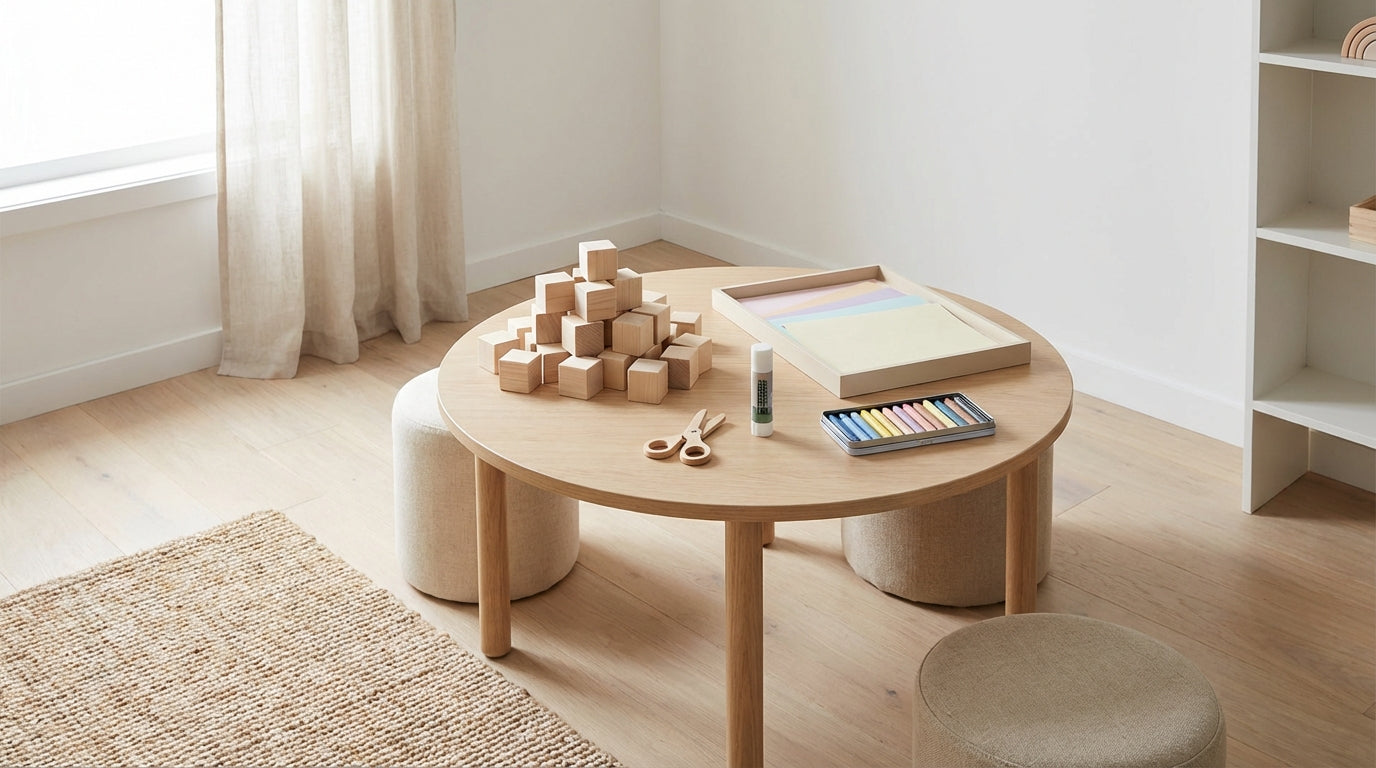
Stacking brings quick feelings of success and is perfect for short rounds of play. Cups, tins, big blocks: first stack together, then knocking down is allowed. When the mood is getting tense, “You get to knock it down” often takes the pressure off, because your child feels in control.
3) Rolling a ball down the hallway (rule: roll, don't throw)
Rolling a ball is a simple game that gets your child moving without anything flying through the air. Sit across from each other, roll slowly, roll fast, roll “super quietly.” For many 2-year-olds, this is sport and concentration in one.
4) Cushion islands (stepping instead of jumping)
Cushion islands are an indoor movement game you can clear away again in 2 minutes. Lay out cushions as “islands”: “Only walk on the islands!” For more calm: Let your child tiptoe “like a cat” or stomp “like a bear.”
5) Masking-tape roads for cars
Painter's tape on the floor suddenly turns “driving cars around” into a real game. A few curves, a parking spot, maybe a “bridge” over a cushion. The upside: You can keep the track small (and the chaos along with it).
6) “Stop” dance in mini rounds
Short music games are ideal when your child needs to move but you're indoors. Music on: dance. Music off: freeze. Two to four rounds are often plenty. If you go on too long, it tends to tip from “funny” to “angry because stop.”
7) Pointing out animal sounds (memory light)
Animal sound games work well from age 2 because they're understood right away. You say “Moo,” and your child points to the cow figure or a picture. Or the other way around: Your child makes sounds and you guess. Spoiler: You'll be wrong more often than you think.
8) Reading aloud with participation
Interactive reading aloud is a game when your child is actively involved. Let your child turn the pages, point, make sounds, look for characters. This isn't “sit still” training, it's doing something together. And yes: the same page 12 times is allowed.
Practical tip: Set up a “2-minute box”: scarves, cups, a ball, a few big blocks. When the mood tips, you reach in and start right away.
Outdoors: games for 2-year-olds when the energy needs to go somewhere
Outdoors, games for kids ages 2 and up can be big-movement and “imperfect.” What matters is movement, fresh air and not having to say “no” every 30 seconds.

1) Collecting game (pine cones, leaves, stones)
Collecting games are an evergreen outdoors because they have a clear goal. “Bring me 3 big leaves” or “5 small pine cones.” If your child still puts things in their mouth, choose leaves or larger finds instead and stay close.
2) Balance line (curb, line, tree trunk)
Balancing is a simple movement game you can fit in anywhere. Holding hands is completely fine. Variation: “Slow like a snail” or “backwards” (if it's safe).
3) Running & stopping (short and friendly)
“Run!” and “Stop!” are two words that can save a lot outdoors. Keep distances short, give lots of praise, no military parade. If “stop” doesn't work yet: first run together, then stop together.
4) Bubble chase
Soap bubbles are a movement game with a built-in sense of achievement. Blow, chase, pop. And if your child just holds the wand while you do the blowing: That's fine too. It's called teamwork.
5) Kicking a ball (big and soft)
A big, soft ball is often better outdoors than any complicated obstacle course. Kick the ball back and forth, or make a “goal” out of two jackets. Keep it short, and it's usually at its best.
6) Sand kitchen (role play without many words)
Sand play is role play light and suits 2-year-olds well. “Stirring soup,” “baking a cake,” “feeding teddy” – this often runs by itself. You only need to say “Mmm, yummy” now and then.
Without toys: games for kids ages 2 and up using household items
Games without toys work because two-year-olds love the routine, not the material. And honestly: Sometimes less stuff means less squabbling.
1) Laundry basket taxi (slow and short)
A laundry basket can be a play item if you keep the speed and distance small. Your child sits inside, you pull across the carpet. Variation: Your child pulls a teddy or a cushion. Watch your back and do two short rounds rather than one heroic trip.
2) Scarf game (hiding, pulling, sorting)
A few scarves are enough for several games: hiding, pulling, sorting. “Where is the ball?” under the scarf. Or: Stack scarves by color. Or: Scarf snowball (scrunch up and throw into a basket).
3) Cups & spoons (pouring, clinking, counting)
Transferring things from one container to another is a calm activity that kids ages 2 and up often love. Use big, harmless items: e.g. large pasta or large pom-poms (only under supervision if your child is still in the mouthing phase). Goal: “Everything into the cup” or “from cup to cup.”
Safety note: Household items are not automatically child-safe. If something is small, sharp, fragile or “could come apart,” keep it away.
With toys: what really supports games for ages 2 and up?
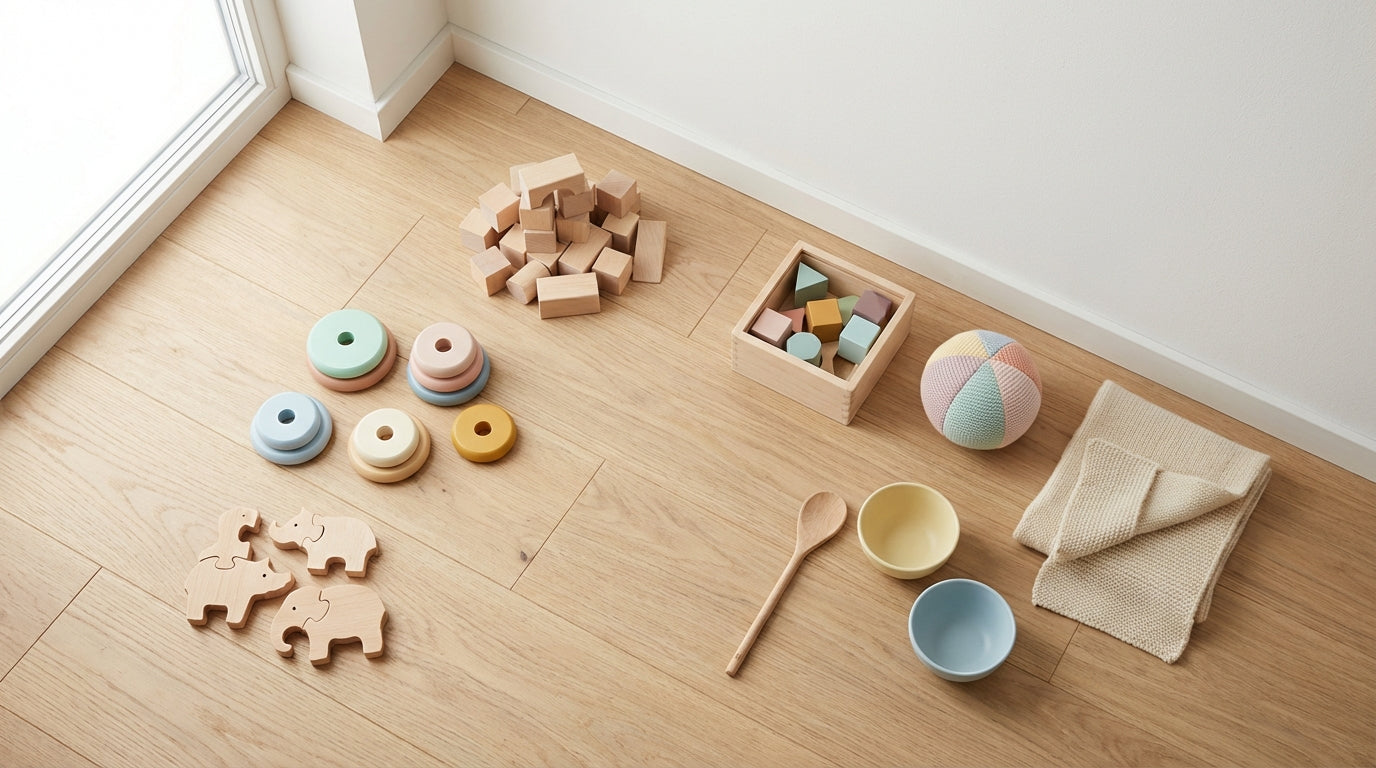
For 2-year-olds, open-ended toys are often better than “one button and done.” Open-ended toys allow for many play ideas: stacking, sorting, rolling, acting things out. That's often the difference between “exciting for 5 minutes” and “loved again and again.”
- Stacking & building: large building blocks, stacking cups, simple building shapes.
- Sorting & inserting: sorting boxes with large shapes, peg and insert games.
- Rolling & pushing: vehicles, simple ball runs (age-appropriate, without small parts).
- Copying & role play: dolls, stuffed animals, play kitchen elements.
- Moving: balls, small movement elements indoors, balance bikes & co. outdoors.
If you're looking for inspiration: In our overview Toys for Ages 2+ you'll find material ideas that suit this age.
And for context: The guide Toys for Ages 2+: The Big Guide for Parents helps you choose based on developmental stage and everyday life.
Safety: keeping games for kids ages 2 and up relaxed
For children under 3, swallowable small parts are one of the most common pitfalls. The Bavarian consumer portal describes the small parts cylinder test: small parts are pieces that fit into a test cylinder with a Ø of 31.7 mm; toys for children under 3 must not contain detachable small parts. (Verbraucherportal Bayern / LGL)
Even in childcare settings, small parts are explicitly warned against. The DGUV recommends keeping risky items such as small beads or mini figures out of reach, because they are easily swallowed. (DGUV)
An important building block for toy safety in Europe is the DIN EN 71 series of standards. According to DIN, it covers mechanical/physical properties, flammability and chemical requirements for toys, among other things. (DIN)
Safety note: 5 Do's & Don'ts: no small parts, no long strings, nothing fragile, check regularly, always keep battery compartments secured.
- Do: Regularly check toys for cracks, loose seams and parts that could come off.
- Do: Take age recommendations seriously (they are often safety-related, not “educationally strict”).
- Don't: Hand over small parts “just for a moment” when you're distracted by something else.
- Don't: Leave strings/ribbons where they could wrap around a neck or furniture.
- Don't: “Quickly fix” broken toys and then leave them lying around anyway.
Why we recommend these play ideas (a quick note from Hamburg)
We recommend games that fit into everyday life and don't overstimulate children. We are a family business from Hamburg and have been doing this for 66 years – you see many trends come and go, but “short, clear, safe” stays. It matters to us that materials are sturdy, that things are easy to grip and that safety information is transparent. And yes: If something wobbles, crumbles or could shed small parts, it's out for us, no exceptions.
How to quickly find the right game (without hours of planning)
The right game fits your child's mood of the day, not your own expectations. Sometimes “rolling a ball” is exactly right. And sometimes you need to go outside before everything escalates indoors.

| If your child is currently… | Then games like these fit… | Why |
|---|---|---|
| full of energy | Running & stopping, kicking a ball, cushion islands | Movement releases tension |
| tired/overstimulated | Sorting, interactive reading, rolling a ball | Few stimuli, clear repetition |
| clingy | Treasure hunt for two, animal sounds, “help me” tasks | Closeness without constant entertaining |
| frustrated | Stacking games (knocking down allowed), mini moments of success | Feeling in control, pressure off |
Practical tip: Set a timer for 10 minutes. Many games only tip over when they go on too long. It's better to end early while it's still fun.
FAQ: Games for kids ages 2 and up
Which games for kids ages 2 and up are best indoors?
Indoors, short, calm games with clear repetition are best. Sorting, stacking, rolling a ball, masking-tape roads and interactive reading start without much setup. You can vary them easily and end them quickly before the mood tips. That's often half the magic in everyday life.
Which games for kids ages 2 and up are good outdoors?
Outdoors, collecting, running and balancing games work especially well. Collecting (leaves/pine cones), balancing on lines, running & stopping, chasing bubbles and kicking a ball bring movement without you having to explain much. Keep the rules simple and the distances short, and it stays relaxed.
Which games for ages 2 and up work without toys?
Games work without toys when the routine matters more than the material. Laundry basket taxi, scarf games (hiding/sorting), cup pouring games or small search tasks work with household items. The only important thing is: no dangerous small parts, nothing fragile, and better too short than too long.
How long do 2-year-olds play at a stretch?
Many 2-year-olds play in short phases of about 5 to 15 minutes. That's normal and not a sign of “can't concentrate.” If you end a game while it's still going well, the mood often stays better. Then the next mini game can simply follow.
What should I do if my child (2 years old) doesn't want to “play anything”?
A very simple start often helps more than announcing a new big game. Offer something that works right away: rolling a ball, looking at a book together or finding three things. According to the BIÖG, play is central, but children don't have to “join in” all the time; sometimes closeness and tagging along in everyday life is enough. (BIÖG)
One last relaxed thought: If you've found 3–4 games that reliably work for you, you've already won a lot. And if you're looking for suitable materials, feel free to visit Toys for Ages 2+ – practical, sturdy and with a focus on safety, just the way we like it here in the north.