Kids' Play Tent: Guide to Size, Safety & Indoor/Outdoor Use
At a glance
- A kids' play tent fits well when space, age and location are clear before you buy.
- Indoors, ventilation, quiet materials and easy cleaning matter most.
- Outdoors, it works with level ground, wind protection and dry storage.
- Good signs: clear warnings, an age recommendation and traceable testing information.
- A teepee tends to stay put, while a pop-up is quicker to put away.

You'll find the right kids' play tent by first deciding on space, age and indoor or outdoor use. Then you look at ventilation, material, setup and safety information – and only after that at the pattern (yes, I know, that's the hardest discipline). In everyday life, a play tent is a retreat, a role-play stage and a “I'm just off on vacation” hideaway all in one. Here you get a practical guide for the nursery, indoors and outdoors – with a few tricks that have proven themselves between breakfast crumbs and mountains of laundry.

Ulli & Flo
Owners of bieco · Hamburg · parents themselves
We've learned that a play tent is only loved if it doesn't get on your nerves in everyday life. With a few quick checks, it becomes more of a den than an obstacle at your place. Feel free to browse our play tent collection.
What types of play tents are there – and which one suits your family?
The best type of tent is the one your child actually uses. In family life, you'll mainly come across these variants:

- Pop-up play tent: very quick to set up and store again – handy if you don't want the living room to stay “adventure land” permanently.
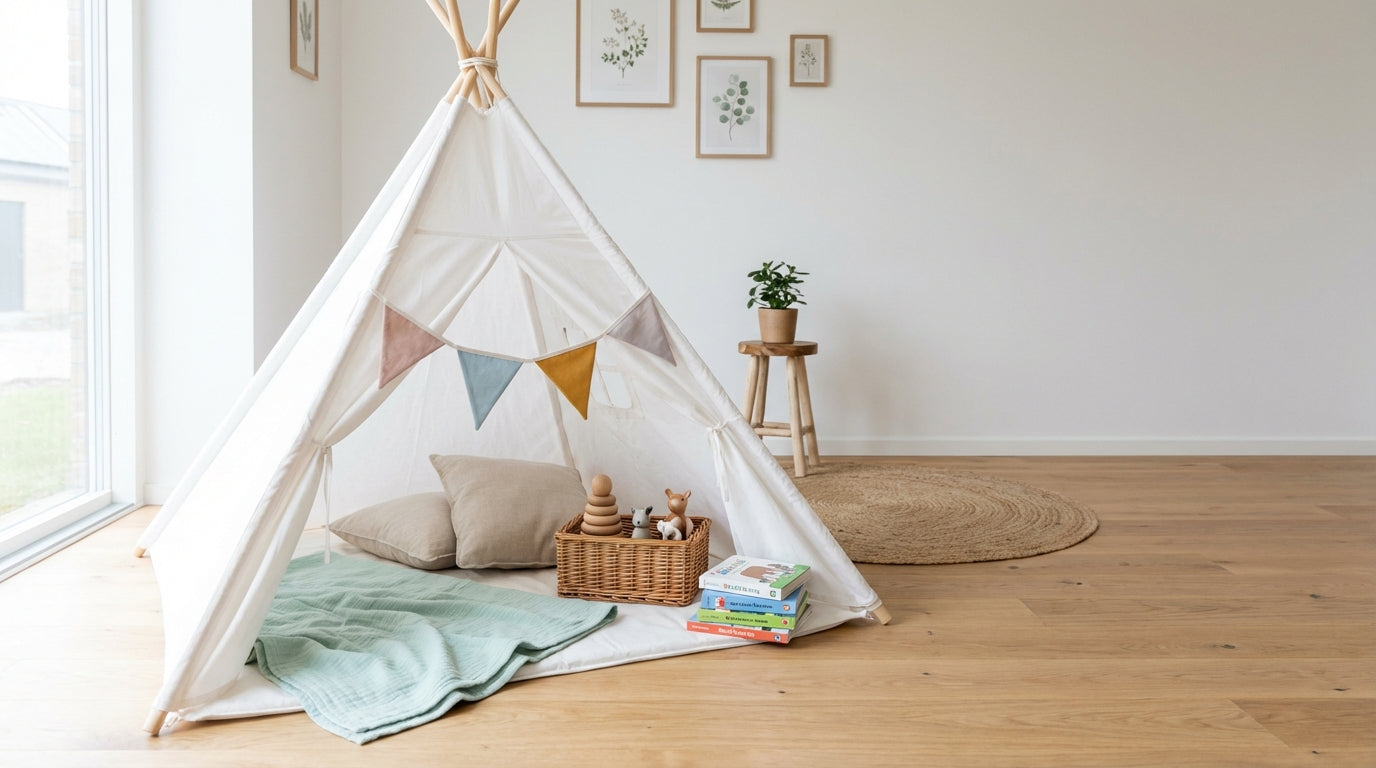
- Teepee: often looks like a small piece of furniture and likes to stay up longer; usually needs more floor space.
- Play tent with tunnel: great for crawling, hiding and “I'm a train” – but it needs space like a small train station.
- Tent with ball pit: high play value, but the balls later develop life plans of their own.
A pop-up play tent is a foldable tent that opens up on its own. That's convenient – but it means an adult has to take care of setting it up and folding it away.
A play tent is a toy children can step into, offering a place to retreat and play pretend. This very “room of their own” is what makes it so valuable to many children – and wonderfully quiet for parents at times.
If you'd first like to see which shapes exist at all: the overview gives you a quick impression of sizes and variants: Discover play tents.
Play tent for the nursery: Which size fits without everyone tripping over it?
In the nursery, the tent that keeps walkways clear wins. That sounds trivial, but it's the classic: beautiful by day – an obstacle course when you're half asleep at night.
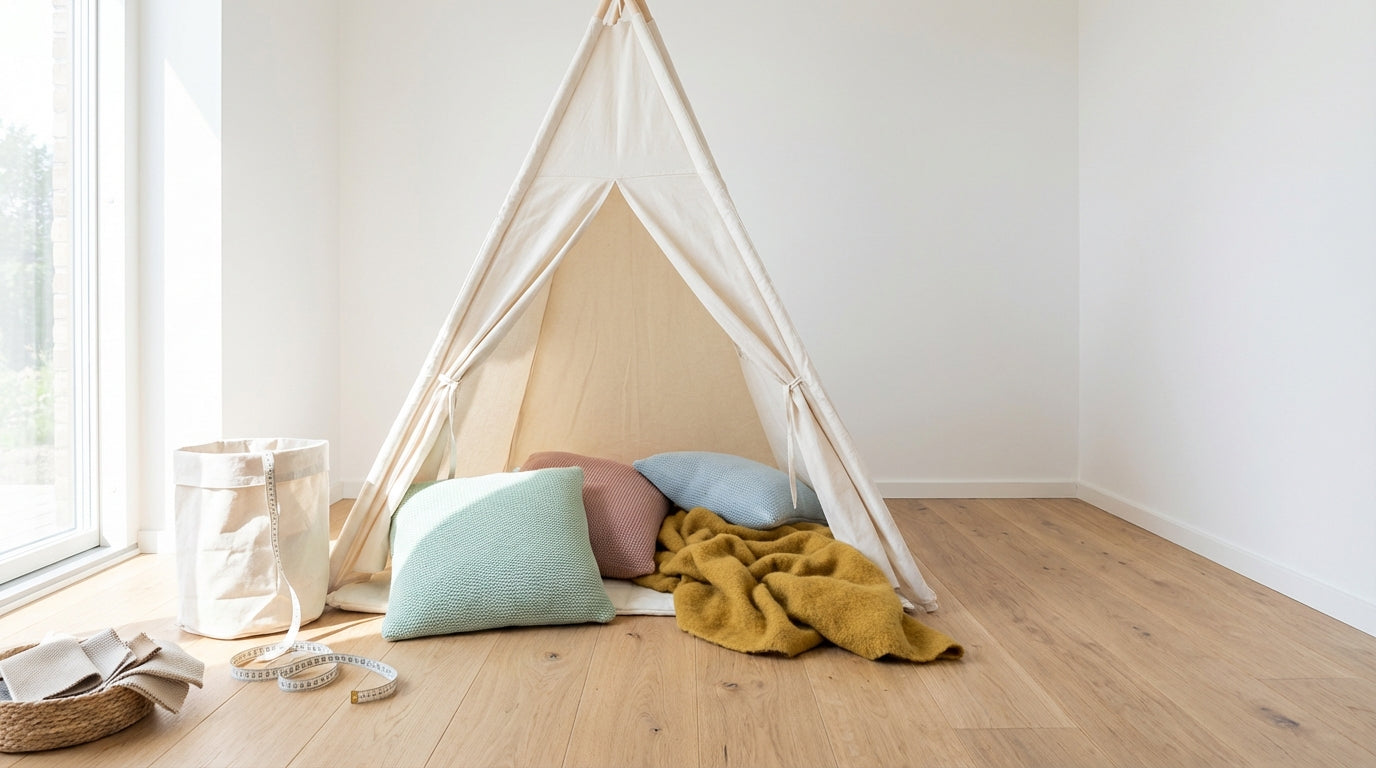
- Measure the footprint: Tape the floor area out with masking tape. Then walk through the room once with a laundry basket or vacuum cleaner – if it's annoying, it's too big.
- Check the height: Does it fit under sloped ceilings? Can your child sit inside without folding in half?
- Plan the door side: Don't put the opening directly in the walking path. Otherwise the entrance becomes a tripping hazard (and you become the night watchman).
- Be realistic about “growing with your child”: A tent that's too big won't automatically be used for longer – it just stays in the way longer.
Practical tip: Block off the area for 3 days as a trial (tape, cardboard boxes). If it still doesn't bother you by then: it fits.
A concrete size example for reference: according to the product details, the Pop Up Play Tent Dots measures approx. Ø 105 x 125 cm and has two windows with mesh inserts for light and ventilation.
Kids' play tent indoors: What really matters inside?
Indoors, ventilation, easy care and quick setup count. Inside, a play tent is often used daily – and anything used daily should be easy on your nerves.
Ventilation & “I can still see you” windows
Mesh windows help against heat build-up and stuffiness. At the same time, you can peek in briefly without completely blowing the privacy of the den (kids notice things like that).
Material, noise & living room suitability
Quiet fabrics are worth their weight in gold when someone is on the phone next door. Crinkly material can be “super exciting” or “please not during naptime”, depending on the child.
Cleaning: crumbs, juice, felt-tip pens – real life
A wipe-clean tent saves the most time in everyday life. Check the care instructions: for the Pop Up Play Tent Dots, for example, they say “damp cloth and mild soap”, “do not immerse in water” and “air dry” (product details). Those are the details you really need.
Kids' play tent outdoors: Does it work – and where are the stumbling blocks?
Outdoors, a kids' play tent works well if you take wind, ground and storage seriously. Outdoors is great – but it's not a case of “toss it out and forget about it”.

- Ground: Level and soft is the most relaxed option (lawn, patio with a mat). Gravel or crushed stone is more of an “ouch”.
- Wind: Lightweight tents can slide or tip over. Place it sheltered from the wind and stay nearby.
- Sun/heat: It can get warm in the tent quickly. Better to place it in the shade and air it out in between.
- Moisture: Store it dry after playing. Damp fabric in a box otherwise becomes a “musty surprise”.
Safety note: Keep play tents away from fire, grills and patio heaters.
An “enterable toy” is a toy that a child can crawl into. This includes play tents and tunnels – and that's exactly why warnings about heat and fire are especially important here.
According to the European Union, the Toy Safety Directive 2009/48/EC sets out essential safety requirements, including requirements on the flammability of toys; the full text can be read on EUR-Lex (EU Toy Safety Directive 2009/48/EC).
Safety & testing information: How do I spot “good signs”?
Good signs are clear warnings, an age recommendation and traceable testing information. You don't have to memorize standards. But you can ask yourself a few simple questions:
- Are warnings clearly visible? “Keep away from fire”, “use under supervision”, “assembly by adults” – that's not a buzzkill, but helpful clarity.
- Is there an age recommendation? It helps you judge whether the tent suits your child's stage of development.
- Is there a reference to EU toy requirements? Many manufacturers mention EN 71 or “complies with the European standard for toys” in the product information.
For the Pop Up Play Tent Dots, for example, you'll find notes on setup (by adults), care and the reference to the standard (product details). That's exactly the kind of transparency we like.
We're northern-German-picky about this, because it's about children. Bieco is a family business from Hamburg, and we've been doing this for 66 years – you learn that honest information beats pretty promises.
Material & care: What works for everyday life (and what doesn't)?
The right material is the one that fits your pace of life. Some families love “homey and soft”, others need “wipe-clean and quick-drying”. Both are perfectly valid.
- If you mostly play indoors: Look for good ventilation and surfaces that are easy to clean.
- If it should go outside now and then: Quick-drying and robust makes outdoor use more relaxed.
- If siblings play together: Clean workmanship and a sturdy construction matter more than the prettiest print.
Practical tip: Put a washable sheet or a thin blanket inside as an “indoor floor”. It catches crumbs and spills.
Teepee vs. pop-up: Deciding without agonizing (with a mini checklist)
A pop-up is flexible, a teepee is more of a “stands and stays”. If you can't decide, use this quick checklist:
| Question | Points more to a pop-up | Points more to a teepee |
|---|---|---|
| Do you want to set up and take down often? | Yes, quickly stored away | Rather not, it stays up |
| How much space is permanently free? | Little space | Enough floor space |
| How “furniture-like” should it look? | Unobtrusive, functional | Part of the room corner |
| What will it be used for? | Den, short & frequent | Role play, longer stretches |
If you'd like a more detailed direct comparison: Teepee or pop-up tent? Which play tent suits your child?.
DIY: Making your play tent cozy (without much clutter)
With three little touches, the tent becomes a real cozy den. You don't need a decorating license for this – just things you probably already have.
- Soft base: A blanket, play mat or flat cushion makes it instantly cozier.
- “Quiet corner”: A small basket with 3–5 books or figures is enough. Less choice = more play.
- Light: If you use light, then only child-safe and in a way that nothing gets hot or lies in the way. (And if you can do without: even better.)
- A rule for tidiness: One sentence that works: “Everything that goes into the tent fits into this one box.” Often that's all it takes.
If you need more ideas for what children really play in a tent (and not just what looks pretty): What belongs in a play tent? The ultimate checklist & ideas.
Care & small repairs: How to make your play tent last longer
Regular airing and dry storage extend its lifespan the most. It's not spectacular, but it's effective.
- After outdoor use: Let it dry completely first, then store it.
- Smell: Better to air it out than to “perfume” it. Fresh air almost always wins.
- Poles/connections: Check every now and then that everything is seated properly – especially after wild romping days.
- Stains: Follow the care instructions and test on an inconspicuous spot first.
If you need a replacement or help, a look at the product information often already does the trick. At Bieco, we try to write care and safety notes so that you can understand them even with a child on your arm.
FAQ
From what age does a kids' play tent make sense?
A play tent makes sense as soon as your child can sit safely and enjoys playing “den”. Go by the manufacturer's age recommendation. For the Bieco Pop Up Play Tent Dots, for example, “from approx. 12 months, when your child can sit safely” is recommended (product details).
What's the easiest way to clean a play tent?
The easiest are tents you can wipe down with a damp cloth. Be sure to check the care instructions for the specific model. For the Bieco pop-up play tent, for example, “damp cloth and mild soap”, “do not immerse in water” and “air dry” are listed (product details).
Teepee or pop-up: Which is better?
A pop-up is better if you want to be flexible; a teepee if it should stay up permanently. A pop-up is worthwhile when space is tight and you tidy up often. A teepee fits well if the tent becomes a permanent play corner and you have enough floor space.
Can you use a play tent both indoors and outdoors?
Yes, many play tents can be used both inside and outside if you set them up in a sheltered spot. Outdoors, level ground, wind protection and dry storage are crucial. Also pay attention to warnings such as “keep away from fire”, especially for tents children crawl into.
What do I do in wind or light rain in the garden?
In wind, place the tent sheltered from the wind and stay within reach. In rain, it's better to take it down and let it dry rather than thinking “it'll be fine”. Damp fabrics that get packed away quickly smell musty – and nobody needs that.
How can I tell if a play tent is safe?
A safe play tent has clear warnings, an age recommendation and transparent product information. According to the EU, the Toy Safety Directive 2009/48/EC sets out essential safety requirements, including flammability; the text is available on EUR-Lex.
In the end, a kids' play tent should make your everyday life easier, not more complicated. If space, use (indoor/outdoor) and safety information all fit, the design can happily be the icing on the cake. And if you'd like to browse: in the play tents overview you'll find different shapes at a glance.