Which Melodies Are Available for Music Boxes? List, Play Time & Replacement
At a glance
- Which melodies are available for music boxes? Mostly lullabies, children’s songs and gentle classical pieces.
- The play time per wind-up is often around 1–2 minutes, depending on the movement and model.
- A music box really becomes practical for everyday life when the movement can be removed for washing.
- Look for clear safety information (e.g. EN 71, CE) and a fastening that doesn’t slip.
- If you have a favorite melody in mind: first check whether the model allows the movement to be replaced.

The most common music box melodies are calm lullabies, well-known children’s songs and gentle classical pieces. If you’re torn between “Brahms” and “La Le Lu” (or simply looking for something you can still bear at three in the morning): here you’ll find a practical overview of melodies, typical play times, guidance on brands, and a DIY guide to replacing the music movement in suitable models. We’re writing this as parents (Ulli & Flo) from a family business in Hamburg – and yes, we’ve been doing this for 66 years. Above all, that means we know where products can get on your nerves in everyday life.

Ulli & Flo
Owners of bieco · Hamburg · parents themselves
We’ve learned that the melody is only half the story – everything around it (washing, fastening, daily life) decides whether you’ll really use it. And yes: at night, every detail counts. Feel free to browse our music box collection.
Which melodies are available for music boxes?
Most music boxes play short, repeatable melodies with a calm character. That’s no coincidence: mechanical music movements are designed for simple, clear sequences of notes – and that often fits nicely into an evening routine.
A music box melody is a short piece of music that a mechanical movement plays after being wound up. The real-life advantage: no battery, no charging cable, no “Why is it empty again already?”
The melody categories you’ll come across most often
The most widespread are lullabies, calm children’s songs and classical favorites. Here are the groups you’ll run into again and again across many brands:
- Lullabies: e.g. “Brahms’ Lullaby” (“Guten Abend, gut’ Nacht”).
- German lullabies and children’s songs: e.g. “La Le Lu”, “Schlaf, Kindchen, schlaf”, “Guter Mond, du gehst so stille”.
- Calm children’s songs (gently arranged): e.g. “Alle meine Entchen”, “Alle Vögel sind schon da”.
- Gentle classics/traditionals (depending on the model): e.g. “You are my sunshine” or “The sound of silence” (not available everywhere).
- Classical music (as a melody excerpt): e.g. Mozart melodies or excerpts that loop well.
Melody lists from the manufacturer are a great help for listening beforehand. Sterntaler provides such an overview online; it names the melodies and offers them as a download, including, according to Sterntaler, examples such as “Brahms’ Lullaby”, “La Le Lu” or “Schlaf, Kindchen, schlaf”. (Source: Sterntaler – Music box melodies)
Practical tip: Choose the melody you can stand yourself. You’ll hear it at night more often than your baby will.
How long does a music box play per wind-up?
Many music boxes play for roughly 1–2 minutes per wind-up, depending on the movement. Some models are a little shorter or longer – it depends on the built-in movement and the construction.
Play time is mostly a matter of ritual, not a technical competition. If winding it up becomes part of your bedtime routine, “short and reliable” is often nicer than “long and eventually it winds down into a drawl” (and yes, that is a very scientific measurement).
- If you want a longer play time: Check the product information for the specific model.
- If you want to slip out quickly at night: An easy-to-grab pull tab is sometimes more important than 30 extra seconds of music.
How do I choose the right melody – without overthinking it?
The best melody is the one you’re happy to repeat and that suits the evening. Babies often like repetition more than variety – and adults mostly like one thing: not being annoyed.
- Calm & even: Fewer jumps, fewer “ta-da” moments – it often feels more relaxing.
- Recognizable, but not intrusive: Many families choose well-known lullabies because they sound familiar.
- Suited to the situation: Falling asleep = gentle. During the day at the stroller = can be a bit more cheerful (if it suits your child).
A music box is above all a recurring signal in everyday life. It can be your “now we’re winding down” sign – and sometimes that’s already half the battle.
Which music box brands are there – and what sets them apart?
Brands often differ less in the melody and more in details like care and workmanship. That’s exactly where it’s decided whether you love the piece after two weeks or quietly curse at the third spit-up accident.
A manufacturer is the brand responsible for material choice, labeling and safety information. For you, that pragmatically means: don’t just look at the design, but also at care instructions, fastening and traceable safety information.
- Sterntaler: Offers music boxes and, depending on the model, provides care instructions; there is also a melody overview directly from the manufacturer. (Source: Sterntaler – Music boxes)
- BIECO: For individual products, you’ll find specific details on melody, care and safety/standards in the product description, e.g. for the Hase Fine bunny music box.
What we’ve taken away from 66 years (and many questions from parents): “washable” has to be practical for everyday life. What matters is not whether “washable” is written somewhere, but whether the movement is truly removable and how easy that is.
What you should really look for when comparing (checklist)
The four big topics are volume, washability, fastening and safety information. Here’s the list you can still tick off on very little sleep:
- Volume: Pleasant rather than shrill. If possible, listen beforehand (or at least read reviews/manufacturer information).
- Removable movement? This decides whether washing is relaxed or fiddly.
- Care instructions: Hand wash vs. machine wash depends on the model and should be clearly stated.
- Fastening: Loops/ribbons should hold without you needing to know sailor’s knots.
- Workmanship: Seams, appliqués, pull tab – things that take a lot of wear in everyday life.
| What to look for | Why it matters in everyday life | How it is at BIECO (depending on the model) |
|---|---|---|
| Removable movement | Washing gets easier when the cover can be cleaned separately | For individual items, care instructions and construction details are given in the product description |
| Clear care instructions | You know right away whether hand washing or machine washing is possible | Care instructions are listed with each product (e.g. hand wash for individual models) |
| Traceable safety information | You can check labeling and notes instead of guessing | For individual products, standards/testing information is mentioned in the description |
| Practical fastening | On the crib/stroller, everything stays where it should | Different solutions depending on the model; check the photos/details before buying |
Safety note: Attach music boxes so that no long cords/loops dangle freely. Always remove the movement before washing and store it safely again afterwards.
Safety & standards: EN 71, CE and the EU Toy Safety Directive explained briefly
EN 71 is a European series of standards for toy safety. According to DIN, DIN EN 71 describes requirements so that toys are fun and at the same time safe. (Source: DIN – Requirements for safe toys)
The EU Toy Safety Directive 2009/48/EC sets safety requirements for toys in the EU. According to the German Federal Ministry for the Environment (BMUKN), the parts on technical and structural safety have applied since 20 July 2011, and the rules on the chemical part since 20 July 2013. (Source: BMUKN – Safe toys)
CE marking is mandatory, but it is not an independent test seal. According to the Bavarian consumer portal, CE declares conformity with legal requirements; responsibility lies with the manufacturer and there is no automatic independent inspection. (Source: Verbraucherportal Bayern – CE marking on toys)
DIY: Can you replace music box movements?
Yes, with some music boxes the movement can be replaced, but not with all of them. Whether it works depends on the construction: Is there an opening (e.g. a zipper), and is the movement a separate, removable part?
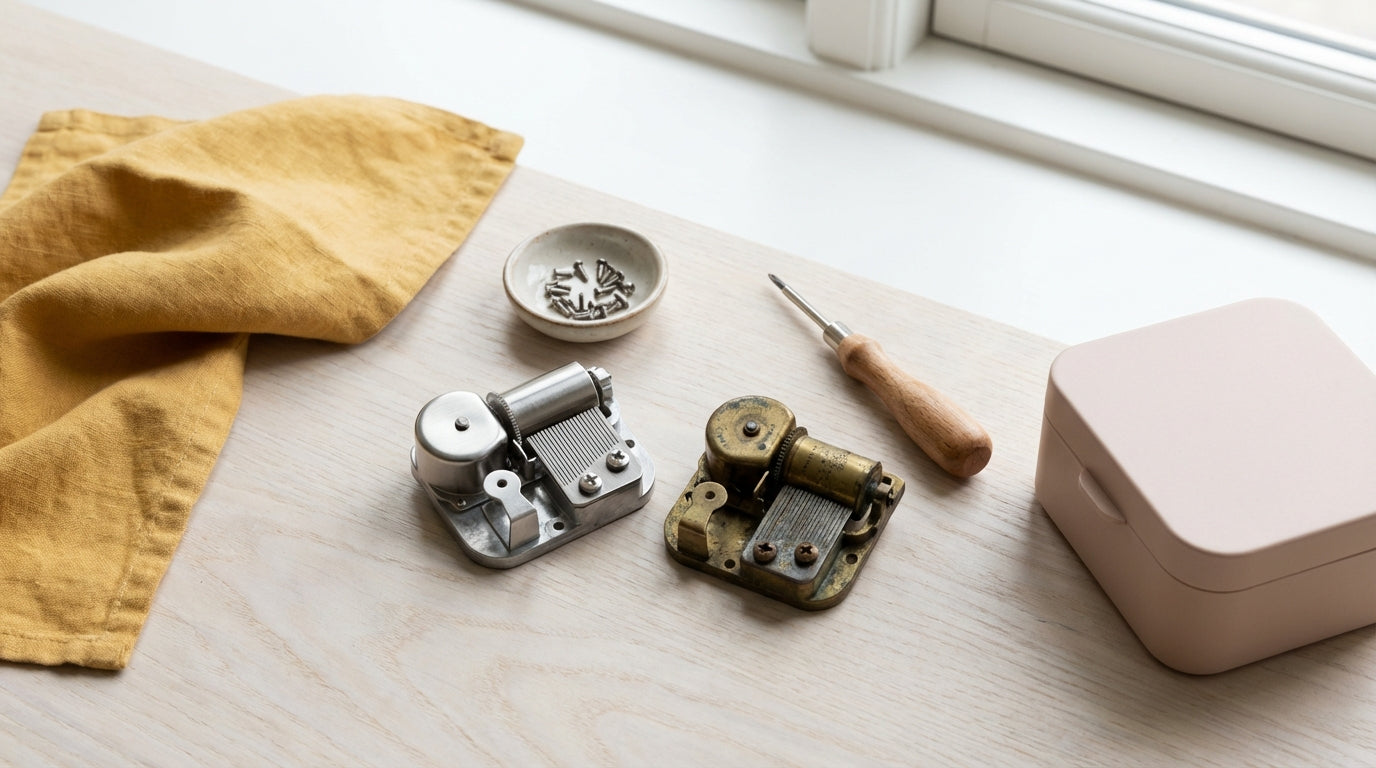
A music movement is the mechanical inner workings that produce the melody. For you, that means: if it’s removable, washing is often easier – and sometimes you can also replace it if it breaks or you want a different melody.
Step by step: replacing the movement (if the model is designed for it)
- Check care and product information: Look for “removable movement” or similar notes.
- Open the music box: Usually via a zipper or a secured opening on the back/belly.
- Carefully remove the movement: Don’t yank on the pull cord – grip the movement itself.
- Insert the new movement: Make sure it sits securely and nothing chafes or jams.
- Close the opening securely: Zipper fully closed, no loose parts.
- Function test: Wind it up once and listen briefly to check that everything runs smoothly.
Practical tip: Do the function test during the day. At night, every little sound seems twice as loud.
If you can’t find clear information on whether a replacement is possible: better not to open it “on suspicion”. When in doubt, check with the manufacturer or ask customer service – it saves frustration and loose parts.
What designs are there – and what suits your family?
The design decides whether the music box really works in everyday life where you need it. A few typical situations from family life:
- Cuddly fabric music box: The classic for the crib and the bedtime ritual.
- Wooden music box: Often more for the shelf/nursery and as a lovely gift.
- Mobile with music box: For babies who love to watch; movement + music in one.
- Unusual music boxes: When you want something other than a bunny/bear (I feel you).
If you want to browse, take the short route via the overviews. With us you’ll find the collection of music boxes as well as, depending on style, wooden music boxes, mobiles with music box or unusual music boxes.
FAQ
Which melodies are available for music boxes?
Lullabies, calm children’s songs and gentle classical melodies are common. Typical examples are “Brahms’ Lullaby”, “La Le Lu” or “Schlaf, Kindchen, schlaf”. Some manufacturers provide listening lists so you can try out in advance which melody feels right for your family.
Which melodies are available for music boxes – also as a list to listen to?
Some manufacturers publish a music box melody list for listening beforehand. Sterntaler offers an online overview with named melodies and downloads. That’s handy because you don’t have to guess how a melody really sounds before it moves in with you. (Source: Sterntaler – Music box melodies)
How long does a music box play per wind-up?
The play time per wind-up is often roughly 1 to 2 minutes. This varies depending on the movement and model. If the duration matters to you (e.g. for the bedtime ritual), check the product description of the specific item or the manufacturer’s information.
Can you replace music box movements?
Yes, with some models a replacement is possible if the movement is removable. What matters is whether the music box has a secured opening (e.g. a zipper) and whether the movement can be taken out as a separate part. If there is no clear information on this, it’s better to ask the manufacturer.
Which music box brands are there?
Well-known brands include Sterntaler and BIECO. In everyday life, they often differ in care instructions, workmanship, fastening and whether the movement is removable. The melodies themselves often overlap – so it’s worth looking at the details around the product.
How can I tell whether a music box is “safe”?
Look for labeling, warnings and traceable safety information. In the EU, the requirements of the Toy Safety Directive 2009/48/EC apply; EN 71 is also frequently referenced. CE is mandatory, but according to the Bavarian consumer portal it is not an independent test seal but a manufacturer’s declaration. (Source: Verbraucherportal Bayern)
Bottom line: choose a melody you enjoy hearing and a model that is easy to care for in everyday life. If you’d like to click through designs, the best place to start is our overview of music boxes – you’ll also find wooden variants, mobiles or something a little more unusual there.