Can You Repair a Music Box? Guide, Care & Safety
At a Glance
- Can you repair a music box? Often, yes: check the string, the seams and how the movement sits.
- A 5-minute check saves your nerves: listen, feel, look – then act.
- Only wash a music box according to its care label, and take the movement out first if possible.
- Clicking, grinding or “spinning freely”: stop instead of winding further.
- After every repair, make sure it is firm, stable and has no loose parts – otherwise it stays out of the baby's crib.
Yes, many music boxes can be repaired – if the problem is the string, a seam or a movement that has slipped. You don't need to fire up the sewing machine right away or turn half the nursery into a workshop. In this guide you'll find a calm step-by-step walkthrough: first find the fault, then fix it properly – and we'll also be clear about the points where it's better to stop. Handy for parents, grandparents and anyone standing there with a “Why does this thing only play for 8 seconds now?!” in their hands.

Ulli & Flo
Owners of bieco · Hamburg · parents themselves
We've stood in front of a “silent” music box in the middle of the night more than once. With the checks here, you'll quickly find out whether it's just stuck or whether you're better off stopping. Feel free to browse our Music Boxes collection.
Which music boxes can be repaired – and which can't?
It works best with fabric music boxes that have a removable movement. Many models consist of a fabric body (a little animal, star or cloud) and a separate movement in a pocket. If you can reach the movement and safely tuck it back in, there's a good chance you'll get further with just a few simple steps.
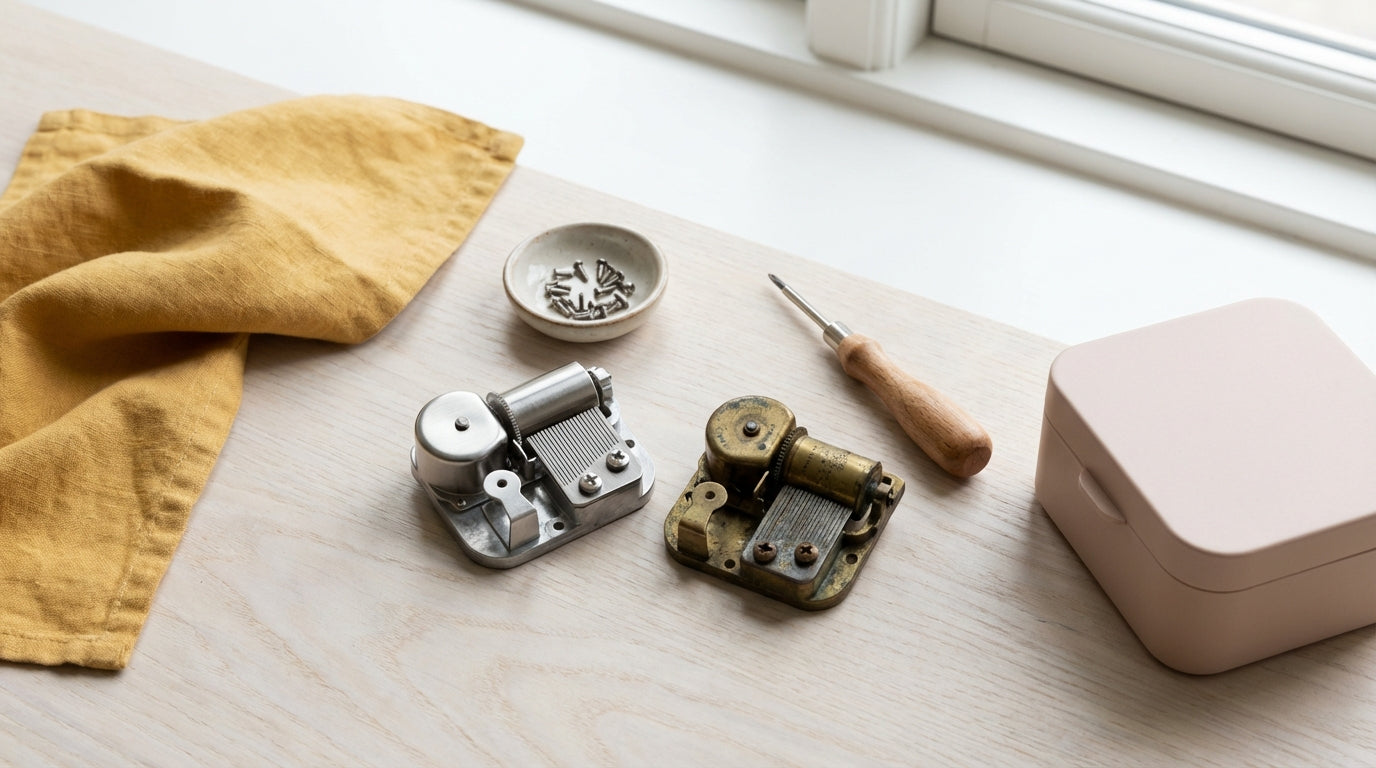
A mechanical movement is a spring mechanism that is wound up by pulling a string. It then plays a melody without a battery until the spring has unwound. That's wonderfully simple – but also delicate if something jams or dirt gets in.
It gets tricky when the movement would have to be opened or parts are loose. At that point it's no longer about “straightening things out a bit”, but about child safety and stable fastenings. According to the Bavarian consumer portal (LGL), toys for children under 3 years must not contain detachable small parts that fit into a test cylinder (VIS Bayern / LGL).
Safety note: If, after the repair, you can't say with confidence, “That is rock solid,” don't use the music box at the crib anymore.
The 5-minute fault check: what exactly is “broken”?
Before you unpick anything: listen, feel, look – in that order. Put the music box on the table, turn the light on and test it calmly once. That saves you 80% of unnecessary sewing (and yes, I know: time is a luxury).
- It doesn't play at all: the string can't be pulled / winding doesn't work / no melody.
- It only plays briefly: it's over after a few seconds.
- It sounds odd: wobbly, scratchy, clicking or grinding.
- The string doesn't come back: it hangs out or doesn't retract.
- Fabric/seam is open: the movement is peeking out or wobbling.
Clicking or grinding is a stop signal, not a reason to try “once more, harder”. With mechanical movements, extra force can quickly turn a small snag into a real defect.
Step by step: repairing a music box (without the drama)
Work from the outside in – and stop before you have to get into the movement. Most of the time you only need: good light, blunt tweezers or wooden sticks, a needle, strong thread and a bit of patience.
Step 1: Check the string routing (knots, twists, blockages)
A twisted or pinched string is the most common “defect” that isn't one. Look to see whether the string is caught around labels, loops or fabric edges. Pull it straight slowly, without jerking. If it moves stiffly: don't yank it like a lawn mower cord – look for the cause instead.
Step 2: Check how the movement sits (tilted, pressing against the fabric)
If the movement sits crooked, it slows down the mechanism and the melody gets short. If you can reach the movement through an opening: take it out carefully, check for lint or fabric pressing against it, and put it back straight into its intended pocket. What matters is that nothing presses against the movement permanently.
Practical tip: Take a photo of how the movement sits before you remove it. It will save you from “How did that go again?” later.
Step 3: Close the seam (if the fabric has come open)
An open seam is often easy to repair – and should be closed quickly. Use strong thread and make small, tight stitches. The ladder stitch (also called the invisible stitch) is handy here because it closes the seam “invisibly” and holds firmly. Make sure the movement is back in its pocket and isn't rubbing directly against the seam.
Step 4: Check the fastening (loop, ribbon, ring)
Anything that hangs on the crib has to withstand a pull – without anything coming loose. Gently tug on loops and ribbons (not brutally, but firmly). If you notice seams giving way or something wobbling: repair it or put it aside – “it'll do” is unfortunately not an option here.
Step 5: Interpret noises (clicking, wobbling, grinding)
Unusual noises often point to a problem in the movement. If the noise stays even though the string and the fit are right, it's usually not a “quick fix” case. In that case, replacement or servicing makes more sense than opening the movement and risking small parts afterwards.
Replacing the movement: when it makes sense – and how to go about it
Replacement is often the cleanest solution if the movement spins freely or clicks permanently. Important: I can't give you a universal DIY guide here, because movements are fastened differently depending on the model. But the basic logic is similar for many fabric music boxes.

- Find the opening: Is there a pocket with Velcro/a zipper, or a service opening?
- Remove the movement: Take it out carefully, and don't tie the string in a knot.
- Remember the fastening: Take a photo: How is the string routed, how does the movement sit?
- Only a matching replacement: Only use a movement that is intended for this purpose and can be fastened securely.
- Test after inserting: Test it in your hand first, and only then use it again where it belongs.
A “safe repair” means: afterwards, everything is firmly and child-safely assembled again. If you can't check this with certainty, replacement through the manufacturer or a qualified service is the more relaxed (and, honestly, often cheaper) option for your nerves.
Washing a music box: how to keep it clean without harming the movement
Washing is only relaxed if the care label allows it and the movement can come out. The label is the boss here. If you can no longer read it: it's better to clean gently with a damp cloth than to risk a “it'll be fine”.
- Movement removable: take it out, secure the opening, then wash according to the label.
- Not removable: better to clean only the surface, because water and mechanics don't get along.
- After washing: let it dry completely before the movement goes back in.
Completely dry really means completely – otherwise it gets musty and unpleasant. And nobody needs a music box that smells like a basement when all you really want is sleep.
Practical tip: Let fabric music boxes dry longer after washing rather than “just barely”. Moisture likes to hide inside.
If the string hangs or doesn't retract: what you can check
A hanging string is often a routing problem – not immediately a total loss. First check whether the string has slipped under the fabric somewhere or wrapped around an inner loop. If you can take the movement out, check that the string comes cleanly out of the outlet and isn't twisted.
If the string only comes back with force, stop and don't keep testing. More pulling can strain the mechanism inside. It's better to correct the fit or get help than to force it with a “it'll be fine”.
When it's better to skip the repair (and why that isn't giving up)
If you would have to open the movement, the answer is usually a clear no. Not because you couldn't do it – but because afterwards it's hard to make sure everything is closed and fastened child-safely again.
Loose small parts are also a hard stop, especially for children under 3. Stiftung Warentest describes that safety tests involve, among other things, stresses such as pulling, tugging and dropping (Stiftung Warentest). That's a good reality check: if you don't trust your repair to withstand everyday stresses like these, putting it aside is the safe decision.
Safety note: Improvised knots, glue or “a button if all else fails” do not belong on baby toys.
Standards & labels explained briefly (so you know what to look for)
The CE marking is mandatory, but it isn't an independent pre-market test. According to the Bavarian consumer portal (LGL), CE indicates that the manufacturer declares compliance with the requirements; an automatic check by an independent body is not guaranteed (VIS Bayern / LGL).
DIN EN 71 is a key series of standards for toy safety in Europe. According to DIN, DIN EN 71-1 describes requirements and test methods for the mechanical and physical properties of toys (DIN e. V.).
A safe repair means: the toy is stable and firm again afterwards. That isn't a matter of gut feeling, but a practical check: does something wobble, does a seam come open under tension, can something be twisted off – then it's no longer suitable for the crib.
Our view from Hamburg: what we keep seeing after 66 years
Many “defects” happen because strings snag or movements sit crooked in the pocket. It happens in everyday life: the music box gets stuffed quickly into the diaper bag, there's sand in the stroller, someone pulls it with a jerk – and suddenly it only plays briefly.
As a family business from Hamburg, we're practical in true northern German style: check first, then repair. At BIECO, we've paid attention to clean workmanship, firm seams and traceable safety for 66 years – and Ulli & Flo write here as parents, because we know that in real life it has to be quick, safe and doable.
If you'd like to look around, you'll find an overview in the music box section. Here's the way to the hub: Music Boxes. And if you're looking for something that's often especially sturdy and easy to wipe clean, take a look at Wooden Music Boxes.
FAQ: quick answers when you need them right now
Can you repair a music box?
Yes, often – as long as the string, a seam or the fit of the movement is the problem. If the movement spins freely, clicks permanently or grinds, repairing at home rarely makes sense. What matters is that nothing wobbles after the repair and no parts come loose.
Can you repair a music box movement if it clicks?
Usually not sensibly, because opening the movement brings small parts and safety risks. Clicking can point to an internal problem. First check the string routing and the fit. If the noise stays, replacement/servicing is the better choice rather than tinkering with an opened mechanism.
Music box string is hanging: what can I do?
First check whether the string is twisted, knotted or pinched. Don't pull with a jerk, but look for the blockage. If you can take the movement out, check the string routing at the outlet. If the string only comes back with force, it's better to stop and avoid consequential damage.
What does “music box spins freely” mean when winding?
It means: when winding, the normal resistance is missing and the spring isn't engaging properly. Often something inside has come unhooked or is damaged. That's rarely a quick kitchen-table repair, because it usually requires work on the movement itself. In that case, a matching replacement is often the safe way.
Can you wash a music box?
Only if the care label allows it – ideally with a removable movement. Without a removable movement, washing is risky because water can damage the mechanism. If washing is allowed: let it dry completely before you reinsert the movement or use the music box.
How do I know whether my repaired music box is safe again?
It's safe if everything sits firmly, seams hold and nothing is detachable. Gently tug on loops, check seams and listen for rattling. According to the Bavarian consumer portal (LGL), detachable small parts are especially critical in toys for children under 3 (VIS Bayern / LGL).
Bottom line: repairing is great – as long as it's truly safe again afterwards. If you notice it's turning into more of a “craft project”, it's better to look for a suitable alternative in the Music Boxes section or get inspired by Unusual Music Boxes for Babies.