Small Wooden Play Kitchen: Which Size Fits Your Child's Age & Your Space?
At a glance
- A small wooden play kitchen is the right fit when your child can comfortably reach the stove and sink.
- Height matters more than extras: playing comfortably beats "more features".
- For small spaces: go for compact and sturdy, plus good accessories.
- For toddlers, what counts is sturdy doors, rounded edges and few small parts.
- White, pink or natural is a matter of everyday taste – what matters is that it gets played with.

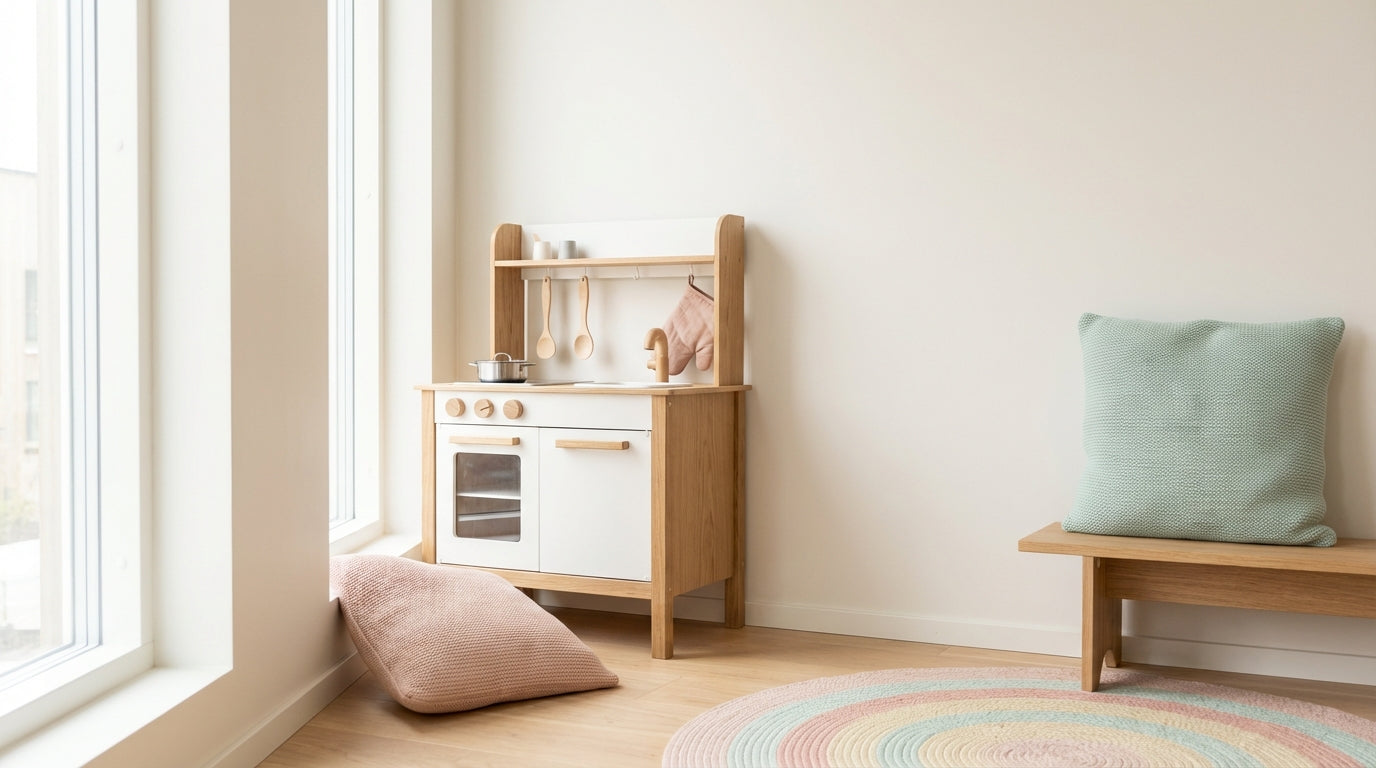
A small wooden play kitchen works best when your child can stand safely in front of it and "work" comfortably. Then it isn't just looked at, but truly played with – and that's exactly the point. In this guide you'll find a simple decision aid based on age, body height, space requirements and play style. Plus a few tricks from ordinary family chaos, so your play kitchen doesn't end up as a sock dumping ground after three days (purely theoretically, of course).

Ulli & Flo
Owners of bieco · Hamburg · parents themselves
We've learned this: a small wooden play kitchen is loved when it doesn't get in the way of everyday life. With a few checks on height and accessories, it all becomes very relaxed. Feel free to browse our Spielkueche collection.
Definition: A play kitchen is role-play equipment that lets children act out everyday routines in a child-friendly way. The benefit is very practical: children practise storytelling, language and togetherness – without anyone having to say "now you're going to learn something".
What size does a small wooden play kitchen really need to be?
You can tell the size is right when your child can reach everything important without climbing. Sounds simple – and it is. A play kitchen gets used happily when little hands comfortably reach the knobs, sink and counter. If your child is constantly standing on tiptoe or pulling themselves up, that quickly turns into frustration rather than "cooking".

How to check the height in 30 seconds (no measuring tape needed): Place your child where the kitchen is going to stand and let them "stir" – arms forward, hands at roughly tummy to chest height. That's about where the work surface should end up. If you already have a kitchen: does the hand height match the sink? Great.
- Work surface: easy to reach, without pulling up or crouching.
- Controls: knobs should be easy to grip without your child having to twist around.
- Doors/oven: nothing should jam when opening or bang into furniture.
Practical tip: Use masking tape to mark the planned width/depth of the kitchen on the floor. Walk over it for three days. If it doesn't annoy you, it fits.
Definition: Space requirement is the footprint plus the room that doors and play movements need. With play kitchens, this "door and elbow room" is often underestimated – until the oven door keeps knocking against the coffee table.
Small wooden play kitchen by age: guidance without stress
Age helps with orientation, but motor skills and the mouthing phase matter more. Two children can be the same age and still play completely differently: one happily sorts plates, the other tests whether a wooden spoon fits up the nose (spoiler: it does). So: use age as a rough guide, plus a quick reality check.
| Age (approx.) | What works well | What to look out for |
|---|---|---|
| from approx. 1 year | short role-play moments, large pieces, few accessories | very sturdy, few small parts, simple doors/knobs |
| 2–3 years | small wooden play kitchen as a permanent "main kitchen" | comfortable height, robust fittings, accessories not too small |
| from 4 years | longer role play, "shopping", recipes, more tidying | storage space, hooks/rails, expandable accessories |
If you're torn between two sizes, choose the one that's actually allowed to stay put. A kitchen in the storage room is about as useful as an umbrella in the cellar when it's pouring outside.
How much space does a small wooden play kitchen need in your home?
The play kitchen is best placed where you spend a lot of time anyway: the living area or the real kitchen. In the children's room it's often "out of sight, out of mind" – and then the sofa wins. If space is tight, it helps to treat the kitchen like a piece of furniture: a fixed spot, clear boundaries, no constant moving around.

- Wall space: A wall is usually more relaxed than "in the middle of the room".
- Walkways: Don't place it directly in the path to the hallway or balcony door (otherwise it'll eventually go flying).
- Door clearance: Leave some room in front of the kitchen so the oven and cupboard doors can open.
Safety note: Look for the CE marking and the manufacturer's age recommendation. According to the European Commission, the EU Toy Safety Directive 2009/48/EC sets out essential safety requirements for toys: (European Commission: Toy safety)
And one more thing from experience: "stable" beats "stylish". When children lean on it, yank doors open or set the pan down with gusto, nothing should wobble.
Which features really matter on a small wooden play kitchen?
A few well-usable features are worth more in everyday life than a fireworks display of functions. Children play stories, not kitchen inspections. For most role play, three things are enough: turn, open, put down. Everything else is a bonus – nice, but not essential.

- Knobs: easy to grip, not too wobbly, with pleasant resistance.
- Oven or cupboard door: sturdy, easy to open, without sharp edges.
- Sink/basin: as a shelf and "washing station" for all sorts of things.
- Hooks/rail: makes tidying part of the play (and saves your nerves).
Accessories often decide whether it gets played with every day. A small basic set is enough: pot, pan, plates, cups, spoons. You can add the rest bit by bit – to suit the current favourite phase. Starting with dishes & accessories usually works better than a huge mountain of accessories all at once.
Practical tip: Rotate accessories like books: 6–8 pieces visible, the rest in a box. Swap after two weeks. It feels like "new".
Design & everyday life: white, pink or natural – what makes sense?
The best colour is the one you can look at calmly in everyday life. Because yes: play kitchens get lived in. Fingerprints, little dings and the famous "soup" made of imaginary sand all come with the territory. If that stresses you out with white or pastel, go for natural or a darker option.
White wooden play kitchen: lovely and calm, but please without perfection pressure
White looks light in a room, but shows signs of use more easily. For many homes it's still great, because it visually recedes. In everyday life a slightly damp cloth is usually enough; harsh cleaners can damage surfaces.
- Water play: If real water is allowed, put a mat underneath.
- Patina: Small marks are normal – toys aren't museum pieces.
Pink wooden play kitchen: often the most relaxed solution as an accent
Pink is a question of style – and in the end your child (and your living room) decide. If you're giving it as a gift: a quick question about preferences saves long faces. If you're unsure, pink accents through accessories are often a good middle ground.
Natural wooden play kitchen: the classic for "just get on with it"
Natural wood feels warm and usually forgives dings best. Look for a smooth surface, cleanly rounded edges and clear material information. When a seller explains transparently what a product is made of and how it is tested, that's usually worth its weight in gold for parents.
Material & safety: what to look for in wooden play kitchens
Good safety features are: sturdy construction, clean edges and age-appropriate accessories. With play kitchens, mechanical issues (wobbling, pinch points at doors) and small parts (accessories) come together. That's why a quick check is worthwhile before the kitchen moves into the children's room.
- Edges & corners: rounded, no splinters, no sharp transitions.
- Doors & hinges: run smoothly, without jamming or "snapping".
- Small parts: for little ones, choose larger pieces and fewer at a time.
- Smell: a strong chemical smell is a warning sign; air it out well and ask the seller if in doubt.
Safety note: The GS mark is voluntary and means a product has been tested by an approved body. The consumer advice centre (Verbraucherzentrale) offers a good overview: (Verbraucherzentrale: Quality seals & test marks)
And because trust doesn't come out of thin air: we're a family business from Hamburg and have been doing this for 66 years. In parent feedback and product development, Ulli & Flo see it again and again: a small wooden play kitchen becomes a favourite when it's sturdy and doesn't need to be fussed over in everyday life.
DIY & everyday tricks: keeping the small wooden play kitchen exciting
With three simple ideas, the play kitchen feels "new" again without you having to buy anything. Children love repetition – but they also love small changes. And you need neither a craft degree nor a free Saturday.
- Menu card: Draw (or print) 3–5 "dishes" on paper, laminate them or slip them into a clear sleeve. Add a piece of chalk or a wipeable pen.
- Role-play roles: Restaurant today, café tomorrow, "grocery store" the day after. A basket as the "till" is enough.
- Storage baskets: One basket for dishes, one for food. When everything has a place, tidying up becomes more play than battle.
Care, quick and painless: Shake out the crumbs, wipe damp, let dry. If real water is involved: give it a quick wipe-over rather than letting the wood stay damp for long.
Why so many families end up with "small, made of wood" at bieco
We'd rather build for everyday life than overcomplicate – that suits real families. As a Hamburg family business, we've spent 66 years making sure toys are designed to be sturdy, understandable and safe. That includes not glossing over materials and testing, but naming them clearly. And when something is annoying in everyday use, we take the feedback seriously (children, by the way, are mercilessly honest).

If you'd like to browse: In our overview you'll find our Spielküche category and, to complement it, play kitchen accessories.
FAQ
From what body height does a small wooden play kitchen fit well?
It fits when your child can reach the work surface and knobs without climbing. In practice this means: standing, their hands should rest comfortably at "stove height". If your child has to pull themselves up or is constantly on tiptoe, the kitchen is probably too high or poorly positioned.
How much space should stay free in front of the small wooden play kitchen?
Leave enough room for the doors to open and for two children to stand side by side. The oven door needs space in front, otherwise it bangs into furniture. If siblings or visitors join in, a free area next to it helps – then there's less "You're in my way!".
Which is better: a mini wooden play kitchen or a large one?
Mini is better when space is tight or if the kitchen needs to move around often. A large kitchen is worthwhile if your child plays long role-play games and you have a permanent spot. In both cases: easy to reach and stable – otherwise cooking quickly turns into grumbling.
Which small wooden play kitchen is suitable for children from 1 year?
For ages 1 and up, a very sturdy, simple kitchen with few small parts makes the most sense. Look at the age recommendation, robust doors and accessories in larger pieces. If your child still puts a lot in their mouth, start with a few large pieces and expand later.
Is a wooden play kitchen easier to clean than plastic?
Both are fine for everyday life if you clean gently and dry afterwards. With wood, a slightly damp cloth is usually enough, followed by a quick dry rub. With plastic it's often just as quick. The material matters less than the rule: no harsh cleaner, and avoid standing water.
What role do standards and test marks play for play kitchens?
They help check typical risks such as mechanics, small parts and material requirements. According to the European Commission, the Toy Safety Directive 2009/48/EC regulates essential safety requirements for toys in the EU. A voluntary GS mark can provide additional guidance, see Verbraucherzentrale.
Finally, quite pragmatically: the best small wooden play kitchen is the one that actually gets used in your home. Choose the size that fits comfortably into your everyday life, and add accessories bit by bit. If you'd like to take a look: in the Spielküche hub you'll find a good overview – and with play kitchen accessories, the play grows along nice and easily.