Rocking Horse: What Age, Safety & Tips for Babies & Kids
At a glance
- From what age is a rocking horse suitable? Usually from 9–12 months, once sitting is steady.
- For babies, a bucket seat, belt, handles and footrests are the nerve-soothing combo.
- From 3 years you'll need more space, because the momentum picks up noticeably.
- Do a quick check regularly: screws, rockers, seams, stability.
- Look for warning labels, CE marking and clean workmanship.

A rocking horse is usually suitable from 9–12 months, as soon as your child can sit steadily. The age on the box is a helpful guide, but in the end what counts is this: can your child keep their upper body steady and hold on securely? In this guide you'll get a clear age overview, a little “Is this the right time?” checklist, a table for quick comparison – and a few practical tips for everyone who already has enough to juggle in daily life.

Ulli & Flo
Owners of bieco · Hamburg · parents themselves
We've learned it ourselves: when it comes to “from what age”, less gut feeling and more of a quick sitting and safety check helps. Then brooding quickly turns into a good feeling. Feel free to browse our Rocking Horse collection.
If you want to give a rocking horse as a gift, plan around ability and space. Grandma, Grandpa, godmother: feel free to ask – that's not unromantic, that's spot-on.
Rocking horse from what age – the simple rule of thumb
A rocking horse fits when sitting is steady and holding on securely works. If your child still tips far forward when sitting or can barely support themselves, rocking will be more “ugh” than “yay”.

A rocking horse is a movement toy that challenges balance and core tension. That's exactly what makes it so valuable – and exactly why it's worth not forcing the start too early.
Warning labels are not decoration, but the short version of the most important rules. According to the Verbraucherzentrale (German consumer advice centre), warnings must begin with “Achtung” (“Warning”) and should be clearly worded so parents can spot risks quickly. Verbraucherzentrale
Practical tip: The “sitting test”: place your child on the floor. Do they stay sitting steadily for 1–2 minutes while playing with their hands? Then the question of “from what age” is often already answered.
Age and feature overview: what fits when?
The table helps you bring age, features and daily life together quickly. It doesn't replace the manufacturer's information – but it makes the decision much more relaxed.
| Age / stage | Typical abilities | Useful features | What to look out for |
|---|---|---|---|
| 9–12 months | Steadier sitting (very individual), able to hold on | Bucket seat, belt, handles, footrests, anti-tip protection | Very steady stand, low seat height, use only under supervision |
| from 12 months | More core tension, targeted grasping, controlled momentum | Handles, footrests, anti-tip protection; belt useful depending on model | Free space all around, non-slip surface, regular screw check |
| from 3 years | Strong momentum, getting on/off independently, role play | Very sturdy construction, easy-to-reach handles, robust rockers | More space needed, clear rules (no jumping on from the side), supervision still makes sense |
Baby rocking horse: what matters for the little ones?
For babies, models with a bucket seat and belt are usually the most relaxed choice. Not because babies are “too wild” – but because they're still practicing keeping their upper body steady. And you'd like to rescue a cup of tea for a moment without the alarm bells going off right away.

A bucket seat is a supportive seat shape that guides your child better at the sides. That's practical, because little wobbles don't immediately end in a tilt.
A safety belt is a restraint that makes slipping out harder, but doesn't replace supervision. It's helpful when your child likes to “look forward to see what's going on down there” – so, almost always.
A concrete example: according to the product information, “Calimero” is recommended from 9 months. Among other things, it lists a padded bucket seat with safety belt, handles, footrests and anti-tip protection, as well as compliance with EN-71-1-2-3-9. BIECO: Baby Rocking Horse Calimero
“Hopsi” is also listed from 9 months according to the product information. The product details mention, among other things, EN-71-1-2-3-9 and use under supervision. BIECO: Baby Rocking Animal Bunny Hopsi
Safety note: Always place the rocking animal on a level, non-slip surface and use it only under supervision – especially in the baby years.
Rocking horse from 1 year: why it often fits well
By around 12 months, many children can sit, grasp and rock in a controlled way much better. Not all – but many. And that's exactly why “from 12 months” models are so common: for many families, it's a realistic starting point.

A rocking horse for ages 1 and up should have easy-to-reach handles and footrests. This gives your child clear “anchor points” – and you have to step in less.
Example: according to the product information, “Ginger” is suitable from 12 months. Among other things, it lists handles, footrests, anti-tip protection and “tested and compliant with the European toy standard EN 71”. BIECO: Rocking Horse Ginger
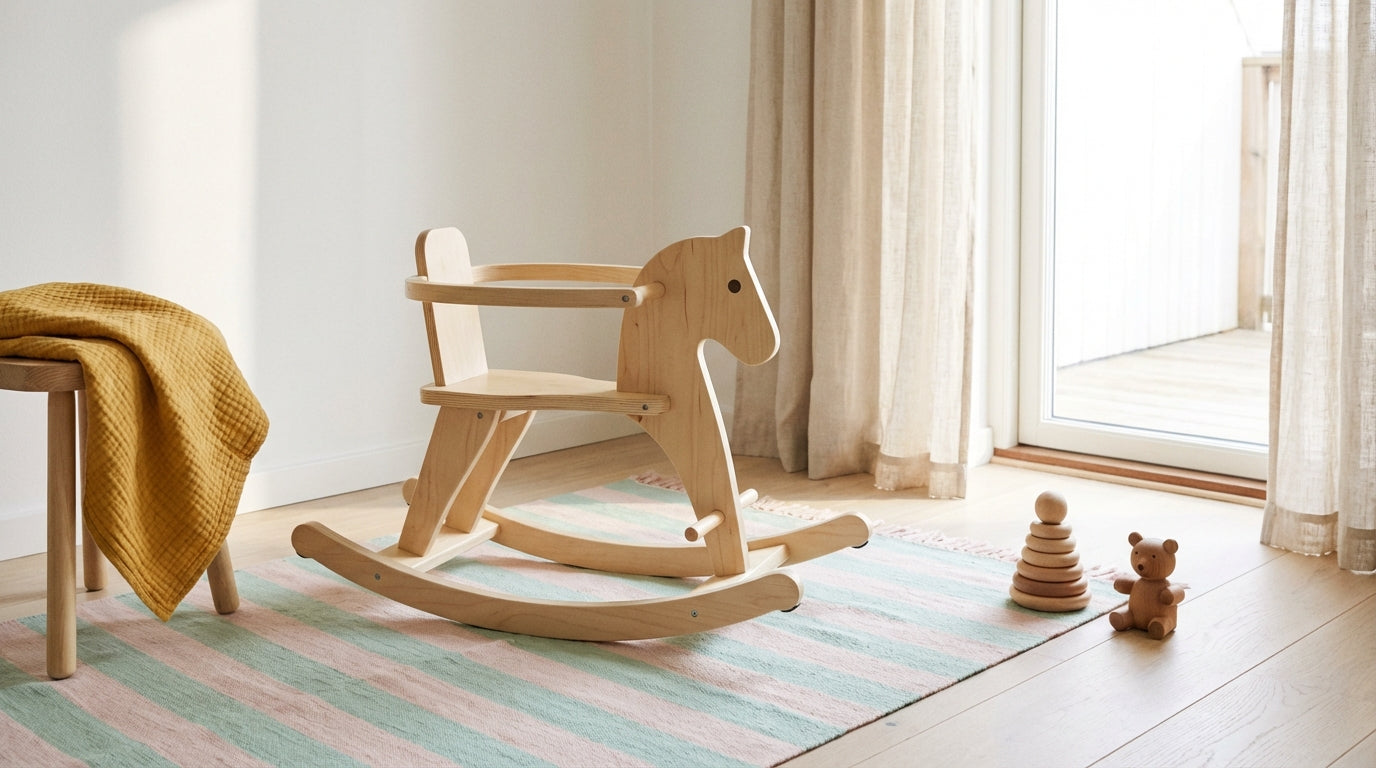
A classic wooden rocking horse is also listed with us as “from 12 months”. The product description emphasizes use under supervision. BIECO: Wooden Rocking Horse
Rocking horse from 3 years: what really changes?
From 3 years, gentle rocking often turns into a little indoor rodeo. In the best sense: more courage, more momentum, more role play. In the not-so-great sense: more “Look!” while you're just emptying the dishwasher.
Now space becomes more important than any extra detail. Plan free space all around, so knees, heads and furniture don't have to argue with each other.
Even at 3 years, supervision makes sense, because children get creative. And creativity rarely comes with built-in anti-tip protection.
Materials guide: wood vs. plush – what suits your daily life?
Wood is often sturdy and long-lasting, plush often softer and more “baby-friendly”. Both can be great – it depends on how old your child is and how wildly they already rock.
A wooden rocking horse should be cleanly made: smooth edges, sturdy screw connections, a secure stand. Especially with second-hand pieces, it's worth taking a close look at cracks, loose screws and worn rockers.
Plush models are pleasantly soft, but you need to check seams and loose parts. If anything sticks out or can come loose, “cuddly” quickly becomes “please not in the mouth”.
What to look for in a rocking horse? The short checklist
A checklist has to be short, otherwise nobody uses it in real life. Here's the version that still works on little sleep:

- Age recommendation & warning labels: Read them in full, not just “from …”. According to the Verbraucherzentrale, warnings must begin with “Achtung” (“Warning”). Verbraucherzentrale
- CE marking & manufacturer information: According to the Verbraucherzentrale, the CE mark as well as the manufacturer's name and address belong on the toy. Verbraucherzentrale
- Stability & anti-tip protection: It shouldn't “walk away” when your child builds up momentum.
- Handles & footrests: Easy to reach, low-slip, firmly attached.
- Workmanship: No splinters, no sharp edges, no loose small parts, firm seams.
- Surface: Level and non-slip; on smooth floors, an anti-slip mat helps.
EN 71 is a European series of standards that describes safety requirements for toys. The European Commission lists harmonised standards on toy safety in connection with Directive 2009/48/EC. European Commission
The Toy Safety Directive 2009/48/EC regulates safety requirements and CE marking for toys in the EU. You can find the legal text on EUR-Lex. EUR-Lex
Practical tip: The “30-second check” before every rocking session: is anything wobbly, is anything loose, is the floor slippery? Check first, then put your child on.
How to check your rocking horse regularly (without a big production)
Regular mini-checks are more effective than one big inspection marathon. You don't need to get out the toolbox and headlamp – usually a quick look and a quick grip is enough.
- Before every use (30 seconds): Stand firm? Floor slippery? Handles sturdy? Any visible damage?
- Weekly (2 minutes): Tighten screws/connections (if present), check rockers for wear, check seams/cover for tears.
- After “wild days”: If visiting children were over or the toy tipped over: give it one extra check.
If something is loose or creaks, that's a good reason for a break. Repair or clarify first, then keep rocking – in the end that saves nerves and tears.
Why we're so picky about safety at BIECO
We're a family business from Hamburg and have been making toys for 66 years. That doesn't mean we know everything better – but we know pretty well which questions parents are still googling at half past ten at night.
Safety transparency means to us: clear product information on age, use and materials. When standards or notes are mentioned in the product details, it should help you so you don't have to guess.
Ulli & Flo write here as parents – and we always base our recommendations on everyday life. So: better a model that fits now and gets used, than one that would be theoretically great “someday”.
From what age in 3 sentences (to remember)
A rocking horse usually makes sense from 9–12 months, once sitting is steady. From 1 year it gets noticeably easier for many children, because grip strength and core tension increase. From 3 years you mainly need more space and a particularly stable environment, because the momentum gets bigger.
FAQ
Rocking horse with belt: from what age?
A belt is especially helpful in the baby years, when your child still sits wobbly. It can make slipping out harder, but doesn't replace supervision. What matters is the manufacturer's information for the model and whether your child already stays calm while sitting and holds on securely.
Wooden rocking horse: from what age?
A wooden rocking horse often fits from around 12 months, when your child sits steadily. Then easy-to-reach handles, a secure stand and clean workmanship are important. Also look at the manufacturer's age recommendation and warning labels, because design and seat height can vary a lot.
How much space does a rocking horse need?
Plan enough free space all around so that nothing gets hit while rocking. Exactly how much depends on the model and your child's momentum. A practical tip: don't put it right in front of edges, radiators or low tables, but rather “freely” in the room.
How long can my child rock at a time?
As long as your child rocks relaxed and safe – with short breaks. Especially at the beginning, a few minutes are often enough before core tension fades. If your child gets tired, holds on less well or sits restlessly, that's a good sign for a break.
How can I tell a rocking horse is safe?
A safe rocking horse has clear warning labels, CE marking and sturdy workmanship. According to the Verbraucherzentrale, warnings (starting with “Achtung”), the CE mark and manufacturer information are important points when buying toys. Verbraucherzentrale
Wood or plush: which is better?
Better is what suits age, ability and your daily life. Plush is often soft and gives babies more support through a bucket seat/belt (depending on the model). Wood looks classic and sturdy, but needs especially clean edges, sturdy screw connections and a secure stand – above all when there's a lot of momentum involved.
If you'd like to see what suits your child's age, an overview is the quickest help. In our Rocking Horse category you'll find different variants – each with an age recommendation and notes you can understand even half asleep.