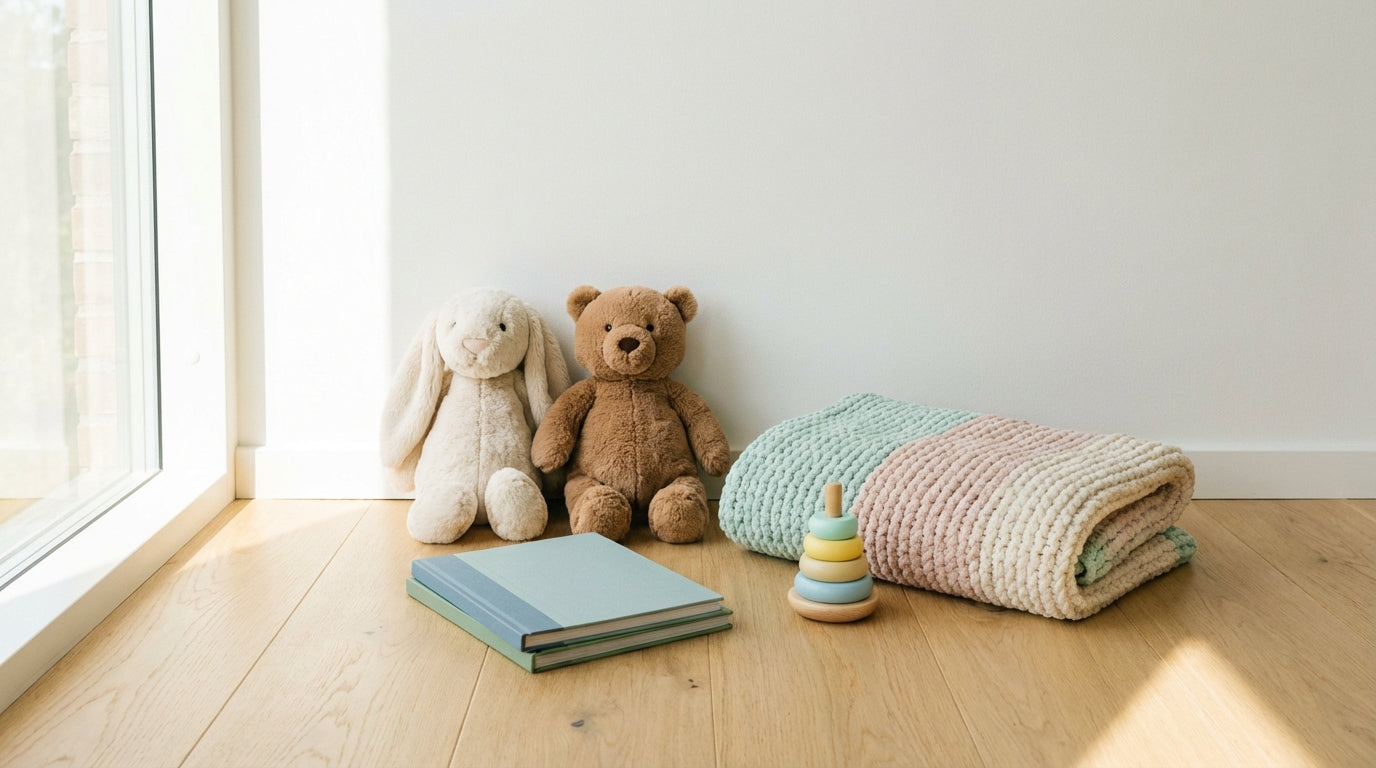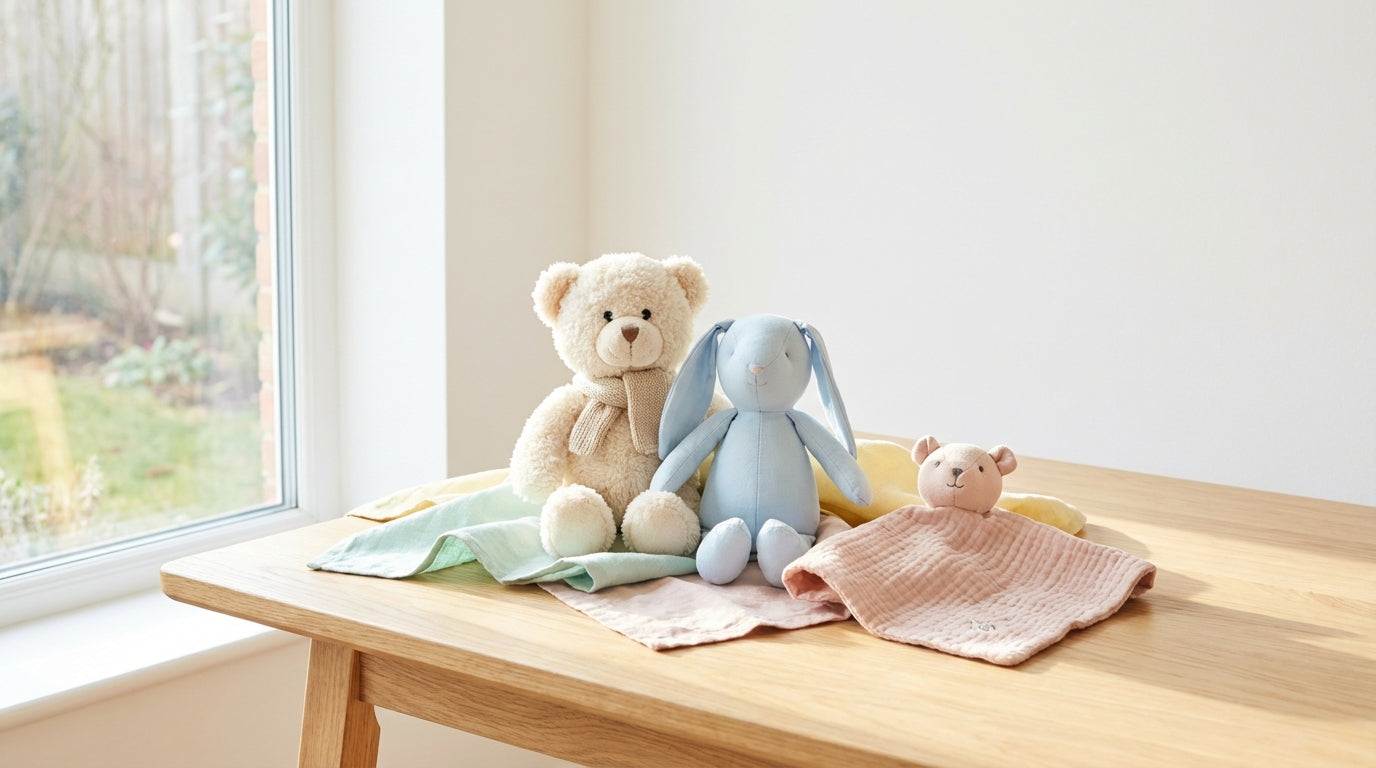
Plush Toy vs. Stuffed Animal vs. Cuddly Toy: The Difference, Simply Explained
At a glance
- The difference between a plush toy, a stuffed animal and a cuddly toy is quickly explained: material, construction or the role it plays in everyday life.
- "Stuffed animal" is the umbrella term for animal figures made of fabric.
- "Plush toy" describes the fluffy plush surface.
- "Cuddly toy" is the favorite companion for comfort and falling asleep.
- More important than the word: labeling, age recommendation, care and safe construction.

The difference between a plush toy, a stuffed animal and a cuddly toy usually comes down to material versus everyday language. A plush toy is a stuffed animal with a plush surface, and a cuddly toy is the one (stuffed animal or plush toy) that becomes a faithful companion in your home. Sounds like splitting hairs? A little. But it helps when you're giving gifts, when you're doing laundry – and especially when a baby is involved and it's worth taking a second look.
You can find our cuddly toys and stuffed animals here.

Ulli & Flo
Owners of bieco · Hamburg · parents themselves
For a long time, we ourselves lumped "plush", "stuffed" and "cuddly" all together – until it came to gift-giving and laundry. Here's the breakdown that really helps in everyday life. Feel free to browse our cuddly toy collection.
So you don't have to search for long, here you'll find clear definitions, a quick safety check and care tips. No wagging finger – more the way you'd chat at the kitchen table: practical, friendly, with an eye for real life (including "Where on earth is the teddy again?!").
Table of contents
- What exactly is the difference?
- What is a cuddly toy?
- What is a plush toy?
- What is a stuffed animal?
- Which terms appear on labels – and why?
- What to look for when gifting (safety & everyday life)?
- Materials guide: What feels like what?
- Care: washing, drying, rescuing the fluff
- FAQ
What is the difference between a plush toy, a stuffed animal and a cuddly toy?
"Stuffed animal" describes the construction, "plush toy" the surface, "cuddly toy" the use. If you only want to remember one sentence, make it that one.
- Stuffed animal: An animal figure made of textile (e.g. cotton, velour, terry cloth, plush or blended fabrics).
- Plush toy: A stuffed animal with a fluffy plush cover (plush = fabric with a soft pile).
- Cuddly toy: The animal (whatever the fabric) that is used for snuggling, comfort or falling asleep.
In everyday life, these words are often used interchangeably – and that's perfectly fine. Grandma says "plush toy" and means "soft and sweet". Parents say "cuddly toy" and mean "the thing nobody sleeps without tonight". Both are kind of right.
In the end, what matters isn't the word, but whether the toy is safe and suitable for the child's age. According to the EU, the legal basis for toys in Europe is the Toy Safety Directive 2009/48/EC, which regulates, among other things, essential safety requirements and CE marking (EUR-Lex).
What is a cuddly toy?
A cuddly toy is a soft companion that tags along through everyday life. It's less a material and more a role: it's there at bedtime, on the first day of daycare, or when the hallway looks "weird" at night.
A cuddly toy can be a plush toy – but it doesn't have to be. Some children love smooth fabrics, others need fluff. And still others are attached to a comfort blanket with an animal head (which may officially be a "textile toy" – but in practice, a lifesaver at 3:17 a.m.).
Definition (quotable): A cuddly toy is a soft toy that a child uses for comfort, falling asleep or feeling secure. That says nothing about "better" or "worse" – only about how it's used in your home.
Practical tip: If a favorite is emerging, get a second one right away and alternate between the two. That saves your nerves when there's a laundry or lost-toy drama.
With babies, the rule is often: less frills, more calm. The smaller the child, the more important clear age recommendations, sturdy seams and no detachable small parts become. If you'd like to dive deeper into the topic: you'll find a starting point in our parent hub Cuddly Toy, and the guide From what age is a cuddly toy suitable for babies? Safety & tips gets really specific.
What is a plush toy?
A plush toy is a stuffed animal whose outer fabric is plush. Plush is a textile with a pile – that fluffy surface you automatically have to stroke at least once. (If you don't, you're either very disciplined or in a big hurry.)
Plush toys are popular as gifts because you "get" them instantly. Soft, friendly, huggable – that's pretty universal, whether for a toddler, a school-age child, or as a comfort-giver for adults with a cold.
For safety, what counts isn't "plushy", but construction and labeling. The Verbraucherportal Bayern (Bavarian consumer portal), for example, explains clearly what to look for with plush toys in terms of materials, tear resistance and labeling (Verbraucherportal Bayern).
What is a stuffed animal?
A stuffed animal is the umbrella term for animal toys made of textiles – fluffy or smooth. Teddy, fox, duck, hedgehog: if it's sewn and looks like an animal, you're usually in stuffed-animal territory.
The term is handy when you want to lump "everything together". Stuffed animals as the category, plush toys as a subgroup, cuddly toys as the "job description" in family life.
Definition (quotable): A stuffed animal is a textile animal figure for playing or cuddling, regardless of the type of fabric. That also makes it clear: a stuffed animal can become a cuddly toy – but doesn't have to. Some are more playmates for pretend play, others sit decoratively on the shelf (bravely gathering dust).
Which terms appear on labels – and why does it matter?
Labels are rarely about "cuddly toy" – they're about care, material and warnings. The label isn't romantic, but it's useful – like a good raincoat.
- Material information (outer fabric/filling)
- Care instructions (washing, drying)
- Age recommendation and, where applicable, warnings
- CE marking (generally required for toys in the EU)
The CE marking is a manufacturer's declaration of compliance with EU requirements. According to the Verbraucherportal Bayern, the CE mark is applied by the manufacturer and is not an independent test seal (Verbraucherportal Bayern).
And yes: many cuddly toys legally count as "toys". The BMUKN (German Federal Ministry for the Environment) explains how requirements for safe toys are implemented in Germany and what consumers can look out for (BMUKN).
What should I look for when buying or giving one as a gift?
The best stuffed animal is the one that fits your child and your daily life. A few practical questions help more than any debate over terms:
- Age: Does it match the age recommendation?
- Small parts: Are there button eyes, bows or decorations that could come off?
- Seams: Does everything feel sturdy – especially at the ears, arms and labels?
- Shape: Is it easy to grasp and hold?
- Care: Can it go in the washing machine – and is that realistic in daily life?
- Smell: Does it smell neutral? If it has a strong "chemical" smell: air it out first, and if in doubt, better to leave it on the shelf.
Safety note: For very young children, detachable small parts and long ribbons are particularly critical. Pay attention to the age recommendation, warnings and sturdy construction.
If you choose by animal type: totally legitimate – children have clear preferences. Some are Team Fox, others Team Mouse, and some switch daily (like we adults do with the weather forecast). For browsing, try Fox Cuddly Toy, Mouse Cuddly Toy or Duck Cuddly Toy.
Materials guide: What feels like what (and why is that practical)?
Material isn't just a matter of feel, it's also an everyday question: what can stand up to washing and cuddling? Here's a quick overview, without a lecture on textiles:
- Plush: Fluffy thanks to its pile, feels "warm" and cuddly. Can lose some of its fluff after many washes – but can often be brushed back up.
- Cotton: Often smoother, and very pleasant depending on the weave. Many parents like it because it feels "honest" and is often easy to care for (please still check the label).
- Velour/terry cloth: Velour is soft with a short pile, terry cloth is more "towel-like" and grippy – it can be exciting for babies because their fingers have something to do.
- Blended fabrics: Common because they combine certain properties (e.g. shape stability + a soft surface).
If you care about additional standards, a look at well-known textile labels helps. OEKO-TEX® describes, for its STANDARD 100, product classes including one for baby articles (OEKO-TEX®).
Practical tip: For big cuddlers: choose a material that forgives frequent washing – and a size that fits in the laundry bag.
Why we at bieco think the way we do about cuddly toys
For 66 years, we've been checking whether a cuddly toy truly keeps up with family life. bieco is a family business from Hamburg – in northern German terms: we like things solid, honest and not too complicated.
Transparency is part of it for us: material details, care instructions and safety information should be easy to understand. Big promises don't help at half past two in the morning – a well-made, easy-care cuddly toy is more likely to.
How do you properly care for stuffed animals and plush toys?
Care is the difference between a "favorite" and "somehow musty". Basic rule: check the label first, then act. And it's better to wash gently and regularly than once a year on "hot and hope".
- Washing: If possible on a gentle cycle, ideally in a laundry bag or pillowcase.
- Spinning: Rather low, to protect seams and shape.
- Drying: Air drying is often the kindest to shape and pile.
- Rescuing the fluff: After drying, knead it briefly or carefully fluff it up with a soft brush.
If you're looking for a step-by-step guide, you'll find it explained compactly here. Washing & caring for cuddly toys: How to keep them hygienic and fluffy.
FAQ
What is the difference between a plush toy, a stuffed animal and a cuddly toy?
The difference lies in a material term versus use in everyday life. Stuffed animal is the umbrella term for textile animal figures. A plush toy is a stuffed animal with a plush surface. A cuddly toy is the one (stuffed animal or plush toy) used for snuggling, comfort or falling asleep.
Is a teddy always a plush toy?
No, a teddy can be made of plush – but doesn't have to be. "Teddy" mainly describes the figure (a bear) and the type of toy. There are teddies made of plush, but also of other textiles such as cotton or velour. What matters is the surface: plushy or not.
How can I tell whether a cuddly toy counts as a toy in the EU?
It usually counts as a toy if it's intended for children to play with. In that case, CE marking is generally relevant. The essential requirements are described in the Toy Safety Directive 2009/48/EC (EUR-Lex); additional information for consumers is provided by the BMUKN.
What is especially important with cuddly toys for babies?
What matters are the age recommendation, sturdy seams and no detachable small parts. Also pay attention to warnings and to whether the cuddly toy is easy to care for. For very young children, long ribbons or loose decorations are particularly unsuitable – better simple, soft and well made.
Are there "better" materials – plush vs. cotton?
"Better" depends on what your daily life needs. Plush is often especially fluffy, while cotton is often smoother and, depending on construction, very easy to handle. More important than the name of the fabric are clean workmanship, understandable care instructions and trustworthy labeling (e.g. CE for toys).
How often should you wash a cuddly toy?
As often as your daily life requires – and as the label allows. For constant companions, regular, gentle washing can make more sense than rare "big operations". If the cuddly toy is much loved: start the wash in the morning so it's ready for duty again by evening.
If things look a bit clearer now: perfect – it doesn't need to be more than that. To keep browsing and get your bearings, you'll find plenty of animal candidates in the parent hub Cuddly Toy, and even more guidance on materials, care and typical family questions in the Cuddly Toy Guide.