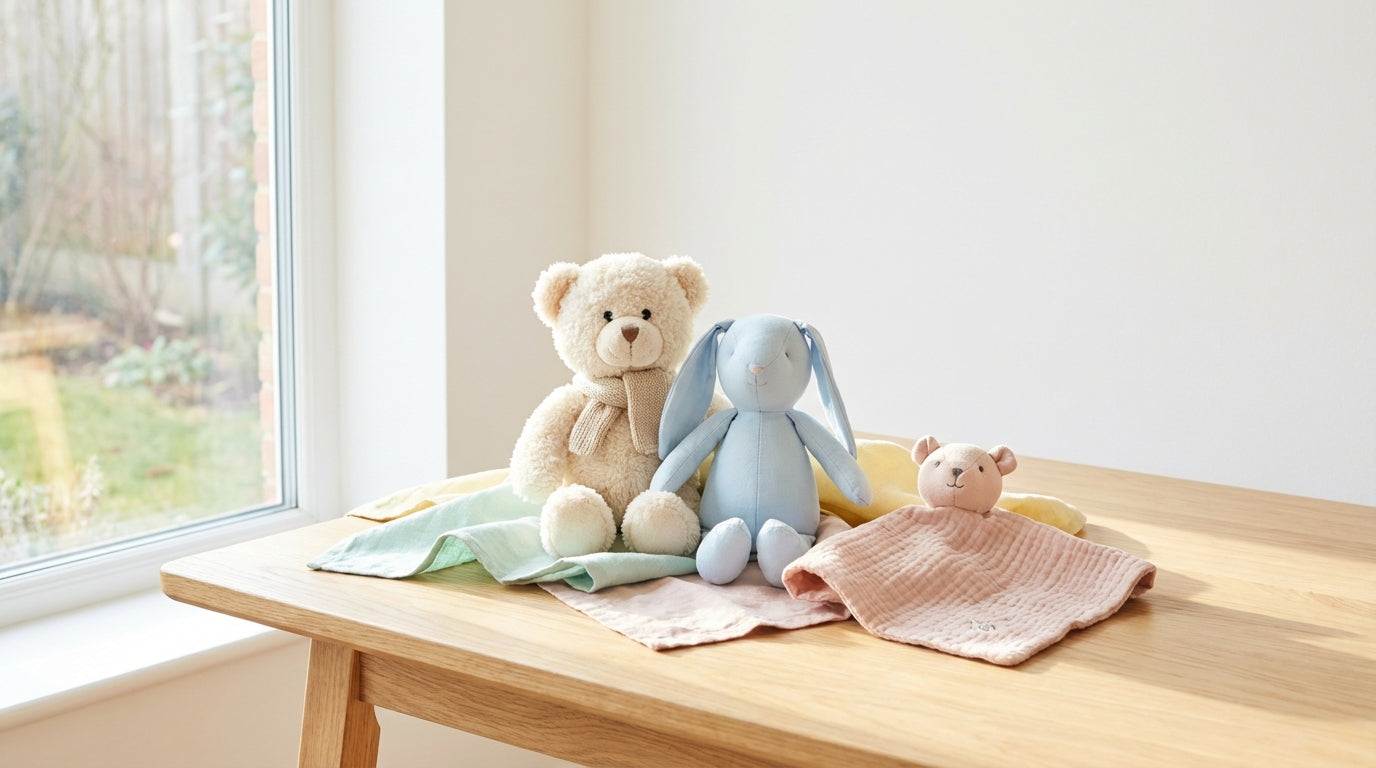
Caring for Dolls: Cleaning, Washing Hair & Repairs – Here's How
At a glance
- Caring for dolls: check the material, clean gently, let them dry completely.
- Cloth dolls can often go in at 30 °C on a delicate cycle – the care label decides.
- Vinyl dolls are better wiped clean; keep eyes and mechanisms dry.
- Doll hair: detangle, dampen lightly, air dry – no heat.
- Repairs (seams, buttons, elastic) usually take just 10–20 minutes.

Caring for dolls works best when you check the material and care instructions first. Then “Oh no, a stain!” quickly turns back into “All good, our friend is saved.” In this guide you'll find simple steps for cleaning, drying and repairing – for cloth dolls, vinyl dolls, plush toys and doll hair. No jargon, no drama in the laundry room. And yes: it's also written for those days when all you really wanted was a coffee.

Ulli & Flo
Owners of bieco · Hamburg · parents themselves
We've learned that with dolls, “more” rarely helps – “gentler” almost always does. With a few calm steps, your child's favorite friend will be clean and ready for the next adventure. Feel free to browse our Dolls collection.
Look first, then get started: a 60-second material check
The care label or the manufacturer's information is the most reliable guide. That's exactly where it says whether the doll can go in the machine, whether hand washing only is advised, or whether you're better off using just a damp cloth. According to HABA (USA), many plush items and dolls should be washed on a gentle cycle and then air dried (HABA: Caring for your toys).

- Cloth doll: fabric body with soft stuffing; the face is often embroidered or sewn on.
- Vinyl/plastic doll: head, arms and legs made of vinyl/plastic, sometimes with sleeping eyes; the body is sometimes made of fabric.
- Wooden doll: varnished wood; doesn't like soaking or wet adventures.
- Plush: fur fabric (often polyester); quickly turns “scruffy” if dried the wrong way.
Practical tip: Take a photo before cleaning (hair, bows, clothes). It saves a surprising amount of searching when it's time to make everything pretty again.
A cloth doll is a doll with a textile body and soft stuffing. That's handy, because fabric is usually gentler to clean than vinyl – but it takes longer to dry all the way through.
Cleaning cloth dolls: hand wash or 30 °C – step by step
Many cloth dolls are washable at 30 °C if you protect them well. For the HABA cloth doll Annelie, for example, the product details say “washable at 30 °C” (HABA cloth doll Annelie). And HABA (USA) recommends for many toys: gentle cycle, ideally in a laundry bag or pillowcase, then air dry (HABA care instructions).

- Preparation: remove the clothes, close any Velcro, and briefly secure loose seams.
- Protection: put the doll in a pillowcase or laundry bag (knotted/zipped shut).
- Wash cycle: delicate/gentle cycle, 30 °C, mild detergent, low spin speed.
- After washing: pull it back into shape and lay it on a dry towel.
- Drying: let it air dry, turn it regularly, and don't put it on the radiator.
If you're unsure, hand washing is almost always the gentler choice. Lukewarm water, a little mild detergent, press gently instead of rubbing, rinse thoroughly – and then: patience while it dries. (Yes, I know. Patience in family life is about as common as an empty laundry basket.)
Safety note: Make sure the doll dries completely – inside too. Damp stuffing can turn musty.
When it's time to get dressed again after the wash, a fixed outfit spot helps. For fresh changes of clothes, a look at doll clothes fits in quite naturally – simply so nothing disappears into the chaos of the sock drawer.
Can I wash my HABA doll?
For many HABA cloth dolls: yes, often at 30 °C – but please check the specific model. On the product pages of several cloth dolls it explicitly says “washable at 30 °C” (e.g. Annelie, see the link above). In addition, HABA (USA) recommends a gentle cycle, a laundry bag or pillowcase, and air drying (HABA USA).
- If it says “washable at 30 °C”: gentle cycle, laundry bag, mild detergent.
- If there's no instruction: better to hand wash or spot clean with a damp cloth.
- If there's electronics inside: don't wash the whole doll, just clean the surface.
By the way, this applies to every brand: read first, then wash. It's not memory that decides, but the label – even if your memory looks very convinced.
Cleaning vinyl & baby dolls: wipe gently instead of bathing
The safest way to clean vinyl is with a damp cloth and a little water. Dolls with sleeping eyes in particular don't like water around the head. American Girl explicitly advises in its care instructions not to submerge the doll and to keep water away from the eyes, because they can rust (American Girl: Doll Care Tips).

- Everyday dirt: soft cloth + lukewarm water, then rub dry.
- Stubborn marks: test on an inconspicuous spot first; American Girl, for example, describes a baking soda and water paste for vinyl (source).
- Fabric body: keep it as dry as possible and clean only the affected spots.
Safety note: No hot water, no hair dryer, no harsh cleaners – and always keep eyes and mechanisms dry.
If you have a whole doll household living with you, sorting by material is worthwhile. In the Dolls overview you'll see different types – and when caring for them, it helps you avoid mixing up methods.
Can you wash the hair of a doll with makeup?
Yes, but with doll hair, “washing” usually means: detangle, dampen, rinse, air dry. Many doll hairs are synthetic fibers and react sensitively to heat and styling products. American Girl recommends, among other things, lightly dampening the hair, brushing carefully in small sections and, explicitly: no styling products and no heat tools; water should also be kept away from the eyes (American Girl: Doll Care Tips).
- Protect the eyes: with sleeping eyes, keep the eye area dry; don't submerge the head.
- Detangle: work in small strands from the bottom up, holding the hair gently in place.
- Dampen: moisten the hair lightly with water, don't “soak” it.
- Rinse: if needed, clean very sparingly with something mild and rinse thoroughly – without letting water run into the head or mechanism.
- Dry: arrange the hair in shape and let it air dry; no heat.
Practical tip: For a quick morning, this is often enough: detangle, dampen lightly, done. You can do the thorough rinsing when nobody is calling “NOW!”
Synthetic doll hair is made of man-made fibers and often doesn't tolerate heat well. That's why flat irons, curling wands and “just a little hairspray” are usually the moment when smooth suddenly turns permanently wild.
How do I get plush fluffy again?
Fluffiness comes back mainly through air drying, shaking it out and gentle brushing. According to Nordbayern, it helps to air dry plush (not in strong sun or on a radiator), shake it out in between and then brush it gently (Nordbayern: washing stuffed toys).
- Wash: if machine-safe, then 30 °C, gentle cycle, in a laundry net or pillowcase.
- Get the water out: press it out in a towel (don't wring).
- Shape it: tug, shake, and “fluff up” the fur.
- Air dry: at room temperature, turning regularly.
- Brush: only once everything is dry, go over it gently with a soft brush.
Safety note: If there's still moisture inside, it's better to let it dry longer. Otherwise you risk a musty smell or, in the worst case, mold.
Small repairs: sewing, replacing elastic, restuffing – no tailoring degree needed
The most common “doll emergencies” are seams, buttons and stretched-out elastic. Many people can manage these with a needle, thread and a calm moment. And if it doesn't work out: that's not the end of the world either – some repairs are better handed over to someone else.
1) Open seam on the body or arm
A ladder stitch closes seams securely and looks almost invisible. Fold the edges inward, insert the needle alternately on the left and right at small intervals, and carefully pull the thread tight at the end. If stuffing is poking out: push it back in first, then close the seam.
- Tools: needle, strong thread, small scissors.
- Durability: better to knot twice than to think “it'll be fine.”
- Extra: for high-stress spots, sew back and forth once.
2) Loose button / wobbly eye
Anything that can come off should be secured immediately when small children are around. Sewing buttons back on is usually quick: use doubled thread, pass through several times, and knot well at the end. For eyes, the rule is: if they can't be fixed securely, it's better to have them professionally replaced – especially with very small children.
3) Stretched-out elastic (e.g. in clothing or a hair tie)
New elastic is often the quickest repair with a big effect. Roughly measure the old elastic (or take the width around the body/wrist), pull the new one through the channel with a safety pin, and neatly knot or sew the ends. Done – and the trousers no longer hang around the knees.
4) Restuffing: when stuffing is missing or lumpy
Restuffing works best in small portions, evenly distributed. Open a seam a little (or use the opening that's already there), add stuffing and spread it with a stick or your finger. Then close the seam again with a ladder stitch.
Safety note: After repairs, always do a quick check: is everything firmly attached, are there any loose parts or long threads? With small children, it's better to check once more than once too little.
5) Hair “pulled out” or wig coming loose
With wigs, careful fixing is better than “the more, the better.” Glue can react depending on the material; so test on an inconspicuous spot or, if in doubt, have it done for you. For everyday use, this is often enough: detangle, braid loosely (protects against new knots) and don't pull braids too tight during play.
For tidiness after the repair, small role-play items sometimes help more than you'd think. In doll accessories you'll find practical little extras – and yes, sometimes a “fresh start” after a mishap is just what's needed.
Do/Don't checklist: so nothing goes wrong when caring for dolls
With this mini checklist you'll avoid the typical care pitfalls. Save it, print it, stick it to the washing machine – whatever your daily life allows.
| Do | Don’t |
|---|---|
| Check the label/manufacturer's instructions | “It'll be fine” without a material check |
| Gentle cycle, laundry bag, mild detergent | Wash hot or spin heavily |
| Wipe vinyl, keep eyes dry | Submerge the doll (especially with sleeping eyes) |
| Detangle hair, dampen lightly, air dry | Hair dryer, flat iron, styling products |
| Let it dry completely after washing | “Quick-dry” on the radiator |
Why we see it this way at BIECO (without much fuss)
When it comes to toys, we always think about everyday life, safety and honest materials. BIECO is a family business from Hamburg, and we've been doing this for 66 years – so we've seen a few “oops” moments involving cocoa, mud and felt-tip pens. It's important to us that materials are transparent, care instructions stay easy to understand and safety aspects aren't swept under the rug.

For us, good care starts with the choice of materials and workmanship. When something is made to be sturdy and carefully tested, it's easier to clean in everyday life – and you don't have to panic at every stain.
FAQ
How often should you care for dolls?
As often as necessary and as rarely as possible. For everyday life, this is usually enough: wipe off visible dirt and wash the clothes now and then. A complete wash makes sense when the doll is truly worn out (daycare adventures, anyone?). What matters is that it dries completely afterwards.
Can you wash the hair of a doll with makeup?
Yes, but gently and without heat. Detangle the hair in small sections, dampen it lightly and rinse carefully if needed. According to American Girl, no styling products or heat tools should be used; water should also be kept away from the eyes (American Girl).
Can I wash my HABA doll?
Many HABA cloth dolls are washable at 30 °C – check the specific model. For the HABA cloth doll Annelie, 30 °C is stated in the product details (HABA). HABA (USA) additionally recommends a gentle cycle, washing in a pillowcase/laundry bag and air drying (HABA USA).
How do I get plush fluffy again?
Air dry, shake it out and only then brush gently. According to Nordbayern, it helps not to dry plush on the radiator, to shake it out in between and to go over it with a soft brush at the end (Nordbayern). Important: let it dry completely.
Can dolls go in the dryer?
Air drying is usually the safer choice. Heat can warp fabric bodies, loosen glued areas or damage synthetic hair. Only use the dryer if the manufacturer expressly allows it. When in doubt: dry on a towel, turn regularly and be patient.
How do I clean a vinyl doll without damaging it?
With a damp cloth and a little water – don't submerge it. For dolls with sleeping eyes, the eye area should stay dry. American Girl advises keeping water away from the eyes (risk of rust) and not submerging the doll; a baking soda and water paste is also described there for vinyl (American Girl).
Finally: caring for dolls gets easier when everything has a fixed place. Whether it's clothes, accessories or the next doll to give as a gift – feel free to browse Dolls, Doll Clothes or Wooden Dolls & Accessories when you want to get doll life nicely sorted again after the “spa treatment.”