
Montessori Toys for 1-Year-Olds: Ideas by Age from 6 Months to 5 Years
At a glance
- Montessori toys for 1-year-olds: few pieces, one clear task, lots of repetition.
- 6 months: grasping, rolling, looking – safe, simple and easy to hold.
- 2 years: sorting, twisting, pouring – “me do it” with manageable frustration.
- 3, 4 and 5 years: fine motor skills, role play, rules and pre-school skills, each considered separately.
- More important than age labels: your child's interest, ability and safe construction without small parts.
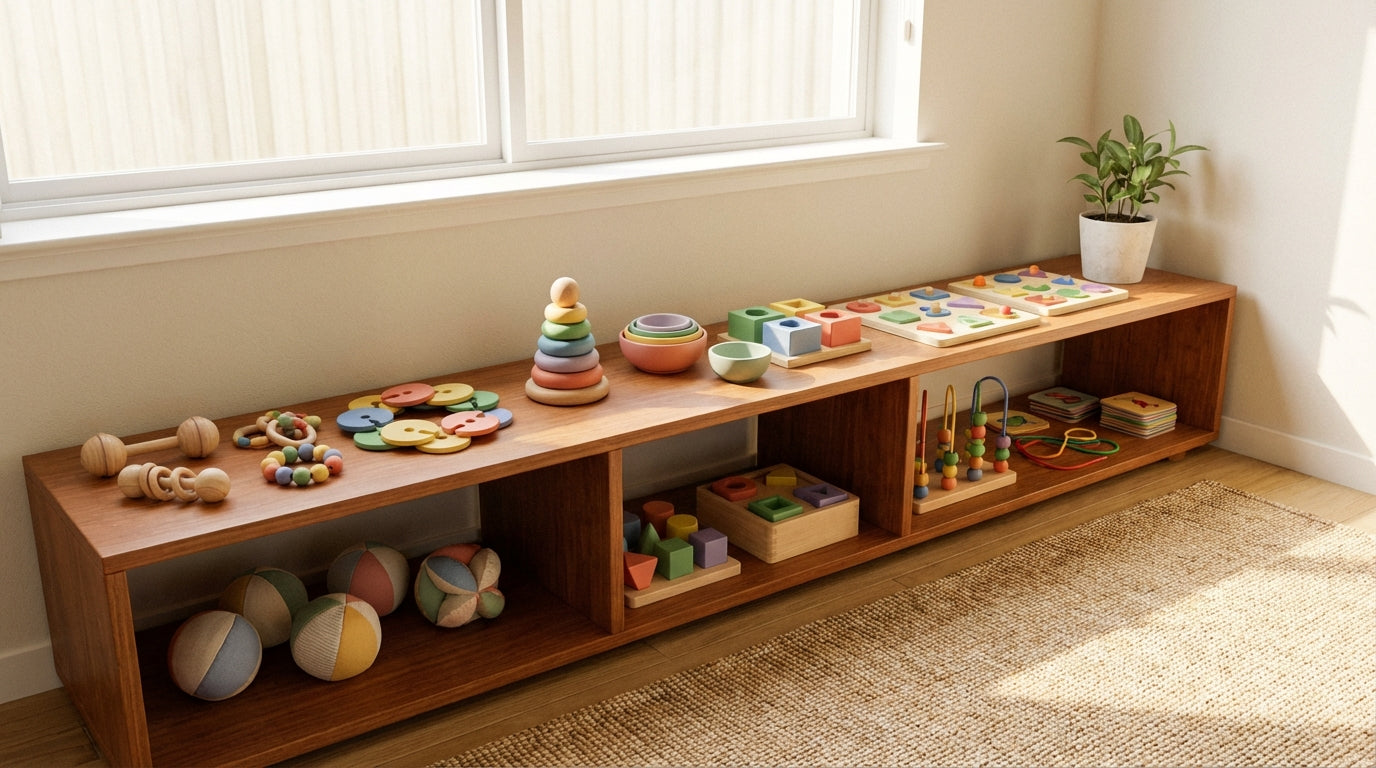
Montessori toys for a 1-year-old work best when they have one clear task that your child can repeat on their own. At one year old, little moments of success are pure gold: dropping things in, stacking, sorting, pushing – without 100 individual pieces that end up living under the sofa. In this guide you'll find a practical overview by age from 6 months to 5 years, plus simple criteria for good materials and a few everyday tricks that really make life easier.

Ulli & Flo
Owners of bieco · Hamburg · parents ourselves
What helped us most at age 1: set out just a few things and pack the rest away. Then “entertaining” often turns into “doing it myself” all on its own. Feel free to browse our Montessori collection.
Montessori toys means: one material practises one skill as clearly as possible. This helps children concentrate, because they don't have to “figure out” ten things at once.
A prepared environment is a child-friendly space that makes independence possible. In short: within reach, easy to see, and set up so that tidying up doesn't feel like an escape room.
Montessori Toys for 1-Year-Olds: What Really Makes Sense at This Age?
At 1 year old, drop-in, stacking and simple sorting tasks work most reliably. Concentration is still short and the urge to explore is huge – so the best materials are those that are understood right away and can be repeated often. If your child also uses things in unexpected ways (ring on the head, cup as a drum): completely normal. Montessori doesn't mean “only use it this way”, it means “do it yourself”.

- Drop-in games: large discs or balls going into an opening – hand-eye coordination and cause and effect.
- Stacking rings or stacking cups: grab, place on top, knock over, start again (a favourite sport of many 1-year-olds).
- Simple sorter: just a few shapes, large openings, not too tricky.
- Push toys: for when walking is getting exciting and “I need to go over there” matters more than “I'll sit still”.
Practical tip: Put out only 2–3 materials where your child can see them and rotate them weekly. Less choice = more playtime (and less tidying up).
If you'd like a quick starting point: choose a material your child can “read” on their own. If it needs a long explanation, it's often too early – or simply too packed with features.
Montessori Toys at 6 Months: Grasping, Looking, Rolling (No Frills)
At 6 months, safe sensory stimulation and shapes that are easy to grasp matter more than “learning”. Babies explore with their hands, eyes and mouth – that is development, not “just chewing on things”. Above all, toys should be safe, sturdy and easy to hold, with no small parts.

- Grasping toy / teether: different surfaces, easy to hold.
- Soft ball: rolling, crawling after it, repeating.
- Baby-safe mirror: faces are a hit – including their own.
- Cloth or board picture book: short moments, lots of repetition.
Safety note: Toys for children under 36 months must, among other things, be designed so that no swallowable small parts can come off; this is regulated in the EU Toy Safety Directive. According to EUR-Lex (Directive 2009/48/EC), requirements for construction and part size are described there.
A simple mobile can be fine if it stays calm and hangs securely. Please always attach it out of reach and in such a way that nothing can be pulled down. If you'd like to take a look: in the mobile overview you'll find inspiration for calm eye-catchers.
Montessori Toys at 18 Months: “Me do it!” – and You Take a Deep Breath
At 18 months, children want to join in, not be entertained. This is the phase in which a lot of “Montessori” happens in everyday life almost by itself: opening, closing, carrying, putting things away. Play materials can pick this up – ideally in a way that lets your child succeed without you having to rescue them all the time.
- Peg and sorting games: one shape, one opening – a clear sequence.
- Stacking and balancing items: cups, blocks, rings.
- Everyday trays: cloths into a box, large clips onto a cloth (under supervision).
- First puzzles: 2–4 pieces, large knobs.
Good materials at this age are the ones that forgive “mistakes” kindly. If everything tips over or jams straight away, frustration is guaranteed – and you actually just wanted a quick coffee.
Montessori Toys from 2 / Montessori Toys for 2-Year-Olds: Fine Motor Skills & Love of Order (Yes, It Exists – Briefly)
At 2 years old, repetition becomes a hobby: “again” on an endless loop. That's perfect for sorting, matching and small hand movements. At the same time, children test boundaries – so clear, simple tasks that don't end in overwhelm are helpful.

- Screwing & twisting: large screw parts, simple turning mechanisms.
- Sorting by colour/shape: bowls, large grabbing tongs, large pieces.
- Practical life activities: pouring (small jug), sweeping (mini hand brush), “setting the table” with unbreakable items.
- Activity boards: worthwhile if sturdy, uncluttered and free of loose small parts.
An activity board is right when it practises specific skills instead of overloading. Better a few solid elements (latch, buckle, turning knob) than a constant funfair. If you'd like to browse: activity boards.
Safety note: For children under 3, detachable small parts are especially critical. According to the Bavarian consumer portal (VIS), a part is considered swallowable if it fits into a test cylinder (Ø 31.7 mm).
Montessori Toys for 3-Year-Olds: Fine Motor Skills, Role Play & First Rules
At 3 years old, role play and “understanding rules” suddenly become really exciting. Many children can now wait, listen and imitate better – not always, but often enough that short games and small tasks work well.

- Role play based on everyday life: “kitchen”, “workshop”, “shopping” – ideally with real, safe items.
- Fine motor skills: threading, buttoning, practising simple bows (on clothing or a practice frame).
- First games with rules: short rounds, little material, clear sequences.
- Language: picture cards of animals, feelings or everyday situations – great for storytelling.
A simple trick: demonstrate the rules first, then play – not the other way round. Three sentences of explanation already feel like a small lecture to many 3-year-olds. Showing is faster (and easier on the nerves).
When the kitchen is the big topic right now, clear, safe tasks help the most. For many families, child-friendly kitchen helpers are a good way in, because the child is “really” helping. If you're interested: in the children's knives collection you'll find ideas for simple hands-on tasks (always under supervision and with firm rules).
Practical tip: Plan hands-on tasks in 10-minute bites. End them briefly, clearly and kindly – then it stays pleasant for everyone.
Montessori Toys for 4-Year-Olds: Concentration, Sequences & “Real” Projects
At 4 years old, many children love tasks with a purpose – and notice immediately when something is just decoration. Now small projects work well, where something really happens at the end: something is finished, sorted, built or prepared. This builds perseverance and concentration without you having to say “practise”.
- Multi-piece puzzles: a bit trickier, but with clear pictures.
- Threading & patterns: beads, laces, pattern cards – great for steady hands.
- Sequences: “first–then” routines in everyday life (e.g. setting the table: plate, cutlery, cup).
- Story books and non-fiction: when they spark curiosity and inspire doing.
A good book at this age is one that leaves an idea in the mind afterwards. Something like: “Shall we try that too?” If you're looking for inspiration: in the books collection you'll find topics that are easy to bring into everyday life.
Montessori Toys for 5-Year-Olds: Pre-School Skills Without School Stress
At 5 years old, what helps most is perseverance, accuracy and independence – not being “finished early”. Many children feel like doing tasks “like the big ones”: planning, working from a template, finishing things neatly. These are good foundations for school, entirely without worksheets.
- Building from a template: simple building plans, copying patterns, sketching their own ideas.
- Cutting, gluing, crafting: with child-friendly tools and a fixed workspace.
- Games with rules: slightly longer rounds, practising losing fairly (yes, that takes a while).
- First ideas about numbers and letters: only if the child really wants to – not because someone asks at the coffee table.
Pre-school skills are abilities that make learning easier later. They include things like pencil grip, sequences, listening, sticking with something and finishing tasks – and these can be practised wonderfully through play.
How Can I Recognise “Good” Montessori Material – Whatever the Age?
Good Montessori material is sturdy, uncluttered and invites self-correction. Self-correction means: your child can tell without your “No, like this” whether something fits (the shape fits or it doesn't, the piece sits or it doesn't). That takes the pressure off both of you.
- One main task: better clear than “everything at once”.
- Few, stable pieces: less chaos, more play.
- Clean workmanship: no sharp edges, nothing wobbly, nothing that comes loose easily.
- Fits the child: interest beats the number on the box.
What We Look For at bieco (So You Can Sleep Better at Night)
We pay particular attention to safe materials, clean workmanship and clear functions. We are a family business from Hamburg and have been doing this for 66 years – and yes, in that time we have seen enough broken-off parts and unnecessary gimmicks to become pretty level-headed about it.
- Focus on materials and safety: We look closely at whether something is sturdy and holds up in everyday life.
- Transparency: If a material or a way of using it has limits, we'd rather say so honestly than sugar-coat it.
- Everyday suitability: Things should feel good in the hand, be easy to clean and not get on your nerves after three days.
Our recommendations come from parenting life and feedback – not from theory. Ulli & Flo write as parents for parents: what works for us (and in a lot of feedback) goes in; what is only pretty on paper gets thrown out.
Further Reading & Browsing (If You Have 2 Quiet Minutes)
If you want to get your bearings, a good overview is often the best place to start. Here are some suitable starting points – depending on where you are right now:
- Montessori – the big collection as a hub across all age groups.
- Mobile – calm visual stimulation for the very little ones.
- Activity boards – for twisting, latching, buckling (when sturdy and uncluttered).
- Montessori shop – for targeted browsing when you already know what you're looking for.
FAQ
How Do I Recognise Good Montessori Toys for a 1-Year-Old?
Good material for 1-year-olds is uncluttered, sturdy and immediately understandable. Look for a few large pieces, one clear task (e.g. dropping in or stacking) and make sure your child can try it out independently. If you constantly have to explain or “rescue”, it is often too complicated.
Which Montessori Toys for a 1-Year-Old Are a Good Start?
Drop-in games, stacking rings and simple sorters are usually the best way in for 1-year-olds. They support grasping and coordination and work without long instructions. Look for robust workmanship and make sure nothing breaks off or comes loose easily – especially in the “everything goes in the mouth” phase.
What Makes Montessori Toys for 1-Year-Olds Different from Regular Toys?
The difference usually lies in clarity: one task instead of constant noise. Montessori-style materials are often simpler so that your child can concentrate on one skill. Self-correction is ideal: the child notices for themselves whether something fits, without you having to correct them constantly.
Which Montessori Toys Suit Children from 2 Years Old?
From 2, screwing, sorting and practical everyday activities fit especially well. Children want to open, close, pour and “really help”. Good material is sturdy and practises small hand movements without overwhelming. Activity boards can work if they are not overloaded.
Which Montessori Toys Make Sense for 3-Year-Olds?
At 3 years old, role play, language and first rules are a strong combination. Short games with rules, picture cards for storytelling and tasks like buttoning or threading often fit very well. Make sure the task leads quickly into doing – long explanations are rarely a hit at this age.
Which Montessori Toys for 4–5-Year-Olds Support Pre-School Skills?
For 4–5-year-olds, projects, patterns and games with rules are ideal for perseverance and accuracy. Building from a template, copying patterns, cutting and gluing or longer games with rules train sticking with it and working neatly. Numbers and letters only when the child reaches for them on their own.
Finally: pick an age group and start small – that is Montessori enough. If you'd like to collect more ideas, take a look at the Montessori overview. And if your child ends up preferring to play with the salad bowl after all: well. That's pretty “Montessori” too.


