Montessori Materials: A Sensible Selection for Nursery & Preschool
At a Glance
- Montessori materials work best when you start small and rotate them.
- For the nursery years (0–3), the rule is: big, sturdy, and no detachable small parts.
- A prepared environment is often just a low shelf and clear places for things.
- In a Montessori preschool, free work and real everyday tasks are what count.
- When buying, size, safety, a clear task and easy care are your best guides.
Montessori materials make sense when they give your child real independence. It's not rocket science: a tray, two bowls for pouring, a fixed spot for tidying up – and suddenly “Mummmy!” turns into a little bit of “I can do it.” In this guide you'll find a practical selection for nursery through preschool, a simple DIY idea for home, a complete buying checklist and clear safety notes. As we say in northern Germany: we keep it practical, not perfect.

Ulli & Flo
Owners of bieco · Hamburg · parents themselves
We've learned that Montessori works best when you don't try to do everything at once. Pick two small ideas – and leave the rest alone until next week. Feel free to browse our Montessori collection.
Montessori Materials: What Are They Actually – and What Aren't They?
Montessori materials are things that children choose themselves and use with concentration. Typically they are uncluttered, “self-explanatory” and designed so that the child notices mistakes on their own (for example, a piece only fits in one way). The goal isn't “finished early” but “able to do it myself” – at their own pace.

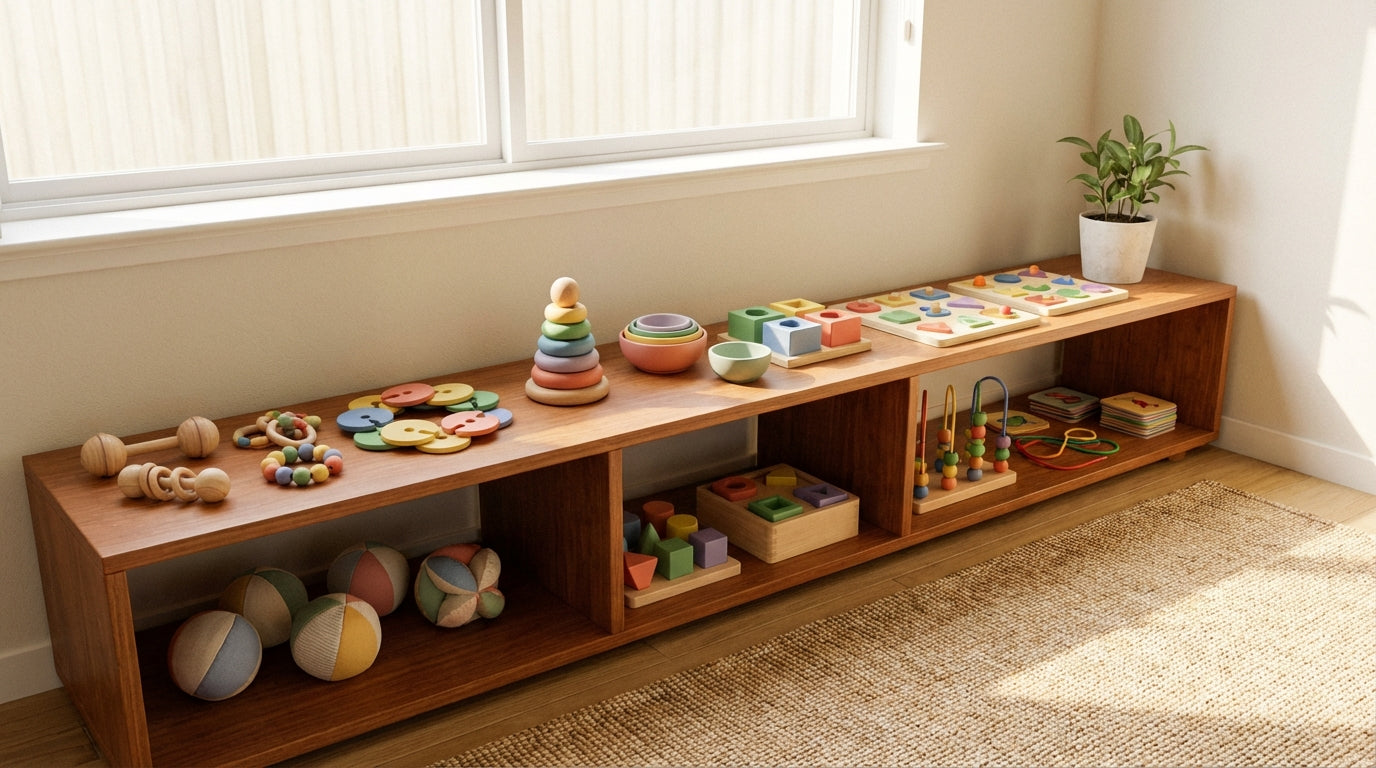
A prepared environment is set up so that children can act independently. Concretely, that means materials are within reach, complete and have fixed places – so children can start and tidy up again without you having to serve as a human crane. According to the Montessori-Campus Dietzenbach, the prepared environment and free work are among the central elements of Montessori education.
Montessori toys aren't automatically “Montessori” just because they're called that. A pretty rainbow can be wonderful – but it isn't necessarily the right material for your child. Conversely, an ordinary kitchen utensil (measuring cup, small bowl, spoon) can be exactly right if it suits your child's stage of development.
If you'd like to click your way through ideas, a good overview helps. You'll find our matching collection page here: Montessori. We're a family business from Hamburg, we've been doing this for 66 years – and we've learned in everyday life: less stuff, more calm. (And yes, that goes for adults too.)
Montessori Materials for Nursery (0–3): Few, Safe, Repeatable
In the nursery years, what matters most is grasping, sorting, stacking and pouring. Children under 3 love repetition – not because they can't think of anything else, but because it helps them consolidate skills. For you, that means: better to have a few materials that do one thing really well than a jumble that ends up just lying around.
Good nursery materials are big enough and have no detachable small parts. According to the Bavarian Consumer Portal (referring to DIN EN 71-1), parts are considered “swallowable” if they fit into a test cylinder with a diameter of 31.7 mm; toys for children under 3 must not contain detachable small parts. In addition, LAVES Lower Saxony explains how toys are tested for swallowable small parts.
Safety note: For children under 36 months, no detachable small parts that fit into the test cylinder (Ø 31.7 mm); this is a key point of DIN EN 71-1 (see Bavarian Consumer Portal).
Montessori materials for the nursery years: these everyday ideas often work right away at home.
- Pouring station: 2 bowls + a large spoon/scoop; as filling, for example, large pasta or felt balls (depending on age and with supervision).
- Stacking & nesting: stackable cups, large rings, sturdy tins.
- “Open and close” without tiny parts: large screw lids, tins, simple twist closures (with supervision).
- First sorting: one basket for “cars”, one basket for “balls” – and the system is done.
Practical tip: Put out only 6–10 things where your child can see them. The rest goes into a “for later” box – that's not deprivation, it's noise protection for the mind.
Montessori Materials in Everyday Life: How to Set Them Up (Without Remodeling)
The best Montessori corner is one you can manage even on tired days. You don't need a Pinterest-perfect room. You need a spot that can be “closed” again: a small shelf, a sideboard compartment or a rolling cart. When you tidy up in the evening with one eye open, it should still work.

Here's how it works step by step in 20 minutes:
- Choose a spot: where you really spend your time (the living room beats the children's room).
- One basket/tray per activity: this helps at the start and at the end.
- Few materials: 6–10 visible options, suited to your child's age.
- Clear places: every item has a home; that's half the battle.
- Rotation: swap every 1–2 weeks once something is “done.”
Polarization of attention means: children dive in freely and for a long time. According to the Montessori-Campus Dietzenbach, this is how Montessori describes that state of being absorbed in a self-chosen activity. The best way to support it at home is not to keep offering “something else,” but to leave room.
DIY: Making Your Own Montessori Material – the Pouring Tray
A pouring tray is a simple Montessori material that gets used right away. It costs little, is quick to put together and suits both nursery and preschool age – depending on what you fill it with and which tool (spoon, scoop, tongs) you add.
All you need are things that many families already have at home.
- 1 tray (non-slip is nice, but it doesn't have to be fancy)
- 2 small bowls (sturdy, not too light)
- 1 tool: large spoon, scoop or tongs
- Filling material: e.g. felt balls, large pasta, large pom-poms (always age-appropriate)
- Optional: a small cloth for “wiping up by myself”
Here's how to set it up – in 3 minutes:
- Bowls on the left and right of the tray: one “full,” one “empty.”
- Add the tool: spoon/scoop/tongs goes in the middle.
- A short invitation instead of an explanation: “Would you like to spoon this over?” – done.
Practical tip: Put a small cloth next to it and just say: “If something spills, you can wipe it up.” That saves you 30 reminders.
Safety note: Always choose filling material that is age-appropriate and can't be swallowed; for children under 3, please be especially strict when sorting out what's suitable.
What Is Montessori Play Material? Short and Practical
Montessori toys are play materials that let a child practice one skill clearly and on its own. “On its own” means: not lights, music and five functions – but one task that can be understood and repeated. That makes it easier for children to stay with it.
A good Montessori toy doesn't reward with effects, but with ability. The child realizes: “I can do this.” And yes, that's sometimes less spectacular – but often interesting for much longer.
If you want to browse with purpose, a sorted collection helps more than wild scrolling. In the Montessori Shop you'll find categories bundled together. As we say in northern Germany: clear beats overexcited.
Montessori Materials for Preschool (3–6): More Everyday Life, More Fine Motor Skills
In preschool age, Montessori materials often become more “practical” and more precise. Many children then want to cut, pour, button, sort, count – and above all: do it themselves. You don't have to turn your household into a learning workshop. A small, child-friendly set is enough.
Typical ideas for preschoolers are tasks with a real result.
- Practical life: cutting fruit (with supervision), setting the table, watering plants, small wiping tasks.
- Fine motor skills: screwing, fasteners, threading, tweezers/tongs tasks.
- Order & sorting: sorting by color/shape/size, small “assignments” around the house.
For cutting, a child-friendly knife can be helpful if the rules are clear. If that's a topic for you right now, you'll find a suitable selection under Montessori knives (please always work with supervision and in a calm spot).
Montessori Preschool: How to Recognize Good Programs
A Montessori preschool isn't about “more material” but about more independence throughout the day. Good settings rely on free work and real everyday tasks: setting the table, watering, tidying up, helping. You often notice it as soon as you walk in: children move confidently, know where things are, and adults act more as companions than as constant instructors.
Montessori preschool programs are strong when free work really takes place. When you visit, don't hesitate to ask specifically: “What does a typical morning look like?” and “How much free work is there?” The Montessori-Campus Dietzenbach describes free work as a central building block – not as “if there's time left.”
A good sign is when materials are within reach, complete and well cared for. Not as decoration, but as working tools. And when a child fetches something, uses it and puts it away again without anyone having to say “Do it now!”: then a lot is going right.
What to Look for When Buying: A Complete Checklist for Montessori Materials
When buying, it's not the label that counts, but whether your child can use it independently. This checklist is written the way you can really use it in a store (or online).

- The right size: Can your child grasp, carry and set it down – without everything tipping over?
- One clear task: Can you see “by itself” what to do (without 10 explanations)?
- Control of error: Does the child notice on their own when something doesn't fit (e.g. a shape fits only one way)?
- Sturdy materials: wood, stable plastics, metal – depending on use and age.
- Surfaces & workmanship: No sharp edges, no splinters, nothing that chips off easily.
- Safety by age: Under 3: no detachable small parts; the test cylinder and testing principles give guidance (see Bavarian Consumer Portal and LAVES Lower Saxony).
- Cleaning: Can it be wiped or washed without immediately looking “sad”?
- Smell & coating: If something smells strongly or is sticky: better leave it on the shelf.
- Everyday suitability: Does it fit your shelf, your routines, your nerves?
- Less is more: Better 1 good piece than 5 mediocre ones.
CE is a minimum standard, but not a quality seal for “educationally valuable.” The CE marking is linked to the EU Toy Safety Directive 2009/48/EC; it is meant to show that basic safety requirements are met. For you, that means: CE is mandatory – and your own check (size, workmanship, everyday use) is still worth its weight in gold.
Material Transparency & Safety: How We Think as Parents (and as bieco)
Good Montessori material feels honest: sturdy, easy to understand, without frills. Ulli & Flo write here as parents for parents – and yes, we look at toys very closely, because children aren't “careful,” they're thorough. At bieco we don't talk about safety in a whisper: materials, workmanship and age-appropriate use belong out in the open.
If you're unsure, one simple question helps: Would I leave this in the room unsupervised? If the answer is “Hmm… probably not,” the material may be better for time together – or not yet the right moment. That's not failure, that's good timing.
Ideas by Area: How to Build a Small Montessori World (Without a Museum)
With four areas, you already cover a surprising amount at home. You don't have to do everything at once – pick the area that fits your everyday life right now.
1) Practical Life (Nursery to Preschool)
Practical life means everyday tasks that children can practice independently. This includes pouring, wiping, scooping, getting dressed, sorting. If you have a child who constantly wants to “help”: congratulations – that's exactly this area. And yes, it won't always be tidy. But eventually it will be good.
2) Sensorial Materials
Sensorial materials make differences tangible: rough/smooth, heavy/light, big/small. That can be a sorting game, but also a touch bag with familiar objects. The main thing: not too much at once, otherwise it turns into a funfair again.
3) Language & Books
Books fit well when they invite naming, pointing and thinking along. Clear pictures, little clutter, real words. If you'd like to browse: Montessori books gather ideas around reading aloud and discovering.
4) Movement & Grasping (Baby Time)
In the baby months, a mobile can be a calm stimulus if it hangs safely. What matters: securely fastened, out of reach, and not as a constant fireworks show. If you're interested: Montessori Mobile is the matching category.
Safety note: Always hang mobiles so that the baby cannot reach into them or get tangled; as soon as grasping/pulling becomes possible, check again or take it down.
FAQ
What are Montessori materials in one sentence?
Montessori materials are things that children can use independently and with concentration. They are uncluttered, suit the child's stage of development and help the child notice mistakes on their own. At home, a small selection that you rotate regularly is often enough, rather than a full playroom.
Which Montessori nursery materials make sense for 1–2-year-olds?
For 1–2-year-olds, pouring, stacking and simple sorting tasks work best. Choose large, easy-to-grasp pieces without detachable small parts. Two bowls, a large spoon and a few felt balls can do more in everyday life than complicated toys.
Montessori nursery materials: How much do you really need?
Usually 6–10 visible materials are completely enough. The rest is put away and swapped in later. This reduces sensory overload and makes it easier for your child to really get into doing – instead of switching every minute.
Montessori materials for preschool: What suits children from 3 years?
From 3, tasks with a real result, like pouring, cutting or buttoning, are a good fit. What matters is that your child can handle things independently and that you have clear rules (especially around water and kitchen tasks). A small, fixed selection on the shelf often works better than constantly adding something new.
How do I recognize a good Montessori preschool?
A good Montessori preschool has real free work and tasks close to everyday life. Ask about the daily schedule and see whether materials are within reach and complete. If children are visibly allowed to set the table, water plants and tidy up themselves while adults mainly accompany them, that's a very good sign.
What should I look for when buying Montessori toys?
Look for safety, one clear task and the right size for your child. For under 3, detachable small parts are taboo; testing information on swallowable parts, e.g. from the Bavarian Consumer Portal and LAVES Lower Saxony, offers guidance. Also: sturdy, easy to clean and not overloaded.
If you're feeling inspired now: start small and stay relaxed but consistent. Pick 1–2 materials, set up a fixed place and rotate rather than constantly buying more. If you'd like to browse, take a look at the Montessori overview or – for little hands in the “screwing, sliding, buttons” phase – the Montessori Activity Board. As a Hamburg family business (for 66 years now), we remain fans of honest things that stand up to everyday life.