Montessori Sensory Toys: 6 Calm Play Ideas for Home
At a glance
- Montessori sensory toys: clear, calm materials for focused discovery.
- Sensory toys work best with one focus per activity.
- 6 everyday play ideas: pouring, finding pairs, sound, textures, posting, sorting.
- Safety first: age recommendation, warnings, sturdy parts, no small parts.
- Fewer choices often help more than a full toy shelf.

Montessori sensory toys are most helpful when they are simple and your child gets to try things out on their own. You offer one material that speaks to one sense in particular (seeing, feeling, hearing …) and then your child can explore, repeat and sort in peace. In this guide you'll find a practical overview (no jargon), a simple safety checklist and six play ideas for at home. All of it is designed to fit into real family life, including the days when getting dressed is already an Olympic event.

Ulli & Flo
Owners of bieco · Hamburg · parents themselves
In our home, Montessori sensory activities work best when they're simple: one focus, little material, lots of calm. And if it only lasts three minutes, we'll take it. Feel free to browse our sensory toys collection.
What are Montessori sensory toys?
Montessori sensory toys are simple materials that engage one sense in a targeted way. Instead of non-stop entertainment, there is one clear task: matching, comparing, posting, pouring, sorting. Your child gets to notice differences, without a song playing and a light flashing at the same time.

“Sensory” means: children learn through seeing, feeling, hearing, smelling and tasting. That's not schoolwork, it's everyday life: How heavy is this? How smooth is that? Do these sound the same? These sensory impressions are the foundation for later thinking and doing, and you don't have to give a lecture to make it happen.
Montessori sensory play means: one material, one feature, and your child works at their own pace. This idea, consciously telling apart single properties such as color, shape, weight or sound, is typical of the sensorial area in Montessori settings (examples and goals are described by Montessori School House, among others: Sensorial Materials).
How do Montessori toys work in everyday life?
Montessori toys work because they reduce stimulation and make independence possible. You don't have to guide constantly; you simply prepare the setting. And then something lovely happens: many children stay with it longer because they aren't pulled away by the next button, zap, the next distraction.
- Clear task: The material practically “tells” what to do (e.g. shape fits into hole).
- One focus: Only color or only size, not everything at once.
- Repetition is welcome: Doing the same thing 20 times is not a step backwards, it's practice.
“Control of error” means: the material gives feedback without an adult. In practice that means: it fits or it doesn't, and your child notices on their own. Control of error is a built-in self-check that can make children more independent.
Practical tip: Put out only 1 material at a time. The rest goes into a box and gets rotated. Fewer choices often means more calm.
Which senses does Montessori sensory play engage?
Montessori sensory play mainly engages seeing, feeling and hearing, depending on the material. Smelling and tasting do play a role in everyday life (e.g. when cooking), but with play materials the rule is: better to keep it simple and safe.

- Seeing: telling colors apart, grading sizes, matching shapes.
- Feeling (tactile perception): rough/smooth, soft/firm, textured/flat.
- Hearing: comparing sounds (same/different, quieter/louder).
The point is not “more stimulation” but “easier to tell apart”. That's exactly why Montessori-style sensory toys fit so well into family life: they tend to calm rather than rev up, and that's almost a hobby for parents.
How can I recognize good Montessori sensory toys?
Good Montessori-style sensory toys are easy to take in, sturdy and feel “real”. You don't need certification bingo, but a few points help you judge, whether you're buying yourself or receiving something as a gift.

- Few parts: Your child quickly sees what to do.
- Materials with character: wood, fabric, silicone, ideally with a noticeable texture.
- Usable alone: Turning, posting and sorting work without constant help.
- Low stimulation: no constant jingles, no flashing-light storm.
- Transparent safety: clear age information, warnings, easy-to-follow details.
In the EU, toy safety requirements are described, among other things, in the Toy Safety Directive. According to DIN, there is information on Directive 2009/48/EC and its implementation, including references to standards (DIN: Information on the Toy Safety Directive).
Safety note: For children under 3, small parts that can be swallowed are a no-go. Follow the age recommendation and warnings, and keep younger siblings in the same room in mind.
Montessori sensory play in everyday life: 6 play ideas without the fuss
You don't need a “perfect Montessori room”; a quiet spot at the table is enough. The following ideas are deliberately simple: one focus, little material, lots of repetition. If your child loses interest after three minutes: that's fine too. This is not the world championship in sitting still.

1) Pouring & transferring (feeling + coordination)
Transferring is sensory play without a toy, and surprisingly popular. You need two bowls and a transferring tool: a spoon, a small cup or a funnel. Depending on age, good fillings are, for example, large pasta or large pom-poms (no small parts for the little ones).
- How it works: Bowl A full, bowl B empty. Your child transfers at their own pace.
- One focus: just “from A to B”, no sorting on the side.
- Variation: a different tool (tongs instead of a spoon) or a different material (soft/hard).
Practical tip: Put a tray or a tea towel underneath. That saves you the big crumb expedition afterwards.
2) “Find the matching things” (seeing)
Finding pairs trains close looking, without it feeling like training. Take 6 pairs of identical objects: wooden rings, fabric scraps, identical lids, whatever you have on hand. Lay everything out mixed up and let your child put the pairs together.
- How to start: first 3 pairs, then build up.
- One focus: only “same/different”, no extra rules.
- Control of error: Two pieces visibly fit together, and your child notices on their own.
3) Sound pairs (hearing)
Sound pairs are Montessori sensory play at its purest: listen, compare, match. You need 3 pairs of small, sturdy tins or containers that really close securely. Fill each pair identically (e.g. rice, lentils, small pasta). Then shake and match.
- How it works: Show one pair first, then let your child search.
- One focus: only sound, not color or shape.
- Variation: “loud/quiet” or “same/different” (with one “wrong” container).
Safety note: Containers must be firmly closed and sturdy. If something comes loose or cracks, better to get rid of it.
4) Texture trail (feeling)
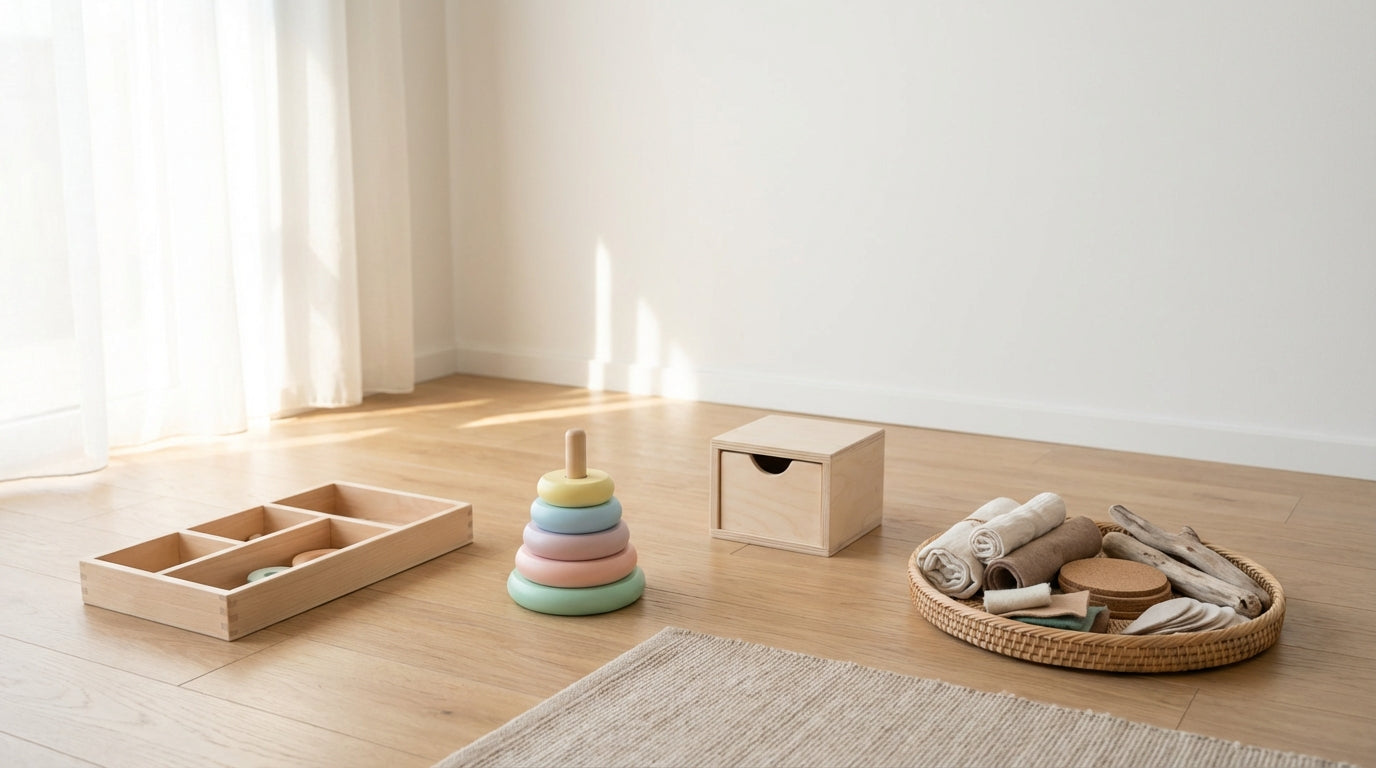
A texture trail makes differences tangible, without many words. Collect 5 pieces of fabric or materials with a clear structure: terry cloth, felt, cotton, corduroy, a piece of jute (only if it isn't scratchy or fraying). Lay them out in a row.
- How it works: Your child runs their hand over them and orders them “soft – less soft – scratchy”.
- One focus: only surface, no color sorting at the same time.
- Variation: Close the eyes and “guess” which piece it is.
Tactile perception is the ability to tell surfaces and shapes apart through touch. In everyday life it helps, for example, with getting dressed (grabbing socks correctly) or crafting (using the right amount of glue), without it ever being called “practice”.
5) Posting shapes (seeing + hand skills)
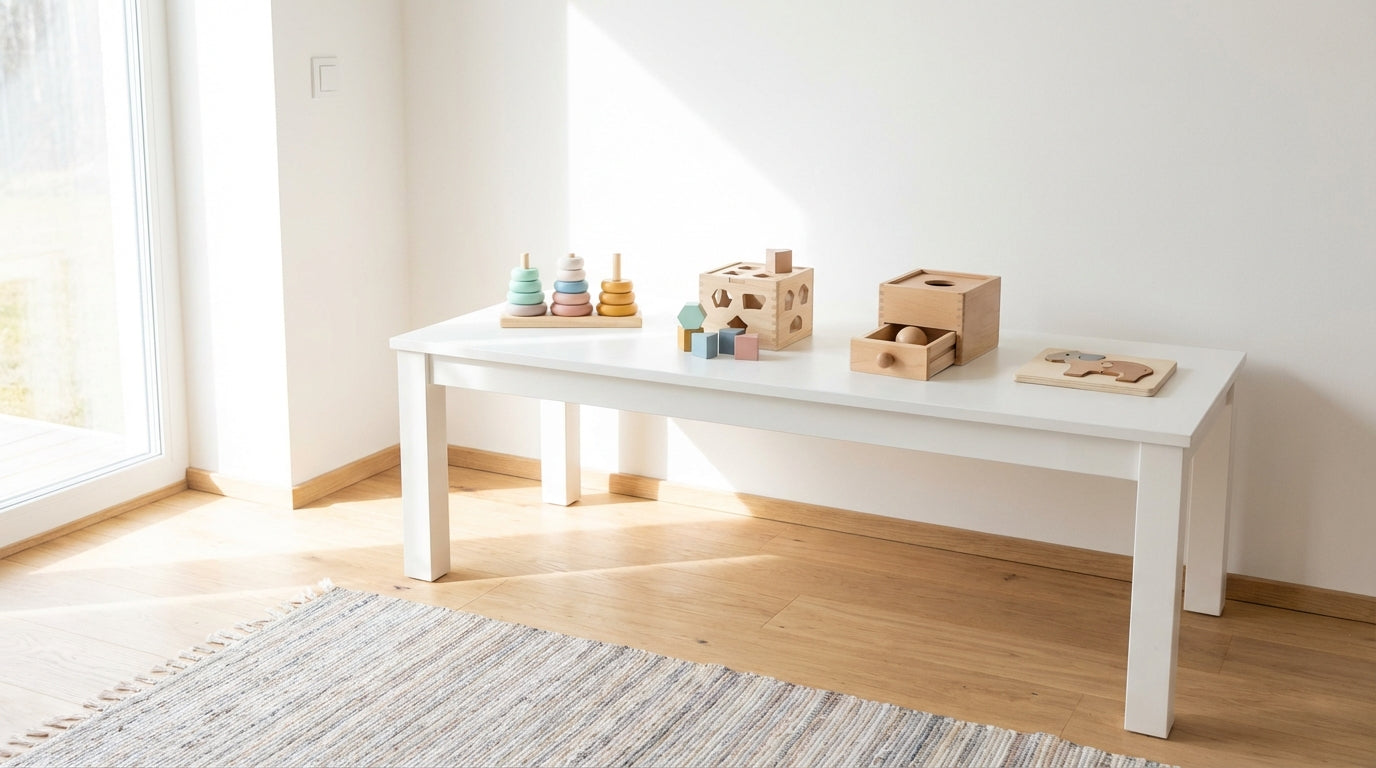
Posting games are a classic because the task is crystal clear. One shape, one hole, and your child tries, turns, starts again. That fits Montessori sensory play wonderfully because the feedback is immediate: it fits or it doesn't.
- How it works: 2 shapes are enough to start. More can come later.
- One focus: only shapes, don't try to teach colors at the same time.
- If frustration comes up: take a short break, don't take over. Often it works on the next try.
If you're looking for something suitable, take a look at the BIECO collection for motor skills toys. We're a family business from Hamburg and have been doing this for 66 years, and yes, we know: a toy has to work in real life, not just in the photo.
6) Sorting by one feature (Montessori sensory play)
Sorting by one feature is Montessori sensory play in its purest form. Take, for example, 10 items and let your child sort only by color or only by size. That sounds simple, but for little heads it's real thinking work, and it still feels like play.
- How it works: Two bowls: “red” and “not red” (or “big” and “small”).
- One focus: stick to exactly one criterion.
- Variation: later three categories (red/yellow/blue), but only once two work reliably.
If you're looking for inspiration, the sensory toys hub is a calm place to start. You can look at what suits your daily life in peace, without wading through 100 tabs.
How much Montessori makes sense, and when is it too much?
Montessori makes sense when it relieves you, not when it stresses you out. Your child doesn't have to play in a “Montessori-compliant” way. Role play, silliness, pillow forts: all allowed. Montessori sensory play is an offer, not a rulebook.
A good rule of thumb: short, calm phases rather than a fully planned program. Concentration tends to develop when you aren't constantly adding more. Sometimes it's enough to set the material out and sit down next to it with a coffee, present but not acting as the entertainer.
And if it doesn't work at all: that's rarely because of the material, often because of the day. Tired, hungry, teething, visitors, life. You know how it is. Tomorrow is another day for Montessori sensory play.
Safety & transparency: what we (and you) should look out for
Safe play material is sturdy, labeled with an appropriate age and clearly described. Especially with sensory toys, which like to end up in little mouths, clear information is worth its weight in gold.
The BfR explains that EU requirements and standards also cover chemical requirements and testing methods for toys. According to the German Federal Institute for Risk Assessment, you can find information for parents in the overview “Health assessment of toys” (BfR).
In practice at home: regularly check quickly whether anything is loose, cracked or worn. It takes 20 seconds and, if in doubt, saves you trouble. (And yes: we parents always find every single piece lying barefoot in the hallway at night. Sadly.)
FAQ
From what age do Montessori sensory toys make sense?
Montessori sensory toys already make sense in babyhood if they are large, safe and simple. Feeling, grasping and cause and effect are exciting early on. As children get older, matching, sorting and posting become more interesting. What always matters: the age recommendation, warnings and no swallowable small parts.
What is the difference between sensory toys and Montessori sensory toys?
Sensory toys engage the senses; Montessori sensory toys deliberately reduce things to one focus. With Montessori-oriented materials, it's often about telling things apart (e.g. only size or only sound) and about independence. Sensory toys in general can also be more colorful and varied, while Montessori sensory play is usually calmer.
How can I tell whether Montessori-style sensory toys are really safe?
You can recognize safety by clear age information, warnings and sturdy workmanship. Make sure nothing can easily break off or come loose. According to the BfR, EU requirements and standards also cover chemical requirements and testing methods for toys (BfR).
How long should a child play with a Montessori material?
As long as they stay focused, which can be 2 minutes or 20. Montessori sensory play thrives on repetition, but not on pressure. If your child walks away, that's not failure but a signal: a break, hunger, tiredness, or simply not the day for sorting. Tomorrow you can continue.
Is less toys really better for Montessori sensory play?
Often yes, because fewer choices help many children stay with something longer. Montessori-oriented doesn't mean “bare”, it means “orderly”. When 1 material is visible, the task is clearer and you have to moderate less. The rest can rotate, which is easier on your nerves too.
Can I make Montessori sensory toys myself?
Yes, many Montessori-style sensory ideas work with household materials, as long as they are sturdy and safe. Transferring, feeling textures or finding pairs often works without buying anything. What matters: one focus per activity, no small parts for little children, and always close containers really tightly.
If you'd like more inspiration, BIECO offers a calm selection of sensory toys. Feel free to visit the sensory toys hub or browse the teethers and grasping toys, simply as a treasure trove of ideas, with no stress and no “you must”.