Attaching a Stroller Chain: Fit It Safely, Check the Length, Avoid Mistakes
At a glance
- Attaching a stroller chain: up high on the side of the canopy or frame, never on the harness.
- As short as possible, as long as necessary – the main thing is taut, with no loops.
- Before every ride: quickly check clip fit, sagging and pinch points.
- Typical mistakes: too low, too loose, on fabric edges, caught when folding the stroller.
- If your child pulls or wriggles a lot: attach it higher or take it off for a while.

A stroller chain sits most safely up high on the side of the canopy or on the frame, pulled taut with no sagging. That is exactly what we will look at here, nice and calmly: the best attachment points, a simple “click-click” method without fiddling, the right length (no tape-measure panic) and two checklists you can get through with a coffee in your hand. For parents, grandparents and everyone who loves to give gifts – and still wants the thing not to hang crooked after 30 seconds.

Ulli & Flo
Owners of bieco · Hamburg · parents themselves
We’ve experienced it often enough ourselves: everything is fine outside – until the chain suddenly hangs crooked. With the checks here, it quickly sits properly again, without a big fuss. Feel free to browse our stroller chain collection.
Where do you attach a stroller chain?
Ideally you want two sturdy points on the left and right, at the same height if possible. In practice, these spots work most often:

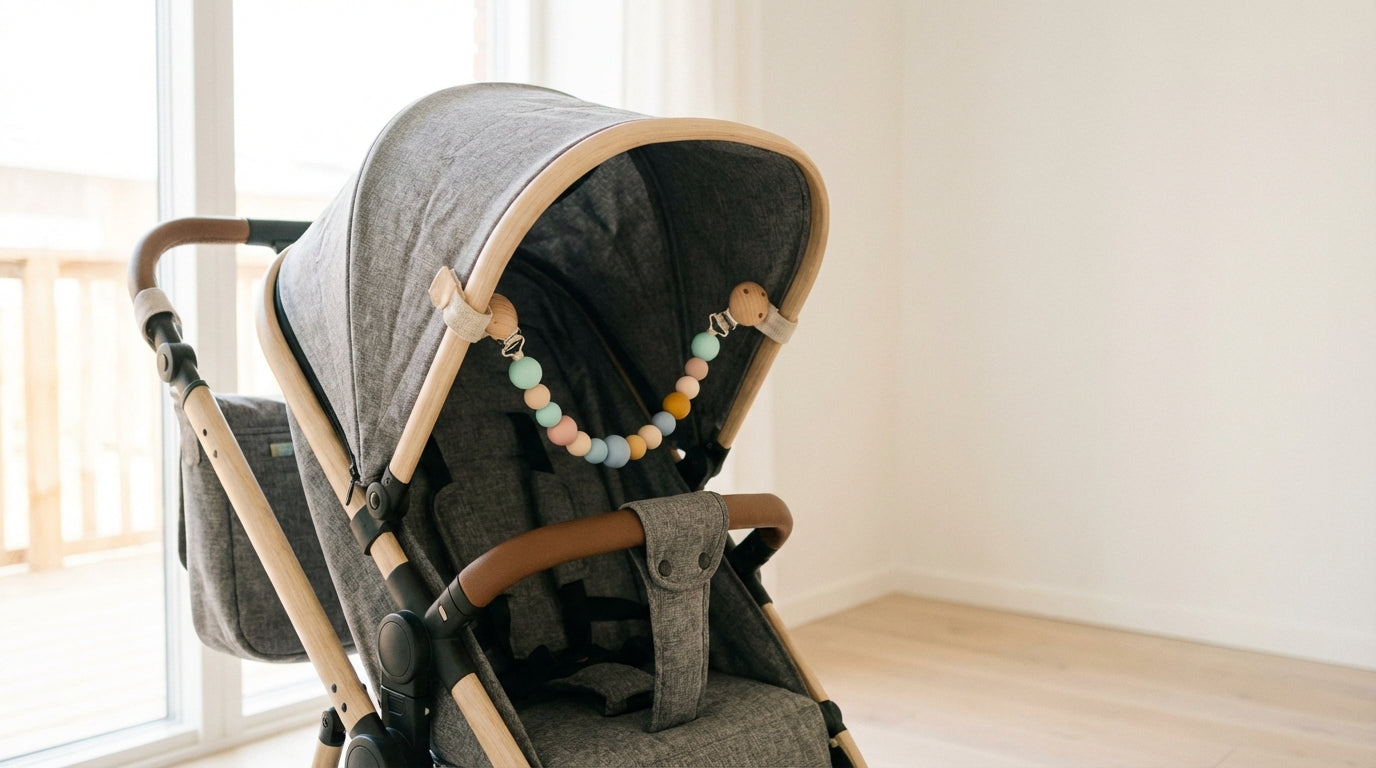
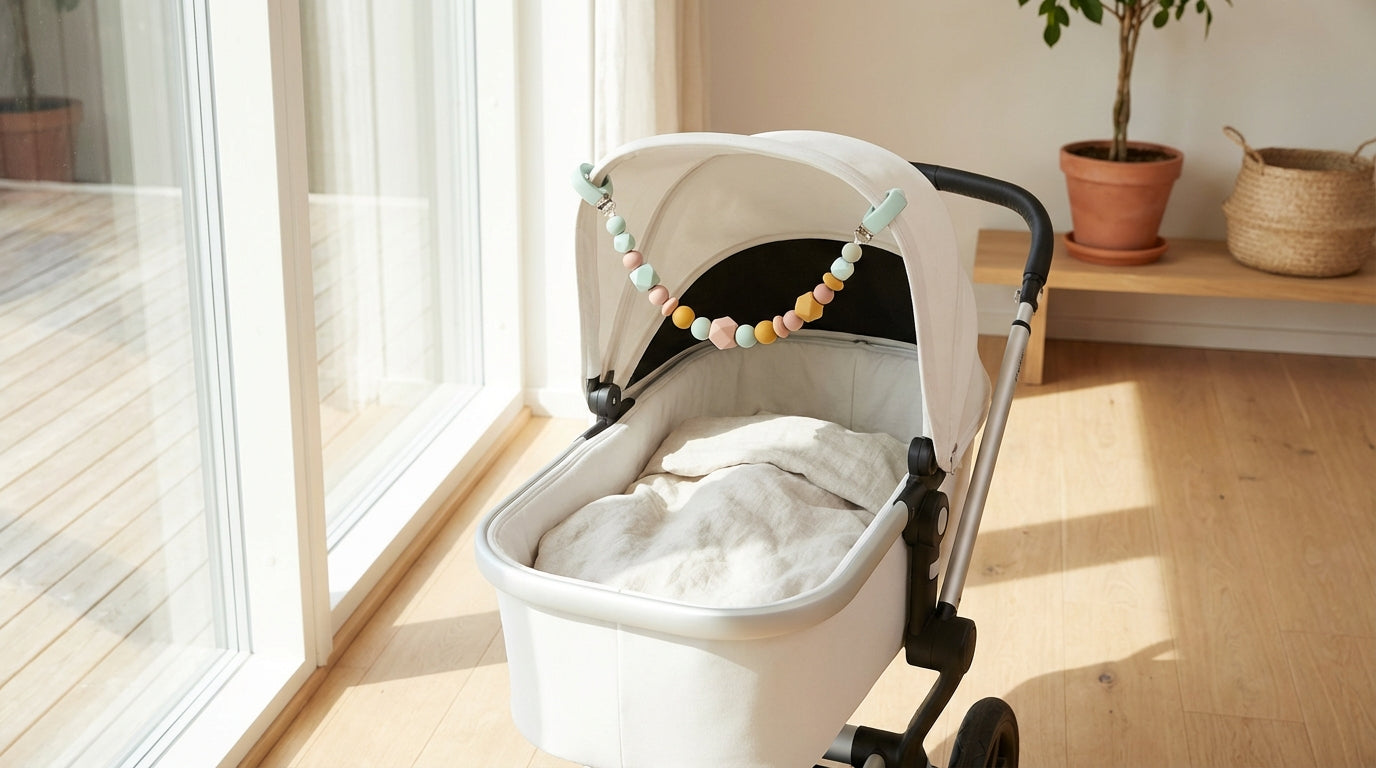
- On the canopy (hood): at the side on a firm edge, loop or reinforcement, so the chain lies across the seat/carrycot.
- On the frame: on the upper side tubes/crossbars – clips tend to slip least there.
- On fixed eyelets/loops: if your stroller has attachment points for this, use them – they’re made for it.
Avoid anything soft, loose or “fabric only” – it likes to slip. That includes fabric edges, covers, flapping tabs or spots that get squeezed when the stroller is folded.
A stroller chain is simply a toy with two clips for the stroller. The benefit is very down-to-earth: baby has something to look at and grab, and you get a few more minutes of fewer “What is going on now?” moments.
Practical tip: Only attach the chain once your baby is already lying or sitting in the stroller. Then you can see right away whether anything slips toward their face.
How do you fasten a stroller chain (so it doesn’t keep slipping)?
It holds best when both clips sit symmetrically and at the same height. Here is how to do it step by step:

- Choose attachment points: find one stable point on each side (canopy edge, frame bar, fixed loop).
- Attach the first clip: open the clip fully, place it around the point, let it snap in.
- Align the chain: pull it smooth once (no twists, no knots).
- Attach the second clip: at the same height as the first, so nothing hangs crooked.
- Mini pull test: tug lightly. If a clip slips right away: you need a different point or a different clip size.
In the carrycot, the rule is: better up on the rim than down on the lining. Down low, hands and feet reach it faster – and then “Oh, how cute” quickly turns into “Oh, how hard can they pull on that?”.
Safety note: Do not attach stroller chains to harnesses, straps or loose parts – things can get caught more easily there.
Which length is right – and how to tell without a tape measure
“Right” is a length where the chain lies taut and forms no loops. The exact number of centimeters depends on the stroller and the attachment point – that is why the fit matters more than the number.

- Good fit: The chain stays across the spot where baby looks/grabs, without dangling downward.
- Too long: It sags, forms an arc or slides toward the face at the first jolt.
- Too short: The clips are under tension or can only be closed with force (that often ends in a “pop”).
A loop is a sagging circle of ribbon or chain. In practice that means: if you see a “ring” anywhere that could get bigger, it’s time to go higher/tighter.
Standards & notes: what you really need to know
In the EU, toys are subject to safety requirements that manufacturers must meet. According to the EU Toy Safety Directive (2009/48/EC), toys must be designed so that they do not endanger children’s safety and health.
The well-known 22 cm rule is often mentioned for pacifier clips, not across the board for stroller chains. For stroller chains, what matters in everyday life is that they are used appropriately: high enough, taut enough, checked regularly – and adjusted as your child becomes more mobile.
If you want to dig deeper: EN 71-1 describes mechanical requirements for toys. You can find a freely accessible overview of the standard series in the DIN Media/Beuth standards info on DIN EN 71-1 (standards listing/info).
Adjusting for carrycot, buggy & infant car seat: how it sits at every stage
The more upright your child sits, the higher the chain should hang. Three typical situations:
- Carrycot: attach it rather on the canopy or at upper frame points, so nothing hangs into the lying area.
- Sport seat/buggy: place it higher, because baby has more reach and pulls more actively.
- Infant car seat on frame: make sure nothing gets caught when clicking in and out (adapter, carry handle, joints).
When folding the stroller, taking the chain off is often the most relaxed option. That way nothing gets squeezed, nothing warps – and you don’t have to wonder later why a clip suddenly closes “strangely”.
Practical tip: Take a photo of the perfect position. Next time everything sits in 10 seconds – even in drizzle.
Wood, silicone, fabric & clips: materials for real everyday life
The best material is the one that suits your everyday life and care routine. A short, practical overview:
- Wood: feels pleasant and can usually be wiped well with a damp cloth; smooth surfaces without splinters are important.
- Silicone: often grippy and easy to wipe clean; look for clean workmanship with no sharp edges at the transitions.
- Fabric elements: can be exciting (crinkling, feeling), but depending on the material need more care and dry more slowly.
- Clips: must close securely and fit the attachment point (too thick/too thin = slips or jams).
You can recognize good workmanship by the fact that nothing is sharp-edged and nothing wobbles. If you spot a loose bead, a crack or a clip with a flaw anywhere: better to sort it out consistently – babies are brutally honest about that.
Cleaning & care: quickly clean, quickly ready to go again
Usually this is enough: wipe with a damp cloth and then let it dry well. That takes you surprisingly far in everyday life:
- Wood: do not soak, just wipe damp and let it dry completely.
- Silicone: wipe damp; if needed, use mild dish soap and wipe off thoroughly.
- Fabric: if possible, clean according to the care label; gentle is better than “one hot wash and done”.
Important: After cleaning, briefly check all connections and the clip. Sometimes you only notice after drying that something has loosened.
Common mistakes when attaching a stroller chain
Most mishaps come from “too low”, “too loose” or “attached to the wrong part”. Here are the classics – and the quick fix:
- Too much sag: slides toward the face → attach higher or tension more tightly.
- Clipped to a fabric edge: the clip wanders → switch to frame/reinforcement/eyelet.
- Attached crooked: one side higher → set both sides to the same height.
- Too many pendants attached: more weight, more wriggling → better fewer, but well placed.
- Forgotten when folding: gets squeezed → take it off before folding.
If you have to choose between “pretty” and “practical”: go for practical. Your child will find it exciting anyway – and you keep your nerves (more or less).
Safety check before every ride
A 10-second check prevents 90% of the “Why is that hanging like that now?” moments. Just take a quick look:
- Clips: are both firmly seated and completely snapped in?
- Height: does the chain hang above the face area?
- Sagging: does a loop or a large arc form anywhere?
- Pinch points: is anything lying in a joint or where you are about to fold the stroller?
- Condition: cracks, loose parts, stretched-out cords? Then take it off.
Why we at bieco are so picky about this topic
We are a family business from Hamburg – and we think in terms of children’s hands. We have been doing this for 66 years and know: in everyday life it’s not only about something being pretty, but about it being cleanly made and something you can rely on.
Transparency is part of it: materials, notes and testing info should be easy to follow. When you browse with us, you will find details on standards/testing and clear usage instructions for many items – without the waffle, because parenting life is complicated enough.
Finally: a small checklist – and then off you go outside
If the chain sits up high, taut and symmetrical, you’re in the green. Take two minutes once for the basic setup, and then it mostly runs on its own:

- Attach at the side, up high (canopy/frame), not on harnesses.
- Both clips at the same height, quick pull test.
- No sagging, no loops.
- 10-second check before every ride.
If you are looking for a suitable one, you will find a selection of stroller chains to browse with us. Feel free to take a look at the stroller chain overview or go straight to wooden versions and personalized stroller chains (we could all use gifts – at least the easy ones).
FAQ
Is it okay to attach stroller chains to the harness?
Better not, because harnesses and straps are movable and things can get caught in them more easily. Use stable points on the canopy or frame instead. That way the chain stays where it belongs and doesn’t slide down with every movement. Then give it a quick tug: if it sits firmly, you’re good.
How high should a stroller chain hang in a buggy?
High enough that it is within view, but cannot hang toward the face. In a buggy, children are often more active and lean farther forward – so it’s better to attach it a bit higher than in a carrycot. If you see a loop or the chain sags a lot when pulled: attach it higher or tighter.
What do I do if the clips keep slipping off?
Then the attachment point is usually too soft, too thick or too smooth. Switch from a fabric edge to a frame bar or a fixed loop. Make sure the clip snaps in completely and doesn’t sit at an angle. If it still slips: rather than “hoping it holds”, choose a different position.
When should you take a stroller chain off?
If your child becomes very mobile, pulls hard or turns around a lot, “attach higher or take it off” is often the best solution. In this phase their reach changes quickly – sometimes it feels like overnight. Then it’s worth rechecking the position or only using the chain briefly and under supervision.
What is the best way to clean a stroller chain?
Wiping with a damp cloth and letting it dry well is enough in many cases. Don’t soak wood, clean fabric only according to the care label, and rinse silicone mildly and wipe it down if needed. Afterwards, quickly check whether anything has loosened – especially at the clip or at the transitions.