Storage Box with Lid for Kids: Comparison, DIY & Buying Guide
At a glance
- Storage box with lid for kids: the best ones are easy to open and easy to carry.
- 32 liters is often the most relaxed size for everyday life in the nursery.
- For small items, small boxes plus clear labels (word or picture) really help.
- Lids should sit securely, but never make little fingers fight with them.
- DIY is quick: a sturdy box, smooth edges, big handles and simple labels.

A good storage box with a lid for kids is one your child can open and close all by themselves. That way, “tidying up” doesn’t turn into a full-blown family drama. Here you’ll find a practical decision guide: which box suits which purpose, which sizes make sense (15/32/40 liters), which materials hold up in everyday life – plus a simple DIY guide for when you need a quick solution.

Ulli & Flo
Owners of bieco · Hamburg · parents themselves
We’ve found that when kids can manage the lid on their own, tidying up works much better. And if not, at least everything is quickly put away again. Feel free to browse our Storage collection.
Editorial note
Tested in real family life: we look at lids, handles, edges and everyday practicality. Ulli & Flo (parents) – and at bieco in Hamburg we’ve been making children’s products for 66 years.
What really matters in a storage box with a lid for the nursery
In the nursery, the box that quickly disappears back onto the shelf wins. A lid is worth its weight in gold if you want to stack boxes or keep the contents dust-free. Three things are crucial: the lid has to open easily, the box has to take a beating, and it has to fit where it’s going to live (shelf, under the bed, in the corner).

A storage box is a container that sorts, protects and makes things portable. In the nursery, that means toys, craft supplies, books, dress-up clothes – and those “treasures” you must never, ever throw away.
Practical tip: Only one category per box (“cars”, “building blocks”, “drawing”). Mixed boxes reliably turn into rummage boxes.
Our test criteria: what fails in everyday life (and what doesn’t)
If kids can’t operate the box, you end up tidying up on your own again. That’s why these points matter more in daily life than “matches the wall color”:
- Lid handling: Can it be opened without effort? Does it sit securely without jamming?
- Handles: Grip recesses or sturdy handles are a blessing at 32/40 liters.
- Weight: A large box quickly gets too heavy once it’s full.
- Stackability: Practical, but only if the boxes don’t tip or slide.
- Cleaning: Wipe-clean isn’t a luxury in the nursery, it’s basic equipment.
- Interior: For small items, smaller boxes or inserts are better than “one big lake”.
Safety note: Watch out for pinch points on the lid and for sharp edges. Especially with chests, little fingers quickly end up where they shouldn’t.
Material comparison: plastic, fabric or wood – what suits your family?
The material determines whether a box is more robust, lightweight or furniture-like. There is no single “best” for everyone – but there is definitely a “best” for your daily life.

Plastic (e.g. PP/PE)
Plastic is often the most robust and the easiest to clean. It’s practical for building blocks, vehicles, sand toys or anything that might end up on the patio. If material transparency matters to you, take a look at the manufacturer’s information and any test notes.
REACH is an EU chemicals regulation that governs information on substances of very high concern. According to the European Chemicals Agency (ECHA), consumers can ask whether an article contains SVHC > 0.1%; the answer must be provided free of charge within 45 days (ECHA).
Fabric boxes / foldable boxes
Fabric boxes are light, quiet and perfect for shelves. They’re great if you use a storage shelf and want things to go fast: pull out, toss in, done. Downside: if kids sit on them or you want to put heavy things in, many fabric boxes lose their shape.
OEKO-TEX® STANDARD 100 is a testing system for textiles tested for harmful substances. According to OEKO-TEX®, textile components including accessories are tested for many potentially harmful substances (OEKO-TEX®).
Wood / wood fiber (crates, chests, shelves)
Wood looks calm, stands firmly and feels like a piece of furniture. That’s wonderful for fixed spots and “stays right here” storage. At the same time: wood can be heavy, and with chests the lid is issue number one.
Safety note: For chests with a lid: look for a lid damper or a safe guide mechanism so that nothing slams shut unchecked.
Size guide: 15, 32 or 40 liters – what suits what?
The liter figure describes the interior volume, not the outer dimensions. So measure the spot where the box will go (width/height/depth) and then compare the dimensions – don’t just read “15 L” and hope for the best.

Volume (liters) is the interior of a box; outer dimensions can differ significantly. This is especially important if the box has to fit on a shelf or under a bed.
15 liters: small items, crafts, figurines
15 liters is handy and ideal for things that would otherwise crumble all over the place. Typical contents are drawing and craft supplies, small figurines, puzzles or collectibles. If kids are supposed to sort things themselves, several small boxes are often better than one big one.
32 liters: the everyday all-rounder
32 liters is often big enough for toys and still manageable for a child to carry. Building blocks, vehicles, dress-up pieces – this works well in practice without lifting the box turning into strength training.
Practical tip: If your child is meant to carry the box: better two medium boxes than one huge one. Your back and your nerves will thank you.
40 liters: stuffed animals, blankets, “lots and fluffy”
40 liters is great for volume – but when full it quickly gets heavy. Perfect for stuffed animals, blankets or seasonal items. For small items, this size is often too big because it quickly turns into a rummage box.
Which storage box is the best? Our recommendations by purpose
The best solution depends on whether you want to stack, slide onto a shelf or tame small items. Here’s the short decision guide, the way we use it in everyday life:
| Best of | Recommendation | How to recognize it |
|---|---|---|
| Best for shelves | Lightweight box (often fabric) without a hard lid | Fits the compartment, slides out quietly, easy to label |
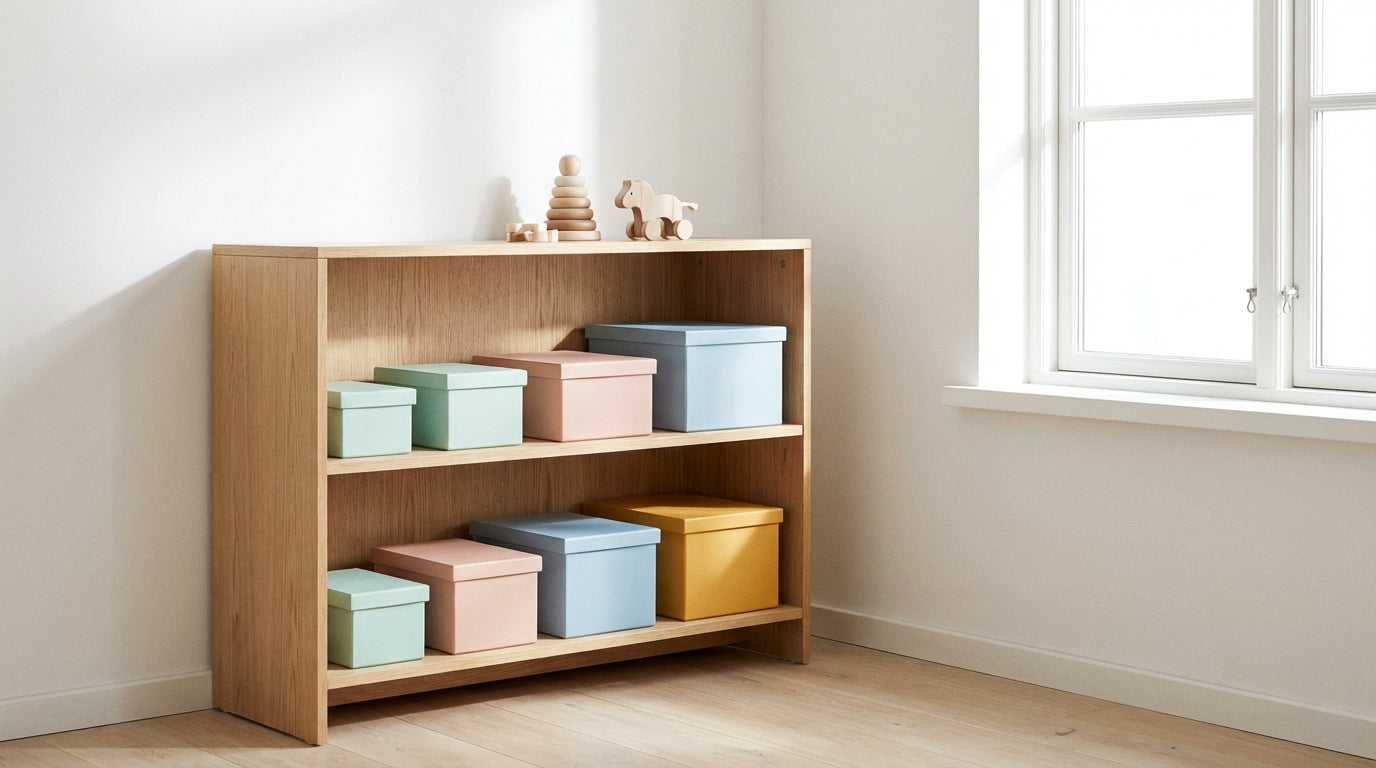
| Best for building blocks (e.g. Duplo) | Robust plastic box of around 32 liters | Sturdy grip recesses, lid sits securely, easy to wipe clean |
| Best for small items | Several small boxes (approx. 15 liters) instead of one big one | Less rummaging, quicker to put away again, contents stay easy to see |
| Best for stacking | Stackable box with a lid that really clicks into place | Doesn’t slip, doesn’t tip, lid can carry a second box |
| Best for “quick, away it goes” | Mix of an open basket + 1–2 boxes with lids | Speed in everyday life, dust protection for the rest |
If you only want to start with one size, usually go for 32 liters and stick with it. Uniform sizes stack better, look calmer and you don’t have to play Tetris every time.
DIY: make your own storage box (quick, sturdy, child-friendly)
A DIY box is a success when it has smooth edges and is easy to grip. You don’t need a crafting award, just a solid base and two or three clean steps.
Materials (easy to find)
- Base: sturdy cardboard box, wooden crate or firm cardboard
- Reinforcement: thick cardboard for the bottom/sides or a thin plywood sheet (optional)
- Surface: self-adhesive furniture film or firm fabric + suitable glue
- Handles: wide webbing straps (sewn or screwed on, depending on the material)
- Edges: edge protection tape or neatly folded-over film/fabric
- Labeling: label, picture or pictogram
Step by step
- Check stability: If it wobbles, reinforce the bottom and sides on the inside.
- Smooth the edges: Anything that pokes or is sharp gets sanded down or covered.
- Attach the handles: Better wide and sturdy than small and fiddly.
- Cover the surface: Pull film or fabric neatly around the edges so nothing frays.
- Build the lid: From firm cardboard/plywood, with a little overhang for gripping.
- Label it: One word or one picture – and your organizing helper is done.
Safety note: Don’t glue on any small decorative pieces that could come loose. If it can be picked off, it will be picked off.
DIY is especially worthwhile for light contents – for heavy items, tested boxes are often more reassuring. And “relaxed” is a very underrated quality in family life.
Nursery storage that lasts: 7 small rules that really help
Order lasts longer when kids can reach things without help and understand where everything belongs. It’s not magic, more a good habit plus a little patience.

- 1. Stack low, live high: Things used often go at the bottom, rarely used things at the top.
- 2. One spot per category: Cars live together, not “here and there”.
- 3. Label it: Word or picture – as long as it’s unmistakable.
- 4. Don’t choose too big: Large boxes love to become “everything goes in” boxes.
- 5. Tidy up without rearranging: Box out, items in, box back.
- 6. Rotation instead of excess: Put one part away, bring another out – it calms the room.
- 7. A buffer box: For the evening, when really nothing else works.
Matching solutions at bieco (short & practical)
If you want to save yourself the searching, start with a clear, simple basis. In our Storage collection you’ll find a variety of solutions for the nursery. For boxes with lids, take a look at Storage Box with Lid, for quick access check out the Storage Basket, and for larger “stays put” solutions visit the Toy Chest. We’re a family business from Hamburg and we’ve been doing this for 66 years.
FAQ
Are storage boxes with lids safe for kids?
Yes, if the lid is easy to operate and has no pinch points. Look for smooth edges, sturdy handles and a lid that doesn’t slam shut heavily. With chests, lid dampers or safe guide mechanisms are especially important so that little fingers don’t get caught.
How can I recognize a low-pollutant storage box?
Best by clear material information and traceable test notes. For textiles, OEKO-TEX® STANDARD 100 can provide guidance; according to OEKO-TEX®, components are tested for harmful substances (OEKO-TEX®). For articles in general, ECHA provides a right to information about SVHC > 0.1% (ECHA).
Should a storage box with a lid be stackable?
Stackable is practical if the boxes stand stably and don’t slip. Make sure the lid and base are shaped so that they interlock or rest securely. If kids do the stacking themselves, “tip-proof” matters more than “as tall as possible”.
Which size is best for kids: 15, 32 or 40 liters?
For everyday life, 32 liters is often the best compromise between space and portability. 15 liters is suited to small items, crafts and figurines because it stays easy to survey. 40 liters is great for stuffed animals and blankets, but gets heavy quickly when full and often ends up as a rummage box for small items.
Transparent or opaque – which is better in the nursery?
Transparent is often easier because kids can see right away what’s inside. Opaque looks calmer in the room, but needs clear labeling (word or picture). Many families do well with a mix: transparent for everyday toys, opaque for rarely used items.
How do I stop lids from disappearing or constantly being in the way?
Best with fixed “lid parking spots” or boxes whose lids stay attached. If lids are loose, a spot behind the shelf or on top of the wardrobe just for lids helps. Alternatively, boxes with a firmly attached lid work better if kids are meant to tidy up independently.
If you want to get started now: begin with two or three boxes in one size and stick with it for a while. For a quick overview, you’ll find suitable basics in our Storage collection – and then the system grows along with your daily life, nice and relaxed.