What Goes in a Kids' Doctor Kit? Checklist, Ages & DIY
At a glance
- What goes in a kids' doctor kit? A few safe classics plus some plaster and bandage play pieces are often all you need.
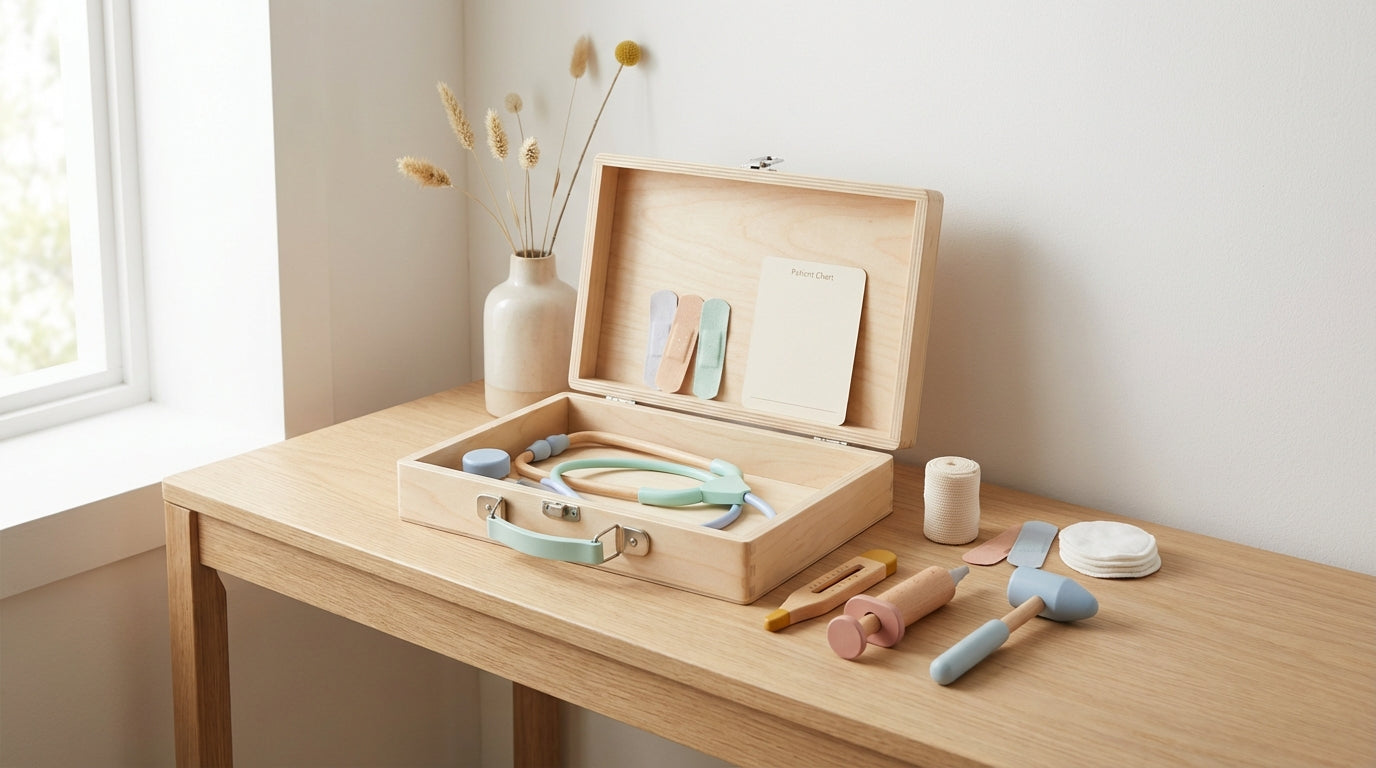
- Must-haves: stethoscope (toy), thermometer (toy), plasters/bandages (toy), patient card or prescription pad.
- Choose by age: 2/3/4/5+ differ mainly in small parts and how the play unfolds.
- DIY: you can fill a doctor kit yourself – with sturdy pieces and simple role-play cards.
- Toys stay toys: keep real first-aid supplies stored separately.

A kids' doctor kit should contain safe toy instruments, a small “first-aid” set for role play and accessories that make playing easy. With these, children can act out doctor visits, patch up their teddy and practise what happens – without the whole family's pulse racing. Here you'll find a clear checklist, a practical age guide (2/3/4/5+), a DIY idea for filling your own kit and tips on cleaning, storage and safety. Easygoing in true northern-German style, practical for everyday life – and without unnecessary frills.
You can find our doctor kits and doctor play sets for kids here.

Ulli & Flo
Owners of bieco · Hamburg · parents themselves
In our house, the doctor kit has already “rehearsed” plenty of appointments – first on the teddy, then on Dad. It takes the pressure off, without any big fuss. Feel free to browse our doctor kit collection.
What goes in a kids' doctor kit? The short checklist
A good kids' doctor kit playfully covers “examine, treat, document”. If you just want to tick things off quickly: pick the classics for examining, a few “plaster and bandage” pieces for treating, and at least one item that lets children “play practice” (card, prescription, stamp).

Copy-and-paste checklist (short & sweet):
- [ ] Stethoscope (toy)
- [ ] Thermometer (toy)
- [ ] Otoscope/ear scope (toy) or “lamp” (play)
- [ ] Plasters (play) + bandage/wrap (play)
- [ ] Tweezers (play, without sharp tips)
- [ ] Patient card/prescription pad (play)
- [ ] Case/box that everything fits back into
A kids' doctor kit is a role-play set that gives children back a sense of control in “doctor situations”. Its value often lies less in the sheer number of pieces and more in the way your child can act out routines and sort through feelings.
Must-have, nice-to-have, unnecessary: keeping the kit playable
Fewer pieces often mean more play – and less chaos under the sofa. Many sets are packed to the brim, but in the end children keep reaching for the same few things. Here's a little guide that has proven itself in family life (and yes: tidiness is just a hobby).

| Must-have | Nice-to-have | Rather unnecessary |
|---|---|---|
| Stethoscope (toy), thermometer (toy), plasters/bandage (toy) | Blood pressure cuff (toy), reflex hammer, face mask/coat (toy) | Lots of mini bottles, tiny “tablets”, disposable small parts |
| Otoscope/ear scope (toy) or torch (sturdy) | Stamp, name badge, “prescription” slips | Overly delicate pieces that break off easily |
What's practical is anything little hands can grip well and play with again and again. If a piece is only exciting for a moment, it's usually just decoration – pretty, but not a long-term favourite.
Age groups: what suits 2, 3, 4 or 5+ years?
The best equipment depends less on the “kit” and more on the child. Age recommendations are a guideline, but you know your child: do they still put a lot in their mouth, do they love sorting, or are they already playing proper roles with “You're next, please”?
From 2 years: chunky, sturdy, few pieces
At 2, it's mostly about imitating – not “proper diagnoses”. Large, solid pieces without small parts make the most sense: a sturdy stethoscope (toy), a “thermometer” without removable caps and a few reusable plasters (play). Short routines are enough: listen, feel, plaster on, done.
From 3 years: more role play, but keep an eye on small parts
At 3, “copying” often turns into a little consultation. Now a patient card, prescription pad or stamp goes down well. At the same time, small parts remain an issue – especially when siblings or visiting children join in. A case that is closed after playing is worth its weight in gold.
Safety note: The warning “Not suitable for children under 36 months” points to risks such as swallowable small parts. Under EU toy law, warnings must be clear and visible before purchase; the details are set out in the Toy Safety Directive 2009/48/EC. (EUR-Lex)
From 4 years: more routine, more accessories, more imagination
At 4, many children love sequences: registration, examination, prescription, “see you next week”. Now accessories that provide structure are worthwhile: patient card, “prescription”, stamp, perhaps a coat (play). Examination pieces like an otoscope (toy) or tweezers (play) make more sense because children play more carefully and purposefully.
From 5 years: stories, rules, “doctor team”
At 5+, the doctor kit often becomes a role-play set for entire afternoons. Children like to set up a whole “practice”: waiting room, appointments, treatment room. Sturdy pieces matter here because more children join in. And: paperwork (prescription pad, index cards) is suddenly more exciting than the tenth plastic bottle.
Safety & labelling: what you can really look out for
A quick look now saves nerves later – and sometimes tears too. A kids' doctor kit is a toy, but it gets carried around, dropped and used very seriously. That's why a small reality check is worthwhile.

- CE marking: It shows that the manufacturer declares compliance with EU safety requirements for toys. According to the European Commission, only toys bearing the CE marking may be placed on the market in the EU. (European Commission)
- Warnings: They must be understandable and visible before purchase (online too); this is regulated in the Toy Safety Directive. (EUR-Lex)
- Workmanship: No sharp edges, no caps that come off easily, no “nasty” points.
- Material realism: Children put things in their mouths – that's normal. According to the German Federal Institute for Risk Assessment (BfR), children are exposed to more plasticisers (e.g. phthalates) than adults, partly because they put objects in their mouths. (BfR)
We're honestly picky about this, because children don't play “carefully”. We're a family business from Hamburg, we've been doing this for 66 years – and when it comes to materials, workmanship and testing, we'd rather look once too often than once too little.
DIY: fill a doctor kit yourself (without craft stress)
You can fill a doctor kit yourself quite easily – so it fits your child perfectly. This is handy if you already have a box or case, if you want to avoid small parts, or if you'd rather add things step by step.
Step 1: Pick a sturdy box (and make it “practice-ready”)
A case is great, but a box with a lid is often just as good. What matters is that it closes and is easy to carry. Inside, small pouches or an insert help keep everything from flying around (and save you from playing “emergency room under the sofa” every evening).
Step 2: Start with 6–8 pieces, not 25
Getting started works best when children immediately understand what they can do. Take: stethoscope (toy), thermometer (toy), plasters/bandage (toy), tweezers (play), otoscope (toy) or torch (sturdy) and 1–2 “paper” items (prescription/patient card).
Practical tip: Put 3–5 plasters on top. Then play can start right away, with no “Where is…?”.
Step 3: Make simple patient cards (30 seconds, really)
A patient card turns a set of pieces into a story – and stories are the real game. All you need is paper and a pen. Examples: “Teddy has a tummy ache”, “Doll has a cough”, “Dad has an ouchie on his finger”. Children love being allowed to scribble the “diagnosis” and “prescription”.
Step 4: Add things as needed (not by catalogue)
If your child always plays the same thing, add exactly the piece that goes with it. Do they play “looking in ears”? Then add an otoscope (toy). Do they play “bandaging”? Then more bandage (play). Do they play “practice”? Then a stamp or notepad. That way the kit grows sensibly – and doesn't just fill up.
What does NOT belong in a kids' doctor kit?
Anything that is truly sharp, fragile or hygienically critical stays out. It sounds strict, but it's actually relaxing – because then you don't have to keep watching constantly.
- Real medication: Not even “harmless” vitamins or homeopathic globules – play and real intake should stay separate.
- Real syringes, needles or lancets: These don't belong in a children's room, full stop.
- Loose small parts: Especially when younger children join in or visitors are over.
- Liquids: Please only use “medicine bottles” as play pieces without real liquid – otherwise you'll end up with sticky practice floors.
- Sterile dressing materials from the medicine cabinet: These should stay sterile until they're really needed.
Toys and real first aid belong in two different drawers – quite literally. If you want to be prepared: the German Red Cross explains the typical contents of a first-aid kit (DIN 13164) clearly. (DRK)
Cleaning & storage: keeping the kit nice (and not sticky)
A clean doctor kit takes less effort than you'd think – if you keep it simple. Children love to “treat” everything and everyone, breakfast crumbs included. That's why a few small routines help.
- Close it after playing: Kit closed = fewer pieces in the living-room jungle.
- Shake it out regularly: Crumbs out, done. (Yes, that counts as housework.)
- Wipe with a damp cloth: If pieces are sticky, a damp cloth is usually enough; follow the manufacturer's care instructions.
- Store “paperwork” dry: Prescription pads & cards don't like wet hands – ideally keep them in a small pouch.
Practical tip: Create a “kit parking spot”: a fixed place on the shelf. Then it gets used more often – and searched for less often.
Play value in everyday life: turning the doctor kit into a “courage kit”
With two small rituals, play becomes an everyday helper – no magic required. Not every day is relaxed, and it doesn't have to be. But a familiar routine can help when a real appointment is coming up or when sticking on a plaster would otherwise mean drama.

Ritual 1: The teddy consultation (5 minutes)
- Greeting: “Hello, what brings you to me today?”
- Examine: Stethoscope, thermometer, looking in the ears – always in the same order.
- Treat: Plaster/bandage (play), done.
- Wrap-up: “You were very brave. Next appointment: tomorrow.”
Ritual 2: Swap roles once before the real appointment
When your child examines you, they often feel less at the mercy of things. Let your child “listen to” the grown-up, “take their temperature” and write a prescription. That gives control back – and you get a very creative diagnosis on the side.
Where to read on or browse with us
If you're looking for a set after the checklist, choose one that fits your everyday life. You'll find an overview in our doctor kit collection. And if the question of age is on your mind right now, our guide From what age is a doctor kit suitable for children? Safety & tips will help you sort it out.
FAQ
What goes in a kids' doctor kit?
A kids' doctor kit should contain play pieces for examining and for “treating”. A stethoscope (toy), thermometer (toy), otoscope/ear scope (toy) as well as plasters and bandage (play) are practical. For role play, a patient card or prescription pad contributes far more than lots of mini bottles.
What makes sense for 2-year-olds – and what doesn't?
For 2-year-olds, large, sturdy pieces without small parts make the most sense. A simple stethoscope (toy) and a “thermometer” (toy) plus reusable plasters (play) are often enough. Delicate pieces, removable caps or lots of mini accessories usually mean more frustration than play at that age.
What does the warning “Not suitable for children under 36 months” mean?
The warning usually points to risks such as swallowable small parts. It doesn't mean “dangerous for everyone”, but rather: certain parts or functions are unsuitable for children under 3. Under EU toy law, warnings must be clearly stated and visible before purchase. (EUR-Lex)
Can a doctor kit help make doctor's appointments more relaxed?
It can help, because children recreate routines in a controlled way through play. When your child examines teddy, sticks on plasters and writes a “prescription”, the unknown becomes familiar. That often takes the edge off – not always, but surprisingly often exactly when you need it.
What doesn't belong in a kids' doctor kit?
Real medication, sterile dressing materials and anything sharp don't belong in it. Play and real first aid should stay separate, so that nothing gets “treated” that needs to stay clean and safe. For real preparedness, a proper first-aid kit makes sense; the German Red Cross explains the typical contents according to DIN 13164. (DRK)
Bottom line: a good doctor kit is small enough to actually get used. If you like, take a look at our doctor kit overview – and pick something that suits your child's age, play style and your living-room reality.