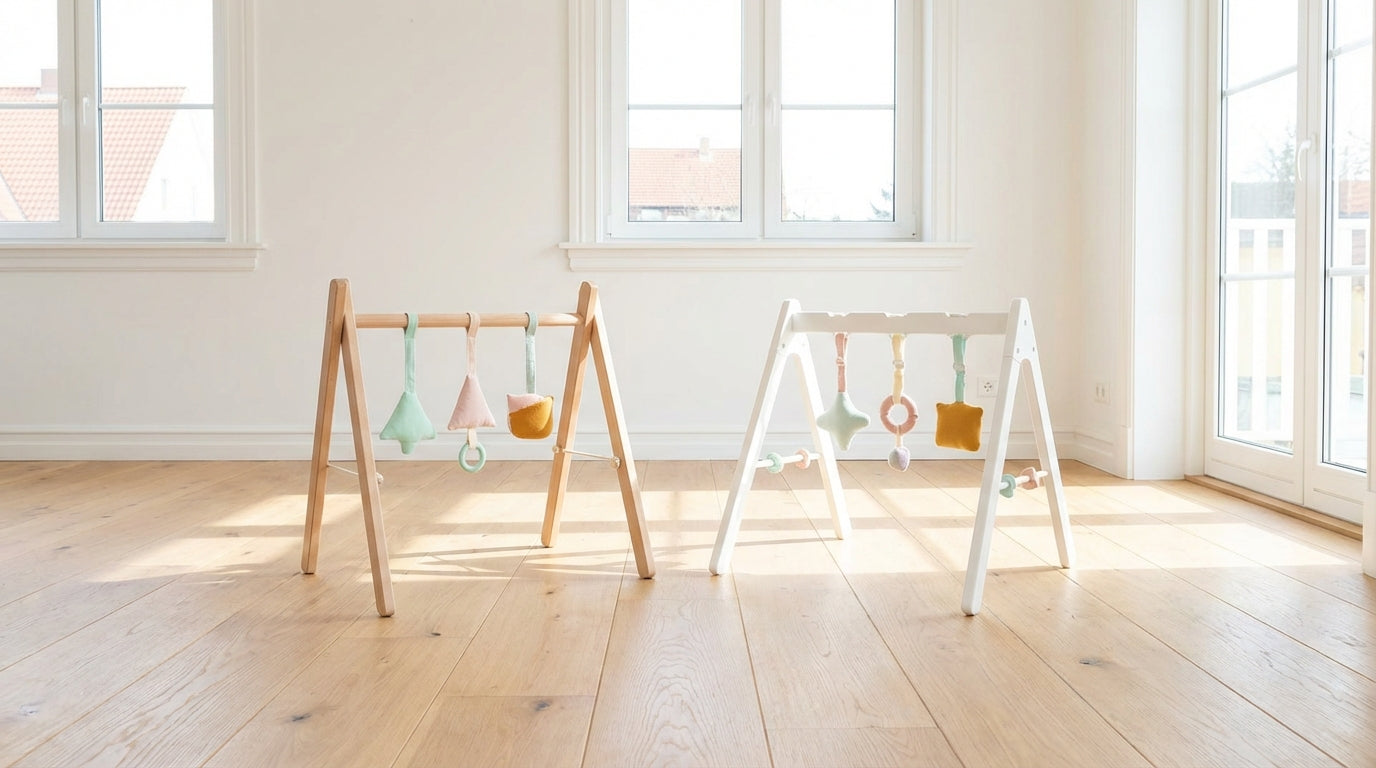
When Is a Play Gym Useful? How Long to Use It & When Babies Grab
At a glance
- When can you start with a play gym? From birth in short, supervised moments; on the floor it usually becomes really handy within the first few weeks.
- How long: rather 2–10 minutes per session, and more often throughout the day.
- Purposeful grabbing often starts at around 3–4 months – before that, a lot of it is “lucky hits”.
- Good signs: alert eyes, calm kicking, happy babbling. Stop signs: looking away, fussing, a stiff body.
- Set it up safely: stable, no long ribbons, and never leave your baby unattended underneath it.

You can offer a play gym from birth in short, supervised moments, and it often becomes really useful on the floor within the first few weeks. In the beginning, it’s less about “training” and more about calm looking, a bit of kicking and that wonderstruck baby face you’d love to frame. In this guide you’ll get clear, everyday-friendly guidance: when to start, how long a session should be, when babies really start to grab – and how to spot overwhelm before the mood tips. No drill, no drama. More like: “It’s fine, let’s keep it short and sweet.”
You can find our wooden play gyms here.

Ulli & Flo
Owners of bieco · Hamburg · parents themselves
We’ve learned that with a play gym, it’s not about “more”, it’s about “right”. A few short, good moments a day are often plenty. Feel free to browse our play gym collection.
The ideal starting point: when a play gym really makes sense
A play gym is possible from birth – but in mini portions and with you right there. Newborns mainly benefit from observing: contrasts, calm shapes, gentle movement. Some babies find it exciting right away, others are more Team “I’ll look later”. Both are completely normal.

A play gym is a supplement, not a full-time activity. According to the World Health Organization (WHO), babies under 1 year should be physically active several times a day; for babies who are not yet mobile, that includes at least 30 minutes of tummy time spread across the day while they are awake (WHO). In other words: play gym, yes please – but not as a parking spot while you “just quickly” get through three loads of laundry.
A play gym is a frame over a blanket from which toys hang. The benefit is simple: babies are encouraged to look, kick and later grab – without you having to put on an entertainment show.
Which signs show that my baby is ready?
“Ready” means your baby is awake, comfortably positioned and seems interested. You don’t need a test run or a baby diploma. These are good starting signals:
- Their gaze lingers briefly and wanders curiously to shapes and colors.
- Arms and legs move freely (not swaddled like a little burrito masterpiece).
- Your baby is calm or “chatting” quietly to themselves.
Stop signals are no drama, just a helpful “Thanks, that’s enough”. It’s better to end the session if you see:
- Turning the head away, a stare “into space”, sudden fussing.
- Frantic kicking, a stiff body, “pushing away” with arms or legs.
- Yawning, hiccups or that glassy look that says: “I’m done.”
Overstimulation is when a baby can no longer process stimuli well. Typical signs are restlessness, crying or “switching off” – and then less is more, not more.
Practical tip: Only set up the play gym when your baby is awake & curious. “Getting it ready just in case” surprisingly often ends in fussing.
How long should you leave a baby under a play gym?
As a rule of thumb: start short, build up slowly, and prefer several mini sessions. Minutes aren’t sacred – your baby’s mood is the better timekeeper. Many families do well with this framework:
- Newborns: 2–5 minutes per session, 1–3 sessions a day (if it fits).
- From about 2–3 months: 5–10 minutes per session, several short sessions are welcome.
- From about 4–6 months: 10–15 minutes per session – if your baby is having fun and isn’t “over it”.
More important than counting minutes is changing positions throughout the day. The American Academy of Pediatrics (AAP) recommends starting awake tummy time from the first day at home and gradually increasing the duration (AAP). That fits nicely with the play gym idea: short sessions, then something different.
Practical tip: A kitchen timer set to 7–10 minutes is gold. Not to be strict – just realistic, because in everyday life it’s easy to get lost in conversation.
Where is the best place for the play gym – and what is really safe?
A play gym is safest on the floor, on a firm, level surface. For babies, the floor isn’t “second choice”, it’s premium: stable, plenty of room, and little risk of anything slipping.

A play mat or crawling blanket is practical because it cushions without being too soft. If you like a combination where everything fits together, a play mat with play gym is often pleasantly uncomplicated in everyday life.
Safety note: Only let your baby be under the play gym when supervised. Make sure it stands securely, the fastenings are safe and no long ribbons or cords are within reach.
Bed and sofa are tempting for a “quick moment”, but they’re not ideal as a play area. On soft, raised surfaces, things can slip more easily or your baby may end up in an unfavorable position. If at all possible: the floor wins. Always.
When does a baby start grabbing for a play gym?
Purposeful grabbing often develops from around 3–4 months; before that, a lot of it is chance. In the first weeks, hand movements are largely driven by reflexes. Then eye-hand coordination improves step by step – and suddenly “waving” turns into “I want that thing over there”.
You can make grabbing easier without overwhelming your baby.
- Hang only 1–2 toys, within easy reach and securely fastened.
- Go for clear shapes and calm colors – too much clutter is like a fairground at 7 a.m.
- Switch sides (sometimes left, sometimes right) so both sides get to “join in”.
If your baby only looks, that’s not “too little”, it’s completely normal development. Looking is learning – and, incidentally, the only activity babies truly perfect without falling asleep. (Okay, sometimes even while falling asleep.)
Material & care: wood, fabrics and the matter of drool
Whether wood or another material: what matters is clean workmanship and secure fastenings. Look for smooth surfaces, no sharp edges and toys that sit firmly. If anything wobbles or rattles where it shouldn’t: better to check once more.

A wooden play gym is often simple, sturdy and long-lasting – if it’s well made. If you’d like to take a calm look around: the play gym overview shows various options, and wooden play gyms focuses specifically on wooden models.
In everyday baby life, care mainly means: quick, doable, not fussy. Depending on the design, fabric toys have their own care instructions (the label helps more than gut feeling). Wooden surfaces can usually be cleaned with a slightly damp cloth and then dried well – it’s important that nothing stays damp for long, as the material can suffer otherwise.
An everyday-friendly routine: using the play gym without stress
A good routine is: play gym as a short game, then a change – and you’re done. Three building blocks that often work:
- Start: Baby awake, not full to the brim after a feed, fresh diaper. A short session (e.g. 5–10 minutes).
- Mix: Afterwards, change position: a short cuddle in your arms, free kicking or some awake tummy time. According to the German Society for Pediatrics and Adolescent Medicine (DGKJ), sleeping on the back is safest; tummy time while awake and supervised is recommended for practice (DGKJ).
- End: Stop while it’s still fun. That’s the trick. Really.
If your baby finds the play gym silly today, it’s not personal. Babies have their days. So do we adults – we’re just better at hiding our frustration in emails.
Why we take this so relaxed (and still look closely)
We’re a family business from Hamburg and have been making baby & toy products for 66 years. Ulli & Flo write here as parents for parents – with an eye for the fact that “safe” doesn’t sound like panic, but like: stable, understandable, everyday-friendly. And yes: some things only make sense under supervision. We’ll say so, without a drumroll.

FAQ
When can you start using a play gym?
A play gym is possible from birth, but at first only briefly and with you by their side. Start with a few minutes when your baby is awake and content. If they look away, fuss or get frantic, that’s usually no problem – just a sign: break, cuddle, try again later.
How long should you leave a baby under a play gym?
Several short sessions are usually better than one long one. For newborns, 2–5 minutes is often enough; later, 5–15 minutes per session is a rough guide – depending on mood. What matters is a mix of movement opportunities throughout the day, not working through a stopwatch.
When does a baby grab purposefully for a play gym?
Purposeful grabbing often develops from around 3–4 months. Before that, many touches are chance or reflex. You can help by offering only a few toys, placing them within easy reach and switching sides. If your baby only looks for now: that’s completely normal.
Is a play gym also useful during tummy time?
Some babies like a play gym during tummy time, others find it rather tiring. Awake, supervised tummy time is important, but it can be short and build up slowly. Try it with a few clearly visible toys and end it as soon as your baby grumbles.
How can I tell that my baby is overwhelmed?
Overwhelm often shows up as looking away, fussing or frantic restlessness. Some babies also become very quiet and “switch off”. What helps then: reduce stimuli, put the play gym away, offer close contact. That’s not a step backward – it’s regulation, and for babies that’s real hard work.
What’s better: a play gym or just a free play mat?
Ideally both, taking turns. The play gym offers a clear stimulus for looking and grabbing, while the open space is important for turning, rolling and, later, crawling. A good base is handy – for example a play mat with play gym, if you like to have “everything in one place”.
Finally, a relaxed note: A play gym is a lovely tool for short play moments – especially on the floor and with an alert baby. If you’d like to look for something suitable, at Bieco you’ll find a selection of play gyms and the practical combination of a play mat with play gym.