
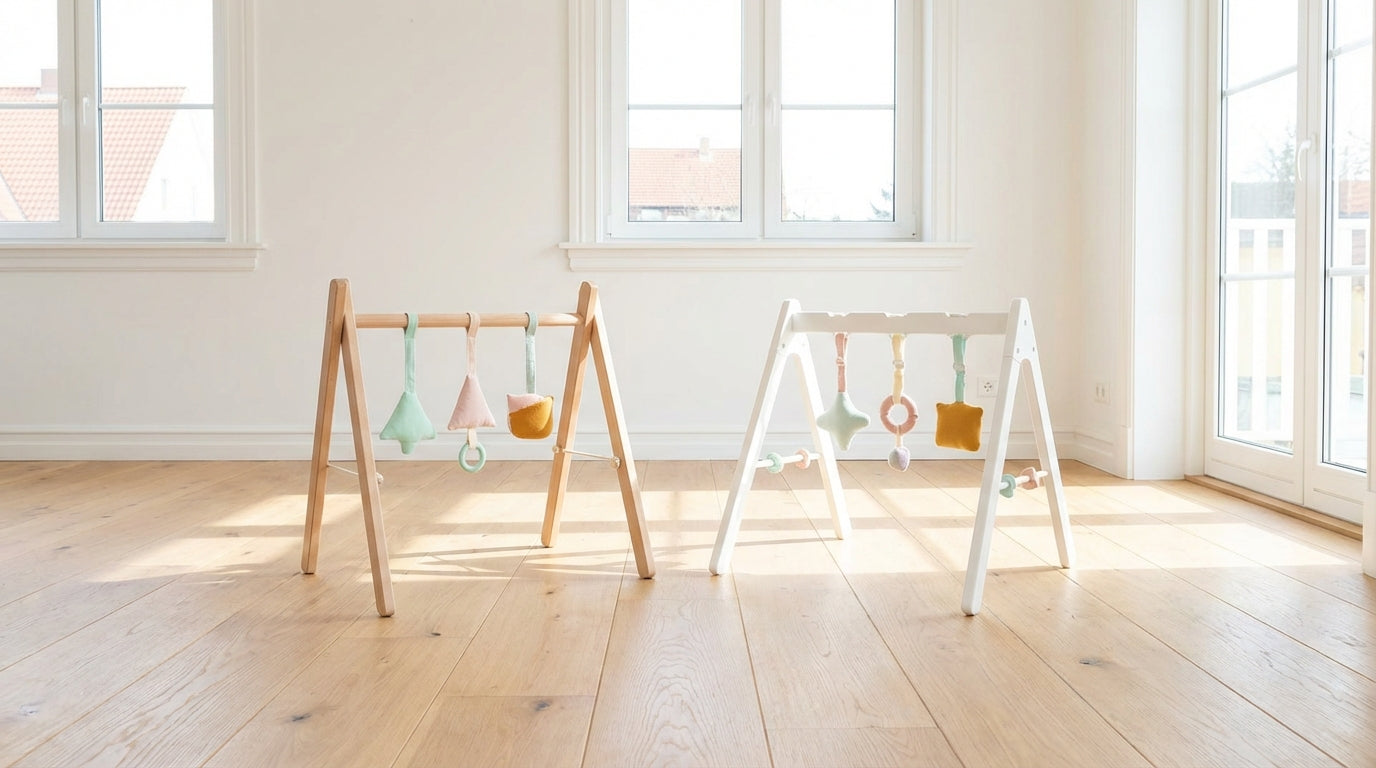
Wooden or Plastic Baby Gym? How to Find the Right Material
At a Glance
- A wooden baby gym is worth it if you want stability and a calm look.
- Plastic is often lighter, easy to care for and handy to move around.
- Safety depends mostly on stability, workmanship, warning labels and condition.
- CE marking and clear warnings are a must for toys.
- With the 60-second safety check, you can quickly see whether it fits.

A wooden baby gym is the better choice if you want a firm, stable play spot for your baby. A plastic baby gym can make just as much sense if you rearrange a lot, are short on space or often end up "at Grandma's living room". In this guide you get an honest comparison, plus checklists, common mistakes and a few everyday tricks. We write this the way we would want it for ourselves: practical, no drama, knowing that the coffee will go cold anyway.

Ulli & Flo
Owners of bieco · Hamburg · parents themselves
What we've learned about baby gyms: in the end, the winner isn't the "perfect material" but whatever stands steadily in everyday life and is easy to clean. If you can decide more calmly after reading this, it was worth it. Feel free to browse our baby gym collection.
Wooden Baby Gym: What Speaks for It in Everyday Life?
A wooden baby gym often stands more steadily and slips less when your baby kicks. Especially when your little one is playing a full "leg orchestra", you notice the difference: a stable stand takes the stress out of things, for child and parents alike. Many wooden models also look homey because they are visually less "loud".

Wood feels warm and is pleasant to touch for little hands. Babies explore a lot through touch, and wood often has a "friendly" feel. What matters here isn't romance but workmanship: smoothly sanded, no splinters, no sharp edges.
A wooden baby gym can often be used for longer despite small blemishes. With wood, scratches are usually more patina than catastrophe. And depending on the model, you can retighten connections or replace parts, but only as the instructions and manufacturer allow.
Practical tip: If the baby gym wanders on a smooth floor, a non-slip pad under the play blanket often works right away (and saves you from pushing it back 20 times).
Plastic Baby Gym: Where Plastic Is Really Practical
Plastic baby gyms are often light and therefore quicker to move or put away. That's worth gold when you shuttle between living room, kitchen and bedroom, or when guests arrive and suddenly "space" becomes a rare commodity.
Plastic is often easy to wipe clean in everyday life. In the "everything goes in the mouth" phase, that's simply realistic: you don't want to plan a deep clean every time a hanging toy has been dragged through the applesauce.
Many plastic models are flexibly adjustable and offer quickly changing positions. That can help if you want to hang toys higher or lower, or if your baby suddenly grabs very purposefully. (That development always arrives just when you only wanted to do something for "one minute".)
What Is Safer: Wooden or Plastic Baby Gym?
It's not the material that makes it safe, but stability, workmanship and clear labeling. In the EU, the Toy Safety Directive 2009/48/EC applies to toys; among other things, it regulates CE marking and warnings. According to EUR-Lex (Directive 2009/48/EC), toys must bear the CE marking and carry the required warnings. (Source)
DIN EN 71 is a series of standards that specifies safety requirements for toys. Depending on the part, it covers, for example, mechanical/physical requirements and other test areas. According to DIN, DIN EN 71 specifies requirements for safe toys and is continuously being developed. (Source)
Safety note: Only use the baby gym on a level surface, remove damaged hanging toys immediately and follow the manufacturer's age and usage instructions.
For babies, what counts is that nothing comes loose, splinters or has sharp edges. With wood, that means good sanding quality, sturdy connections and no flaking surface. With plastic, it means no cracks, no sharp burrs and no wobbly connection points.
60-Second Safety Check: Is the Baby Gym Really Right?
With this mini checklist, you can quickly tell whether a baby gym is safe enough for everyday use. Going through it once quickly is often enough before you get lost in details.

- Stability test: Give it a light nudge. Does it tip over or "wander" right away?
- Edge test: Run your hand over all edges and drill holes. Is anything rough, sharp or splintery?
- Connection test: Check screws and connection points. Does anything wobble or creak suspiciously?
- Hanging toy test: Do the hanging toys sit securely, with no small parts that could come loose?
- Distance & height: Do the hanging toys hang so your baby can reach them easily without getting tangled?
- Labeling: CE marking present, warnings understandable, age recommendation plausible?
Material Check: Care, Drool, Stains and the Perfectly Normal Chaos
With both wood and plastic, the surface determines how relaxed cleaning is. Smoothly sealed surfaces are usually easier to wipe than open-pored, heavily textured or intricate areas.

Please clean a wooden baby gym with a barely damp cloth and rub it dry afterwards. Depending on the finish, a lot of water can turn unsightly over time. A soft cloth, lukewarm water, mild: done. If the manufacturer recommends something different, trust the manufacturer, not the internet.
Plastic often tolerates moisture better, but crevices collect crumbs like a vacuum cleaner. Especially at connection points, there's often what you thought was "wiped away" yesterday. A soft cloth and, if permitted, a mild cleaning product usually do the job reliably.
For material mixes (wood + fabric), clear care instructions are really worth gold. If you'd like more details, here is our guide: Cleaning baby gyms and play mats: washing & care tips for all brands.
Wooden Baby Gym Through Developmental Stages: What Fits When?
A baby gym makes sense once your baby starts to look and reach with purpose. That's less a question of the calendar than of "What can my child do right now?", and your baby usually answers that very clearly.
Phase 1: Looking & marveling – less is more. In the first weeks, high-contrast, calm hanging toys are often more exciting than a whole circus. A stable wooden baby gym can feel pleasantly "unexcited" here because it doesn't keep slipping.
Phase 2: Grabbing & pulling – now stability shows. Once your baby grabs hanging toys and pulls on them, construction matters. A wide stance, non-slip pad, secure fastenings: that's more important than the material debate.
Phase 3: Turning & rolling – the baby gym becomes a short stop, not a permanent station. As your baby gets more mobile, the baby gym is often more of a "waypoint". Then models that are quickly put away score, or you combine it with a firm play blanket as a safe home base.
Practical tip: Don't hang everything on at once. Two easy-to-reach hanging toys are often enough, and you can swap them every few days without your baby feeling "flooded".
Play Value: Hanging Toys, Contrasts and the "Not Too Much" Principle
Babies don't need a design award, but reachable stimuli and repetition. Contrasts, gentle sounds and different materials on the hanging toys are often more exciting than constant blinking and blaring.
A baby gym is the frame; the hanging toys decide the everyday fun. Make sure the hanging toys are securely attached, not too small and suited to your baby's stage of development. And yes: sometimes less is more, so your baby can concentrate on one thing.
"Montessori" is mentioned a lot. In practice it means: simple, reachable, discover for yourself. If you like this style, you'll find inspiration here: Montessori baby gym.
Definition: A baby gym is a frame over the play blanket from which hanging toys dangle for grabbing and watching. The benefit is simple: your baby practices coordination, and you don't have to be the entertainer all the time.
Harmful Substances, Smell, Materials: What You Can Look Out For
A strong, pungent smell is a reason to air it out first and take a critical look. "New" can smell, sure. But if it stays unpleasant or has a really chemical sting: let it air out, check the instructions and, if in doubt, make a complaint.
For plastics, certain substances in toys are health-assessed and regulated. According to the German Federal Institute for Risk Assessment (BfR), phthalate plasticizers and other substances in toys are, among others, assessed for health risks. (Source)
Wood is not automatically "chemical-free", because surfaces can be treated. What matters is that the surface is stable, nothing peels off and the labeling remains clear. In short: don't romanticize, rather take a proper look.
Definition: CE marking means the manufacturer declares compliance with EU requirements. For you, it's a mandatory check, but it doesn't replace a look at workmanship, warnings and current condition.
Comparison Table: Wooden vs. Plastic Baby Gym at a Glance
The differences mostly lie in weight, feel and "how annoying is it in everyday life". Here's a quick overview, so you don't need five tabs open.
| Feature | Wooden baby gym | Plastic baby gym |
|---|---|---|
| Stability | Often very stable (depends on model) | Can be stable, but often lighter |
| Weight/transport | Rather heavier, but "stands rock solid" | Often light, quickly put away |
| Feel/look | Warm, calm, homey | More colorful/technical depending on design |
| Cleaning | Usually barely damp, not too wet | Often easy to wipe, mind the crevices |
| Durability | Blemishes often uncritical, partly repairable | Cracks/breaks are more of an "end" |
| Flexibility | Often simpler, fewer adjustment options | Often adjustable, quickly adapted |
Common Baby Gym Mistakes (and How to Avoid Them)
Most problems don't come from the material but from small things in setup and everyday use. Here are the classics we see again and again, and which you can easily avoid.
- Too many hanging toys at once: Baby is overstimulated, and you wonder about "no interest". Better to reduce and rotate.
- Baby gym on the sofa/bed: Sounds cozy, but it's wobbly. Better on the floor, level and stable.
- Slippery surface: The baby gym wanders. A non-slip pad or play blanket helps.
- Damaged parts "still work": With babies, the rule is: if you see it, it's time to act. Replace it or leave it off.
- Wrong height: Too high means frustration, too low means baby pulls everything into their face. Better so that grabbing works well.
Why We at bieco Focus So Much on Everyday Life & Safety
We develop from a parent's perspective, with a northern German "it has to work" attitude. We are a family business from Hamburg, and we've been doing this for 66 years. You learn that a baby product can't just be pretty; it has to hold up in real life.
For us, transparency means that materials, workmanship and instructions should be easy to follow. We like clear warnings, understandable instructions and workmanship where you don't first have to make friends with sandpaper. Ulli & Flo write here as parents for parents, not as the morality police, more as the "I've assembled that at 11 pm too" crowd.
Which Version Makes the Best Gift?
The best gift is the one that fits into the parents' everyday life, not the one that looks prettiest on the shelf. If you can ask quickly: Do they have space? Do they rearrange a lot? Is there already a play blanket? That saves wrong purchases and duplicate models.
If you're unsure, timeless designs and clear care properties are almost always a hit. Wood often looks homey and stable, plastic is often light and uncomplicated. Both can be right, as long as stability, workmanship and labeling are in order.
A set of crawling blanket with baby gym is particularly practical for many families. If you're thinking along those lines: Crawling blanket with baby gym.
Our Short Conclusion: How to Decide Without Tying Yourself in Knots
Choose a wooden baby gym if stability, feel and "stays put" are the priority. That often suits a permanent spot in the living room and families who like to use things for a long time.

Choose plastic if you need easy handling, wipe-clean surfaces and flexibility. That's practical if you rearrange a lot, have little space or the baby gym often comes along.
Whichever material you choose: regularly check stability, connections, hanging toys and surface. Safety comes from good construction plus attentiveness in everyday life, not from the material question alone.
FAQ
Is a wooden baby gym better than plastic?
A wooden baby gym is often more stable, plastic is often more flexible. "Better" depends on your everyday life. If you want a permanent play spot, wood often scores with its stability. If you rearrange a lot or take it along, plastic is often more practical. Workmanship, tip-over safety and clear warnings remain decisive.
How can I tell whether a baby gym is safe?
A baby gym is safe if it stands tip-proof and has no loose or sharp parts. Look for CE marking and understandable warnings. According to EUR-Lex (Directive 2009/48/EC), toys must bear the CE marking and the required warnings must be correctly applied. (Source)
How do I clean a wooden baby gym properly?
It's best to wipe wood with a slightly damp cloth and then rub it dry. Avoid a lot of water and aggressive cleaners so the surface stays stable. With material mixes (wood plus fabric), always follow the care instructions; they're often more precise than any well-meant kitchen recipe.
Is plastic a problem because of plasticizers?
In the EU, substances in toys are assessed and certain plasticizers are strictly regulated. Still, look for reliable labeling and avoid products with a strong, pungent smell. According to the BfR, phthalate plasticizers and other substances in toys are, among others, assessed for health risks. (Source)
What is better: baby gym or activity center?
A baby gym is usually calmer, while an activity center often offers more functions and adjustment options. If you want fewer stimuli and a simple solution, a baby gym is perfectly enough for many babies. If you're looking for more variety in one product, an activity center can be practical.
When does a baby gym make sense?
A baby gym makes sense as soon as your baby looks at things with interest and makes first attempts to grab. That's individual and depends on the stage of development. Follow the manufacturer's notes on age and use, and adjust the hanging toys so they are easy to reach without anything getting tangled.
If you'd now like to look at different options in peace, it's best to start with the categories. For wooden versions: Wooden baby gym. If you're looking for more functions: Activity center for babies.


