
Matryoshka
Sort by
2 products


recently viewed
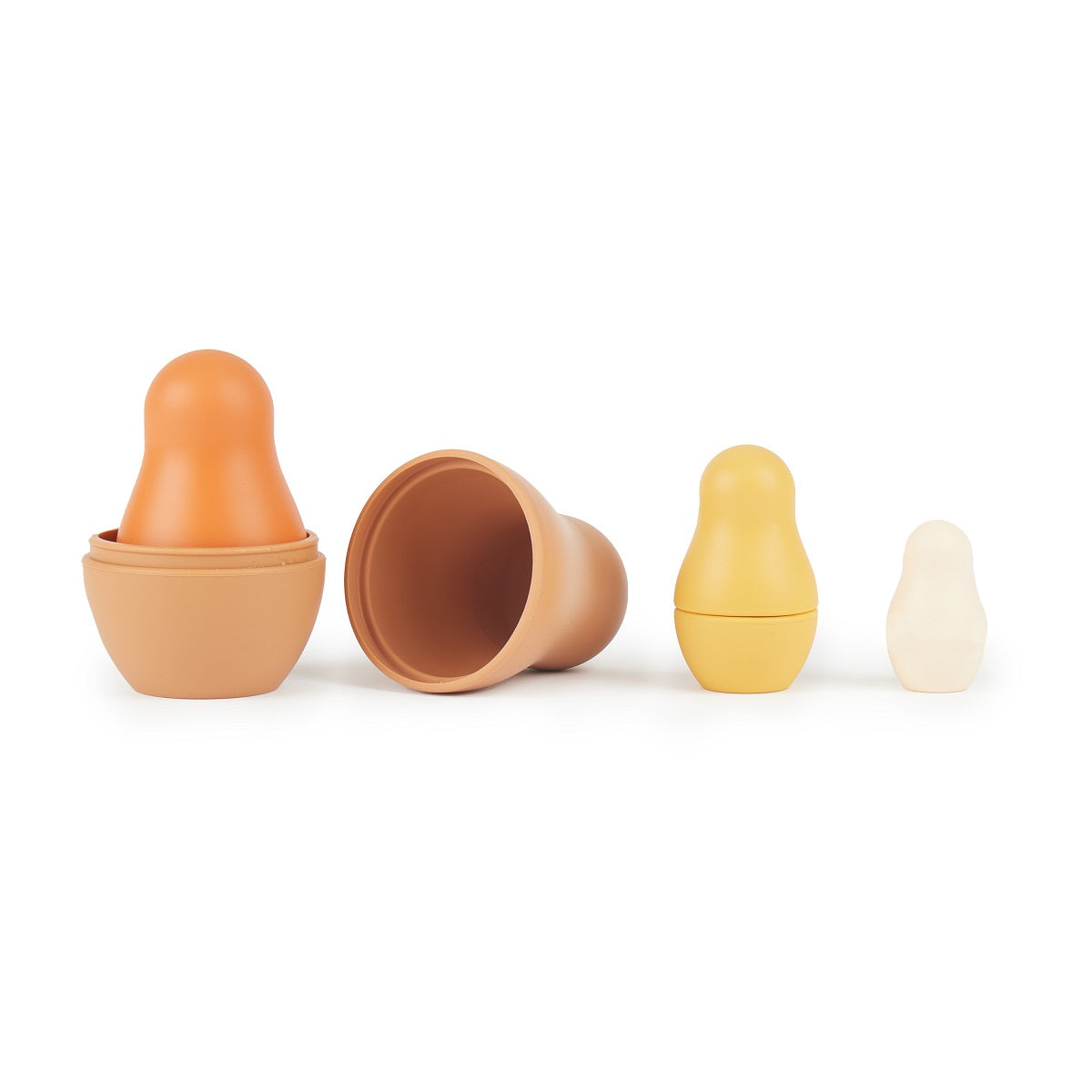
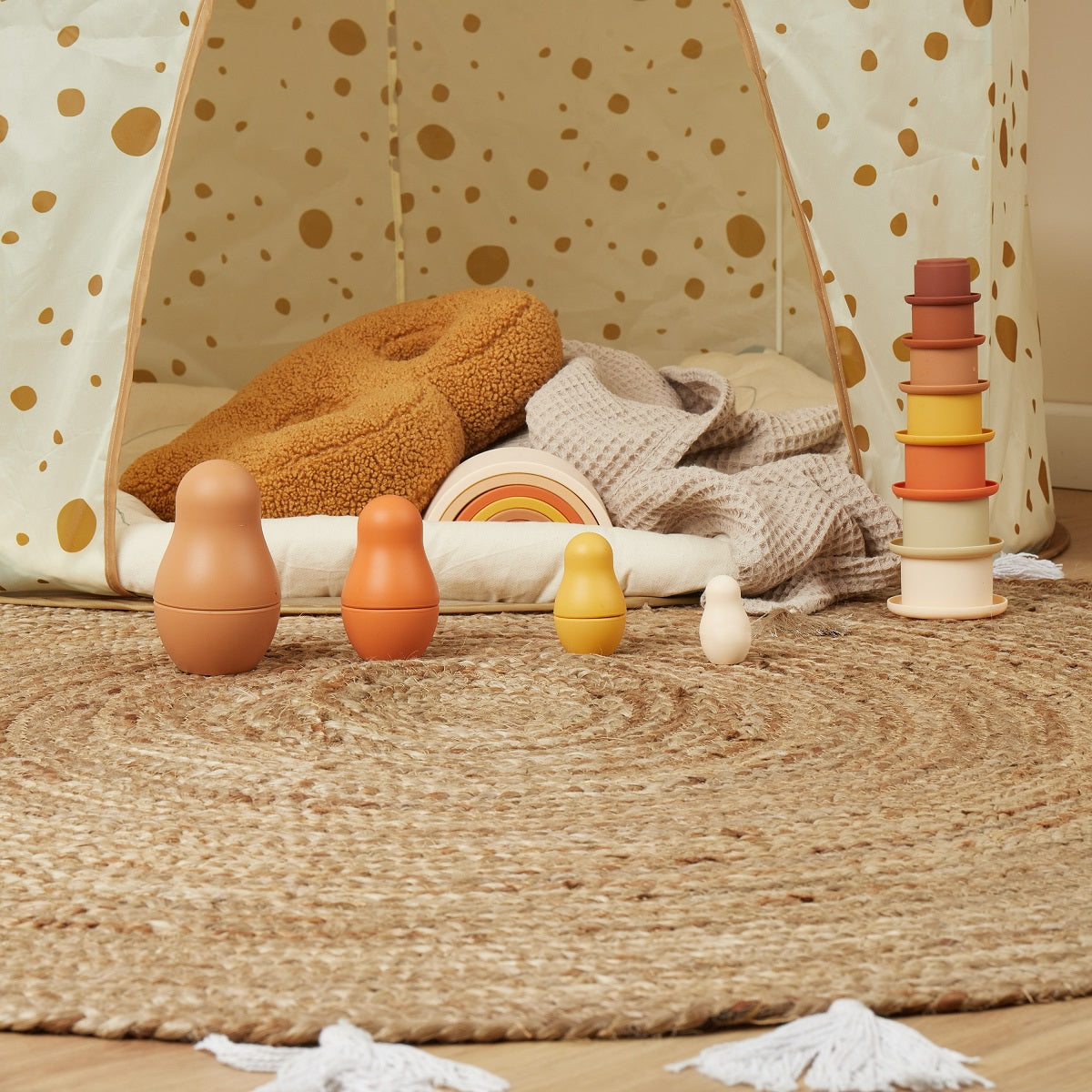
A matryoshka (often also called nesting dolls – and yes, some people wrongly say “babushka”) is a nesting and stacking toy where pieces fit inside each other and come back out again. The play principle is simple: put in, pull out, repeat – happily. For kids, it's a little “I can do it!” moment; for adults, ideally two minutes of peace at the table. In the BIECO Matryoshka collection you'll find two silicone matryoshka sets: Silicone Matryoshka Chocolate Bliss and Silicone Matryoshka Tropical Vibes.
If you want to buy a matryoshka, three things matter: size, number of pieces, cleaning. And if you're thinking right now, “Please, nothing that clatters”: that's exactly where silicone is often pleasant in everyday life.
- Quiet activity: Matryoshka toys are calm nesting toys for the table, the sofa and on the go.
- Easy to tidy up: Stacking inside each other means less piece chaos on the floor.
- Practical for everyday use: Silicone can usually be wiped clean quickly – handy around mealtimes.
The most important points at a glance
- The smaller the child, the larger the pieces should be.
- Fewer pieces bring success faster – and fewer sofa search missions.
- Silicone is pleasantly quiet when a baby is sleeping nearby.
- CE is mandatory – GS is voluntary and independently tested.
- Please really take a moment to read warnings (e.g. “under 36 months”).
Buying a matryoshka in 30 seconds: the little cheat sheet
The best matryoshka is the one you actually get out often. And it rarely wins by being “especially fancy,” but by “fitting into our everyday life.”
- Age & stage: If a lot still goes into the mouth, large, grippy shapes are more relaxed than delicate mini pieces.
- Number of pieces: Fewer pieces = understood faster = less frustration (for everyone involved).
- Cleaning: If it's played with at the dining table, you want to be able to wipe it clean – without drama.
Mini product overview: our 2 silicone matryoshka sets
Here are the two BIECO silicone matryoshkas at a glance – with direct links. For hard facts like number of pieces, dimensions, recommended age or “dishwasher safe: yes/no,” please quickly check the respective product page (that's the most reliable).
What is a matryoshka – and what isn't it?
In the nursery, “matryoshka” usually means the play principle, not the classic Russian wooden doll. Classically, matryoshkas are painted wooden figures that can be opened; as a children's toy, it's often a nesting game in which shapes disappear inside one another.
A silicone matryoshka is a quiet nesting toy that you can get clean again quickly. That's not rocket science – but in family life it's sometimes the difference between “gets used” and “sits on the shelf.”
Fabric, wood or silicone – what suits when?
The material determines noise level, care and annoyance factor. Wood feels classic and stands stably, but can make a proper “clack” on tiles. Silicone is often quieter, grippy and more forgiving when something slips off the table.
Pros & cons: so the set doesn't get annoying after three days
Most wrong purchases happen with piece size, number of pieces and cleaning. Not a big deal – but it doesn't have to happen.
- Pro: Nesting and stacking toys promote patience and hand-eye coordination in everyday life.
- Con: Very many individual pieces will reliably end up living under the sofa (permanently).
- Pro: A matryoshka set is quickly explained – even to grandma, grandpa and babysitters.
- Con: Elements that are too small quickly become unsuitable for toddlers (please observe the warnings).
- Pro: Silicone is often quieter – nice when someone is sleeping next door.
- Con: Some kids prefer “hard & clack” – it's simply a matter of personal taste.
Safety & labeling: short, clear, reassuring
CE is mandatory – but it is not an independent quality seal. According to the BAuA, the CE marking is in many cases a manufacturer's declaration of conformity with EU requirements and must not be equated with a safety test mark: BAuA: Differences between GS and CE.
GS is voluntary and is tested by an independent body. The BAuA describes the GS mark as a “genuine safety mark” within the meaning of the Product Safety Act: BAuA: GS mark.
Warnings such as “Not suitable for children under 36 months” are regulated EU-wide. The legal basis is the Toy Safety Directive 2009/48/EC (18.06.2009): EUR-Lex: 2009/48/EC (and for an overview also from the European Commission: European Commission: Directive 2009/48/EC).
Harmful substances & standards: what parents really want to know
The DIN EN 71 series of standards is the big safety compass for toys. DIN explains that DIN EN 71 describes, among other things, mechanical/physical requirements and, with EN 71-3, also covers the “migration of certain elements”: DIN: Requirements for safe toys.
EN 71-3 specifically names 19 elements that can be tested. The standard description lists, among others, aluminium, lead, cadmium, mercury and further elements: DIN Media: DIN EN 71-3 (standard info).
If a toy smells strongly: better keep your distance for now. The BfR recommends avoiding unpleasant-smelling consumer products, because a noticeable odor can indicate low quality: BfR: Health assessment of other products.
Silicone, BPA-free, “food-safe” – what can be said credibly?
“BPA-free” is only a fact if the product explicitly says so. So: if this matters to you (understandably), please check the product description of the respective silicone matryoshka – it must be clearly stated there.
Silicone is also considered among materials that come into contact with food. The BfR lists silicone as an example material in its information on food contact materials and explains the basic principle that only very low transfers of substances are considered harmless to health: BfR: Recommendations on food contact.
What will you find at BIECO?
BIECO is a family business from Hamburg – for 66 years. Our Matryoshka collection is deliberately small and easy to survey: two silicone matryoshka sets that fit into everyday life as a calm nesting and stacking toy. If you want to get started right away: Chocolate Bliss or Tropical Vibes.
Modern Scandi design means, for us: calm colors, less “neon screaming.” That's not just pretty – it also makes it easier to leave a toy out in the living room without immediately squinting.
Goes well with it (if you want to build a little play corner)
With 2–3 well-chosen things, you often gain more than with 20. If you want to add to it: for on the go, stroller toys are a good fit, for quiet moments wooden puzzles – and if water generally makes everything better: bath toys.
FAQ
What is a matryoshka and how does it work?
A matryoshka is a nesting and stacking toy in which pieces fit inside each other and are taken out again. The child practices “fits/doesn't fit” and sequences – without pressure. Detailed with play ideas in our guide: Buying & playing with a matryoshka.
From what age is a matryoshka suitable for children?
That depends on piece size, warnings and developmental stage – the age indication on the product is the best starting point. For children under 3, detachable small parts are especially critical. The basis for warnings such as “Not suitable for children under 36 months” can be found in the EU Toy Safety Directive 2009/48/EC: EUR-Lex.
Where can I buy a matryoshka?
You can buy matryoshkas online or in stores – what matters are complete labeling, manufacturer details and clear warnings. CE marking should always be present on toys. With us you'll find the selection here: Matryoshka collection – and details in the guide: Buying & playing with a matryoshka.
What is the difference between a matryoshka and stacking cups?
Both follow a stacking-toy principle, but the focus is different: a matryoshka is often “hide & find,” stacking cups are more “build a tower.” If your child likes making things disappear, a matryoshka is usually a perfect hit. Many families use both – depending on mood and how the day is going.
How many pieces should a matryoshka set have?
Fewer pieces are often more relaxed at the start, because moments of success come faster and tidying up stays easier. A good set is easy to survey and not too fiddly. If you're unsure: go for “a little bigger” – it usually gets played with longer and more calmly.
Is a silicone matryoshka good for on the go?
Yes, often it is – because it's light and doesn't rattle when it ends up in the bag. On the go, what counts is: compact, packed quickly, found again quickly. Tip from Grandpa's toolbox: a small fabric bag in the stroller saves your nerves when things need to go fast.
How do I recognize “safe” toys when buying online?
Look for the CE marking, manufacturer address, warnings and a clean product description. GS is voluntary and independently tested, CE is mostly a manufacturer's declaration. This is exactly the distinction the BAuA explains: BAuA: GS vs. CE.
Is a matryoshka a good gift?
Yes, because it's understood quickly and often stays interesting for a long time: first grasping and trying out, later sorting and little play ideas. A matryoshka is a gift that gets by without batteries. If you still want to browse: Gift ideas.
About this page
This text was written and reviewed by the BIECO editorial team (Hamburg). As of: February 2026. For safety and labeling questions, we use, among others, EU sources (Toy Safety Directive 2009/48/EC) and independent information from the BAuA, as well as standards background from DIN, so you can get your bearings quickly – without 20 open tabs.
In closing: browse briefly, then decide calmly
If you're looking for a matryoshka for children, it's perfectly fine for it to be “simply good.” Choose a set that fits your everyday life: quiet, grippy, not too fiddly – and please one that you'll actually get out often. Take a look at the two BIECO silicone matryoshkas directly: Chocolate Bliss or Tropical Vibes.
Structured Data (JSON-LD)
By Ulli & Flo · Owners & parents More about us ↓

About this page
Ulli & Flo
Owners of bieco · Hamburg · parents ourselves
We like matryoshka dolls because they're quiet, quickly explained, and when tidying up they simply disappear back inside each other. In real family life, that's sometimes luxury enough.